Cost to Move a Power Pole on My Property in NSW: 2026 Homeowner Guide
Could a single piece of timber or steel standing in the wrong spot on your block actually derail your entire 2026 renovation budget? If you are planning a new driveway or a structural extension in Sydney, you have likely discovered that the power pole in your way is not just an eyesore, it is a complex regulatory hurdle. It's understandable to feel overwhelmed by conflicting quotes and the confusing distinction between network assets and your own private infrastructure. Most homeowners find that navigating the red tape of network providers and waiting on long approval lead times is the most stressful part of their project.
This guide provides the professional clarity you need to establish a realistic budget for the cost to move a power pole on my property NSW. You will learn about the mandatory regulatory fees, the technical site factors that influence the final price, and the specific legal requirements for hiring an accredited Level 2 ASP. We will also explain the vital differences between simple relocation and undergrounding, ensuring you can make an informed decision that protects your property value while meeting strict safety standards. By the end of this guide, you will have a clear roadmap to manage the logistics and find a qualified specialist to handle the high-stakes electrical work required.
Key Takeaways
• Identify whether you're dealing with a private pole or a network-owned asset to understand your legal obligations and the likely approval timeline.
• Evaluate how relocation distance and material choices, such as galvanised steel or titan composite, impact the total cost to move a power pole on my property NSW.
• Compare the aesthetic and property value benefits of undergrounding your electrical connection versus the standard overhead relocation.
• Navigate the mandatory Ausgrid or Endeavour Energy application process by partnering with a qualified Level 2 ASP who handles the technical design and safety protocols.
• Factor in potential hidden expenses, including telecommunications equipment relocation and network design fees, to ensure your 2026 project budget remains accurate.
Private Pole vs. Network Pole: The First Cost Hurdle
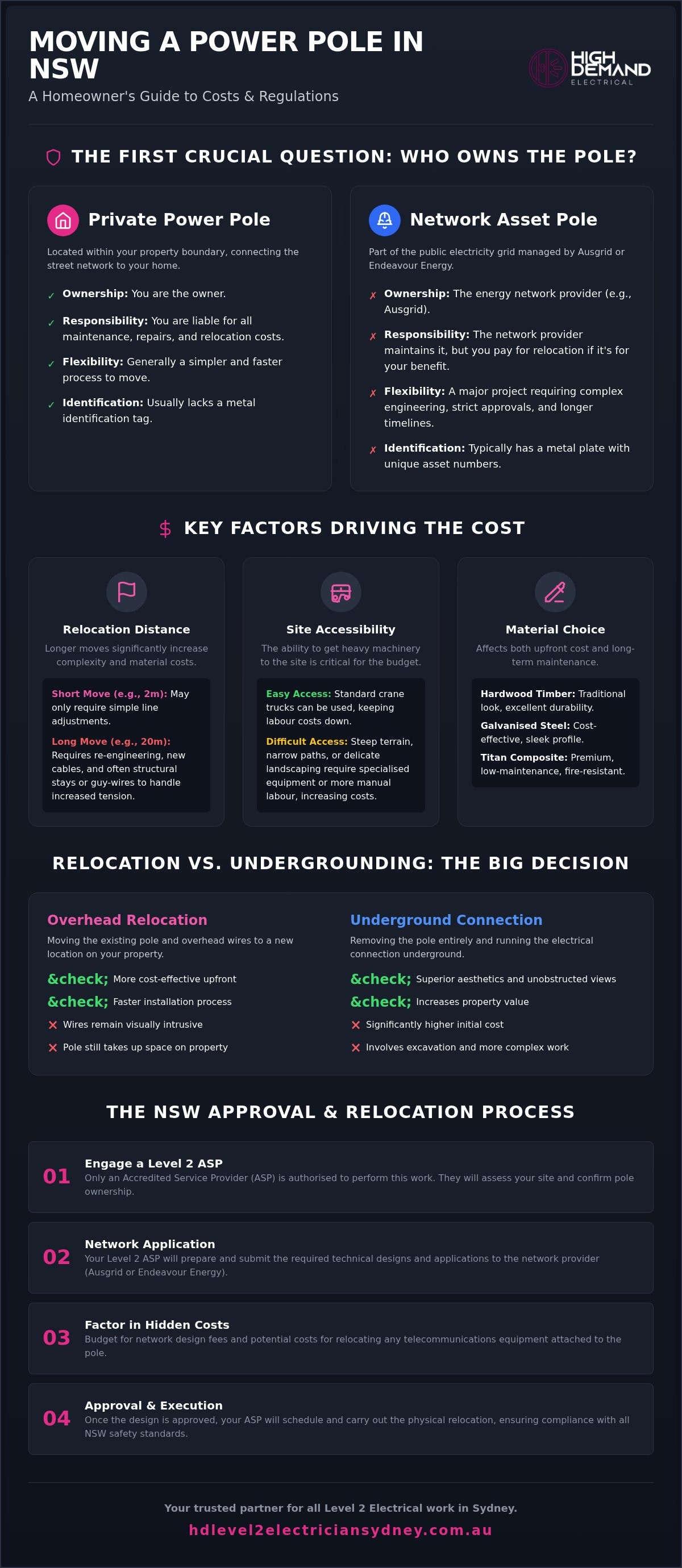
Determining ownership is the first step in calculating the cost to move a power pole on my property NSW. If the pole is a private asset, you are the owner and the person responsible for its maintenance and relocation. Conversely, a network pole is part of the public grid managed by distributors like Ausgrid or Endeavour Energy. While a private pole gives you more flexibility, a network pole relocation is a major infrastructure project that requires strict utility approval and complex engineering designs. A utility pole might look like a simple piece of timber or steel, but its legal status determines who pays the bill and who grants permission for the move.
The Point of Attachment (POA) serves as the critical bridge between the network and your home. Relocating a pole isn't just about moving a physical structure; it's about re-engineering this connection point. If the new pole location changes the angle or tension of the incoming lines, your Level 2 ASP must ensure the POA remains compliant with strict height and safety clearances. Because network poles often carry high-voltage equipment or serve multiple neighbours, moving them is significantly more expensive and technically demanding than shifting a private pole that only serves your residence.
Identifying Your Pole Type
You can usually spot a network pole by looking for a small metal identification plate at eye level. These tags contain unique numbers used by the distributor for asset tracking. If the pole lacks a tag and sits well within your property boundaries, it's likely a private asset. You should also check your property title or electrical service agreement for any mentions of private infrastructure. If you're still unsure, a Level 2 ASP can perform an on-site inspection to confirm ownership before you begin the formal application process. This step is vital because requesting a move for a pole you don't own involves an entirely different set of regulatory fees and design requirements.
Liability and NSW Regulations
NSW law places the burden of safety squarely on the homeowner for all private electrical assets. This means you're liable for any damage or fire risks caused by a failing pole. Poorly positioned or maintained poles can lead to official defect notices from your energy provider, which require immediate rectification to avoid disconnection. Beyond legal compliance, your pole's condition and location directly impact your home insurance. In high-risk bushfire zones, a non-compliant pole can lead to increased premiums or even the rejection of claims if an incident occurs. Only a qualified Level 2 ASP is authorised to perform this work, ensuring that every relocation meets the NSW Service and Installation Rules to protect your property and the wider community.
Factors That Influence the Cost to Move a Power Pole
The physical distance of the relocation is a primary driver of the final project price. Shifting a pole just 2 metres often involves simple adjustments to the existing overhead lines; however, moving it 20 metres completely changes the engineering profile. When calculating the total cost to move a power pole on my property NSW, you must account for increased cable tension. Longer spans of wire are heavier and create significant pull on the structure, which often requires the installation of structural stays or guy-wires to ensure the pole remains upright and safe over time.
Site accessibility also plays a critical role in the labour budget. A standard Level 2 ASP project requires a crane truck to safely lift and position the new pole. If your property has steep terrain, narrow access points, or delicate landscaping that prevents heavy machinery from reaching the installation site, the job becomes more complex. In these scenarios, specialised equipment or additional manual labour is required to prepare the footing and secure the asset, which inevitably increases the total investment required for the move.
Material Costs and Durability
Your choice of material impacts both the immediate price and the long-term maintenance requirements of the asset. Galvanised steel poles are a frequent choice for Sydney's inland suburbs because they are cost-effective and provide a sleek profile. Hardwood timber poles offer exceptional durability and a traditional look, though they require periodic termite inspections to remain compliant with NSW safety standards. For homeowners seeking a premium, low-maintenance solution in 2026, composite Titan poles are the gold standard. They are resistant to fire, rot, and corrosion, making them ideal for coastal environments where salt spray destroys metal and wood over time.
Hidden Infrastructure Requirements
Relocating the pole often triggers a mandatory upgrade of your consumer mains cabling. If your current wires are outdated or too thin for the new distance, they will fail to meet the 2026 NSW Service and Installation Rules. Moving the pole further from your switchboard increases the risk of voltage drop, which necessitates heavier gauge copper wiring to maintain a stable power supply. This relocation may also require a switchboard modernisation to accommodate new circuit protection devices. If you are concerned about these hidden technical hurdles, speaking with a Sydney Level 2 ASP can provide the clarity needed to avoid budget blowouts.
Relocation vs. Undergrounding: Which is More Cost-Effective?
Deciding whether to simply shift an existing structure or transition to a completely underground supply is a pivotal moment in your project planning. While many homeowners initially focus on the cost to move a power pole on my property NSW, a growing number of Sydney residents are opting for total removal instead. This shift isn't just about modern aesthetics; it's a strategic move to eliminate the visual clutter of overhead lines and those bright yellow Tiger Tails that often detract from a home's exterior. By moving the connection underground, you effectively bulletproof your power supply against severe Sydney storms and falling tree branches that frequently cause overhead outages.
The initial outlay for undergrounding is typically higher than a simple pole relocation, but the long-term financial profile is often more attractive. A private pole requires ongoing maintenance and carries a finite lifespan; galvanised steel poles typically last 10 to 20 years, while hardwood timber may last up to 30 years before requiring replacement. Underground lines, once installed, are protected from the elements and mechanical damage, significantly reducing the risk of unexpected repair bills. For properties with complex layouts or high-value landscaping, the security of a subterranean connection provides peace of mind that overhead infrastructure simply cannot match.
The Underground Service Pillar Option
Transitioning to an underground supply involves replacing the pole with a compact service pillar, often referred to as a 'turret.' This process requires precision trenching from the boundary to your main switchboard to house the new consumer mains. In many Sydney council areas, you'll need specific permits to excavate footpaths or nature strips, which adds a layer of administrative coordination. These logistics, combined with the technical connection work, will influence your Level 2 ASP electrical service fees. However, the result is a clean, unobstructed property line that modernises your site infrastructure and meets 2026 safety standards.
Long-term ROI of Undergrounding
The financial argument for undergrounding extends far beyond the initial installation. You permanently eliminate the legal requirement for private pole safety inspections, which are often mandated every five years by network providers, saving on recurring compliance costs. In a competitive Sydney real estate market, 'kerb appeal' translates directly into higher property valuations and faster sales. When assessing the total cost to move a power pole on my property NSW, consider that undergrounding eliminates overhead line clearance issues for new driveways, allowing for unrestricted height access for caravans or construction vehicles. This one-time investment removes the need for future pole replacements and ensures your property remains compliant with evolving urban planning regulations.
The NSW Approval Process: Ausgrid and Endeavour Energy
Relocating electrical infrastructure is a highly regulated activity that requires more than just technical skill. It demands a thorough understanding of the NSW planning and approval framework. Every project requires a formal 'Connection Application' lodged through the distributor's portal. The administrative cost to move a power pole on my property NSW includes several non-negotiable fees set by the network providers, which cover the review of your proposal and the eventual safety sign-off. In 2026, Sydney homeowners should expect a timeline of anywhere from four to twelve weeks for standard approvals, though complex moves involving network assets can take significantly longer.
Design fees are another critical component of the pre-construction phase. If your move is complex, the utility will mandate the use of a certified network designer to produce technical drawings that ensure the new pole location won't compromise the stability of the surrounding grid. Once the work is finished, you must also pay inspection fees to the network provider. These fees cover the cost of a utility officer visiting your site to 'sign off' on the ASP's work, ensuring it complies with every safety standard before the power is permanently re-energised.
Navigating Ausgrid vs. Endeavour Energy
Your property's location determines which distributor's rules you must follow. Ausgrid generally covers the Sydney CBD, Inner West, North Shore, and Northern Beaches. Endeavour Energy manages the network across Western Sydney, the Blue Mountains, and the Illawarra. Each provider has its own specific 'Service and Installation Rules' that dictate pole placement, clearance heights, and cable tension limits. Your Level 2 ASP will use a specific digital portal to lodge your application, ensuring all documentation matches the unique requirements of your local distributor. Failing to identify the correct territory early can lead to costly delays and rejected applications.
The Role of Your Level 2 ASP
A qualified specialist does more than just physical labour; they act as your primary liaison with the utility provider. They are responsible for preparing the site plan and all technical drawings required for the initial application. Managing the 'Notice of Service Work' (NOSW) is a vital part of this role, as it informs the distributor that the work has been completed to the required standard. On the day of the move, your ASP handles the high-risk 'live' line work, managing the 'Notice of Disconnection' and ensuring the property is safely reconnected to the grid. If you need to start the application process today, you should contact a Sydney Level 2 ASP to ensure your paperwork is filed correctly from the start.
Why You Need a Sydney Level 2 ASP for Your Pole Move
Under NSW law, relocating a power pole is not a task for a standard electrician. Only a Level 2 Accredited Service Provider (ASP) possesses the legal authority and technical training to disconnect and reconnect your property from the main network. This is high-risk, live-line work involving high-voltage infrastructure. When evaluating the total cost to move a power pole on my property NSW, remember that you aren't just paying for labour; you're paying for the certification and specialised insurance required to perform the job safely. High Demand Electrical provides this level of expertise, ensuring every project adheres to the stringent safety protocols mandated by Ausgrid and Endeavour Energy.
The physical installation requires heavy machinery that most general contractors do not own. Setting a pole into the ground requires a specialised crane truck for precision lifting and high-torque augers to drill through Sydney's varied soil and rock profiles. Without this equipment, the risk of structural failure or damage to existing underground services is significant. A professional ASP manages these logistics from start to finish, providing the heavy-duty infrastructure needed to secure your new pole for decades to come.
Expertise in Sydney Infrastructure
Every Sydney suburb presents unique challenges, from the heritage-listed streets of the North Shore to the dense urban blocks of the Inner West and the expansive properties in the Western Suburbs. We understand the specific council requirements and network nuances of each area. Often, a pole relocation is the ideal time to modernise your home's electrical capacity. We frequently manage the switchboard upgrade cost Sydney homeowners face during these moves, ensuring your internal wiring can handle the demands of modern appliances and EV chargers. Our team prioritises rapid response times and clear, professional communication so you're never left in the dark during the transition.
Requesting a Quote and Getting Started
To provide an accurate assessment of the cost to move a power pole on my property NSW, we require specific details about your site. Providing clear photos of the existing pole, your property boundary, and any available site plans or architectural drawings helps us understand your goals. While we can provide initial estimates based on your data, a physical site visit is essential for a 'no-surprise' quote. This allows us to inspect soil conditions, verify clearances, and identify any potential obstacles that could impact the installation. If you're ready to clear the way for your next renovation or simply want to improve your property's safety, contact High Demand Electrical today. Our specialists will provide a professional assessment and a detailed roadmap for your pole relocation project.
Secure Your Property Infrastructure for the Future
Relocating a power pole is a significant structural upgrade that requires a balance of technical precision and regulatory compliance. You now understand that the distinction between a private asset and a network-owned pole is the primary factor in determining your project timeline and budget. While the initial cost to move a power pole on my property NSW is a major consideration, choosing the right material or opting for an underground connection can significantly enhance your property's safety and long-term market value. Navigating the 2026 application requirements for Ausgrid or Endeavour Energy doesn't have to be a source of stress when you partner with a specialist who understands the local Sydney landscape.
High Demand Electrical is a fully accredited Level 2 ASP and a specialist in Sydney power infrastructure. We provide the technical expertise and 24/7 emergency support required to manage high-stakes electrical relocations with absolute competence. If you're ready to clear the way for your next project, get a professional quote to move your power pole from Sydney's Level 2 ASP experts. Our team is ready to ensure your property remains safe, compliant, and powered for years to come.
Frequently Asked Questions
Can I move a power pole myself or use a standard electrician?
No, you cannot legally move a power pole yourself or hire a standard electrician for this task. NSW regulations mandate that only a Level 2 Accredited Service Provider (ASP) can perform work on the connection between your property and the street network. This involves managing live high-voltage lines and ensuring compliance with the NSW Service and Installation Rules. Hiring an unaccredited contractor risks immediate disconnection by your distributor and voids your property insurance.
How long does it take to get approval from Ausgrid to move a pole?
Approval timelines for Ausgrid typically range from four to twelve weeks for standard residential relocations. This period includes the initial 'Connection Application' review and the technical assessment of your proposed site plan. If the project involves moving a network-owned asset or requires complex engineering designs, the process can extend significantly. Engaging a Level 2 ASP to lodge your paperwork through the official portal is the most efficient way to manage these lead times.
Do I need a new switchboard if I move my power pole?
You may require a switchboard upgrade if your current board is outdated or if the relocation increases the distance of your consumer mains. Moving a pole often triggers a mandatory inspection of your entire service connection. If your switchboard lacks modern circuit protection or cannot accommodate the voltage requirements of the new cabling, a Level 2 ASP must modernise the system to ensure your home meets 2026 safety standards and remains compliant.
What is the cheapest material for a new private power pole in NSW?
Galvanised steel is generally the most cost-effective material for a new private power pole in NSW. While timber is a traditional alternative, steel offers a lower initial purchase price and a slimmer profile for urban Sydney blocks. However, you must consider the environment; steel is prone to corrosion in coastal suburbs. While steel is the budget-friendly choice, the total cost to move a power pole on my property NSW will still depend on labour and site access.
Will moving my power pole cause a long power outage for my neighbours?
Relocating a private power pole typically only requires a temporary outage for your own property. Your Level 2 ASP will isolate your connection at the point of attachment to perform the move safely. If you are moving a network-owned street pole, the distributor may need to schedule a broader outage for the street. We coordinate these requirements with Ausgrid or Endeavour Energy to minimise disruption and ensure your neighbours are notified according to regulatory protocols.
Can I move a pole if it has telecommunications equipment on it?
Moving a pole with telecommunications equipment is possible but involves significant additional coordination and expense. You are responsible for the costs associated with relocating third-party assets, such as NBN or Telstra cables, which are attached to the pole. This process requires separate applications to the relevant telecommunications providers. Your Level 2 ASP will act as the technical lead, ensuring the electrical relocation aligns with the requirements of the other utility owners on-site.
How much are the application fees for Endeavour Energy in 2026?
Endeavour Energy application fees are subject to annual reviews and have increased for the 2026 calendar year. These regulatory charges cover the cost of processing your 'Connection Application' and the mandatory network inspections required to sign off on the work. Because these fees vary based on the complexity of the connection and the specific asset type, you should request a current fee schedule from your ASP to ensure your project budget remains accurate.
Is it better to move a pole or install an underground service?
Choosing between moving a pole or undergrounding depends on your long-term property goals. Undergrounding is often the superior choice for Sydney homeowners looking to maximise kerb appeal and eliminate the maintenance of a private pole. While the upfront cost to move a power pole on my property NSW might be lower, an underground service pillar offers better protection against storm damage and removes overhead line clearance issues, providing a higher return on investment over time.
Powering Your Needs with Expertise
If you’re looking for a reliable, experienced, and prompt electrician, look no further than High Demand Electrical. We cater to all your electrical needs, from routine maintenance to emergency repairs and complete system installations. Our skilled team is committed to providing professional service that ensures your electrical systems run smoothly. Whether it's a small task or a large project, give us a call today. Let us meet all your electrical demands with the quality and reliability you deserve.