Convincing Strata to Approve EV Charging With Clear Evidence
Convincing strata to approve an EV charger installation in NSW starts with two kinds of evidence: a building-specific electrical assessment and a proposal that follows the right approval pathway. EV charging work classified as sustainability infrastructure can be approved by a simple majority at a general meeting. The pathway depends on the work involved, so the proposal should explain its effect on common property, electrical capacity and future use.
Owners are right to expect clear answers about safety, insurance, costs and responsibility before approving electrical work in a shared building. A well-prepared proposal addresses these concerns with practical details, not assurances alone.
This article explains which building factors to assess, what to include in an application, how NSW strata approval rules may apply, and which insurance and ongoing-management questions to resolve. Technical evidence helps the owners corporation assess the installation on its merits and make an informed decision.
Key Takeaways
• Support a proposal with a building-specific assessment of electrical capacity, cabling, switchboards and suitable charger locations.
• Set out who will pay for installation, electricity, maintenance, repairs and removal before seeking approval.
• Match the motion and by-law to the proposed work, because NSW approval requirements can depend on how the installation affects common property.
• Address insurance, access and future use in the proposal so owners can assess the practical implications, not just the equipment.
• Consider how shared charging could serve residents over time, alongside the building’s capacity and preferred approach to managing use.
Electrical capacity and load management
A strata building may need switchboard, cabling or supply upgrades if its existing electrical capacity cannot safely support the proposed EV charging. The assessment should examine switchboards, cabling, consumer mains, submains and protection systems, comparing their condition and capacity with the proposed charging load and future demand. This gives owners a technical basis for considering the installation’s scope and likely effect on shared infrastructure.
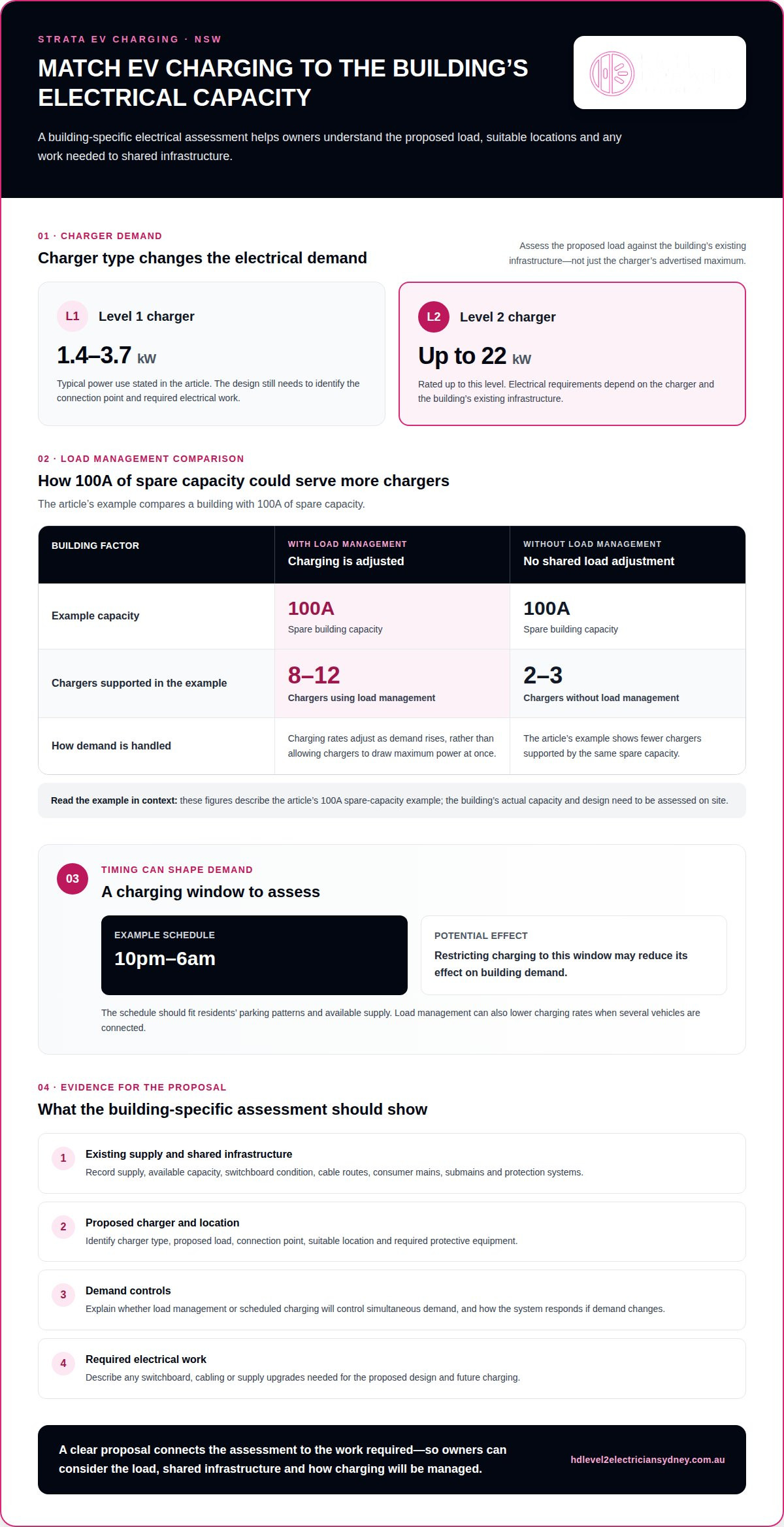
Start with the building’s existing supply, not the charger’s advertised maximum. A qualified electrical professional can assess the supply, proposed load, cable routes and protective equipment, including whether an older building’s common-property meter board needs work. The assessment should identify suitable charger locations and explain any constraints. To convince strata to approve EV charger installation, show how the design fits this building rather than relying on general claims about charger performance.
Charger type changes the electrical demand. A Level 1 charger typically uses 1.4 to 3.7 kW, while a Level 2 charger can be rated up to 22 kW. The electrical requirements depend on the charger and the building’s existing infrastructure, so the design should identify any circuit or distribution equipment needed. The design should show the equipment rating, connection point and required electrical work. This lets owners assess the proposed load against the building’s infrastructure.
Load management can help share available capacity across multiple vehicles. It adjusts charging rates when demand rises, instead of allowing chargers to draw their maximum power at once. For example, a building with 100A of spare capacity can support 8-12 chargers using load management; without it, that spare capacity can support 2-3 chargers. These examples show why an assessment should consider the whole system, not just one parking space.
Charging schedules can also shape demand. Restricting charging to 10pm-6am may reduce its effect on building demand, while load management can lower rates when several vehicles are connected. A schedule should fit residents’ parking patterns and the available supply. For convincing strata to approve EV charger installation, explain when charging will occur and how the system responds if demand changes.
A useful proposal links the assessment to the work actually required:
• Record existing supply, switchboard condition, cable routes and available capacity.
• Identify charger type, proposed load, location and required protection systems.
• Explain whether load management or scheduled charging will control simultaneous demand.
• Describe any switchboard, cabling or supply upgrades needed for the design and future charging.
This evidence helps owners distinguish a site limitation from a design that can manage demand through controlled charging. It also gives the owners corporation a practical basis for assessing electrical capacity, energy use and the proposal’s scope.
Why can’t an Owners Corporation rely solely on standard rules to approve an EV charger?
Standard rules set expectations, but they cannot determine whether a particular charger is safe or how its installation affects common property. The owners corporation needs a building-specific proposal covering the work, decision-making pathway and ongoing responsibilities.
Installation and Ongoing Responsibilities
Installation and ongoing responsibilities cover the practical duties before, during and after the work. Approval should settle who manages the equipment and costs, rather than leaving disputes for later. The application can specify who pays for assessment, installation, electricity, maintenance, repairs, removal and reinstatement. It should also explain how faults or safety issues are reported and who arranges emergency isolation, signage and access.
Responsibilities may differ for a private charger and shared equipment. Depending on approval conditions, a lot owner may be responsible for their charger’s installation, electricity use and maintenance. For shared charging, owners should agree how billing, repairs and future replacement will be managed. If chargers use common electricity, a metered user-pays arrangement can help allocate consumption fairly. Record these arrangements in the approval, rather than relying on informal assumptions.
By-Laws and Common-Property Responsibilities
By-laws set scheme-specific conditions for charger locations, use, electricity billing, maintenance and future removal or upgrades. They matter where equipment, cabling or access affects common property, because a general rule may not cover the actual installation. In NSW, changes to common property for EV charging follow Section 108 of the Strata Schemes Management Act 2015. Section 110 covers minor renovations to common property, including installing or replacing wiring, cabling, power or access points.
A charger fixed to a common-property wall may affect the building’s appearance or require controls over access. The by-law or approval conditions can identify the approved location and who may use the equipment. They can also define maintenance obligations and arrangements if the owner sells or removes the charger. Owners corporations should retain the assessment, technical advice, plans, approval and maintenance arrangements with scheme records.
Approval Steps and Decision-Making
Approval steps identify who reviews the application, which meeting or resolution is needed, and when work may begin. Formal approval should be in place before installation or connection work starts. The application should describe the location, equipment, plans, electrical assessment, installer and effects on common property. It should also state who pays for electricity and ongoing upkeep.
In NSW, owners need owners corporation approval before connecting EV charging equipment in a strata building. Proposals for common-property changes must follow the applicable statutory process; standard rules alone can’t replace that process or a technical assessment. Historically, NSW proposals usually required at least 75% of owners to vote in favour as special resolutions. Current pathways can differ according to the work and how it is classified, so the motion should match the proposed scope.
Tenants should obtain their landlord’s approval before proceeding. The landlord can then act on their behalf with the owners corporation. The owners corporation should also seek insurance and risk advice early, before approving work. Clear records of the decision, conditions, plans and electrical documentation give owners and future strata managers a reliable reference.
EV Charging in Strata: Are your OC rules and approval processes keeping pace?
Australia has no single strata approval pathway for every EV charger proposal; requirements depend on the state or territory and the work proposed. In NSW, the motion, by-law and supporting evidence should reflect the charger’s effect on common property.
Approval Pathways and Processes
Approval pathways set out how an application is assessed and which resolution is needed. They matter because a motion must describe the actual work, not just request permission for a vehicle charger. An application can identify the parking space, equipment, plans, electrical assessment and installer, then explain connections, costs and ongoing maintenance.
State and territory rules differ. In NSW, some proposals may use the sustainability-infrastructure pathway, depending on the work. A sustainability-infrastructure by-law motion for EV charger work may pass with a 51% resolution of unit entitlements, provided the work is limited to sustainability infrastructure. In Queensland, a committee cannot decide matters reserved for a general meeting or a particular resolution type.
Committee Authority and By-Laws
A strata committee acts within its decision-making authority, while a by-law records conditions owners must follow. Committee support cannot replace a resolution reserved for owners. The motion should specify whether the charger is private or shared, where it will be installed, and how residents may access it.
For example, a by-law could define approved locations, permitted users, charging access, billing and maintenance responsibilities. It can also explain how faults are reported and how removal or future upgrades are managed. In Victoria, owners corporations should check the approval process and EV-ready building guidance before work starts. In the ACT, a building may need electrical or structural upgrades before installation.
Special Resolutions and By-Laws
A special resolution is one possible approval mechanism, but it is not the only pathway relevant to EV charging. The work’s classification and effect on common property influence which motion and by-law the scheme should consider. In NSW, EV charging infrastructure is categorised as sustainability infrastructure, replacing the special resolution previously required under section 108 of the Strata Schemes Management Act 2015.
This makes it important to describe the scope precisely. A sustainability-infrastructure motion applies only when the work fits that category; it is not automatic approval for every charger design. If the proposal combines charger installation with other common-property work, the owners corporation needs to consider the approval route for the full scope.
Evidence for an Approval Proposal
Evidence helps owners assess a proposal’s technical, financial and practical effects. Include the proposed location, charger details, plans, electrical assessment and installer information. Add a clear outline of installation and upgrade costs, who pays for electricity, and how maintenance, repairs and removal will be handled.
For example, a motion can state whether a charger uses an owner’s supply or common electricity, then set out the billing arrangement. The application should also explain access, fault reporting and any insurance considerations. Complete plans and technical advice give the committee and owners concrete matters to assess, while a clear draft by-law turns agreed responsibilities into workable scheme conditions.
NSW strata law changes for EV charger approvals
NSW strata law gives some EV charger proposals a sustainability-infrastructure pathway. The key change is that qualifying work no longer follows the special resolution previously required under section 108 of the Strata Schemes Management Act 2015. The NSW Strata Schemes Management Amendment (Sustainability Infrastructure) Act 2021 is associated with this change. It can make the approval route more accessible, but it doesn’t remove the need to define the work clearly.
To use this pathway, the work must be limited to sustainability infrastructure. Some EV charger proposals may qualify, depending on the installation. A lot owner’s charger in a garage, for example, may follow a different by-law approach if it does not change the lot’s external appearance. Classify work affecting other common property carefully before preparing the motion.
For eligible sustainability infrastructure work, the owners corporation can approve a motion by a simple majority at a general meeting. The voting requirements described for these works require less than 50% of owners to oppose the resolution. A committee should not treat that threshold as blanket approval for every charger. It applies within the relevant pathway, not as a substitute for assessing the proposal’s scope.
The owners corporation’s financial planning also matters. The NSW voting requirements described for EV charging works require a 10 years capital works fund that budgets for capital works. This means the proposal should explain whether the work requires common funds or whether costs sit with the lot owner. A clear funding plan helps residents understand the decision alongside the installation’s impact.
The practical task for the strata committee is to match the motion to the installation. The application should identify the charger location, equipment, common-property work and proposed by-law conditions. It should also state who is responsible for electricity, maintenance, repairs and removal. These details let owners vote on a defined proposal rather than a broad request.
Existing rules still matter. Classifying work as sustainability infrastructure does not settle how residents access shared equipment or how a private charger is maintained. A by-law can record approved locations, use arrangements and owner obligations. Keep the resolution, plans and technical documents together so future committee members can understand what was approved.
Electrical demand is separate from the voting threshold. A legal approval pathway does not establish that the existing supply can safely support a proposed charger. The owners corporation still needs a building-specific technical assessment of the electrical infrastructure and proposed load. If the proposal includes switchboard or cabling work, describe those elements alongside the charger.
For NSW residents, the key is to identify the work first, then select the approval pathway. A motion limited to sustainability infrastructure may use the newer resolution process, while other work may need a different route. Clear plans, defined responsibilities and properly recorded conditions help the owners corporation decide based on the actual proposal.
What are the benefits of installing EV chargers in Australian strata buildings?
EV charging can make an apartment building more practical for residents who own electric vehicles. A charger in a designated parking space, or shared equipment in a common area, gives residents an option close to home instead of relying solely on public charging. The suitable arrangement depends on the building’s electrical capacity, parking layout and how residents will use the equipment.
Shared chargers can serve multiple residents and spread the cost per person compared with separate equipment for each parking space. For example, an owners corporation could provide shared charging access and set rules for booking, charging duration and payment. This can suit buildings with limited parking or residents who prefer a common facility. It also requires clear arrangements for billing, maintenance and fair access.
Individual chargers offer a different benefit: residents can charge in their allocated spaces and manage their own electricity use. Where the design allows a connection to an owner’s domestic electricity supply, it can avoid allocating common-property electricity. The proposal still needs to explain the effect on common property, upkeep responsibilities and how the installation fits the building.
Planning for charging can help a strata scheme respond to future resident demand. Rather than considering each request in isolation, owners can discuss whether shared infrastructure or a staged approach better suits the building. A modular approach can make it easier to add charging connections as demand grows, provided the initial design accounts for electrical capacity and suitable locations.
Convenience is another practical benefit. Residents may be able to charge while their vehicle is parked overnight, avoiding a separate trip just to charge. The charging rate and time required depend on the charger, vehicle and available power. A proposal should present a realistic use case, such as overnight charging for residents whose cars remain parked for extended periods.
Benefits are strongest when the scheme agrees on operating rules before installation. A shared charger needs fair arrangements for access and billing; an owner-only charger needs clear responsibility for maintenance and removal. The owners corporation can document these arrangements in approval conditions or by-laws, so residents understand what applies to their parking space and equipment.
For an owners corporation, the decision is not simply whether EV charging is useful. Consider whether the proposed setup serves residents, fits the building and has workable arrangements for costs and ongoing care. Comparing shared charging with individual installations can show which approach better suits the scheme’s parking, power supply and anticipated use.
High Demand Electrical: Tesla & Home EV Charger Installation
High Demand Electrical provides Tesla and home EV charger installation for owners ready to move from an approved proposal to electrical work. A site-specific installation can account for the parking location, cable route and building supply, helping align the work with the approved plans and conditions.
If the proposal identifies switchboard or supply constraints, High Demand Electrical also provides switchboard upgrades and Level 2 ASP Electrical Services. These services address electrical infrastructure needs connected with the project, rather than treating the charger as an isolated addition. The next step is to share the approved scope and relevant plans so the installation work can be considered in that context.
Contact High Demand Electrical to discuss Tesla or home EV charger installation for your strata property in Sydney.
Turn approval into a workable next step
Once the owners corporation approves a proposal, turn its decision into a clear plan for the work. Keep the approved scope and conditions aligned with the installation so the completed work reflects what residents agreed to. A documented handover also gives the strata committee a useful reference when future charger requests arise.
For owners preparing a proposal, convincing strata to approve an EV charger installation is only part of the process. A practical path from approval to installation helps maintain residents’ confidence and keeps agreed responsibilities visible.
High Demand Electrical provides Tesla and home EV charger installation, with related electrical work considered in the context of the approved project. If you’re ready to discuss the next step, contact High Demand Electrical. A clear plan can help move your strata project forward with confidence.
Frequently Asked Questions
What building factors must be evaluated before approving EV charging infrastructure?
Assess the existing supply, switchboards, consumer mains, submains, cabling routes and protection systems. The proposed charger location and distance from the electrical infrastructure also affect the installation design. In an older Sydney apartment building, the common-property meter board may need work. The assessment should consider current electrical demand and future charging needs, so the owners corporation can judge whether the proposed arrangement fits the building.
Can you install an EV charger in a Sydney apartment?
Yes. An EV charger can be installed in a Sydney apartment building if the proposal receives the required owners corporation approval and the building can support the work. The design may involve a private parking space, common-property cabling or a shared charging area. Tenants need their landlord’s approval before proceeding. Formal strata approval should be in place before installation or connection work begins.
Can multiple apartments share one EV charger?
Yes. Residents can share a charger if the owners corporation agrees on access and operating arrangements. For example, a scheme could set booking rules, charging times and a method for allocating electricity costs. A shared charger can serve multiple residents and may reduce the cost per person. The proposal should also establish who handles maintenance, faults and future replacement to keep shared use manageable.
Do I need a dedicated meter for my strata EV charger?
Not in every arrangement. A charger connected to an owner’s domestic electricity supply can keep that usage separate from common-property electricity, where the building design allows. If charging draws on common electricity, the owners corporation should agree how consumption is metered and paid for. A metered user-pays arrangement can help allocate costs fairly. Set out the billing method in the proposal before installation.
How can a committee plan for future EV charger requests?
A committee can plan by assessing the building’s capacity and considering shared infrastructure alongside individual chargers. Surveying owners about whether they expect to buy an EV within the next two, five or ten years can inform planning. The resulting plan can identify suitable locations, how new connections may be added, and how residents will share costs. Keep the assessment and decisions with the scheme records.
Who pays for EV charger installation, electricity, maintenance and upgrades in strata?
Approval conditions should allocate costs before work starts. Depending on those conditions, a lot owner may pay for a private charger’s installation, electricity use and maintenance. For shared equipment or common-property upgrades, the owners corporation needs to agree on funding and ongoing responsibilities. The proposal should also cover repairs, removal and reinstatement, so owners understand which costs are theirs and which are scheme expenses.
How much does it cost to install EV chargers in an Australian apartment building?
The price depends on the building and is provided after a quote request. Key cost factors include the charger location, cable route, distance to the switchboard, available electrical capacity and any required infrastructure upgrades. Shared systems and individual installations can involve different work and cost allocations. For a strata proposal, distinguish the owner’s charger costs from common-property work and explain who would fund each part.
How do load management and shared charging systems reduce costs for strata buildings?
Load management controls charging rates when several vehicles draw power, helping a building use available electrical capacity more efficiently. This can reduce the need to provide maximum power to every charger at once. Shared charging can spread equipment costs across residents who use it, rather than requiring separate equipment for each space. The owners corporation still needs clear rules for access, billing, maintenance and repairs.
Need Help Fast?
Powering Your Needs with Expertise
If you’re looking for a reliable, experienced, and prompt electrician, look no further than High Demand Electrical. We cater to all your electrical needs, from routine maintenance to emergency repairs and complete system installations. Our skilled team is committed to providing professional service that ensures your electrical systems run smoothly. Whether it's a small task or a large project, give us a call today. Let us meet all your electrical demands with the quality and reliability you deserve.

Licensed Level 2 ASP electricians across Sydney. Same-day service and 24/7 emergency response.
Licence 397193C
ABN 87 051 836 527
