Consumer Mains Size in NSW: How It's Worked Out
There is no single consumer mains size for NSW. The cable size is worked out for each property from its maximum demand, the way the cable is installed, the length of the run, the voltage drop and the number of phases. Your distributor’s requirements then apply on top. Sizes such as 16 mm², 25 mm² and 35 mm² turn up often in home upgrades, but they are outcomes of that calculation, not defaults. This guide shows you how the calculation works, what changes it, and what an upgrade involves.
TL;DR
- Consumer mains are the conductors between the network connection point and your main switchboard. Their size comes from a calculation, not a standard figure.
- The size must satisfy both current-carrying capacity and voltage drop. On long runs, voltage drop usually decides it.
- A single-phase to three-phase upgrade changes the per-phase current but does not fix a cable size. It also needs distributor permission and accredited service work.
- Only an accredited Level 2 electrician can connect consumer mains to the network, and a Certificate of Compliance for Electrical Work (CCEW) is required for the job.
- We provide free site inspections for Level 2 work, so you can get the size confirmed for your actual site.
Table of Contents
- What consumer mains are and where they run
- How the size is calculated
- Common sizes, and why one size can’t fit every property
- Single phase to three phase and the effect on mains size
- Who can do the work, and what must be certified
- Which distributor’s rules apply to you
- Our view on consumer mains sizing
- Signs your consumer mains may need attention
- What to have ready before an inspection
- Work with a Level 2 electrician in Sydney
- FAQ
- Sources
What consumer mains are and where they run
In the NSW Service and Installation Rules, consumer mains are the conductors between the connection point and the main service equipment enclosure. They form part of your electrical installation, which means they belong to the property owner, not the network.
On a typical NSW property they take one of three forms:
- Overhead: a cable from the pole or the point of attachment to the building, often fixed at the roofline or eaves.
- Underground: a cable buried or in conduit from a pit or pillar to the building.
- Within a structure: the section that runs inside walls, ceilings or risers to reach the main switchboard, common in units and strata buildings.
The network’s service cable stops at the connection point. Everything after it, up to the main switch, is consumer mains. That boundary matters because it decides who is responsible for the cable’s condition and who can lawfully work on it.
How the size is calculated
The method follows a fixed sequence. The NSW rules point to calculating maximum demand under AS/NZS 3000, selecting a cable from the AS/NZS 3008 current-carrying data, applying installation correction factors and then verifying voltage drop. The result has to meet the thermal and voltage-drop limits as well as the distributor’s requirements, as set out in the NSW rules.
In practice, the steps are:
- Work out maximum demand. This is the highest load the installation is expected to draw, after allowing for diversity.
- Choose the cable type and installation method. Insulation type, and whether the cable is overhead, underground or enclosed, change how much current it can carry.
- Apply correction factors. Grouping, ambient temperature and thermal insulation all reduce capacity. This is called derating.
- Select a conductor whose derated capacity is at or above the design current.
- Check voltage drop over the actual route length.
- Confirm with the distributor that the result meets their connection requirements.
Australian cable-sizing guidance describes the same design sequence: maximum demand, insulation and installation method, correction factors, a conductor whose derated capacity meets the design current, then a voltage drop check.
Step 1: maximum demand
Maximum demand is not the sum of every appliance at full rating. For homes, AS/NZS 3000 Appendix C uses load groups and diversity allowances, so maximum demand is assessed by category: lighting, socket outlets, cooking, heating or cooling, and hot water are each treated separately.
That is why two houses of the same size can need different cables. A home with ducted air conditioning, an induction cooktop and an EV charger has a very different demand from one with gas cooking and a split system. If you want a quick estimate before talking to anyone, our maximum demand calculator applies AS/NZS 3000 Tables C1 and C2. For a measured figure rather than a calculated one, we also run power logging and maximum demand studies.
Steps 2 and 3: installation method and derating
The same copper conductor carries different current depending on where it sits. Installation method, grouping, ambient temperature and thermal insulation are the derating factors, according to Australian trade calculator guidance. A cable clipped in free air in the eaves is rated differently from one buried in conduit, or one running through insulated ceiling space alongside other circuits.
The NSW rules also list soil conditions for underground runs, along with overhead or enclosed installation, conductor insulation, and the phase arrangement of the supply.
Step 5: voltage drop and cable length
Longer runs lose more voltage. Cable-sizing guidance notes that on long runs voltage drop, not thermal capacity, may set the size. The NSW rules require the service voltage drop to be calculated from consumer-mains maximum demand and generally limited to 3% at the point of common coupling, per the Service and Installation Rules.
This is why a rural block or a long driveway run can need a bigger conductor than a terrace house with the same load. You can test a rough scenario with our cable size and voltage drop calculator, then have the numbers confirmed on site.
Common sizes, and why one size can’t fit every property
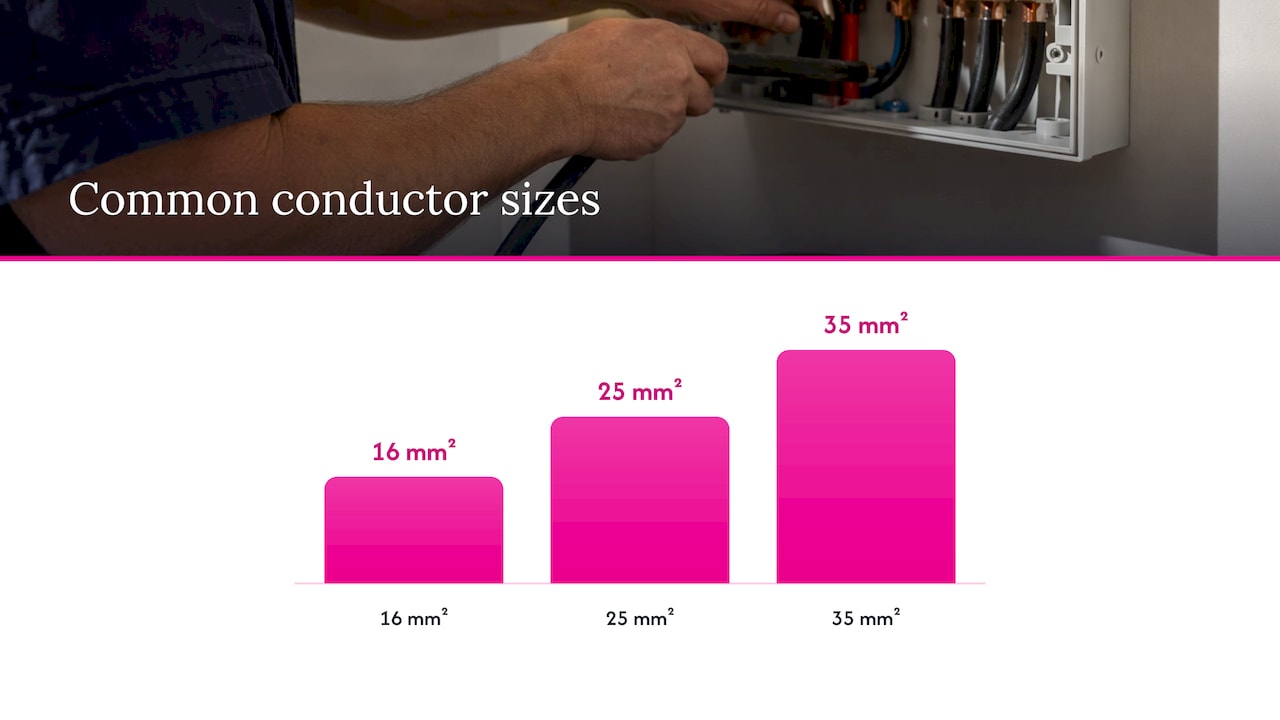
Home upgrades often land on 16 mm², 25 mm² or 35 mm² conductors, while older installations are frequently smaller. Those figures are a pattern, not a rule. The correct conductor depends on maximum demand, installation conditions, length, voltage drop, phase arrangement and the distributor’s requirements, as the NSW rules make clear.
Here is how the factors push the size in each direction:
| Factor | Pushes the size up when… | Pushes the size down when… |
|---|---|---|
| Maximum demand | Ducted air conditioning, electric cooking, EV charger, pool or workshop loads | Small, mostly gas or low-load home |
| Cable length | Long overhead or underground run to the switchboard | Short run from the point of attachment |
| Installation method | Grouped, buried in poor soil or in insulated ceiling space | Free air with good heat dissipation |
| Ambient temperature | Hot roof space or sun-exposed route | Cool, shaded route |
| Phases | Single phase carrying a high load | Load spread across three phases |
If you see a general-purpose sizing chart online, treat it as an illustration of the method. It cannot know your route, your load or your distributor’s rules.
Single phase to three phase and the effect on mains size
Three-phase supply changes the per-phase current calculation and can take higher or differently spread loads. It does not prescribe a fixed cable size. Under the NSW rules, phase selection must reflect maximum demand and equipment characteristics. An installation with maximum demand up to 100 A per phase may use one, two or three phases plus neutral. Demand above 100 A per phase requires three phases and neutral, per the NSW rules.
When homeowners ask about three phase, the usual drivers are:
- large ducted or multi-split air conditioning
- an EV charger alongside other heavy loads
- a workshop, three-phase machinery or a granny flat
- solar or battery systems that need balanced capacity
An upgrade is more than a thicker cable. The NSW rules say it needs distributor permission, accredited service work, metering changes and authorised energisation. Endeavour Energy’s guide confirms that a single-phase to multiphase upgrade needs a Permission to Connect, an accredited service provider (ASP) for the underground or overhead service work and another to energise, plus metering work. It also states that an existing type 6 meter must be replaced with a type 4 meter on upgrade, because mixed meter types are not allowed.
If you want the full picture of what a change involves, see our power supply upgrades page, which covers single phase to three phase work.
Who can do the work, and what must be certified
Consumer mains are not a DIY or general-electrician job at the connection end. Work that connects consumer mains to the network must be done by appropriately accredited and authorised ASP personnel, working to the distributor’s requirements, according to the NSW rules.
The same document lists the checks that must be completed:
- polarity
- phase rotation, where it applies
- insulation resistance
- earthing integrity
New services need at least 50 megohms insulation resistance when tested at 500 V DC. The installation must not be energised past the main switch without the relevant CCEW or an equivalent completed testing record.
Building Commission NSW states that electricians must provide a Certificate of Compliance for Electrical Work. It shows the work has been tested and complies with the Gas and Electricity (Consumer Safety) Regulation 2018, the relevant Australian Standards and the Gas and Electricity (Consumer Safety) Act 2017. The wiring rules themselves have been mandatory in NSW since 1 January 2019.
Keep your copy of the CCEW. Property managers and strata committees in particular should file it with the building records.
Which distributor’s rules apply to you
The size is checked against your distributor’s requirements, so it matters which network you are on. In the Ausgrid area, the Premises Connection Requirements apply to connecting or upgrading private installations and must be read with the current NSW Service and Installation Rules. Endeavour Energy publishes its own requirements for its area. Essential Energy covers much of regional NSW.
Because these documents are updated, always work from the edition the distributor currently publishes. A Level 2 electrician who works across Sydney’s networks does this as routine.
Our view on consumer mains sizing
We are asked for a standard size for consumer mains more often than almost anything else. We understand why. A single number feels simple and easy to budget around.
The honest answer is that a number given without a site visit is a guess. We have seen how much a property’s real load, route length and cable condition vary from one street to the next, and the maximum demand figure is what ties them together. That is why our Level 2 work starts with a free site inspection. We look at the existing mains, the switchboard, the route and the planned loads before anyone talks about conductor sizes.
We also think the size should leave room to grow. If you are likely to add an EV charger, air conditioning or a battery in the next few years, say so early. It is far easier to size the mains once than to open up the route twice.
Our team are accredited Level 2 ASP electricians working to NSW standards, and the work is certified and documented. You get the paperwork, and you know what is in your wall or on your pole.
Christopher
Signs your consumer mains may need attention
Sizing questions often start with a symptom. These are the ones that should prompt a call to a Level 2 electrician:
- the mains cable looks cracked, faded, brittle or damaged where it enters the building
- cable in the eaves or roof space is exposed and not in conduit (mechanical protection is a recurring compliance issue for consumer mains in NSW)
- lights dim when a large appliance starts
- the main switch or its surrounds are warm, discoloured or smell of burning
- you are adding an EV charger, ducted air conditioning, a granny flat or a pool
- the meter box or switchboard is being replaced, and the mains are old
For anything that smells of burning, sparks, or leaves part of the property without power, treat it as an emergency. Keep clear, switch off at the main switch only if it is safe to reach, and call an emergency electrician.
What to have ready before an inspection
A few details speed up an accurate answer:
- Your distributor and your NMI, both printed on your electricity bill.
- A photo of the meter box, the switchboard and the point where the mains enter the building.
- A list of major appliances and any planned additions, such as an EV charger, air conditioning, solar or a battery.
- Roughly where the cable runs and how far it is from the pole or pit to the switchboard.
- Your strata or landlord approval, if the property is not owner-occupied.
With that, we can say whether the existing mains are likely to cope, and whether the job is a mains replacement, a switchboard upgrade or a full phase upgrade.
Work with a Level 2 electrician in Sydney
We are a certified Level 2 electrical contractor serving residential, commercial and strata properties across Sydney. Consumer mains installation, overhead and underground service mains, private power pole installation, metering services and single-phase to three-phase upgrades are all part of what we do. We are triple ISO certified, we offer a 10-minute callback guarantee for urgent calls and we have over 300 five-star reviews. Seniors can also ask about our discounts.
Start with a free site inspection for Level 2 work. We will confirm what your property needs before any work is quoted. See our Level 2 electrician services or go straight to power supply upgrades.
If your mains upgrade also means a new board, our switchboard upgrades team can do both in one visit plan. For no power, burning smells or damaged mains, our emergency electricians are available 24/7.
FAQ
What size are consumer mains in a typical NSW house?
There is no typical size that applies to every house. Sizes like 16 mm², 25 mm² and 35 mm² are common in upgrades, and older homes often have smaller cable. The right size depends on maximum demand, route length, installation method and phase arrangement, so it has to be calculated for the property.
Do I need three-phase power to upgrade my consumer mains?
Not always. Under the NSW rules, an installation with maximum demand up to 100 A per phase may be single, two or three phase. Above 100 A per phase, three phase is required. Many homes choose three phase for heavy loads such as air conditioning or EV charging, but it depends on your maximum demand.
Can I replace consumer mains myself?
No. Connecting consumer mains to the network must be done by accredited and authorised ASP personnel working to the distributor’s requirements. A CCEW must also be completed for the work. Contact a Level 2 electrician to arrange it.
Does a longer cable run mean a bigger cable?
Often, yes. Voltage drop rises with run length, and on long runs it can set the size rather than the cable’s current rating. NSW generally limits service voltage drop to 3% at the point of common coupling, so a long run may need a larger conductor than a short one carrying the same load.
Who decides if my upgrade is approved?
Your distributor must give permission for a phase upgrade or a change to the connection, and an accredited ASP does the service work and energisation. Your electrician handles the application and coordination with the network, and with your retailer for metering changes.
Sources
- NSW Standard Electricity Service and Installation Rules (energy.nsw.gov.au)
- Electrical compliance requirements (NSW Government)
- Electrical standards, rules and notes (NSW Government)
- Endeavour Energy Retailer and Market Guide
- Ausgrid ES1 Premises Connection Requirements
- Australia Cable Sizing, AS/NZS 3008 (ECalPro)
- Maximum Demand Calculator, AS/NZS 3000
- Trade Calculators to Australian Standards (StandardsMate)
Recommended
Need Help Fast?
Powering Your Needs with Expertise
If you’re looking for a reliable, experienced, and prompt electrician, look no further than High Demand Electrical. We cater to all your electrical needs, from routine maintenance to emergency repairs and complete system installations. Our skilled team is committed to providing professional service that ensures your electrical systems run smoothly. Whether it's a small task or a large project, give us a call today. Let us meet all your electrical demands with the quality and reliability you deserve.

Licensed Level 2 ASP electricians across Sydney. Same-day service and 24/7 emergency response.
Licence 397193C
ABN 87 051 836 527
