
Commercial Switchboard Requirements in NSW: A Compliance Guide
A commercial switchboard in NSW must meet AS/NZS 3000:2018 (the Wiring Rules), the Service and Installation Rules of NSW, and the Electricity (Consumer Safety) Regulation 2015. Any work on it must be done by a licensed electrician, who then lodges a Certificate of Compliance for Electrical Work. This guide covers what inspectors look for, what trips up property owners, and when a board needs upgrading rather than patching.
TL;DR
- Commercial electrical work in NSW must follow AS/NZS 3000:2018 and the NSW Service and Installation Rules, and be carried out by a licensed electrician.
- Every board needs a clearly identified main switch. If the premises has safety services such as fire systems, the switch must be labelled so nobody cuts power to them in an emergency.
- Type AC RCDs cannot be used in new work. Type A or Type B devices are required, and adding solar, a battery or an EV charger can expose old units.
- Keep the paperwork: a CCEW is required after electrical work, and missing certificates can cause insurance and warranty trouble.
- If your board is crowded, overheating, tripping or short on capacity, book an inspection before the next fault forces the issue.
Table of Contents
- Who sets the rules for commercial switchboards in NSW
- The main switch and safety services labelling
- RCDs (safety switches) on commercial circuits
- Space, access and board design
- Metering and the point of supply
- Certificates, records and who can do the work
- When a commercial board needs an upgrade
- Planning an upgrade or fitout
- Our perspective
- Get your board checked
- FAQ
- Sources
Who sets the rules for commercial switchboards in NSW
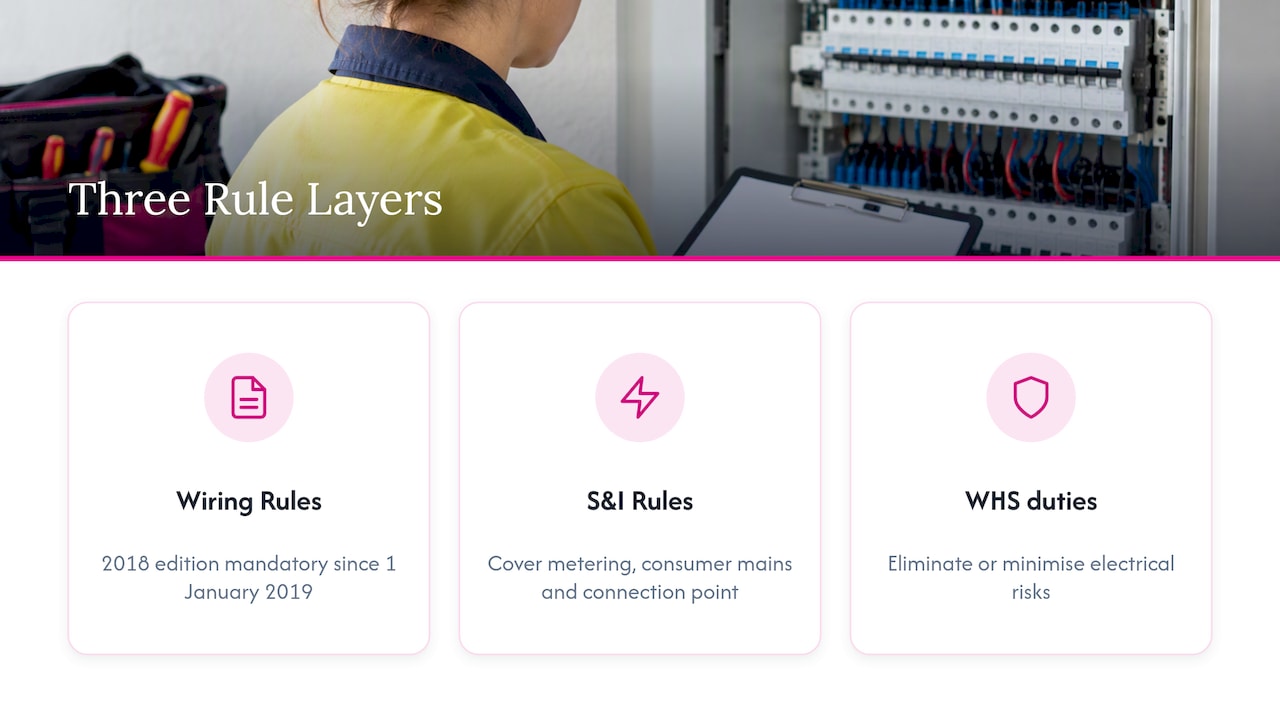
Three layers apply to a commercial board, and they work together.
The Wiring Rules. The NSW Government confirms that the wiring rules specify installation safety requirements for all premises in Australia and New Zealand, and the 2018 edition has been mandatory since 1 January 2019. Under the Electricity (Consumer Safety) Regulation 2015, electrical installation work must be carried out to the standards the regulation specifies.
The Service and Installation Rules. The Service and Installation Rules of New South Wales are the recognised code for what electricity distributors require when connecting a customer to the network. They matter most where the board meets the supply: metering, consumer mains and the point of connection.
Work health and safety law. If you run a business, you are a PCBU under the WHS Act. Safe Work Australia’s model code of practice says electrical risks must be eliminated where reasonably practicable and otherwise minimised so far as is reasonably practicable. A compliant board is part of meeting that duty, not a separate box to tick.
One point catches owners out: the licence requirement has no cost threshold. NSW Government guidance states that you need an electrical licence before doing any electrical wiring work in NSW. A handyman or maintenance staffer cannot swap a breaker in a shop’s board to save a callout.
The main switch and safety services labelling
This is the item inspectors raise most often on commercial boards.
Clause 2.3.3.2 of the Wiring Rules requires the supply to every installation to be controlled at the main switchboard by a main switch or switches. The NSW Government’s note on location and identification of the main switch explains how this is applied.
What that means in practice:
- The main switch must be easy to identify. In a busy board with several isolators, a firefighter or electrician should not have to guess which device kills the whole installation.
- Safety services change the labelling. If the premises has safety services such as fire systems, emergency lighting or fire pump controls, the device that feeds them must be distinctly marked and labelled with the “in the event of a fire, do not turn off” warning. The aim is to stop emergency personnel cutting power to life-safety equipment.
- The service protection device (SPD) must not be mistaken for a general main switch. Where it supplies safety services it should be locked in the ON position.
- Keep the key accessible. The common pitfall is a locked device with the key nowhere to be found. Keep it with building management or in the switchroom so emergency crews can reach it.
If you manage a strata building or a multi-tenancy property, walk your switchroom and check these labels today. It costs nothing, and faded or missing labels are easy to fix.
RCDs (safety switches) on commercial circuits
Residual current devices are the next most common finding. Three rules matter.
Which circuits need them
Under the 2018 Wiring Rules, commercial and industrial installations need RCDs with a rated residual current of no more than 30 mA on final subcircuits rated 32 A or less that supply socket-outlets, lighting, direct-connected hand-held equipment and equipment that presents increased risk of electric shock. There are limited exemptions, for instance where disconnection by an RCD could create a greater danger than the leakage itself. Whether an exemption applies to a particular circuit is a judgement for a licensed electrician, not something to assume.
Type A or Type B, never Type AC
The Wiring Rules prohibit Type AC RCDs in new installations. Type A or Type B must be used instead. The reason is technical: Type AC devices cannot reliably detect the pulsating DC fault currents produced by modern equipment such as EV chargers, solar inverters and LED drivers.
The trap for existing premises is that adding a new energy source can bring the whole associated installation under review. If you plan to add solar, a battery system or an EV charger, expect your electrician to check the RCDs on the board. The NSW Government has also flagged a related finding on batteries: in some installations, final subcircuits supplied by the new backup supply were not RCD protected.
Test them, do not just install them
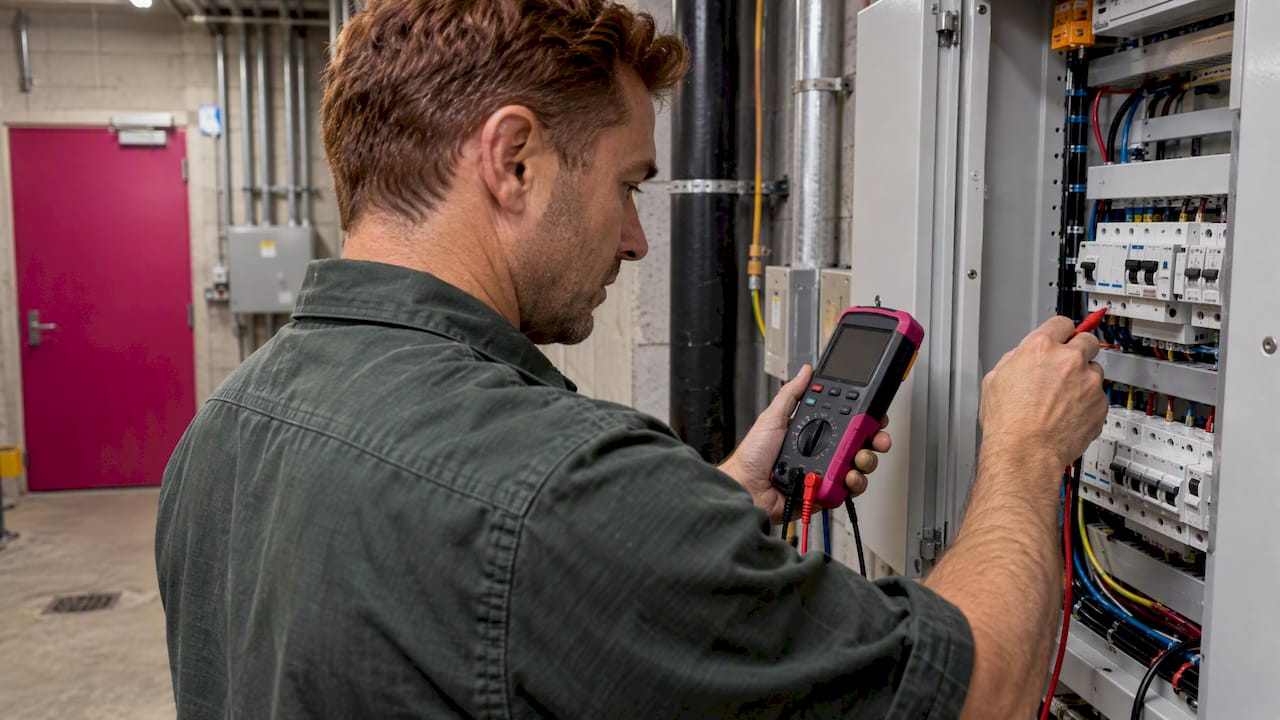
Safe Work Australia’s guidance on electrical hazards in the workplace treats RCDs as devices that need regular testing: a push-button test by users, plus tripping-time testing by a qualified person. A safety switch that has never been tested may not work when a fault occurs. Ask your electrician what testing schedule suits your premises and keep a record of each test. Our RCD and safety switch testing forms part of our maintenance work.
If an RCD keeps tripping, that is a symptom worth chasing rather than resetting. See our notes on what to do when a safety switch keeps tripping.
Space, access and board design
A board that is technically sound can still fail an inspection if nobody can safely reach it.
The 2018 edition of the Wiring Rules tightened switchboard access in Clause 2.10. According to GSES’s summary of the changes, the update added minimum clear distances around closed switchboards. Exact dimensions depend on the type of switchgear and the board’s ratings, so confirm them against the standard or with your electrician before you move shelving, stock or equipment into a switchroom.
Practical points for commercial tenants and managers:
- Do not store stock, cleaning supplies or flammable materials in front of or inside the switchroom.
- Keep the switchroom accessible to authorised persons. A board behind a locked storeroom is an access problem.
- Keep circuit directories current. A board where nobody knows what each breaker controls slows fault-finding and emergency response.
- Allow spare capacity. Most boards that fail an upgrade assessment are full: no spare ways, no room for the new air conditioning unit or EV charger.
Larger boards carry an extra layer. One Sydney electrical resource notes that switchboards rated at 125 A per phase or more, or exposed to a fault level of 10 kA or higher, must comply with the AS/NZS 61439 series, which means the manufacturer provides verification documentation. If you are procuring a new main switchboard for a larger site, ask for that documentation up front.
Metering and the point of supply
Commercial boards often include metering, and metering is where network rules and the Wiring Rules meet. Building Commission NSW inspectors publish advisory notes on common metering non-compliance, so check that your board and meter panel have been installed by someone who knows the distributor’s requirements in the Service and Installation Rules.
Upgrades to the supply side are a different job from a board swap. Moving from single phase to three phase, relocating consumer mains, or adding a private power pole involves the distributor as well as the electrician. These are Level 2 jobs: work on the network connection that only an accredited service provider can do. Our Level 2 electrician and metering services cover that connection work.
Certificates, records and who can do the work
When electrical work is done, the paperwork is as important as the wiring.
- Licensed electrician required. Work must be carried out or supervised by a licensed electrician, as set out in NSW electrical compliance requirements.
- CCEW lodged. The electrician must submit a Certificate of Compliance for Electrical Work to prove compliance and that installation safety inspections have taken place. Penalties apply for non-compliance, and missing certificates can create problems with insurance or equipment warranties.
- Keep a copy. Store the CCEW with your building file. A buyer’s lawyer, insurer or strata auditor may ask for it.
- Ask about supervision. Apprentices can work on commercial boards, but the NSW supervision practice standard for apprentices expects supervision to match the apprentice’s demonstrated competency on each task. A reputable contractor will tell you who is on site and who is responsible.
One more safety point that affects your own staff and contractors: Safe Work Australia’s code stresses that equipment must be proven dead before work starts, not assumed dead because a switch is open. Panel voltmeters are not a substitute. Nobody except a licensed electrician should open an energised board.
When a commercial board needs an upgrade
A board does not have to be replaced because it is old. It needs attention when one or more of these apply:
| Sign | What it often means | Typical next step |
|---|---|---|
| Breakers or RCDs trip repeatedly | Overload, earth leakage or a failing device | Fault-finding and testing |
| Warm, discoloured or buzzing components | Loose connection or overload | Urgent inspection |
| No spare ways for new circuits | Capacity limit | Board upgrade or sub-board |
| Type AC RCDs on a site adding solar, battery or EV charging | Non-compliant for the new work | RCD replacement as part of the project |
| Single phase supply, but three phase equipment planned | Supply limit | Power supply upgrade with the distributor |
| Missing labels, unclear main switch | Identification non-compliance | Relabel, or rework if the board is crowded |
| A defect notice from an inspector or network | Formal non-compliance | Defect rectification and CCEW |
The distinction matters for budgets. Relabelling a board is a small job. Replacing a main switchboard, upgrading the supply or rectifying a defect notice is a planned project, and it is cheaper to plan it than to do it after an outage.
Planning an upgrade or fitout
Before you ask for quotes, gather the board’s current ratings, any single line diagram, the last test records and your plans for the next three to five years: more equipment, a tenant change, solar, a charger. A good scope covers present load and what you will add.
The commercial terms matter too. If a builder or head contractor is engaging the electrician for a fitout, it pays to understand how the contract allocates cost risk. This explainer on cost-plus versus fixed-price contracts is a sensible starting point before you sign.
On quotes, ask each electrician:
- Will the work be done by a licensed electrician, and who holds the Level 2 accreditation if network work is involved?
- Is the CCEW included, and will you receive a copy?
- Will existing RCDs be assessed and replaced where they are the wrong type?
- How will outages be scheduled around trading hours?
- What is excluded, such as distributor fees or builder’s work?
Our perspective
Most commercial switchboard problems we see are not exotic. They are an unlabelled main switch, an RCD nobody has tested, a board with no room left, or a supply that cannot carry the equipment the business just bought. All of them are cheaper to fix on a planned day than at 2 am.
We are a certified Level 2 electrical contractor in Sydney, and we offer free site inspections for Level 2 work, so you know what the job involves before you commit. Our team works in residential, commercial and strata settings, and we are triple ISO certified. If your site is down, our emergency line is staffed 24/7, with a 10-minute callback guarantee.
Our advice to property managers is simple: treat the switchboard as a compliance asset with its own record. Keep the CCEWs, test the RCDs on a schedule, and have the board inspected before you add major load. Do that and an inspection becomes a routine event rather than a surprise.
— Christopher
Get your board checked
If you are not sure your board meets current requirements, we can inspect it, explain what is compliant and what is not, and quote the work. See our switchboard upgrades page, our commercial electrical compliance service, or our power supply upgrades if you need three phase. For a fault right now, use our emergency electrician service: rain, hail or shine, we respond.
FAQ
Do commercial switchboards in NSW need RCD protection?
Yes, in most cases. The 2018 Wiring Rules require RCDs of no more than 30 mA on commercial final subcircuits of 32 A or less supplying socket-outlets, lighting and certain equipment, with limited exemptions. Your electrician should confirm which circuits on your board are covered.
Can I use Type AC RCDs on a new commercial installation?
No. The Wiring Rules prohibit Type AC RCDs in new installations, so Type A or Type B must be used. If you add solar, a battery or EV charging, existing Type AC units may need replacing.
Who is allowed to work on a commercial switchboard in NSW?
Only a licensed electrician, or someone working under proper supervision by one. The electrician must lodge a Certificate of Compliance for Electrical Work when the job is done. There is no cost threshold below which a licence is not needed.
What must be labelled on a commercial main switch?
The main switch must be clearly identifiable. Where the premises has safety services such as fire systems, the device feeding them must be marked and labelled so it is not turned off in a fire. Any lock key should stay accessible to emergency personnel.
Sources
- Electrical standards, rules and notes | NSW Government
- Electricity (Consumer Safety) Regulation 2015 | NSW Legislation
- New South Wales Standard Electricity Service & Installation Rules
- Model Code of Practice: Managing electrical risks in the workplace | Safe Work Australia
- Electricians: compliance and regulation | NSW Government
- Location and identification of the main switch | NSW Government
- Wiring Rules AS/NZS 3000:2018 key updates | GSES
- Residual Current Device (RCD) compliance | NSW Government
- RCD protection in Battery Energy Storage Systems | NSW Government
- Electrical hazards | Safe Work Australia
- Electrical compliance requirements | NSW Government
- Supervision practice standard for apprentices in the electrical industry | NSW Fair Trading
Powering Your Needs with Expertise
If you’re looking for a reliable, experienced, and prompt electrician, look no further than High Demand Electrical. We cater to all your electrical needs, from routine maintenance to emergency repairs and complete system installations. Our skilled team is committed to providing professional service that ensures your electrical systems run smoothly. Whether it's a small task or a large project, give us a call today. Let us meet all your electrical demands with the quality and reliability you deserve.

