Circuit breaker keeps tripping: causes, safe fixes, and when to call
If your circuit breaker keeps tripping, it is doing exactly what it was designed to do. A repeating trip means the protective device has detected a real fault — an overload, a short circuit, earth leakage, or a failing appliance — and that fault will not fix itself by resetting the breaker.
Here is what to do in the first five to ten minutes:
- Turn off or unplug everything on the affected circuit before attempting a reset.
- Reset correctly: push the breaker fully to OFF first, wait five seconds, then push it to ON. Skipping the full OFF position is the most common reason a breaker appears to refuse to stay on.
- If it trips immediately with nothing connected, stop. Do not reset again. The fault is in the fixed wiring or the switchboard itself, and you need a licenced electrician.
- If it holds, plug appliances back in one at a time, waiting 10–15 seconds between each. The device that causes the trip is your culprit.
- Stop and call an electrician if you smell burning, see scorch marks, hear buzzing, or the breaker trips the moment you restore power.
Repeated resets are not a solution. Energy Safe Victoria is clear that forcing resets can mask dangerous underlying faults, including degraded insulation and active earth leakage.
Table of Contents
- Circuit breakers vs safety switches: which one tripped?
- The most common reasons your breaker keeps tripping
- How to safely troubleshoot a tripping breaker yourself
- Warning signs that mean you should stop and call an electrician now
- What a licenced electrician checks and fixes when a breaker keeps tripping
- How much does it cost to fix a tripping breaker in Australia?
- How to prevent your breaker from tripping repeatedly
- Common misunderstandings about breakers tripping too often
- Key takeaways
- Persistent trips in Sydney? High Demand Electrical can help
- Useful Australian sources for further reading
Circuit breakers vs safety switches: which one tripped?
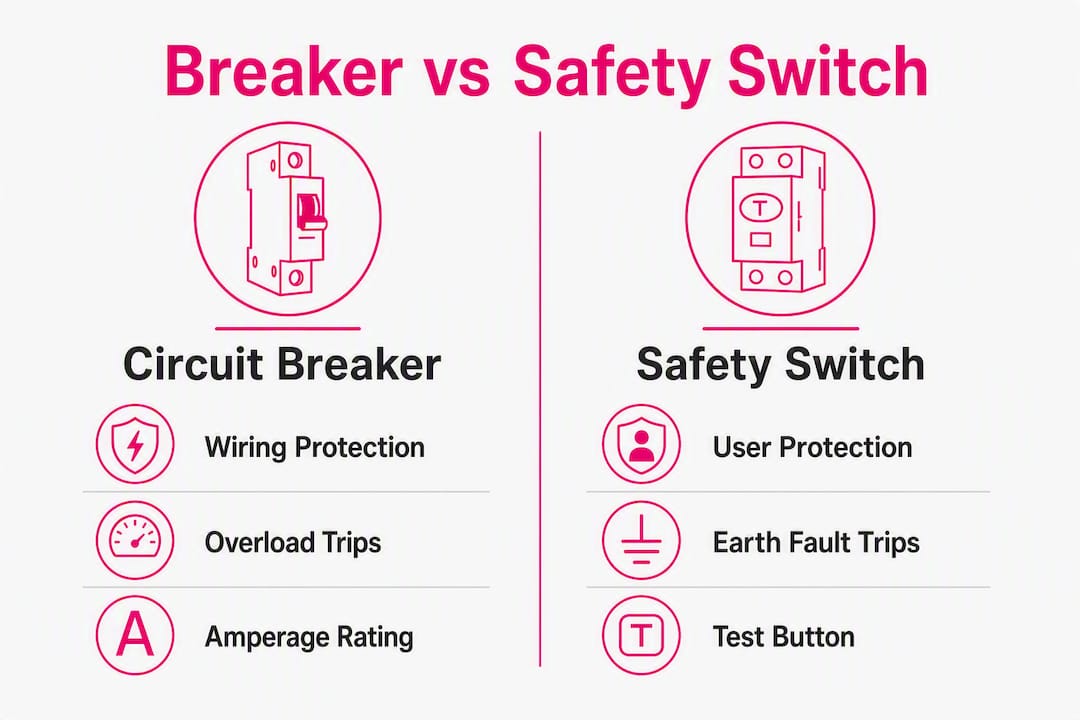
Knowing which device tripped changes everything about how you respond. Electricians report that many homeowners confuse MCBs with RCDs, and that confusion leads to the wrong troubleshooting path — and sometimes unnecessary risk, as the NSW Government's electrical safety guidance notes.
| Feature | Circuit breaker (MCB) | Safety switch (RCD) |
|---|---|---|
| What it protects | Wiring and appliances from overload and short circuits | People from electric shock via earth leakage |
| What triggers it | Current exceeds the breaker's rated amperage | Current leakage as small as 30 milliamps to earth |
| How fast it trips | Seconds to minutes depending on overload level | Within 30 milliseconds or less |
| Has a test button? | No | Yes — a small "T" or "Test" button |
| Typical label | Amperage rating (10A, 20A) | "RCD", "Safety Switch", or circuit description |
How to identify each on your switchboard: MCBs are toggle switches with an amperage number printed on them. RCDs have a small test button and usually protect multiple circuits. Some modern switchboards combine both functions in a single RCBO (residual current circuit breaker with overload protection).
A practical example: your kettle trips the power in the kitchen. If the MCB labelled "Kitchen" has flipped, the circuit is overloaded or the kettle has an internal short. If the RCD has tripped, the kettle's insulation is leaking current to earth — a different problem requiring a different response.
Pro Tip: Press the test button on your RCD right now. If it does not trip the circuit, the RCD may have failed and is no longer protecting you. A non-functional test button means the device needs replacing.
The most common reasons your breaker keeps tripping
Most trips fall into one of six categories. Knowing the signs for each saves you time and helps you give an electrician accurate information when you call.

1. Circuit overload
Too many appliances drawing power at once exceed the breaker's rated current. Signs: trips only when multiple high-draw devices run simultaneously (heater plus kettle plus toaster), and the breaker holds once you remove one load.
2. Short circuit
A live wire contacts a neutral wire, causing a sudden current spike. Signs: a loud pop or flash at an outlet, a burning smell, and the breaker trips immediately on reset. Short circuits are more serious than overloads and always warrant a professional inspection.
3. Earth fault (ground fault)
Current leaks from a live conductor to an earthed surface or to a person. The Electrical Safety Office (QLD) explains that RCDs detect this leakage and trip within milliseconds to prevent electrocution. Signs: the RCD trips rather than the MCB, often near wet areas like bathrooms, laundries, or kitchens.
4. Faulty appliance
Energy Safe Victoria identifies faulty appliances as the most common cause of safety switch trips in Australian homes. Kettles, washing machines, dishwashers, and older fridges are the most frequent offenders, typically due to damaged insulation or a compromised power cord.
5. Degraded wiring
Older Australian homes built before 1980 often have rubber-insulated wiring that has hardened and cracked over decades. This degraded insulation causes nuisance RCD trips and represents a genuine fire hazard. The fault does not always show up visually — it requires insulation resistance testing to confirm.
6. Moisture and storm surges
After heavy rain, safety switches commonly trip on outdoor power points, pool pumps, and garden lighting. Water ingress into outdoor fittings creates a leakage path to earth that the RCD detects immediately.
7. Arc fault nuisance tripping
Newer arc fault circuit interrupters (AFCIs) detect dangerous arcing in wiring, but can also nuisance-trip on certain motor loads or electronic interference. The answer is never to replace an AFCI with a standard breaker — have an electrician test whether the arc detection is responding to a genuine fault.
Pro Tip: In Sydney and across NSW, kitchens, laundries, and outdoor circuits are the highest-risk zones for repeated trips. If your home was built before 1980, treat any repeated RCD trip as a wiring fault until proven otherwise.
How to safely troubleshoot a tripping breaker yourself
A structured isolation method resolves the majority of domestic tripping faults without a callout. Follow these steps carefully and stop the moment any warning sign appears.
- Switch off all appliances and lights on the affected circuit at their power points. Do not just turn them off at the device — physically unplug them. Switching off at the appliance can leave internal capacitors that still leak current and continue to trip an RCD.
- Reset the breaker correctly. Push it firmly to OFF (you will feel a click), wait five seconds, then push to ON. A correct reset requires that full OFF position to re-engage the internal mechanical latch.
- If it holds with nothing connected, plug appliances back in one at a time. Wait 10–15 seconds after each one before plugging in the next. The appliance that causes the trip is faulty and should be removed from service.
- If it trips immediately with nothing connected, the fault is in the fixed wiring, the switchboard, or the device itself. Do not attempt further resets — call a licenced electrician.
- Test your RCD's test button once the circuit is stable. Press it firmly; the circuit should trip within a second. If it does not, the RCD has failed and needs replacing regardless of whether it has been tripping.
- Document what you observed: which device tripped (MCB or RCD), what was running at the time, any smells, sounds, or timing patterns. This information cuts diagnostic time significantly when an electrician arrives.
What not to do: Never open a switchboard panel, never touch wiring, never bypass a breaker with tape or a coin, and never remove an RCD because it keeps tripping. These actions are illegal under Australian wiring rules (AS/NZS 3000) and genuinely dangerous.
Warning signs that mean you should stop and call an electrician now
Some situations move beyond safe home troubleshooting. If any of the following apply, isolate the affected circuit at the switchboard and call a licenced electrician.
- Burning smell from an outlet, switchboard, or wall cavity.
- Scorch marks or discolouration around power points, switches, or the switchboard itself.
- The breaker trips immediately every time you reset it, even with nothing plugged in.
- Buzzing, crackling, or humming from the switchboard or walls.
- Heat at the switchboard or at any outlet or switch plate.
- Visible damage to wiring, outlets, or the switchboard enclosure.
- Multiple circuits tripping at the same time.
- Trips during or after storms that do not resolve once outdoor equipment is unplugged.
Repeated forced resets are not a neutral act. Each reset on a circuit with degraded insulation or an active earth fault pushes current through a compromised path, accelerating damage and increasing fire risk. The wiring does not get a chance to cool or stabilise.
Pro Tip: If you need to isolate the home while waiting for an electrician, switch off the main isolator at the top of your switchboard. Leave the switchboard door closed and keep people away from the affected area.
What a licenced electrician checks and fixes when a breaker keeps tripping
A professional callout for a persistent tripping fault typically follows a structured diagnostic sequence. Understanding what is involved helps you set realistic expectations and ask the right questions.
Diagnostic steps an electrician will perform:
- Circuit mapping: identifying which circuits are affected and whether the fault is isolated to one zone or spread across the switchboard.
- Insulation resistance testing: using a megohmmeter to measure the resistance of wiring insulation. Low readings confirm degraded rubber wiring or damaged cable — the primary diagnostic for older homes.
- Clamp-meter load testing: measuring actual current draw under load to confirm overload conditions.
- RCD trip-time testing: verifying the RCD trips within the required 30 milliseconds at rated current (the standard under AS/NZS 3000).
- Thermal imaging: detecting hot spots in wiring, connections, and switchboard components that are invisible to the eye.
- Neutral and earth connection checks: loose neutrals at the switchboard are a common and underdiagnosed cause of nuisance trips and voltage fluctuations.
Common professional repairs:
- Replacing a faulty or aged MCB or RCD.
- Repairing or replacing damaged wiring sections or outlets.
- Installing a dedicated circuit for a heavy appliance (air conditioner, EV charger, oven).
- Safety switch and RCD upgrades to add RCD protection to circuits that currently lack it.
- Full or partial rewiring where insulation resistance testing confirms degraded rubber wiring.
Where the fault involves the electricity network connection, metering, or the service fuse, a Level 2 Authorised Service Provider is required — a standard licenced electrician cannot legally work on those components.
How much does it cost to fix a tripping breaker in Australia?
Costs vary by state, property age, accessibility, and fault complexity. The figures below are realistic ballpark ranges for Sydney and most major Australian cities; regional areas and after-hours callouts attract higher rates.
| Job type | Typical range (AUD) | Notes |
|---|---|---|
| Callout + basic diagnostic | $150–$350 | Covers travel, first hour, and visual inspection |
| Replace a single MCB or RCD | $150–$350 | Parts plus labour; straightforward switchboard access |
| Wiring repair (single circuit) | $300–$500 | Depends on access, cable length, and wall type |
| Insulation resistance test + report | $200–$500 | Often bundled with fault-finding callout |
| Switchboard upgrade (add RCDs) | — | Scope varies significantly by board size and age |
| Emergency after-hours callout | Add up to $300 | Surcharge on top of standard rates |
These are estimates only. A written fixed-price quote before work begins is the clearest protection against cost surprises. Always ask for a Certificate of Electrical Safety (or Certificate of Compliance, depending on your state) on completion — it is a legal requirement for most electrical work in Australia and confirms the work meets AS/NZS 3000 standards.
Pro Tip: Ask whether the quote is fixed or hourly before the electrician starts. For fault-finding work, a fixed diagnostic fee with a separate repair quote is the most transparent arrangement.
How to prevent your breaker from tripping repeatedly
Most repeated trips are preventable. A few practical habits and one periodic inspection significantly reduce the risk.
Behaviour changes that make a real difference:
- Spread high-draw appliances across different circuits rather than running a heater, kettle, and toaster from the same kitchen circuit simultaneously.
- Avoid long multi-plug adaptors for appliances drawing more than 1,000 watts. Use a single outlet per heavy appliance.
- After storms, unplug outdoor equipment and garden lighting before resetting a tripped safety switch. Check for water ingress in outdoor power point enclosures before reconnecting.
- Test your RCDs every three months using the test button. The Electrical Safety Office (QLD) recommends regular testing and advises labelling each circuit at the switchboard so you know exactly what each RCD protects.
Maintenance steps worth scheduling:
- Book a periodic electrical safety inspection every five years, or sooner if the home is more than 25 years old.
- Ask an electrician to check for rubber-insulated wiring during any switchboard work — replacement is far cheaper than a fire.
- Install surge protection at the switchboard if the property is in a storm-prone area or has sensitive electronics.
- Have dedicated circuits installed for air conditioners, EV chargers, and electric ovens rather than running them from shared circuits.
When an upgrade makes sense: If your home has a single RCD protecting ten or more circuits, or no RCDs at all (common in homes built before 1991), a switchboard upgrade is not optional — it is a safety gap. Modern practice under AS/NZS 3000 calls for RCD protection on all socket outlet and lighting circuits.
Common misunderstandings about breakers tripping too often
"The breaker is faulty — it trips for no reason."
A breaker that trips has detected something. "No reason" usually means the cause has not been found yet. Breakers do fail with age, but a failing breaker is still a symptom worth diagnosing, not a reason to replace it and move on without checking the circuit.
"I can just use a higher-rated breaker to stop the tripping."
This is one of the most dangerous electrical mistakes in domestic settings. A 20A breaker on wiring rated for 10A means the wiring will overheat and potentially catch fire before the breaker trips. The breaker rating must match the cable rating, not the load you want to run.
"RCDs are too sensitive — they trip on normal appliances."
An RCD that trips on a specific appliance has detected real leakage current from that appliance. The appliance is the problem, not the RCD. Replacing the RCD with a less sensitive device removes protection without fixing the fault.
"If it holds after a reset, the problem is gone."
A successful reset means the fault condition has temporarily resolved — not that it has been fixed. Intermittent faults in degraded wiring or failing appliances can disappear for hours or days before returning, often under worse conditions.
"Safety switches and circuit breakers are the same thing."
They are not, and the Electrical Safety Office (QLD) makes this distinction clearly. An MCB protects wiring; an RCD protects people. A home with MCBs but no RCDs has wiring protection but no personal shock protection — a significant safety gap in older properties.
Key takeaways
A circuit breaker or safety switch that keeps tripping is detecting an active fault — the only safe response is to find and fix the cause, not to keep resetting.
| Point | Details |
|---|---|
| Reset correctly first | Push the breaker fully to OFF, wait five seconds, then to ON before assuming it has failed. |
| Isolate appliances methodically | Unplug everything, reset, then reconnect one at a time to identify a faulty device. |
| Know your red flags | Burning smell, immediate re-trip with nothing connected, or heat at the switchboard means call an electrician now. |
| Older homes carry higher risk | Pre-1980 rubber-insulated wiring causes nuisance trips and requires insulation resistance testing to assess safely. |
| High Demand Electrical for Sydney faults | High Demand Electrical provides 24/7 fault finding, RCD replacement, switchboard upgrades, and Level 2 services across Sydney. |
Why repeated trips deserve more respect than most homeowners give them
The most consistent pattern in persistent tripping faults is not the fault itself — it is the delay. Homeowners reset the breaker, it holds for a day or a week, and the problem gets filed away as "one of those things." Then it trips again, and the cycle repeats until something more serious happens.
What makes this pattern genuinely concerning is that the faults most likely to cause fires — degraded rubber wiring, loose neutral connections, and slow insulation breakdown — are exactly the ones that produce intermittent trips rather than constant ones. They are easy to dismiss precisely because they are not always present.
The isolation test described in this article resolves a large proportion of domestic tripping faults quickly and safely. When it does not resolve the fault, that result is itself diagnostic: the problem is in the fixed wiring, and no amount of resetting will change that.
One question worth asking any electrician who attends a persistent tripping fault: "Will you do an insulation resistance test on the affected circuit?" A visual inspection alone will not find degraded wiring inside walls. If the answer is no, ask why.
Persistent trips in Sydney? High Demand Electrical can help
When the isolation test does not resolve the fault, or the red flags above are present, the next step is a licenced electrician who can test what you cannot see.

High Demand Electrical is a certified Level 2 electrical contractor serving Sydney residential and commercial clients 24/7. For persistent tripping faults, the team provides fault finding and electrical diagnosis including insulation resistance testing, thermal imaging, and full switchboard inspection. Where the fault requires RCD replacement, wiring repairs, or a switchboard upgrade, those services are handled in the same visit where possible. For faults involving the network connection or metering, High Demand Electrical holds Level 2 Authorised Service Provider accreditation — the only licence that permits work on those components. Free site inspections are available for Level 2 work, and all completed electrical work is accompanied by the required compliance documentation.
With over 300 five-star reviews and same-day availability across Sydney, call our emergency electrician line when the situation cannot wait, or read our guide to safety switch installation to understand your options before booking.
This article provides general information only and is not a substitute for advice from a licenced electrician. Electrical rules and requirements vary by state — confirm current obligations with your state's electrical safety regulator or a qualified professional.
Useful Australian sources for further reading
| Source | What it covers |
|---|---|
| Energy Safe Victoria | RCD testing guidance, wiring safety, and fault reporting for Victorian properties |
| Electrical Safety Office (QLD) | Safety switch identification, testing frequency, and circuit labelling for Queensland homes |
| NSW Fair Trading — Electrical safety in the home | Licensed work requirements, RCD obligations, and safety rules for NSW homeowners |
For the Australian wiring standard itself, AS/NZS 3000 (the Wiring Rules) is the governing document for all fixed electrical installations. Copies are available through Standards Australia; your electrician is required to work to this standard on every job.
Powering Your Needs with Expertise
If you’re looking for a reliable, experienced, and prompt electrician, look no further than High Demand Electrical. We cater to all your electrical needs, from routine maintenance to emergency repairs and complete system installations. Our skilled team is committed to providing professional service that ensures your electrical systems run smoothly. Whether it's a small task or a large project, give us a call today. Let us meet all your electrical demands with the quality and reliability you deserve.