Safety Switch Installation Sydney: The 2026 Homeowner’s Guide to RCD Protection
Did you know that electrical faults are responsible for approximately 40% of residential fires across New South Wales every year? This sobering reality is why a professional safety switch installation has become the most critical electrical upgrade for any Sydney household. You might currently feel frustrated by frequent nuisance tripping or confused about the difference between a standard circuit breaker and life-saving RCD protection. It's a common worry, especially in older suburbs where ageing infrastructure struggles to meet the demands of modern technology.
This 2026 guide provides the clarity you need to ensure your family is fully protected against lethal electric shocks. We will explore the latest AS/NZS 3000 requirements, the mandatory transition to Type A RCDs, and how to verify your home meets the newest digital compliance standards. You'll learn how to move beyond basic protection to achieve a reliable, high-capacity power system that guarantees peace of mind for your entire household.
Key Takeaways
• Understand the critical distinction between RCDs and circuit breakers to ensure your family is protected from lethal electric shocks.
• Learn about the 2026 AS/NZS 3000 mandates that require full RCD protection for every final sub-circuit in your Sydney residence.
• Identify the hazardous warning signs, such as ceramic fuses or asbestos panels, that make a professional safety switch installation an immediate priority.
• Discover why engaging a Level 2 ASP is the only way to safely modernise your switchboard while addressing potential faults in your consumer mains.
• Gain clarity on the new digital CCEW submission process required by NSW Fair Trading to maintain your property's legal compliance.
What is a Safety Switch & Why is it Non-Negotiable?
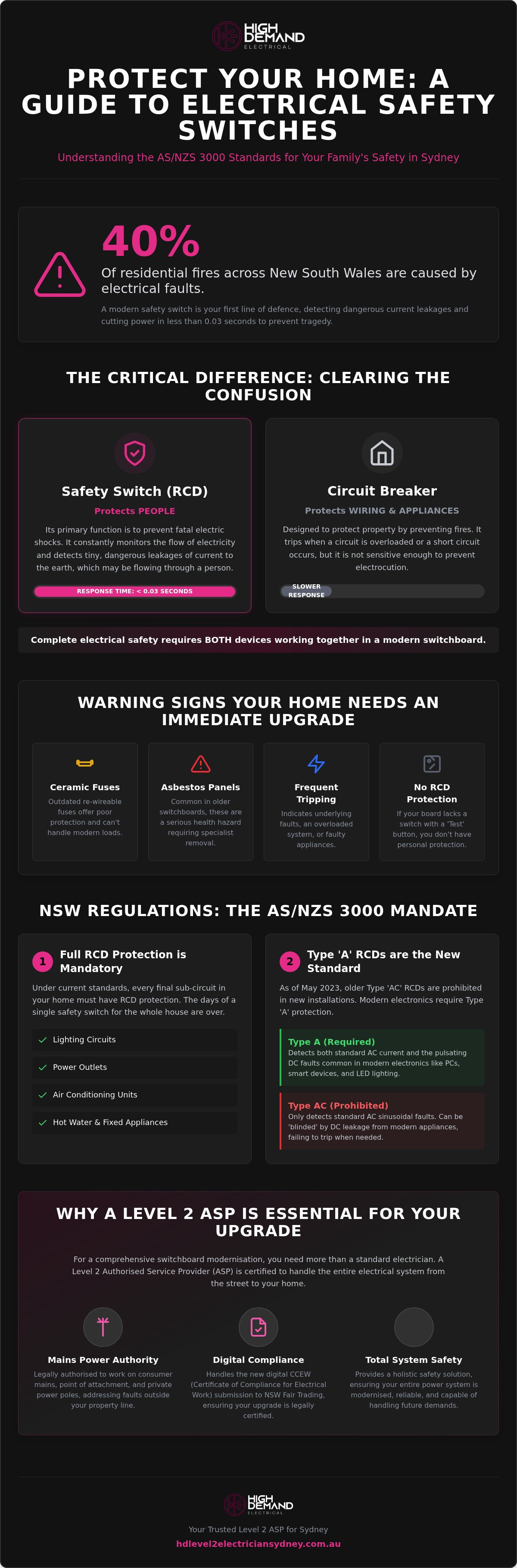
A safety switch, technically known as a Residual-current device (RCD), is a high-speed electrical safety mechanism that constantly monitors the flow of electricity through your home's wiring. If the device detects any leakage of current to the earth, it immediately isolates the power. This intervention is often the only thing standing between a minor shock and a fatal accident. Unlike a standard circuit breaker, which is designed to protect your appliances and property from fires, the RCD is engineered specifically to save human lives.
Speed is the most critical factor in this process. To prevent a fatal heart rhythm disruption, a safety switch is required to disconnect the power in less than 0.03 seconds. This rapid response happens faster than the blink of an eye, ensuring that the electrical current doesn't have enough time to cause permanent physiological damage or cardiac arrest. While "nuisance tripping" can be frustrating, it's often a sign that the device is successfully identifying a dangerous fault before it can cause harm.
The Reality of Electrical Safety in Sydney Homes
Sydney's architectural heritage creates a specific set of risks for modern homeowners. In suburbs like Balmain, Paddington, or Surry Hills, many terrace houses and older apartments still operate with legacy electrical systems. These properties often feature old ceramic re-wireable fuses that were never designed to handle the massive electrical loads of 2026. Modern lifestyles have placed unprecedented stress on these ageing systems. High-draw appliances like ducted air conditioning and Tesla chargers require a robust and modernised switchboard. Relying on outdated protection in an older Sydney home isn't just inefficient; it's a significant safety gamble. A professional safety switch installation replaces these obsolete fuses with modern RCD/MCB combinations, providing the "bones" of a safe and reliable power supply.
Safety Switch vs. Circuit Breaker: Clearing the Confusion
Many homeowners believe they're protected because they see switches in their meter box. However, confusing a circuit breaker with a safety switch is a common and dangerous misconception. Circuit breakers are designed to protect your house from burning down by cutting power when a circuit is overloaded. They do not have the sensitivity to detect the tiny leakages of current that cause human electrocution. Total home security requires both components working in tandem. While the circuit breaker guards your infrastructure, the safety switch guards your family. If you're unsure whether your current board provides comprehensive coverage, a professional safety switch installation is the only way to guarantee that every circuit in your home is fully compliant with modern safety standards.
NSW Regulations: The AS/NZS 3000 Standards for 2026
Electrical compliance isn't a suggestion; it's a legal mandate enforced by NSW Fair Trading. The AS/NZS 3000:2018, commonly referred to as the 'Wiring Rules', serves as the definitive standard for every safety switch installation in Sydney. Recent updates, specifically Amendment 2 in 2021, have significantly tightened these requirements. If your switchboard hasn't been assessed since these changes, your property likely falls short of current safety benchmarks. Failing to meet these standards doesn't just increase physical risk; it exposes you to substantial legal liabilities and potential insurance complications.
Mandatory RCD Requirements for Residential Circuits
The days of relying on a single safety switch to protect an entire house are over. Under the current standards, every final sub-circuit in a residential property must have RCD protection. This includes lighting circuits, air conditioning units, and even fixed appliances like hot water systems. This shift is driven by the reality that faults can occur anywhere in the home, not just at power outlets. Additionally, as of May 2023, Type AC RCDs are prohibited for new installations in NSW. We only install Type A RCDs, which are capable of detecting pulsating DC faults common in modern electronics and LED lighting. Ensuring your home is up to code requires a comprehensive safety switch installation strategy that addresses every circuit individually.
Selling or Renting: The Sydney Compliance Check
Electrical compliance is now a critical factor in the Sydney real estate market. If you're planning to sell, a non-compliant switchboard can stall a property deal or lead to significant price reductions during the settlement process. For landlords, the stakes are even higher. NSW residential tenancy laws require you to provide a safe environment, which includes ensuring at least one functioning safety switch is installed. However, to truly mitigate risk and protect your investment, moving toward full circuit protection is the professional recommendation. If you're ready to bring your property up to standard, you can learn how to organise a switchboard upgrade in Sydney: The Complete 2026 Homeowner’s Guide through our detailed resource.
Documentation is your final line of defence. Every completed job must be accompanied by a Certificate of Compliance Electrical Work (CCEW). From July 1, 2026, all CCEW submissions in NSW must be lodged digitally through the BCNSW eCert portal. This digital record proves your work was performed by a licensed professional and meets all Australian standards. If a contractor cannot provide this digital certification, the work isn't legally recognised. Our team handles the entire lodgement process, providing you with the necessary legal proof that your home's "brain" is safe and compliant. If you need to verify your current system's status, consult with our Level 2 ASP team for a professional audit of your infrastructure.
The Safety Switch Installation Process: What to Expect
A professional safety switch installation is a methodical procedure that requires technical precision and a deep understanding of Sydney's grid requirements. We don't simply swap out old components. We perform a systematic overhaul of your home's electrical "brain" to ensure it can handle 2026 power loads. Our approach follows a strict five-step protocol to guarantee absolute reliability.
Step 1: The Infrastructure Audit.
Our process begins with a comprehensive switchboard audit. As Level 2 ASPs, we look beyond the internal wiring to assess your consumer mains and point of attachment. This identifies unprotected circuits and reveals whether your existing infrastructure can support modern safety devices.
Step 2: Isolation and Removal.
We isolate the power supply to ensure a safe work environment. This involves the removal of obsolete ceramic fuses or standard circuit breakers that offer no protection against earth leakage.
Step 3: Installation of Modern Protection.
We install high-quality RCDs or, more commonly, RCBOs. These devices act as the frontline of your home's defence system.
Step 4: Precision Wiring and Load Balancing.
Our technicians perform precision wiring to eliminate loose connections, which are a primary cause of electrical fires. We also balance the electrical load across your phases to ensure system stability and prevent overloading.
Step 5: Diagnostic Testing.
We conclude with mandatory diagnostic testing. This verifies that every device trips within the required 0.03-second threshold. Finally, we issue a digital CCEW to certify the work meets all NSW regulations.
Upgrading to RCBOs: The Gold Standard
While a single RCD can protect multiple circuits, we recommend installing individual RCBOs (Residual Current Breaker with Overcurrent). An RCBO combines the functions of a safety switch and a circuit breaker into one compact unit. The primary benefit is fault isolation. If a faulty toaster trips the kitchen circuit, your fridge, lights, and home office remain powered. This segregation significantly reduces nuisance tripping and makes fault finding much simpler for the homeowner. It's the most robust way to manage a safety switch installation in a modern, tech-heavy household.
Testing and Certification Requirements
Installation is only half the job. We use specialised RCD testers to simulate fault conditions and measure exact trip times. This ensures your protection is active and responsive under real-world conditions. Once the installation is complete, homeowners must take an active role by pressing the 'Test' button on their units every six months. This simple action keeps the internal mechanism moving and confirms the device is still operational. To understand the investment required for this level of protection, you can view our Electrical Switchboard Upgrade Cost Sydney: 2026 Price Guide for detailed information.
Signs Your Sydney Home Needs an Immediate Safety Switch Upgrade
Is your meter box a ticking time bomb? Many homeowners overlook the very components that keep their property standing, yet the warning signs of an obsolete system are often hiding in plain sight. If you live in an older Sydney property, particularly in established areas like the Inner West or North Shore, your electrical infrastructure might be decades behind current safety standards. Ignoring these red flags doesn't just lead to inconvenient power outages; it significantly increases the risk of a catastrophic house fire.
The most glaring indicator of danger is the presence of ceramic re-wireable fuses. If you still have to manually wind copper wire around a porcelain carrier after a power surge, your home is critically unprotected. These legacy systems were designed for a different era and offer zero protection against the lethal current leakages that an RCD is built to detect. Furthermore, many of these older boards are mounted on black bituminous panels that contain asbestos. If your switchboard backing is a dark, fibrous material, it requires a professional safety switch installation and hazardous material handling to ensure your home meets modern health and safety codes.
Immediate intervention is required if you notice flickering lights or a distinct "burning" smell near your electrical cupboard. These are symptoms of arcing or overheating wires, which are the primary precursors to an electrical fire. If your power trips every time you use the toaster and the kettle simultaneously, your system is telling you it can no longer cope with the demand. Don't wait for a total system failure to act. You can book a comprehensive switchboard audit with our Level 2 ASP team to identify these hazards before they become emergencies.
Identifying Obsolete Protection
It's easy to mistake a standard circuit breaker for a safety switch. The simplest way to verify your protection is to look for a 'Test' or 'T' button on the device. If your switches lack this button, they are likely just standard breakers that only protect your wiring from overloads, not your family from electrocution. In many DIY-renovated Sydney terraces, we often find "piggybacked" circuits where too many power points have been jammed onto a single, unprotected line. This creates a massive fire risk that only a professional safety switch installation can rectify by properly segregating and protecting each individual circuit.
The Impact of Modern Appliances
The electrical load of a 2026 household is vastly different from one built twenty years ago. High-frequency electronics, ducted air conditioning, and Tesla EV chargers place immense stress on your infrastructure. Modern appliances often produce "leakage" currents that can cause older, less sensitive safety switches to trip constantly or, worse, fail to trip during a genuine fault. Moving to Type A RCDs is now a requirement because they are specifically designed to handle the pulsating DC currents generated by modern power supplies. Modernising your switchboard ensures your home's "brain" is ready for the high-capacity demands of future technology while providing the highest level of life-saving protection available.
Why Choose a Level 2 ASP for Your Switchboard Modernization?
When you invest in a professional safety switch installation, you are doing more than just adding a few components to your meter box; you are modernising the primary gateway for your home's power. Many homeowners don't realise that a standard electrician's license has strict limitations. While a general sparky can work on your internal wiring, they are legally prohibited from touching the "point of attachment" or the consumer mains that connect your property to the Sydney grid. Choosing a Level 2 Accredited Service Provider (ASP) ensures that your project doesn't grind to a halt if infrastructure issues are discovered.
This distinction becomes critical during the upgrade process. Modern RCDs are incredibly sensitive and often reveal underlying faults in your consumer mains that older fuses simply ignored. If a standard electrician identifies a defect in your incoming power lines, they must stop work and tell you to call a specialist. As Level 2 ASPs, we possess the specialised authority to rectify these issues immediately. We manage the entire lifecycle of your power supply, from the street connection to the final power point, providing a seamless solution that guarantees both compliance and continuity of service.
Beyond the Switchboard: Consumer Mains and Metering
Modernising your safety system often acts as a catalyst for broader infrastructure health. As we integrate new RCD protection, we simultaneously evaluate the capacity of your consumer mains to ensure they can handle the high-load demands of 2026. This is also the ideal time to ensure your smart meter is correctly integrated with your updated board. A safety switch installation performed without considering these external factors is only a partial solution. For a deeper understanding of how these systems interact, you can consult our Level 2 ASP Electrical Services: The Complete Guide to Sydney Power Infrastructure.
The High Demand Electrical Commitment
High Demand Electrical specialises in the complex "bones" of Sydney's power supply. We understand the unique challenges of the local landscape, from the heritage requirements of the inner suburbs to the high-capacity needs of modern commercial entities. Our approach is built on technical absolute competence and a commitment to rapid, reliable service. We don't just install switches; we fortify your home against the risks of the modern electrical world. We provide transparent communication and ensure every job is finalised with a digital CCEW for your legal protection. Your family's safety is too important to leave to a generalist. Organise your safety switch audit with High Demand Electrical today and secure your home's electrical future with Sydney's infrastructure experts.
Secure Your Sydney Home Against Electrical Hazards
Modernising your electrical system is the most effective way to eliminate the risk of electric shock and house fires. By adhering to the 2026 AS/NZS 3000 standards, you ensure every circuit in your property is actively monitored and protected. As Sydney infrastructure specialists, we understand that infrastructure upgrades often reveal complex issues within your consumer mains that only a Level 2 ASP is authorised to rectify.
Don't leave your family's safety to chance with obsolete ceramic fuses or unprotected circuits that can't handle the power demands of modern air conditioning or EV chargers. Our team provides full digital compliance certification (CCEW) for every project, giving you the legal and technical reassurance required by NSW Fair Trading. Secure your Sydney home with professional safety switch installation from High Demand Electrical and gain peace of mind knowing your electrical "brain" is built to handle the future. Taking this proactive step today protects your property and your loved ones for years to come.
Frequently Asked Questions
How many safety switches do I actually need in my Sydney home?
You need a safety switch for every individual circuit in your home to comply with the 2026 standards. While older regulations allowed for a single device, modern safety requirements mandate protection for lighting, power outlets, air conditioning, and fixed appliances. This granular approach ensures that a fault on one circuit doesn't leave your entire property in the dark or leave specific areas unprotected.
What is the average cost of installing a safety switch in Sydney?
The total investment for a safety switch installation depends on your existing switchboard's age and the number of circuits requiring protection. For older Sydney homes with ceramic fuses, a comprehensive modernisation is often necessary to house modern RCDs. We provide detailed, infrastructure-specific assessments to ensure your system meets NSW Fair Trading requirements while providing absolute protection for your family.
My safety switch keeps tripping; do I need a new installation or a repair?
Frequent tripping usually signals a genuine electrical fault or an overloaded circuit rather than a faulty switch. If your RCD activates regularly, it is successfully performing its life-saving function by detecting a leakage. A professional diagnostic test is required to determine if the issue lies with a specific appliance, ageing wiring, or the switch itself. Repairing the underlying fault is critical for system stability.
Is it a legal requirement to have safety switches on all circuits in NSW?
Yes, it is a legal requirement under the AS/NZS 3000:2018 'Wiring Rules' for all new installations and modifications in NSW. Landlords also have a specific legal obligation to ensure their rental properties are equipped with at least one functional safety switch. For full compliance and family safety in 2026, every circuit in a residential property must have individual RCD protection.
How often should I test my safety switch to ensure it’s still working?
You should test your safety switches every six months by pressing the 'Test' button on the unit. This simple action ensures the internal mechanical components are moving freely and the device can still trip within the mandatory 0.03-second window. If the switch doesn't immediately cut the power when pressed, you must organise a professional replacement immediately to maintain your home's safety.
Can I install a safety switch myself if I'm handy with tools?
No, you cannot install a safety switch yourself. In NSW, all electrical work must be performed by a licensed professional. Unauthorised electrical work is illegal, voids your home insurance, and carries a high risk of lethal electric shock. A professional safety switch installation also includes the mandatory issuance of a digital CCEW, which serves as your legal proof of compliance and safety.
What is the difference between an RCD and an RCBO?
An RCD is a standalone safety switch that protects people from electrocution. An RCBO combines this life-saving protection with a circuit breaker that protects your wiring from overloads in one unit. We recommend RCBOs for modern Sydney homes because they provide dedicated protection for each circuit. This prevents a single fault from affecting your entire property and makes fault finding much faster.
Will a safety switch installation protect me from lightning strikes?
No, a safety switch is not designed to protect your home from lightning strikes or power surges. Its sole purpose is to detect current leakages and prevent human electrocution. To protect your appliances and high-end electronics from voltage spikes caused by lightning, you require a dedicated surge protection device. This should be installed alongside your safety switch installation at the main switchboard for total protection.
Powering Your Needs with Expertise
If you’re looking for a reliable, experienced, and prompt electrician, look no further than High Demand Electrical. We cater to all your electrical needs, from routine maintenance to emergency repairs and complete system installations. Our skilled team is committed to providing professional service that ensures your electrical systems run smoothly. Whether it's a small task or a large project, give us a call today. Let us meet all your electrical demands with the quality and reliability you deserve.