Ceramic Fuse Box Upgrade Sydney: The Complete 2026 Homeowner Buying Guide
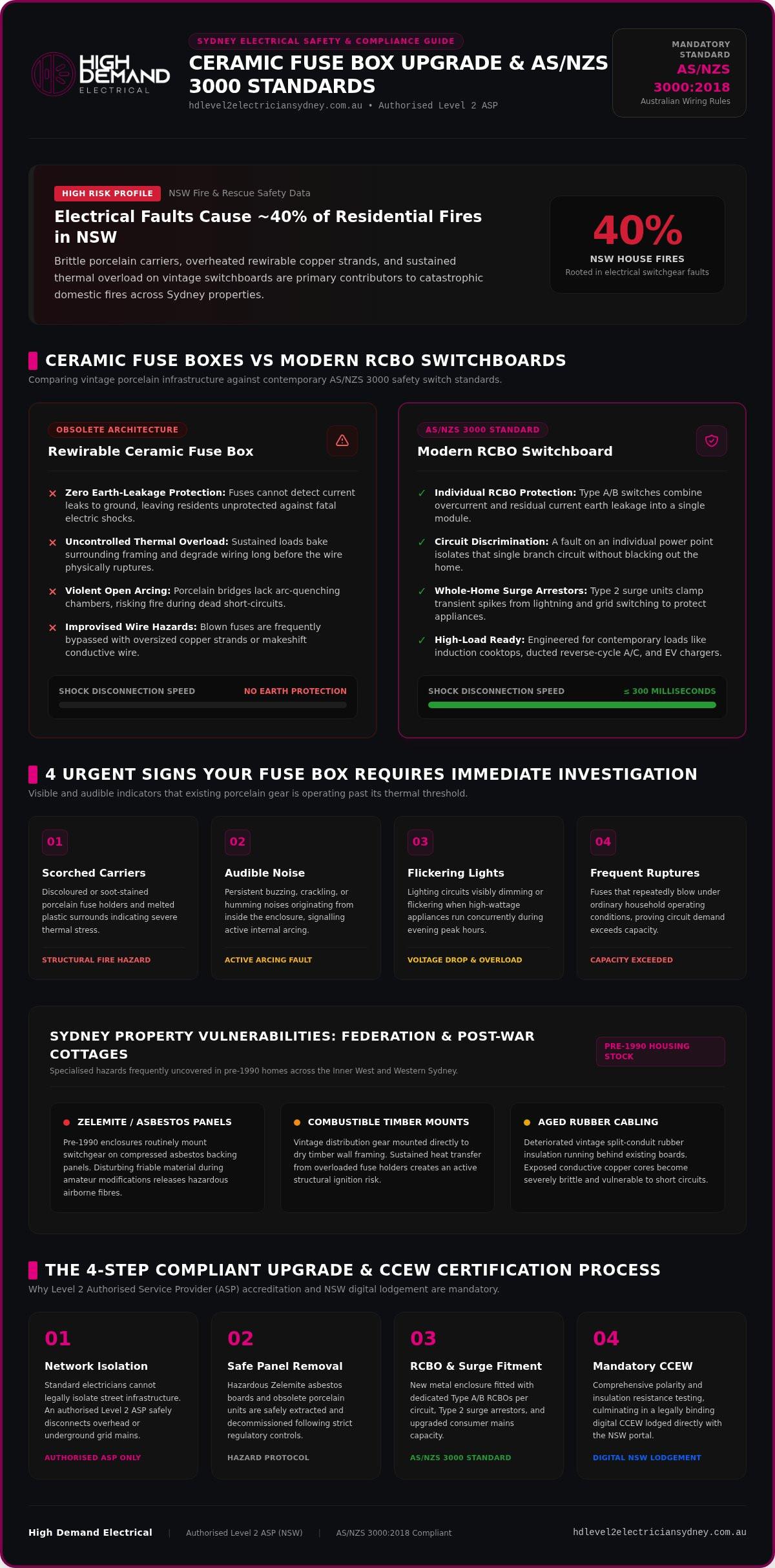
Did you know that electrical faults cause approximately 40% of residential fires across NSW each year? Brittle porcelain holders and overheated rewirable copper wire are often at the centre of that danger. If you are planning a ceramic fuse box upgrade Sydney properties urgently require, you already know that fragile mid-century switchgear cannot safely shoulder the strain of contemporary living.
You shouldn't have to endure sudden blackouts every time you run the air conditioning, nor should you have to wonder whether your switchboard contains hazardous asbestos or demands an authorised Level 2 ASP. Replacing outdated fuses eliminates fire hazards with modern RCBO safety switches, expands your electrical capacity for EV chargers, and ensures strict compliance under AS/NZS 3000 wiring rules.
This 2026 homeowner guide explains network connection protocols, safety standards, and how to secure your mandatory digital Certificate of Compliance for Electrical Work (CCEW).
Key Takeaways
• Rewirable ceramic fuses cannot detect earth leakage or prevent sustained thermal overload, creating severe electrocution and structural fire risks behind aging panels.
• Modern switchboard compliance under AS/NZS 3000 mandates individual Type A or Type B RCBO safety switches to isolate domestic faults in milliseconds without blacking out your entire home.
• Planning a ceramic fuse box upgrade Sydney households need often reveals undersized consumer mains or aged asbestos backing panels that require specialised handling.
• Standard electrical contractors cannot legally isolate overhead or underground street infrastructure, making an authorised Level 2 ASP essential for network disconnections and meter connections.
• Every compliant switchboard installation culminates in mandatory testing and a legally binding digital Certificate of Compliance for Electrical Work (CCEW) lodged via the NSW portal.
Signs and Safety Hazards of Outdated Ceramic Fuse Boxes in Sydney Properties
Rewirable ceramic fuses were designed for an era when a typical home powered a refrigerator, a wireless radio, and a handful of incandescent light bulbs. They simply cannot sustain contemporary life. Modern households run power-hungry induction cooktops, ducted reverse-cycle air conditioning, and high-wattage computing equipment concurrently. This massive electrical demand pulls continuous current through circuits never calculated to carry such loads, making a comprehensive ceramic fuse box upgrade Sydney homeowners require an urgent protective measure.
Sustained overloads push rewirable fuse wire past its thermal threshold long before the physical element ruptures. Intense resistance generates dangerous heat behind distribution panels, baking the surrounding structural framing and degrading vintage cable insulation. To understand how switchboards are safely transitioned from obsolete porcelain gear to modern protection, watch this installation walkthrough:
Warning signs demand immediate professional investigation:
• Scorched or discoloured porcelain carriers and melted plastic surrounds
• Persistent buzzing, crackling, or humming sounds originating inside the enclosure
• Flickering interior lighting circuits during peak evening appliance usage
• Fuses that repeatedly blow under standard, daily operating conditions
Critical Fire and Electrocution Risks of Rewirable Fuses
Porcelain fuse bridges cannot quench electrical arcs swiftly. When a hard short circuit occurs, these units can arc violently within their open housings. Even worse, occupants frequently replace blown elements with oversized copper strands, fencing wire, or makeshift conductive materials. This eliminates thermal overcurrent protection entirely. While modern Residual Current Devices (RCBOs) sever power within 300 milliseconds of detecting minute leakage current, ceramic fuses offer zero earth-leakage monitoring, leaving residents completely unprotected against lethal electrical shock.
Sydney Property Profiles: Federation Homes, Post-War Cottages, and Asbestos Backing
Character homes across the Inner West and Western Sydney routinely retain their original electrical enclosures. Pre-1990 properties frequently mount gear on compressed asbestos panels, often known as Zelemite, or dry, highly combustible timber backings. Disturbing friable asbestos during amateur modifications releases toxic airborne fibres, while aged split-conduit rubber cabling deteriorates behind the scenes. Property owners must engage an accredited level 2 electrician Sydney specialists recommend to safely navigate network isolations and hazardous panels. Schedule a thorough electrical safety inspection to assess panel condition before minor switchboard degradation causes an uncontrollable fire.
Modern Switchboard Standards: RCBOs, Surge Protection, and AS/NZS 3000 Compliance
Executing a compliant ceramic fuse box upgrade Sydney residences require completely restructures how household power is managed and defended. Under AS/NZS 3000:2018 (the Australian Wiring Rules), switchboards can no longer rely on primitive thermal wire or shared, split-bus protection. Modern switchgear incorporates dedicated circuit discrimination, ensuring a fault on an individual power point isolates that single branch circuit without plunging your entire property into darkness.
An RCBO disconnects power within 300 milliseconds of detecting current leakage. Alongside residual protection, updated enclosures feature whole-home Type 2 surge arrestors. These units clamp transient overvoltages caused by lightning strikes or network switching before high-voltage spikes fry sensitive domestic electronics, solar inverters, and smart home systems.
Why Modern RCBOs Outperform Outdated Ceramic Fuses
Residual Current Breakers with Overcurrent protection (RCBOs) merge three critical functions into a single DIN-rail module: short-circuit interruption, sustained thermal overload mitigation, and residual earth-leakage detection. In older switchboards, a dead short caused an exposed flash as wire vaporised inside a ceramic carrier. Replacing it meant stumbling in the dark with pliers, screws, and bare wire strands.
Modern RCBO units change everything:
• Dedicated sub-circuit isolation keeps essential illumination running if a kitchen appliance faults
• Calibrated internal sensors detect minute current leakage down to 30 milliamps
• Restoring an isolated circuit takes a simple flick of a mechanical toggle once the offending appliance is unplugged
Mandated Safety Requirements Under AS/NZS 3000 and NSW Service Rules
Every switchboard alteration in NSW must satisfy the current Service and Installation Rules of NSW (SIRNSW) and the latest revisions of AS/NZS 3000. Under Amendment 2 of the wiring standard, older Type AC RCDs are banned across NSW for new installations. Contemporary switchboards demand Type A or Type B residual protection capable of detecting both AC residual currents and pulsating DC leakage produced by modern variable-speed appliances, induction hobs, and computer power units.
Selecting compliant hardware is only half the battle; licensed switchboard technicians must balance phase loads and verify earth fault-loop impedance across the entire installation. If you are reviewing your property's safety equipment, you can learn more about certified safety switch installation methods or speak with an accredited switchboard specialist to evaluate your existing layout.
Evaluating Your Switchboard Upgrade Scope: Capacity, Mains, and Metering
Simply swapping out porcelain components for new circuit breakers without auditing upstream electrical capacity creates dangerous false security. A successful ceramic fuse box upgrade Sydney installations need involves calculating maximum demand and prospective fault currents. When you add high-draw infrastructure like electric vehicle chargers, ducted HVAC systems, or induction cooktops, your original electrical entry point rarely carries adequate current-carrying capacity.
A comprehensive switchboard evaluation reviews the complete supply chain: service lines from the street network, the physical point of attachment, meter panels, and the internal distribution layout.
Determining If Your Consumer Mains and Point of Attachment Need Renewal
Many older Sydney homes draw power through 6mm² or 10mm² copper conductors, or even brittle, rubber-sheathed aerial cables installed decades ago. Under the Service and Installation Rules of NSW (SIRNSW), altering your switchboard to accommodate increased capacity legally triggers mandatory upgrades to your consumer mains. Today's residential standards typically demand minimum 16mm² XLPE insulated conductors capable of sustaining a continuous 63-amp or higher domestic load. Technicians must also examine the Point of Attachment (POA) bracket on your fascia or private pole to verify mechanical anchorage, weatherproofing, and safe clearance over driveways. Review our detailed guide on consumer mains installation requirements before finalising your scope.
Single-Phase to Three-Phase Power Transition for High-Demand Appliances
Modern electrification quickly stretches single-phase 230V power supplies to their physical threshold. Installing a 22kW fast EV charger alongside a 16kW ducted air conditioning system will easily trip a standard 60-amp incoming service fuse during peak domestic hours. Converting your property to three-phase 400V power distributes these heavy electrical draws evenly across separate active conductors, eliminating system voltage drops and preventing nuisance tripping. Sydney homeowners modernising their infrastructure can assess whole-home capacity through a single phase to three phase upgrade to guarantee future-proof performance.
Managing Smart Meter Upgrades Alongside Switchboard Modernisation
Vintage switchboards usually feature electro-mechanical accumulation meters complete with spinning metal discs. These legacy meters cannot record time-of-use interval tariffs, nor can they handle bidirectional power flows from rooftop solar panels and residential battery storage. Upgrading an obsolete fuse board provides the compliant mounting footprint and physical enclosure clearances needed for modern digital metering equipment. Coordinating switchboard renewal alongside certified smart meter upgrades guarantees your installation integrates smoothly with network retailer requirements and digital monitoring systems.
The Step-by-Step Fuse Box Replacement Process for Sydney Homeowners
Executing an orderly ceramic fuse box upgrade Sydney homes require follows a rigid sequence of technical safety protocols. Upgrading switchgear isn't a simple swap of components; it is a controlled transition from obsolete infrastructure to an actively monitored distribution centre. Each project systematically targets hidden wiring defects, eliminates hazardous materials, and verifies that fault protection functions instantly under fault conditions.
Pre-Upgrade Assessment, Network Isolation, and Asbestos Safety Protocols
The replacement process commences with an exhaustive on-site audit. Electricians inspect existing sub-circuit cabling for brittle vulcanised Indian rubber (VIR) or deteriorating early PVC sheathing, while verifying the integrity of the main earthing conductor and earth electrode. Before anyone touches the panel, power must be cut at the street boundary. An authorised technician isolates supply at the overhead pole, pillar, or network service fuse, creating a verified zero-energy workspace.
Because pre-1990 installations regularly feature compressed asbestos-pitch mounting panels (commonly known as Zelemite), technicians enforce strict WorkSafe NSW containment protocols:
• Application of chemical suppression agents to prevent hazardous friable dust from becoming airborne
• Careful extraction of intact panels without mechanical cutting, grinding, or drilling
• Sealing hazardous components within heavy-duty, 200-micron polythene disposal bags for transport to certified waste facilities
Installation, Testing, and Securing Your Certificate of Compliance (CCEW)
With old materials removed, technicians mount a modern flame-retardant DIN-rail enclosure. Incoming consumer mains, active links, neutral bars, and individual Type A RCBO modules are routed, cleanly terminated, and torqued to manufacturer specifications. Before re-energising the property, the installation undergoes mandatory testing mandated by AS/NZS 3000, including insulation resistance (megger testing), polarity validation, and fault-loop impedance measurements to confirm safety switches trip within specified millisecond tolerances.
Once supply is restored and operational stability is confirmed, the licensed technician lodges an official digital Certificate of Compliance for Electrical Work (CCEW) through the Building Commission NSW eCert portal. This document serves as your legal guarantee of compliance, satisfying network distributors, local councils, and building insurers. Ready to modernise your property's electrical infrastructure? Contact High Demand Electrical today to organise your complete switchboard upgrade.
Selecting an Authorised Level 2 ASP for Your Sydney Fuse Box Modernisation
Hiring a tradesperson for a switchboard project requires understanding a strict regulatory distinction. Standard electrical contractors cannot legally disconnect or reconnect service mains directly from street distribution networks. When planning a comprehensive ceramic fuse box upgrade Sydney properties need, your project routinely demands network-level intervention. Attempting to modify upstream supply connections without formal network accreditation breaches NSW electrical safety laws.
The legal boundary between private property and the local electricity grid lies right at your switchboard enclosure. Authorised Service Providers bridge this gap, ensuring that power disconnection, metering alterations, and sub-circuit cutovers proceed without dangerous delays or utility disputes.
Why Network Authorisation (Ausgrid and Endeavour Energy) Is Essential
Modernising outdated switchgear regularly requires breaking distribution network seals, servicing live incoming overhead lines, or pulling new consumer cables into underground pillars. An unaccredited electrician must schedule a physical disconnection appointment with Ausgrid or Endeavour Energy, wait for network field crews, and reschedule another visit days later to reconnect power. In contrast, an authorised Level 2 ASP manages the complete disconnection and immediate reconnection sequence on the day of installation. Property owners across the Inner West, Western Sydney, South West, and Sutherland Shire can consult our team for compliant switchboard upgrades executed without third-party network bottlenecks.
Verifying Trade Licences, Triple ISO Accreditations, and Local Compliance
Never permit an unverified tradesperson to handle your home's main distribution equipment. Legitimate providers will transparently supply their licensing credentials, which you can easily cross-reference through the NSW Fair Trading public register.
Verify that your chosen contractor maintains verified credentials:
• Electrical Contractor Licence details, such as EC Licence 397193C and ABN 87 051 836 527
• Direct ASP authorisation across Ausgrid, Endeavour Energy, and Essential Energy distribution zones
• Certified management systems covering ISO 9001 (Quality), ISO 45001 (Health & Safety), and ISO 14001 (Environment)
• Full compliance with AS/NZS 3000 wiring standards and the Service and Installation Rules of NSW (SIRNSW)
Engnet Pty Ltd, trading as High Demand Electrical (HDE), combines Level 2 ASP network authority with triple ISO safety systems. Take the first step toward securing your home's electrical core: contact High Demand Electrical directly or phone 0402 559 777 to discuss your project specifications.
Secure Your Home With a Modern Switchboard Upgrade
Retaining obsolete porcelain fuses leaves your household exposed to continuous thermal stresses and unmonitored earth leakage. Transitioning to modern DIN-rail switchgear fitted with individual Type A RCBOs resolves those vulnerabilities, bringing your property into direct alignment with AS/NZS 3000 rules while expanding electrical headroom for high-draw appliances.
Because network connections, consumer mains, and meter isolations require direct grid coordination, engaging an authorised technician guarantees safe, seamless execution. High Demand Electrical operates as a Level 2 Accredited Service Provider authorised across Ausgrid, Endeavour Energy, and Essential Energy networks. Holding EC Licence 397193C, ABN 87 051 836 527, and Triple ISO certification across Quality (ISO 9001), Health & Safety (ISO 45001), and Environmental Management (ISO 14001), our team delivers verified technical compliance from start to finish.
Don't wait for deteriorated wiring or overloaded circuits to compromise your household. When you are ready to book the ceramic fuse box upgrade Sydney properties rely on for long-term safety, speak with an accredited Level 2 ASP at High Demand Electrical to protect your investment.
Frequently Asked Questions
Can I replace a blown ceramic fuse wire with a higher amp rating myself?
No, you shouldn't install oversized fuse wire or attempt DIY electrical repairs under any circumstances. Up-rating fuse wire stops the circuit from breaking safely during an electrical overload, forcing excessive heat into hidden wall wiring instead. In NSW, undertaking unlicensed electrical work is illegal. Repeated blown fuses indicate dangerous circuit overloading or appliance earth faults that demand immediate investigation by a licensed technician.
How long does a full ceramic fuse box upgrade take to complete?
A standard residential switchboard replacement typically takes between four and eight hours of focused on-site work. Duration varies if your property requires asbestos panel remediation, consumer mains upgrades, or metering repositioning. Scheduling a ceramic fuse box upgrade Sydney homeowners rely on allows an authorised technician to isolate network power, mount the enclosure, install individual RCBOs, complete mandatory safety testing, and restore supply within a single day.
Will my home power be disconnected during the switchboard replacement process?
Yes, your electrical supply must be completely disconnected while technicians remove obsolete gear and mount the new distribution enclosure. Total de-energisation is mandatory under NSW workplace safety rules to protect electricians working around main incoming feeds. Authorised Level 2 ASP contractors isolate power directly at the street network or service fuse, keeping the outage restricted strictly to the installation and testing window.
Why do I need an ASP Level 2 electrician instead of a regular electrician?
Standard electrical contractors work on internal building circuits, but only Level 2 Accredited Service Providers (ASPs) can legally alter network infrastructure. Level 2 ASP technicians hold specialised training and direct network authority to isolate street power, break distributor security seals, and upgrade consumer mains cables across Ausgrid and Endeavour Energy boundaries. Engaging a Level 2 ASP avoids costly third-party network call-out fees and scheduling delays.
What is an Electrical Certificate of Compliance (CCEW) and why is it mandatory?
A Certificate of Compliance for Electrical Work (CCEW) is an official legal declaration confirming your installation adheres to AS/NZS 3000 Wiring Rules and NSW regulations. In NSW, licensed electrical contractors must submit the CCEW digitally through the Building Commission NSW eCert platform within statutory deadlines. The certificate provides proof of compliance for building insurers, local councils, and network distribution authorities.
Does my older Sydney home have an asbestos switchboard panel?
If your home was constructed or renovated prior to 1990, your fuse box likely sits on a compressed asbestos backing panel such as Zelemite or Lebah. These dense, pitch-based panels pose severe health hazards if sawn, drilled, or broken. Modernising an older board requires trained technicians to employ dust suppression agents, remove the panel intact, and seal it for certified hazardous waste disposal.
Can an upgraded switchboard handle future solar panels and EV charger installations?
Yes, completing a modern ceramic fuse box upgrade Sydney properties need creates the physical DIN-rail space and amperage capacity required for ongoing household electrification. Modern enclosures feature dedicated capacity for bi-directional solar connections, residential battery storage systems, and high-draw electric vehicle charging circuits. Your technician calculates prospective maximum demand to guarantee your incoming mains support sustained electrical current without nuisance tripping.
Powering Your Needs with Expertise
If you’re looking for a reliable, experienced, and prompt electrician, look no further than High Demand Electrical. We cater to all your electrical needs, from routine maintenance to emergency repairs and complete system installations. Our skilled team is committed to providing professional service that ensures your electrical systems run smoothly. Whether it's a small task or a large project, give us a call today. Let us meet all your electrical demands with the quality and reliability you deserve.