Builders Temporary Power in NSW: Steps, Rules and Timing
In NSW, builders get temporary power through a temporary builders supply (TBS): a metered connection to the electricity network, usually on a dedicated pole or board, installed by an accredited Level 2 electrician before the building exists. The connection needs the distributor’s approval, so the application is the step that decides your start date. We install these as a certified Level 2 contractor in Sydney, and our temporary builders supply service covers the connection from the first inspection to energisation.
This guide explains what a TBS is, when a site needs one, the steps from application to disconnection, the safety rules that apply on site, and how to avoid the delays that push projects onto generators.
TL;DR
- A temporary builders supply is a metered network connection for a construction site. Only an Accredited Service Provider (ASP), meaning a Level 2 electrician authorised by the local distributor, can connect it.
- Your distributor depends on the address: Ausgrid, Endeavour Energy or Essential Energy. Each has its own connection process under one set of NSW rules.
- Apply early. Plan on at least four weeks before site works start, and do not commit to materials or works before you hold written approval.
- Construction wiring must be inspected and tested by a licensed electrician before it is energised, then re-inspected at least every six months.
- A generator is a lawful alternative, but weekly hire costs add up quickly when a late application forces it.
Table of Contents
- What builders temporary power is and when a site needs it
- The steps from application to disconnection
- How long it takes and what it costs
- Safety and compliance on a construction site
- Planning checklist for builders and owner-builders
- Get your temporary supply connected
- FAQ
- Sources
What builders temporary power is and when a site needs it
A TBS is a real network connection, not an extension lead from next door. It has its own meter, its own main switch and safety switches (residual current devices, or RCDs, which cut power in milliseconds when they detect a leak to earth), and its own account with an electricity retailer. It supplies tools, lighting, site sheds and amenities while the permanent building is still being built.
A site needs one when it needs steady power for the length of a build. That usually means:
- a new house or duplex on a vacant block or after demolition
- a townhouse or small apartment development
- a major renovation where the existing supply is disconnected or cannot carry site loads
- a commercial or industrial fitout or build with heavy plant
The NSW Government explains that NSW has three distributors, Ausgrid, Endeavour Energy and Essential Energy, each with its own connection policy. It also says an ASP is the person authorised by the local distributor to connect, disconnect or change the power supply, including providing a temporary builder’s supply. In Sydney, the address decides whether your application goes to Ausgrid or Endeavour Energy.
Is a TBS the only lawful option?
No. SafeWork NSW lists the permitted sources for construction wiring: the distributor’s main, an existing switchboard in the permanent installation, a compliant low voltage generator or a compliant inverter. Running off an existing switchboard works on some renovations. On a bare block or a demolition site, a metered TBS is the practical choice for a build of any length.
The steps from application to disconnection
The details differ between distributors, but the sequence is the same across the state. The wording below follows the NSW rules and Endeavour Energy’s published process; Ausgrid and Essential Energy publish their own versions of each step.
Step 1: Confirm your distributor and your load
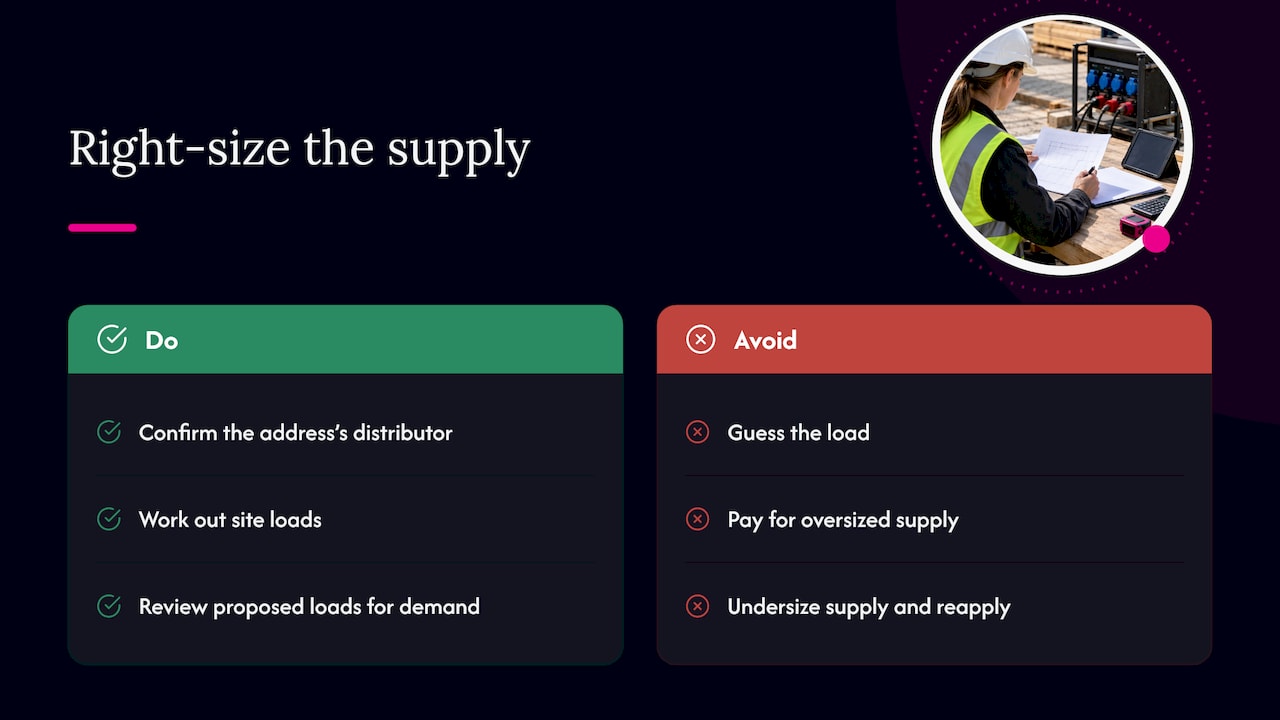
Work out the address’s distributor and what you will run on site: saws, compressors, a concrete mixer, a site office with air conditioning. The size and type of load drives the supply size and the cost. The NSW Service and Installation Rules note that charges may be minimised by a demand management review of the proposed loads, so an oversized supply is money wasted.
Where it goes wrong: guessing the load, then paying for a supply that is too big, or finding mid-build that it is too small and applying again.
Step 2: Engage a Level 2 ASP before you commit to anything
The same rules advise customers not to make commitments or payments for designs, materials or works until the distributor has given written approval. That includes buying a pole or board from a supplier first.
Where it goes wrong: a builder buys a board or pole on the assumption it will be accepted, and the distributor requires something different at your site.
We start with a free site inspection for Level 2 work, so you know what the site needs before the application goes in.
Step 3: Lodge the application and get permission to connect
For a new connection, Endeavour Energy’s guide describes obtaining a National Metering Identifier (NMI, the unique number for the supply point), then a Permission to Connect (PTC) letter from the distributor. Both are steps in its new-connection process. The NSW rules also say an installation must not be energised unless the distributor has permitted the connection.
Where it goes wrong: incomplete forms and wrong load details send the application back, and every round trip costs days.
Step 4: Service works and energisation by the right accreditation
Endeavour Energy’s guide specifies three classes of ASP work: Class 2B for underground service works, Class 2C for overhead service works, and Class 2D to energise the new installation. One provider can hold all three. We offer consumer mains, overhead and underground service mains installation, and private power pole installation, so the pole, service line and connection do not need to be split across several trades.
Step 5: Metering and retailer
The site needs a meter and an energy retailer. One retailer’s NSW meter form states the site is ready when the supply line is connected, permission to connect is complete and there is clear access to the meter board. That retailer says it arranges installation within six business days of being told the connection service is complete. Timing and fees differ by retailer, so confirm yours when you choose it. Endeavour Energy’s guide says the completion paperwork must be submitted within two business days of the work finishing for the NMI to be activated.
We provide metering services, so this step sits with the same team as the connection.
Step 6: Safety and compliance test, then certificate
Before commissioning, a person authorised to do electrical wiring work without supervision must carry out a safety and compliance test. The NSW rules say the result must be notified no later than 7 days after the test.
Step 7: Permanent supply and disconnection
When the building is complete, the temporary supply is replaced by the permanent connection. Plan this early: if the permanent switchboard and meter are ready when the building is, the handover is a short job rather than a stall before occupancy. Ask us about this at the start so the TBS is positioned where it will not be in the way of the permanent service.
How long it takes and what it costs
Timing is the real cost of a TBS. One engineering firm’s 2026 design memo advises applying at least four weeks before site works begin and allowing 10 business days for distributor processing. Treat it as a critical-path item, like a council approval.
The same memo says generator hire as a fallback typically runs $500 to $2,000 per week for medium sites. A three-week delay on a mid-sized site can therefore cost more than the connection itself, before fuel and noise.
A worked example: a builder starts earthworks on a duplex in week 1 but lodges the TBS application in week 1 too. With about 10 business days for processing plus installation and metering, the site runs on hired generators for the first few weeks. At the memo’s range, three weeks of generator hire is $1,500 to $6,000. Lodging four weeks ahead removes that line from the budget.
We do not publish fixed prices for temporary supplies because the cost depends on the distributor, the supply size and the site. A site inspection gives you the actual figures. If you want to compare quotes line by line, a simple electrical quote template helps you set mains supply and generator hire side by side.

Safety and compliance on a construction site
The connection is only half of it. Once power is on, the site’s electrical installation has its own rules. SafeWork NSW’s fact sheet sets them out under AS/NZS 3012:2019, the standard for electrical installations on construction and demolition sites. It is called up by the WHS Regulation.
| Requirement | What it means on site |
|---|---|
| Inspection before energising | Construction wiring, switchboards and transportable structures are inspected and tested by a licensed electrician before they are energised |
| Six-monthly re-inspection | A visual re-inspection at least every six months |
| Three-monthly testing | Portable RCDs, extension leads and other electrical equipment tested at intervals not exceeding three months |
| RCD protection | Final sub-circuits need type A RCD protection with a maximum rated residual current of 30 mA |
The fact sheet also notes that WHS inspectors can act on non-compliant equipment. The CCC memo adds that on-the-spot fines are possible and a serious breach can shut a site down. A compliant board built correctly the first time is cheaper than a stop-work notice.
Installation work must also comply with AS/NZS 3000, the Wiring Rules, under the Gas and Electricity (Consumer Safety) Regulation 2018, as the NSW rules explain. The standard itself, AS/NZS 3012:2019, is listed as current.
If your site has an existing permanent installation that will stay in use, RCD requirements matter there too. See our note on NSW RCD requirements. For a broader view of rules on temporary supplies, our temporary power safety guide covers the day-to-day points.
What changed recently
The NSW Government states that the Electricity Supply (Safety and Network Management) Regulation 2026 commenced on 21 August, with one provision starting on 1 July 2027, and the Electricity Supply (General) Regulation 2026 on 1 September 2026. The current industry code is the Service and Installation Rules, updated April 2026, which brings the distributors’ connection requirements into one document. Your electrician works from the current version, so you do not have to track the changes yourself.
Planning checklist for builders and owner-builders
- Four to six weeks before site works: confirm the distributor, list your site loads and book a site inspection.
- Before buying anything: wait for written approval from the distributor.
- Before the first power tool: have the installation inspected and tested by a licensed electrician.
- During the build: keep a log of three-monthly tests on portable RCDs and leads, and six-monthly visual inspections of the wiring.
- Before completion: book the permanent supply works so the temporary board is not holding up the handover.
If the permanent house will need more than a single-phase supply, for example for a large workshop, ducted air conditioning or an EV charger, raise it now. The NSW rules state that where the existing distribution system is single phase, three-phase loads require extension and possible augmentation of the network, including a transformer upgrade, with the customer applying to the distributor. That adds lead time, so it is far better to start it while the build is still in the ground. Our single phase to three phase upgrade page explains how we handle it.
Our view: treat the supply as part of the programme
Most delays we hear about on builders’ power come from the same place: the application goes in after the job has already started. The connection is not hard work, but it depends on a distributor’s approval, and that approval has a lead time you cannot shorten once the excavator is on site.
Our advice is to bring a Level 2 electrician in at the design stage. A free site inspection lets us look at the pole position, the cable route, the loads and the permanent supply together, so you apply once and apply correctly. Because we hold Level 2 ASP accreditation, the service works, connection, metering and certification are handled by one team. We are available 24/7 if power fails on a live site, and we are triple ISO certified.
Builders get what they need when the electrical side is booked with the same care as the concrete pour: early, in writing and with a single point of contact.
Christopher
Get your temporary supply connected
We are a certified Level 2 electrical contractor serving Sydney’s residential, commercial and strata sites. For builders that means a free site inspection for Level 2 work, accredited electricians for the connection, private power pole installation, metering and a 10-minute callback guarantee when you contact us. We hold over 300 five-star reviews. Seniors building or renovating can ask about our discounts for seniors.

Start with our Level 2 electrician page or the temporary builders supply service to book your inspection. If you want the pricing picture first, our 2026 temporary power buying guide walks through what drives the cost.
FAQ
How long does it take to get temporary power connected in NSW?
Plan on at least four weeks from application to a working supply, with around 10 business days of that being distributor processing, according to one engineering design memo. The real time depends on your distributor, your supply size and whether any network works are needed. Lodge as early as the design allows.
Who can connect a temporary builders supply?
Only an Accredited Service Provider, a Level 2 electrician authorised by the local distributor, can connect, disconnect or change the supply. Endeavour Energy’s guide splits the work into Class 2B (underground), 2C (overhead) and 2D (energising) accreditations. Our team is a certified Level 2 contractor, so the whole connection stays with us.
Do I need an electrician to test the site wiring after it is connected?
Yes. SafeWork NSW requires construction wiring, switchboards and transportable structures to be inspected and tested by a licensed electrician before energisation. They must be visually re-inspected at least every six months. Portable RCDs and leads need testing at intervals not exceeding three months.
Can I use a generator instead of a temporary supply?
Yes, a compliant low voltage generator is one of the permitted sources, and it can bridge a gap while the application is processed. For longer builds, a metered supply avoids weekly hire costs. We also install generators if you need a permanent backup supply on the finished property.
Sources
- Installing or altering electricity supply to your property, NSW Government
- NSW Standard Electricity Service and Installation Rules, June 2025
- Service and installation rules, NSW Climate and Energy
- Endeavour Energy Retailer and Market Guide, v29
- Electrical practices on construction and demolition sites, SafeWork NSW
- AS/NZS 3012:2019, Standards Australia Store
- Electricity Supply Regulations 2026, NSW Government
- Application to install an electricity meter, NSW
- Temporary Power and Services During Construction, design memo
- Free electrical quote template
Recommended
Need Help Fast?
Powering Your Needs with Expertise
If you’re looking for a reliable, experienced, and prompt electrician, look no further than High Demand Electrical. We cater to all your electrical needs, from routine maintenance to emergency repairs and complete system installations. Our skilled team is committed to providing professional service that ensures your electrical systems run smoothly. Whether it's a small task or a large project, give us a call today. Let us meet all your electrical demands with the quality and reliability you deserve.

Licensed Level 2 ASP electricians across Sydney. Same-day service and 24/7 emergency response.
Licence 397193C
ABN 87 051 836 527
