Benefits of 3-Phase Power for Your Home Workshop
Could three-phase power make your home workshop more capable, or would it be an upgrade you rarely use? The benefits of 3-phase power for home workshop equipment depend on what you plan to run. Some tools suit a standard single-phase supply, while others may require three-phase power.
If your equipment struggles when several high-demand loads are in use, it’s reasonable to ask whether your existing supply is the limit. But a three-phase connection isn’t automatically the right answer. The equipment’s stated requirements, your switchboard and consumer mains, and the supply available at your property all need to be considered.
This guide explains when three-phase power may be relevant, how to check your machines’ requirements, and what to gather before seeking an assessment. It also covers considerations for a Sydney property. High Demand Electrical offers single-phase to three-phase power upgrades and switchboard upgrades. Phone 0402 559 777; Email chris@highdemandelectrical.com.au.
Key Takeaways
• The benefits of 3-phase power for home workshop use depend on whether your equipment’s stated supply requirements justify a change.
• Compare your current supply with your tools’ requirements, which machines you may use at the same time, and your future workshop plans.
• Before seeking an assessment, record your equipment details and note what you know about the property’s existing supply.
• An assessment can establish whether the switchboard or consumer mains need attention. Don’t assume an upgrade is necessary.
• High Demand Electrical offers single-phase to three-phase power upgrades and switchboard upgrades. Phone 0402 559 777; Email chris@highdemandelectrical.com.au.
What 3-phase power can change in a home workshop
Would a different electricity supply help you do the work your home workshop is set up for? It might, but the answer depends on the equipment you want to use and the supply available at your property. The benefits of 3-phase power for home workshop use vary from one setup to another. Start with the machines’ documented requirements, rather than assuming an upgrade will solve a problem.
How three-phase supply differs from single-phase
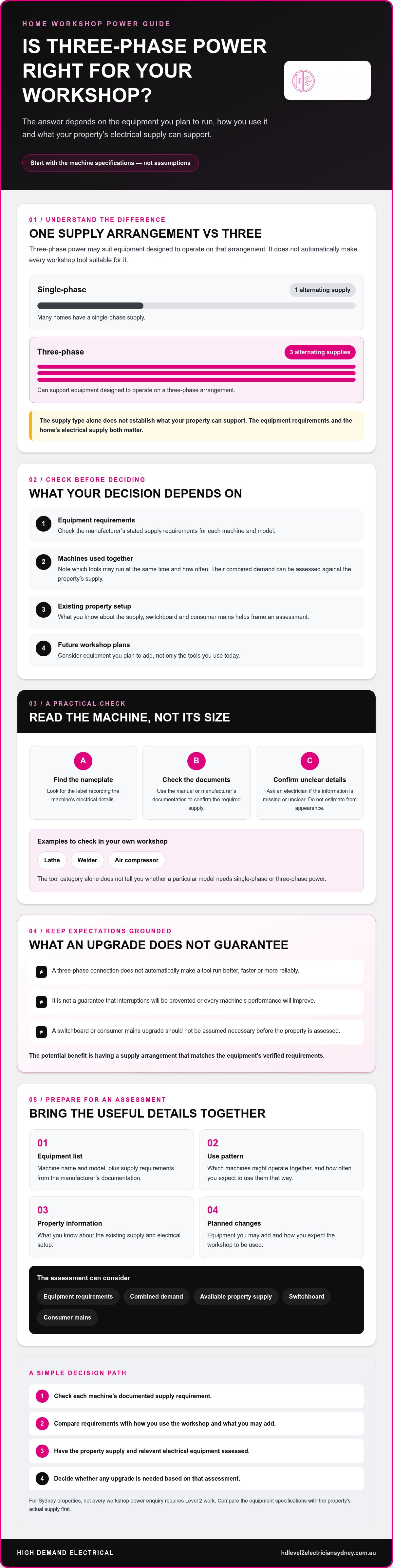
Many homes have a single-phase supply, which delivers electricity through one alternating supply. Three-phase power uses three alternating supplies and can support equipment designed to operate on that arrangement. For a plain-language overview, see Three-phase electric power.
This doesn’t mean every appliance can use either supply, or that changing the property supply makes every workshop tool suitable. Check the manufacturer’s specifications for each machine, including its stated supply requirements. If the information isn’t clear, ask an electrician to assess the equipment and your property before making plans.
Which workshop activities may prompt an upgrade enquiry?
You may want to investigate your supply if a machine’s specifications call for three-phase power, or if you plan to add equipment with requirements your current setup may not meet. The key question isn’t whether a tool looks large or powerful. It’s what the manufacturer specifies for that particular model.
Also consider how you work. If you expect to operate several machines at once, record which ones might run together and ask an electrician to assess their combined demand against the property’s supply. This is a planning step, not a guarantee that three-phase power will prevent interruptions or improve every machine’s performance.
Before seeking advice, make an equipment list. Include each machine’s name and model, its supply requirements from the manufacturer’s documentation, and whether you intend to use it alongside other equipment. A lathe, welder or air compressor may be useful examples to check in your own workshop, but the category alone doesn’t tell you what supply a particular model needs.
Your existing supply and future workshop plans matter as well. Note what you know about the property’s electrical setup, then have an electrician assess whether it can support the proposed equipment. A switchboard or consumer mains assessment may form part of that review, but don’t assume either needs upgrading before the property has been checked.
For Sydney homeowners, an assessment can help clarify the next step. Find details about a Sydney Level 2 electrician, but bear in mind that not every workshop power enquiry requires Level 2 work. First, compare the equipment specifications with the property’s actual supply.
How three-phase power may support workshop equipment
Three-phase power may suit a workshop when one or more machines are designed to use it. However, the supply type alone doesn’t establish what your property can support. The decision depends on both the equipment requirements and the capacity of the home’s electrical supply. Treat any expected change in operation as something to verify, not a guaranteed result of an upgrade.
Check each tool’s stated supply requirements
The equipment nameplate and manufacturer instructions are the starting point for checking supply requirements. A nameplate is the label attached to a machine that records its electrical details. Find it on each tool, note the make and model, and check the manual or manufacturer’s documentation for the required supply. If the information is missing or unclear, ask an electrician to help confirm it rather than estimating from the tool’s size or appearance.
A saw, compressor or welder may be part of your workshop, but the category doesn’t tell you whether a particular model needs single-phase or three-phase power. Nor does a three-phase connection automatically make a tool run better, faster or more reliably. Only expect a performance benefit where the manufacturer’s instructions support that claim. The potential benefit is having a supply arrangement that matches the equipment’s verified requirements.
Consider how the workshop will be used
List the machines you expect to use together, not just every tool you own. Using one machine occasionally presents a different pattern of demand from routinely operating several machines during the same work session. Note which tools might run at the same time and how often. An electrician can assess this expected use alongside the property’s existing supply.
This helps distinguish a genuine supply constraint from an assumption. If a tool’s documentation specifies a supply your home doesn’t currently have, that’s a reason to seek advice, not proof that a whole-property upgrade is automatically necessary. The property’s supply and electrical installation still need to be assessed. The benefits of 3-phase power for home workshop use depend on the match between documented equipment needs and what the home can safely support.
Keep the manufacturer’s instructions and equipment nameplates accessible for an assessment. If the label and manual don’t provide a clear answer, record the model details and ask the electrician what further information is needed. This keeps the discussion focused on your actual machines instead of general assumptions about tool types.
If you’re unsure how your planned workshop loads relate to your current supply, you can contact High Demand Electrical to discuss an assessment.
Single-phase or three-phase: decide what your workshop actually needs
Three-phase power isn’t automatically necessary for every home workshop. A single-phase supply may be suitable if it matches the documented requirements of your equipment and an electrician confirms the property can support your intended use. The benefits of 3-phase power for home workshop equipment matter when they address a verified need, not simply because the workshop contains large or specialised tools.
Use these questions to organise the decision. Your answers will help an electrician assess the setup, but they don’t replace a property-specific assessment.
| What to assess | Questions to ask |
|---|---|
| Current supply | What supply does the property have now? What can you confirm about the existing electrical setup? |
| Equipment requirements | What supply does each machine’s nameplate or manufacturer documentation specify? |
| Simultaneous use | Which tools might operate together during a typical work session? |
| Future plans | Are you planning to add equipment or change how the workshop is used? |
When existing supply may be adequate
If your tools’ documented requirements appear to match the supply you have, that’s useful information. It doesn’t confirm the installation can support the workshop’s actual use, though. Avoid deciding from a tool’s size, age or type alone. Prepare an equipment list with each machine’s make and model, supply details and likely use. An electrician can assess that information against the property.
When to investigate a three-phase upgrade
Ask an electrician to assess the setup if a machine’s documentation specifies a supply you don’t currently have, or if you plan to operate several tools together and aren’t sure the existing supply can support that use. A three-phase upgrade is an option to investigate, not a recommendation that can be made from the equipment list alone. The property’s supply and installation also need to be considered.
High Demand Electrical offers single-phase to three-phase power upgrades. Read about a single-phase to three-phase upgrade, then use an electrician’s assessment to establish whether it suits your equipment and property. A clear list of your tools, their manufacturer requirements, likely simultaneous use and future plans gives that assessment a practical starting point.
What to check before upgrading workshop power in Sydney
Before arranging a change to your workshop supply, gather clear information about the equipment and property. This helps an electrician assess whether the existing setup suits your plans and whether any work is needed. The benefits of 3-phase power for home workshop use depend on that assessment, not on the assumption that a different supply is always better.
Gather information for an electrical assessment
Work through these steps before requesting an assessment:
Document your tools.
Record each machine’s name, make and model. Note which tools you may operate at the same time and how you expect to use the workshop.
Check the specifications.
Consult the manufacturer’s instructions and equipment nameplates for each machine’s stated supply requirements. If details are missing or unclear, flag this rather than guessing.
Note the existing supply.
Write down what you know about the property’s current supply and switchboard. Only note details that are safely visible. Don’t remove covers or open the switchboard.
Request an assessment.
Give the electrician your equipment list, specifications and workshop plans. The electrician can determine what further inspection is needed and whether electrical work should be considered.
A clear list is more useful than a broad description such as “large tools”. It gives the electrician a practical basis for comparing your machines’ requirements with the property and your intended workflow. You don’t need to diagnose the electrical installation yourself.
Check supply and switchboard considerations
The switchboard and consumer mains, which form parts of the property’s electrical supply, may need to be assessed as part of the review. Their condition and suitability can’t be confirmed from a tool list alone. An assessment may find that the existing components are suitable or identify a need for further investigation. Don’t assume a switchboard or consumer mains upgrade is required before the property is checked.
For electrical work in NSW, the applicable requirements must be verified for the specific property and proposed work. AS/NZS 3000 and the Service and Installation Rules of NSW (SIRNSW) are relevant frameworks to check. This doesn’t mean every provision applies to every workshop enquiry. The electrician can establish which requirements apply. Any network-related steps also depend on the property’s location and distributor, so don’t assume which distributor serves your address.
If an assessment identifies a need to change the switchboard, see the information on switchboard upgrades. To discuss your workshop equipment and request an assessment from High Demand Electrical, call 0402 559 777 or email chris@highdemandelectrical.com.au.
Plan a home workshop power upgrade with a Sydney electrician
A sound upgrade decision brings together the equipment’s supply requirements, the existing electrical setup at your property, and how you plan to use the workshop. A machine’s specifications may point to a particular supply, but they don’t confirm what the property can support or what work is needed. An assessment helps establish whether an upgrade is appropriate and what the project involves.
What HDE can assess and upgrade
High Demand Electrical (HDE) offers single-phase to three-phase power upgrades and switchboard upgrades. The work required depends on the property’s condition, the proposed workshop loads and the project scope. A switchboard upgrade may be relevant if an assessment identifies a need, but it shouldn’t be assumed in advance.
For local service context, see the Sydney Level 2 electrician page. Where work involves service line, metering or connection work, HDE’s accreditation is Level 2 Accredited Service Provider (ASP), authorised to carry out service line, metering and connection work for Ausgrid, Endeavour Energy and Essential Energy. This describes the stated scope of that accreditation. It doesn’t mean every workshop upgrade requires Level 2 work.
Prepare for the next conversation
Before discussing the project, gather your equipment list, the manufacturer’s supply requirements for each machine, and a note of which tools you may operate together. Include any plans to add equipment or change the workshop layout. These details help the electrician understand your intended use and assess it alongside the property’s supply. Don’t open the switchboard or try to determine its condition yourself.
HDE holds EC Licence 397193C and Triple ISO certification: ISO 9001 (Quality Management), ISO 45001 (Health and Safety) and ISO 14001 (Environmental Management). These credentials provide relevant business context, while the assessment remains specific to your property and proposed work. The benefits of 3-phase power for home workshop use depend on the match between equipment, supply and plans, so don’t commit to an upgrade based on assumptions about what a tool needs.
To discuss your Sydney property and proposed workshop loads, contact High Demand Electrical. Share your equipment list and manufacturer documentation, then ask what assessment is appropriate. The specific upgrade, result, timeframe and price depend on the property and project assessment.
Phone 0402 559 777; Email chris@highdemandelectrical.com.au.
Make your next workshop power decision with confidence
The benefits of 3-phase power for home workshop use depend on whether your equipment’s documented requirements and your workshop plans call for it. Check the manufacturer’s specifications, list which machines you may use together, and have an electrician assess your existing property supply before deciding whether an upgrade is appropriate.
High Demand Electrical offers single-phase to three-phase power upgrades and switchboard upgrades. Its credentials include EC Licence 397193C and Triple ISO certification: ISO 9001 (Quality Management), ISO 45001 (Health and Safety) and ISO 14001 (Environmental Management). Its accreditation is Level 2 Accredited Service Provider (ASP), authorised to carry out service line, metering and connection work for Ausgrid, Endeavour Energy and Essential Energy.
Ready to discuss your Sydney workshop and property? Contact High Demand Electrical to discuss your workshop power needs. Have your equipment list and manufacturer information ready to help guide the conversation.
Phone 0402 559 777; Email chris@highdemandelectrical.com.au. Start by discussing your equipment and the property’s supply to establish an appropriate next step.
Powering Your Needs with Expertise
If you’re looking for a reliable, experienced, and prompt electrician, look no further than High Demand Electrical. We cater to all your electrical needs, from routine maintenance to emergency repairs and complete system installations. Our skilled team is committed to providing professional service that ensures your electrical systems run smoothly. Whether it's a small task or a large project, give us a call today. Let us meet all your electrical demands with the quality and reliability you deserve.