Bathroom Electrical Zones in NSW: What Goes Where
In NSW, bathroom electrical work follows the zone system in Section 6 of AS/NZS 3000, the Wiring Rules. The system splits the area around a bath, shower or basin into Zones 0, 1, 2 and 3. Each zone has its own limits on lights, power points and switches. Zone 0 is inside the bath or shower base. Zone 3 is the outer area, where the rules are most relaxed. The closer a fitting sits to the water, the tighter the rules.
This guide explains where each zone starts and ends, what can go in it, and what NSW law says about who can do the work. It is for homeowners planning a renovation, property managers checking a bathroom, and anyone choosing lights or a heated towel rail.
TL;DR
- AS/NZS 3000 defines four zones (0 to 3) for baths, showers and fixed water containers. Table 6.1 sets the requirements for each.
- No power points or switches are allowed in Zones 0 or 1. Zone 2 allows only limited types, and switches need a clearance or an IPX4 rating.
- The 2018 edition of the Wiring Rules has been mandatory in NSW since 1 January 2019.
- Wiring work in NSW must be done by, or supervised by, a licensed electrician, who then lodges a Certificate of Compliance for Electrical Work (CCEW).
Table of Contents
- How the four bathroom zones work
- Where each zone begins and ends
- What lights and fittings can go in each zone
- Power points and switches: the rules in NSW
- Safety switches: what the NSW rules require
- Who can do bathroom electrical work in NSW
- Planning a bathroom electrical layout
- Our perspective
- Get your bathroom wiring checked or installed
- FAQ
- Sources
How the four bathroom zones work
The zones are invisible boundaries drawn around wet fixtures. They exist because water and 240 V do not mix, and the risk of a splash, a spray or a wet hand reaching a fitting falls with distance. The Wiring Rules define the zones under Clause 6.2, and Table 6.1 lists what is allowed in each (NECA Victoria’s explainer covers both).
The zones sit within what the Wiring Rules call a damp situation. That is a location where moisture is present, permanently or from time to time, to an extent likely to impair the safety of an electrical installation. Bathrooms are the obvious example.
Here is the quick version:
| Zone | Where it is | Lights | Power points | Switches and accessories |
|---|---|---|---|---|
| 0 | Inside the bath or shower base | Low voltage only (max 12 V), rated at least IPX7 | Not permitted | Not permitted |
| 1 | Above the bath or shower, up to 2.5 m from the floor | Hardwired, at least IPX4 | Not permitted | Not permitted |
| 2 | 0.6 m outside the bath or shower, and around the basin, up to 2.25 m | At least IPX4 | Only a shaver outlet, or RCD protected and in a cupboard | Not within 0.3 m; at 0.3 m or more, IPX4 |
| 3 | Beyond Zone 2 | No specified IP rating | Not within 0.3 m; beyond that, RCD, separated or SELV/PELV supply | Not within 0.3 m; beyond that, no IP rating needed |
The rest of this article walks through each row.
Where each zone begins and ends
Zone 0: inside the bath or shower base
Zone 0 is the interior of the bath or shower tray, the space the water actually fills. A fitting here may be submerged or sit in running water, so only specially designed products qualify. Lighting Style’s guide to the zones, based on AS/NZS 3000:2018, says lights in Zone 0 must be IPX7 or above, no more than 12 V, designed for use in a bath, shower or water container, and supplied from outside Zone 0. Sockets are not allowed.
Zone 1: above the bath or shower
Zone 1 is the vertical area directly above the bath or shower, up to 2.5 m above the floor in Australia. For a shower over a bath, the same source describes a 1.2 m radius out from the shower head, up to 2.5 m. A shower without a hob is treated by the same logic, measured from the shower rose. The 2018 edition expanded damp situations to cover different shower head configurations, so handheld, rail and rainfall heads all need to be considered when the zones are drawn.
If the shower connection point sits higher than 2.5 m, the zone rises to meet it. Ask your electrician to mark the zones on the plan before you pick fittings, because ceiling height and shower head position change the outcome.
Zone 2: the splash band around Zone 1
Zone 2 extends 0.6 m horizontally beyond the bath or shower, and a 0.6 m radius around a basin, up to 2.25 m from the floor. Most bathroom vanity lights, mirror lights and many power point positions land here or just outside it.
Zone 3: everything else in the room
Zone 3 is the remainder of the room outside Zone 2. Fittings here have no specified IP rating, but power points and switches still have limits near the edge, as covered below.
Heights and distances vary slightly between guides, and some sources quote 2.25 m for Zone 1 where others say 2.5 m. The 2.5 m figure is the Australian one. Your electrician will confirm the measurements against the current edition of AS/NZS 3000 on your actual layout.
What lights and fittings can go in each zone
IP ratings describe how well a fitting resists water. The second digit is what matters in a bathroom: IPX4 means it withstands splashing, IPX5 means water jets, IPX7 means temporary immersion.
- Zone 0: IPX7 or higher and extra-low voltage (12 V maximum). Think purpose-built shower niche or bath lights, with the driver sitting outside the zone.
- Zone 1: hardwired fittings rated at least IPX4, according to Thermogroup’s zoning guide. In communal areas such as shared residential bathrooms, Lighting Style states IPX5 applies. If the fitting could be hit by water jets, use IPX5.
- Zone 2: at least IPX4 for residential lights, IPX5 in communal areas, per Lighting Style.
- Zone 3: no specified IP rating.
Transformers and switches must sit outside Zone 2, according to the same Thermogroup guide. It also notes that an electrician will typically recommend a 12 V product in Zone 1 even where a 240 V product is rated for it. That is a sensible habit for a downlight above a shower.
A note on heated towel rails and exhaust fans
These are the fittings people most often place without thinking about zones. A fixed towel rail near a shower may fall in Zone 1 or 2, and a fan above a shower sits in Zone 1. Check the manufacturer’s installation instructions for the zone rating before you buy. Then have a licensed electrician position and wire it.
Power points and switches: the rules in NSW
The NSW Government’s switches and sockets in wet areas page reproduces Table 6.1. In summary:
- Zones 0 and 1: no socket outlets and no switches or accessories.
- Zone 2: a socket outlet may be a shaver outlet, or one that is RCD protected and in a cupboard. Switches and accessories are not permitted within 0.3 m. At 0.3 m or further they need IPX4.
- Zone 3: sockets are not permitted within 0.3 m. At 0.3 m or further they need RCD protection, a separated supply, or a SELV/PELV supply. Switches and accessories are not permitted within 0.3 m, and need no IP rating beyond that.
How to keep a switch out of Zone 2
The same NSW page gives three practical clearances. A switch is outside Zone 2 if it is:
- 0.6 m from the edge of a bath (Figure 6.1 of AS/NZS 3000:2018);
- 0.15 m to the side and 0.4 m above a basin (Figure 6.13); or
- 0.6 m from the entry of a shower screen (Figure 6.8).
Alternatively, the switch can be fitted with a minimum IPX4 rating. For a small bathroom, this IPX4 route is often the simplest, since the clearances can be hard to meet.
Where to put power points in a bathroom
The usual answer is Zone 3, well clear of the shower and basin, or a shaver outlet in Zone 2. Place the general power point on a wall away from the vanity and shower, at least 0.3 m outside Zone 2’s edge, and make sure it is RCD protected. The exact spot depends on your layout, so your electrician should mark it before the wall is lined and tiled. Moving a point later means cutting tiles and waterproofing.
Safety switches: what the NSW rules require
A safety switch, or residual current device (RCD), cuts power in a fraction of a second when it detects current leaking to earth, for example through a person. The 2018 Wiring Rules require 30 mA RCD protection on all final sub-circuits, including fixed equipment such as cooktops, hot water systems and air conditioners. The rules were published in June 2018 and became mandatory on 1 January 2019, and NSW Fair Trading enforces the regulations in the state.
Two details matter for a bathroom renovation. First, the same guide states that where any alteration is made to an existing final sub-circuit, 30 mA RCD protection must be provided. Second, there is an exemption: no RCD is required when a socket, luminaire or single item of equipment is replaced with an equivalent in the same location. Moving a light or adding a circuit during a renovation therefore usually means the circuit needs RCD protection.
This answers a common question about when safety switches became mandatory. For new final sub-circuits in homes, the 2018 edition made 30 mA RCDs universal from 1 January 2019. Earlier editions had phased them in for certain circuits. If your home is older and you are unsure what protects your bathroom circuits, a safety switch and RCD test will show you. Our guide to safety switch installation in Sydney and the NSW RCD requirements cover the details.

Who can do bathroom electrical work in NSW
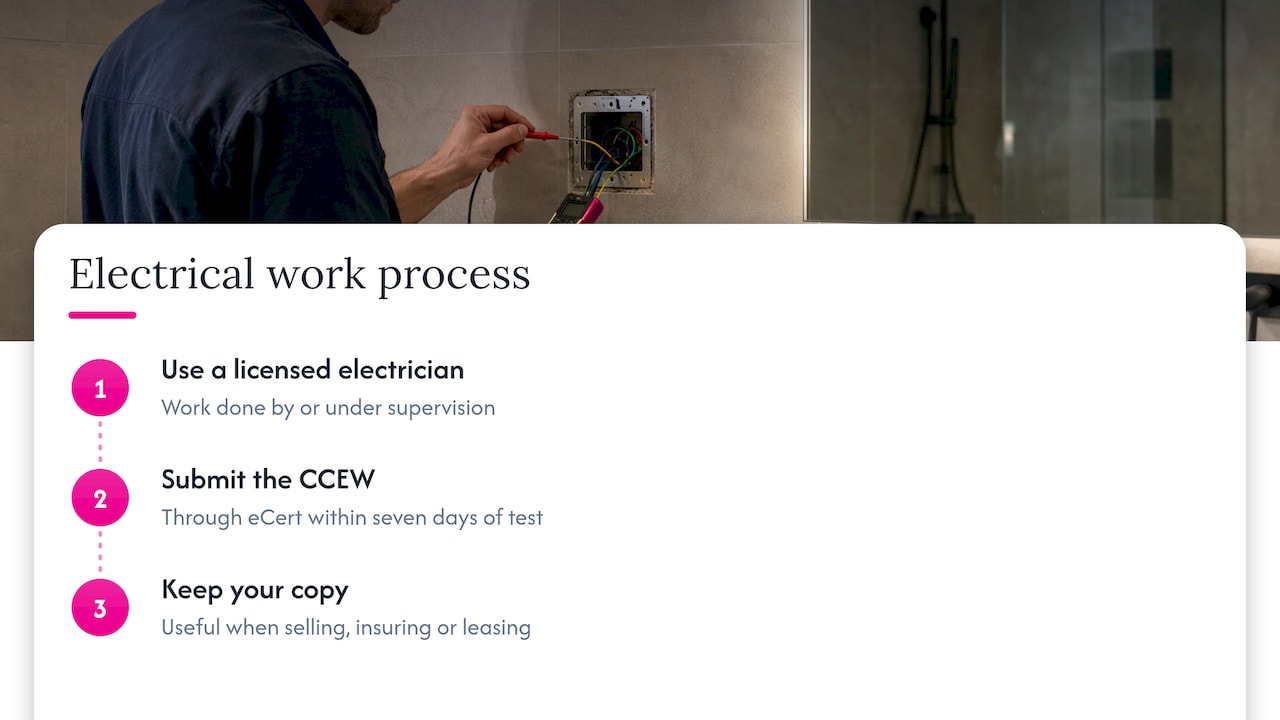
By law, any electrical wiring work in NSW must be done by, or under the supervision of, a licensed electrician. That includes moving a light, adding a fan or fitting a new power point. There is no safe DIY version of this, and a renovation does not change it. A Sydney renovation guide makes the same point: even owner-builders must use a licensed electrician for electrical work, and a licensed plumber for plumbing.
After the work, the electrician must submit a Certificate of Compliance for Electrical Work (CCEW) through the Building Commission NSW eCert portal, as soon as practical and no later than seven days after the electrical test is completed. The same page says penalties include on-the-spot fines of up to $1,000 each time a CCEW is not supplied, and up to $550,000 for failing to carry out installation work to the technical standards.
Ask for your copy of the CCEW. It is your record that the bathroom was wired to the Wiring Rules, and it is useful when you sell, insure or lease the property. Our pages on meeting electrical code in NSW and landlord electrical safety explain how this plays out for owners and property managers.
Planning a bathroom electrical layout
A few practical steps keep a renovation on track:
- Fix the fixtures first. Zones are measured from the bath, shower and basin, so the electrician needs their final positions before marking anything.
- Choose fittings by zone. Check the IP rating on each light, fan and towel rail against the zone where it will sit.
- Decide power point and switch positions at rough-in. This is before wall sheeting and waterproofing.
- Check the switchboard. Extra circuits, such as an underfloor heater or a fan, may need space and RCD protection on the board. Our guide to switchboard requirements under AS/NZS 3000 is a good starting point.
- Get the CCEW. Keep it with your renovation records.
For more on renovation-specific rules, see our bathroom renovation electrical rules for Sydney.
Our perspective
Most bathroom electrical problems we are called to are not faulty products. They are good products in the wrong zone, or a power point added after the tiles went up. The zone rules are not complicated once the layout is fixed, which is why we ask to see the plan early.
As a certified Level 2 contractor, we work to the strictest NSW standards, and we see the zone system as a design tool as much as a compliance rule. Choosing a 12 V fitting above a shower, putting the general power point well outside Zone 2 and checking the circuit has RCD protection costs little at rough-in. It costs a lot to fix after the waterproofing is done.
Our approach is simple: mark the zones, choose fittings to suit them, test the protection, and lodge the CCEW. You get a bathroom that is safe to use and paperwork that stands up when you sell. We offer free site inspections for Level 2 work, so you can talk through your layout before any work starts.
Christopher
Get your bathroom wiring checked or installed
If you are renovating, or you are unsure whether the lights, fan or power points in your bathroom sit in the right zones, our licensed team can inspect the room and advise. We handle electrical repairs, safety switch testing and switchboard upgrades across Sydney, residential and commercial, and we offer free site inspections for Level 2 work.
For a fault in a wet area, such as a tripping safety switch, water in a fitting or a burning smell, switch off the power at the switchboard if it is safe to do so and call our 24/7 emergency electricians. To book an inspection, start at our Level 2 electrician page.
FAQ
What are the electrical zones in a bathroom in NSW?
There are four: Zone 0 inside the bath or shower base, Zone 1 above it up to 2.5 m, Zone 2 a 0.6 m band around Zone 1 and the basin up to 2.25 m, and Zone 3 beyond. They come from Section 6 of AS/NZS 3000, which has been mandatory in NSW in its 2018 edition since 1 January 2019.
Can I put a power point in a bathroom in NSW?
Not in Zones 0 or 1. In Zone 2 only a shaver outlet, or an RCD protected socket inside a cupboard, is allowed. In Zone 3 a socket must be at least 0.3 m from Zone 2 and have RCD protection, a separated supply or a SELV/PELV supply. A licensed electrician must install it.
Can I fit a 240 V light in a bathroom?
Often yes, but it depends on the zone and the IP rating. Zone 0 allows only 12 V fittings rated IPX7 or higher. Zones 1 and 2 need at least IPX4. In Zone 1, an electrician will typically recommend a 12 V product, so ask them to confirm the choice for your layout.
Who can install bathroom lights and power points in NSW?
Only a licensed electrician, or someone working under their supervision. They must lodge a CCEW through the eCert portal within seven days of testing. Even an owner-builder has to use a licensed electrician for this work.
Sources
- AS/NZS 3000 Damp Situations Explained, NECA Victoria
- Bathroom Lighting Zones in Australia, Lighting Style
- Positioning Your Thermorail, Thermogroup
- Switches and sockets in wet areas, NSW Government
- Electrical standards, rules and notes, NSW Government
- Electrical compliance requirements, NSW Government
- New AS/NZS 3000:2018 wiring rules, Hager
- NSW Bathroom Renovation: Council Approval Requirements, Sydney Home Renovation
Recommended
Need Help Fast?
Powering Your Needs with Expertise
If you’re looking for a reliable, experienced, and prompt electrician, look no further than High Demand Electrical. We cater to all your electrical needs, from routine maintenance to emergency repairs and complete system installations. Our skilled team is committed to providing professional service that ensures your electrical systems run smoothly. Whether it's a small task or a large project, give us a call today. Let us meet all your electrical demands with the quality and reliability you deserve.

Licensed Level 2 ASP electricians across Sydney. Same-day service and 24/7 emergency response.
Licence 397193C
ABN 87 051 836 527
