Avoid Fines: NSW Aircon Isolator Checklist and eCert Steps
Fixed-wired air conditioners and heat pumps in New South Wales must have a local, lockable isolating switch installed adjacent to the unit, in line with AS/NZS 3000. The work must be carried out and certified by a licensed electrician, who is legally required to issue a Certificate of Compliance for Electrical Work and lodge it through the BCNSW eCert portal. If you’re arranging an aircon install or upgrade, engage a licensed electrician first and confirm the CCEW paperwork before the job is signed off.
TL;DR:
- Most outdoor fixed-wired air conditioners and heat pumps in NSW require a lockable isolating switch within arm’s reach, typically around 1.25 meters from the unit.
- The isolator must be capable of breaking all live conductors and be properly rated for the unit’s load and weather exposure, with clear, durable labels.
- A licensed electrician must install, test, and certify the isolator, lodge the compliance documentation through the eCert portal, and confirm the certificate is on file before job completion.
- Installing non-compliant or missing isolators increases safety risks, can void warranties, and exposes property owners to penalties and insurance issues.
- In typical cases, outdoor compressors require a local isolator, while indoor units plugged into standard sockets often do not; confirm with an electrician for complex setups.
Table of Contents
- What AS/NZS 3000 and NSW guidance say about isolators for air conditioners
- When a local isolator is required and common exceptions
- Technical requirements for the isolator: lockable off position, poles, ratings, IP and labelling
- Placement and accessibility: how to install the isolator correctly
- Licences, CCEW and the BCNSW eCert process (what property owners must verify)
- Risks, penalties and insurance implications of non-compliance
- Practical compliance checklist and questions to ask on-site
- Practitioner perspective: how compliant isolator installs are done
- How High Demand Electrical can help with compliant isolator installs
- A note from Christopher on getting isolator compliance right
- Sources
- FAQ
What AS/NZS 3000 and NSW guidance say about isolators for air conditioners
The wiring rules that govern every aircon installation in NSW come from AS/NZS 3000:2018, the national standard also known as the Wiring Rules. NSW Government guidance confirms that fixed-wired air conditioning systems need a local, independent, lockable isolating switch installed adjacent to, but not on, the equipment itself. The isolator has to be capable of being locked in the “off” position so the unit stays de-energised while someone is working on it.
This isn’t a suggestion tucked away in an appendix. It’s a core safety clause that applies to split systems, ducted units and heat pumps wherever the equipment is hard-wired rather than plugged in. NSW guidance aligns closely with the national standard here, though it does add practical notes for heat pump installations that installers should check against the current wiring rules before signing off.
Where things get more detailed is at the intersection of the national standard and NSW’s own connection framework. The Service and Installation Rules set out distributor-specific requirements that can affect where an isolator sits relative to a switchboard or metering point. For most residential aircon jobs, AS/NZS 3000 covers the isolator itself. For larger or network-connected installations, the SIRs come into play too.
A licensed electrician working across these documents typically needs to confirm:
- The isolator is positioned adjacent to the unit, never mounted on the equipment casing itself.
- It can be locked in the off position with a padlock, not just switched off manually.
- All live conductors feeding the unit are isolated by the switch, not just part of the circuit.
- The installation satisfies any distributor-specific connection requirements under the SIRs where relevant.
Getting these details right at the design stage saves rework later, particularly on strata or commercial jobs where an inspector will check clause compliance line by line.
When a local isolator is required and common exceptions
Most fixed-wired outdoor compressors and heat pump units need a local isolator, full stop. If your outdoor unit is hard-wired into the switchboard rather than plugged into a power point, AS/NZS 3000 treats it the same way it treats any other fixed electrical equipment: it needs its own dedicated, lockable means of isolation nearby.
Indoor units are where confusion creeps in. Some indoor heads run off a standard power point rather than a fixed connection, which can look like it sidesteps the isolator rule. In practice, industry guidance increasingly expects an isolator at the outdoor compressor regardless of how the indoor unit is powered, because the outdoor unit is almost always the fixed-wired component that needs safe disconnection during maintenance.
There’s also a dedicated switchboard exception that trips people up. If the air conditioner is fed from its own dedicated circuit at a switchboard that is itself readily accessible, lockable and clearly identifiable as serving only that unit, some installations rely on that switchboard isolation rather than a separate local switch. This only holds where “dedicated” genuinely means dedicated: one circuit, one switch, one piece of equipment, with nothing else sharing that breaker.
A few quick ways to work out where your installation sits:
- A split system with an outdoor compressor hard-wired to the switchboard almost always needs a local isolator near the outdoor unit.
- A window or portable unit plugged into a standard socket generally sits outside these isolator rules entirely.
- A ducted system feeding from a dedicated, clearly labelled switchboard circuit may satisfy isolation requirements without an additional switch, but this needs confirming on a case-by-case basis.
When in doubt, treat the outdoor compressor as the equipment that needs the isolator and get a licensed electrician to confirm the specific setup before assuming an exception applies.
Technical requirements for the isolator: lockable off position, poles, ratings, IP and labelling
The isolator itself has to meet a specific technical brief, not just exist somewhere near the unit. Industry best-practice notes built around the current wiring rules set out several requirements installers work to on every job.
Lockable in the off position. The switch needs a padlock provision so a technician can physically lock it off during maintenance and remove the key, preventing anyone from re-energising the circuit while work is underway. This is the whole point of the isolator: it turns “switched off” into “verified de-energised.”
Switching scope. The isolator has to break all live conductors feeding the unit, not leave one phase or the active connected. Industry guidance also recommends switching the neutral conductor as good practice, even where it isn’t strictly mandated, because it removes any ambiguity during isolation testing.
Current rating and IP rating. The isolator’s rating needs to sit comfortably above the unit’s full-load current, and outdoor installations need an IP rating suited to weather exposure. New AS/NZS 3000 wiring rules confirm that final subcircuits feeding fixed equipment such as air conditioners must carry 30 mA RCD protection, which works alongside the isolator rather than replacing it.
Labelling. The isolator has to be clearly labelled so any technician, not just the one who installed it, can identify its purpose at a glance. A mislabelled or unlabelled isolator is one of the most common items flagged during compliance checks.
Key points to confirm on any install:
- Padlock provision fitted and functional, not just a switch that happens to have a slot for one.
- All live conductors isolated, with neutral switching applied as recommended practice.
- Rating and IP class matched to the unit’s load and its outdoor or indoor exposure.
- Clear, durable labelling identifying the isolator’s function.
Placement and accessibility: how to install the isolator correctly
“Adjacent but not on the equipment” sounds straightforward until you’re standing in front of a compressor working out where the switch actually goes. Industry best-practice guidance points to an arm’s length rule of thumb, commonly cited as around 1.25 metres from the unit, with the isolator visible from where someone would be standing to service it.
Accessibility matters as much as distance. An isolator tucked behind a garden bed, blocked by a storage cupboard or mounted somewhere a technician needs a ladder to reach doesn’t meet the intent of the rule, even if it’s technically within reach. The switch needs to be somewhere a person can walk up to, see clearly and operate without moving anything else first.
Placement should also follow the manufacturer’s own installation instructions where they specify clearances or mounting positions, since these can be stricter than the general wiring rules in some cases.
- Position the isolator within easy reach of the unit, with a clear sightline for the technician operating it.
- Avoid mounting behind fixed structures, dense planting or anything likely to grow and obstruct access over time.
- Check the manufacturer’s installation guide for any unit-specific clearance requirements before finalising placement.
Pro Tip: Ask your electrician to photograph the isolator’s final position and padlock fitting before they leave. It’s a five-minute step that saves an argument with an inspector or insurer later.
This is also where lock-out/tag-out procedures start on any future service call. A technician arriving for a repair needs to walk up, lock the isolator off, and know with certainty the unit is de-energised before touching anything.
Licences, CCEW and the BCNSW eCert process (what property owners must verify)
Not everyone who can install or service an air conditioner is licensed to do the electrical work that goes with it. Refrigeration and air-conditioning mechanics generally hold a trade licence for the mechanical side of the job, but connecting the unit to fixed wiring, fitting the isolator and certifying the electrical work requires an electrician’s licence with the relevant associated electrical modules.
Once the work is done, the process runs through a few clear steps:
- The licensed electrician tests the installation, including the isolator, RCD protection and general wiring, before anything is signed off.
- They issue a Certificate of Compliance for Electrical Work, confirming the work meets the current wiring rules.
- From 1 July 2026, that certificate must be lodged digitally through the BCNSW eCert portal. Legacy paper submissions or older portals are no longer accepted, and failure to lodge correctly can attract on-the-spot fines.
As the property owner, you’re entitled to ask for three things before the electrician leaves site: their licence number, a copy of the CCEW, and confirmation that it has actually been lodged via eCert rather than just promised. Treat the CCEW as a legal document, not a courtesy receipt. It supports insurance claims, underpins warranty coverage on the work, and becomes relevant again if you ever sell the property and need to show the electrical work was compliant.
Risks, penalties and insurance implications of non-compliance
Skipping or botching an isolator install isn’t a paperwork technicality, it’s a safety hazard with real financial teeth. Without a lockable isolator, a technician servicing the unit later has no reliable way to confirm the equipment is de-energised, which is exactly the scenario the rule exists to prevent.
On the legal side, unlicensed electrical work breaches the Home Building Act and related regulations, and penalties can be substantial. Beyond the fine itself, unlicensed work exposes the property owner to civil liability if something goes wrong later, and it can void warranty cover on the installation entirely.
Insurers take a similar view. A non-compliant installation, or one without a retained CCEW, can complicate a claim if a fire or fault is ever traced back to the aircon circuit. Keeping the certificate on file isn’t optional box-ticking, it’s the document your insurer will ask for first.
Practical compliance checklist and questions to ask on-site
A little preparation before the electrician arrives makes the whole job faster and easier to verify afterwards.
- Have the unit’s model details, install photos and a note on whether the indoor head is plug-in or fixed-wired ready before the visit.
- On-site, check the isolator is padlockable, correctly labelled, rated for the unit’s load, and fitted with an IP rating suited to its location.
- Confirm RCD protection is in place on the final subcircuit feeding the unit, not just assumed.
- Ask directly about licence number, CCEW issuance and the eCert lodgement timeline before the electrician leaves.
Pro Tip: Keep a simple folder, digital or physical, with your CCEW, isolator photos and licence details together. It turns a stressful insurance query into a two-minute email.
Asking these questions upfront also weeds out anyone unwilling to confirm their licence details on the spot, which is a red flag worth taking seriously.
Practitioner perspective: how compliant isolator installs are done
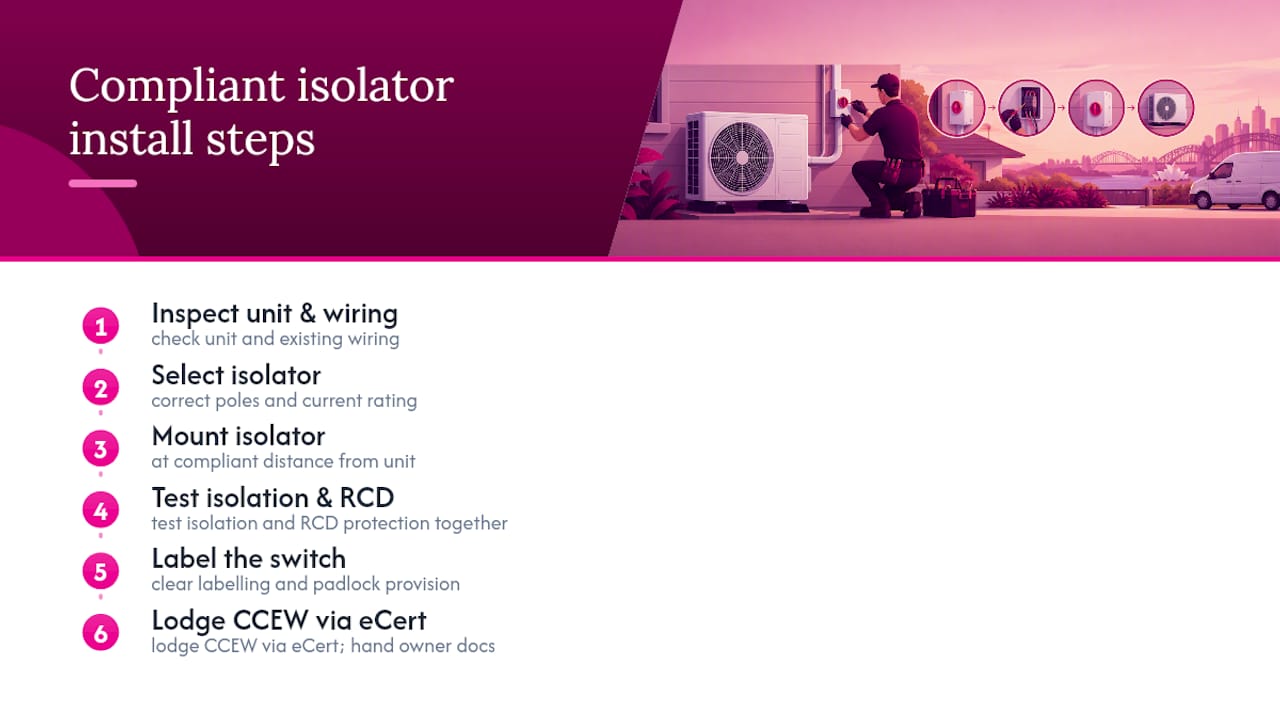
A typical compliant install follows a consistent sequence on-site: inspect the unit and its existing wiring, select an isolator with the correct poles and current rating, mount it at a compliant distance, test isolation and RCD protection together, label it clearly, then lodge the CCEW via eCert before handing documentation to the owner.
The most common failing found during inspections isn’t a missing isolator, it’s one that’s present but non-compliant: no padlock provision, poor labelling, or mounted too close to or directly on the unit. A Level 2 electrician resolves these by relocating or replacing the switch and retesting before certifying the job.
High Demand Electrical offers professional electrical services including emergency and scheduled work, site inspections for Level 2 jobs, and has received positive customer feedback.
How High Demand Electrical can help with compliant isolator installs
Getting an aircon isolator right the first time saves you the cost and hassle of a failed inspection later, and this company can handle aircon electrical inspections, isolator installation, switchboard upgrades and compliance certificate lodgement.

If you’re planning a new aircon install, upgrading an existing unit, or you’ve inherited a property with wiring you’re not sure about, start with our aircon electrical inspection and report service. We’ll check the isolator, wiring and switchboard connection, then give you a clear picture of what’s compliant and what needs attention.
What to expect when you book:
- Site inspection for Level 2 work to clarify scope before pricing.
- On-site testing of isolator placement, RCD protection and labelling against current wiring rules.
- A licensed electrician who issues your compliance certificate and confirms compliance lodgement before the job is closed out.
For broader switchboard work alongside the aircon job, our switchboard upgrade service covers the connection end of the same installation. Get in touch to book a free site inspection and see exactly what your property needs.
A note from Christopher on getting isolator compliance right
Working across Sydney properties day to day, the isolator issues I see most often come down to shortcuts: no padlock, poor placement, or paperwork that never actually reaches eCert. Compliance isn’t a formality, it’s what keeps the next technician safe. If you’re unsure about an existing install or planning a new one, book a free inspection and we’ll walk you through exactly what’s needed.
— Christopher
Sources
For clause-level detail, check NSW Government electrical standards, the BCNSW eCert compliance guidance, Energy NSW’s Service and Installation Rules, and AS/NZS 3000:2018 direct from Standards Australia.
- Electrical standards, rules and notes | NSW Government
- Service and Installation Rules NSW | Energy NSW
FAQ
Does an aircon need an isolator?
Yes, fixed-wired air conditioners and heat pumps in NSW need a local, lockable isolating switch installed adjacent to the unit under AS/NZS 3000. Plug-in indoor units may sit outside this requirement, but the outdoor compressor generally still needs one.
What are the rules for air conditioners in NSW?
Air conditioning installations in NSW must comply with the AS/NZS 3000 wiring rules, which require a lockable isolator near fixed-wired units and RCD protection on the final subcircuit. The licensed electrician who completes the work must issue a Certificate of Compliance for Electrical Work and lodge it via the BCNSW eCert portal.
What is the $5000 rule for AC?
There isn’t a documented “$5000 rule” tied to air conditioning isolator or electrical compliance in NSW government or standards guidance. If you’ve seen this figure referenced elsewhere, it isn’t something we can verify against current NSW electrical standards or compliance requirements.
What is the latest version of the AS/NZS 3000 wiring rules?
The current edition is AS/NZS 3000:2018, published by Standards Australia. It remains the standard NSW electricians work to for wiring rules, including isolator and RCD requirements for fixed air conditioning installations.
Recommended
Powering Your Needs with Expertise
If you’re looking for a reliable, experienced, and prompt electrician, look no further than High Demand Electrical. We cater to all your electrical needs, from routine maintenance to emergency repairs and complete system installations. Our skilled team is committed to providing professional service that ensures your electrical systems run smoothly. Whether it's a small task or a large project, give us a call today. Let us meet all your electrical demands with the quality and reliability you deserve.