Air Conditioner Isolators in NSW: Rules, Types and Who Can Fit One
An air conditioner isolator is a lockable switch, fitted beside the outdoor unit, that cuts power to the whole system so it can be serviced or repaired safely. In NSW, AS/NZS 3000:2018 requires one on air conditioners with a compressor, and only a licensed person can fit or replace it. This guide covers where it goes, which type suits your unit, what to do if yours is damaged, and what to expect from the job.
TL;DR
- An isolator is a local, lockable switch next to the outdoor unit. It isolates the whole system from one place, so a technician can work without the unit starting up.
- The wiring rules require it for air conditioning and heat pump systems with a compressor. It sits adjacent to the unit, not on it.
- Pole count follows the supply: single-phase units use a single-phase isolator, three-phase units need a three-pole or four-pole type. Rating must exceed the unit’s full load current.
- Outdoor isolators need a weatherproof enclosure, chosen by IP rating.
- Fitting, replacing or repairing one is electrical work. It needs a licensed electrician and a Certificate of Compliance for Electrical Work (CCEW).
Table of Contents
- What an air conditioner isolator does
- What NSW requires
- Where the isolator goes
- Choosing the right isolator
- Who can fit or replace one in NSW
- When an isolator needs attention
- Our perspective
- Get the isolator done properly
- FAQ
- Sources
What an air conditioner isolator does
Think of the isolator as the local off switch for the entire air conditioning system. The circuit breaker in your switchboard can also cut power, but it is usually a long way from the outdoor unit. If a technician is cleaning a coil or replacing a fan motor, they need to know the unit cannot be switched on from somewhere else. A lockable isolator next to the unit gives them that certainty.
The rules describe it as a lockable isolating switch adjacent to but not on the unit, isolating all parts of the system from the same location. That wording comes from AS/NZS 3000:2018 Clause 4.19, reproduced in government guidance. Two details matter:
- Lockable. The technician can padlock it off while they work.
- All parts of the system. One switch must isolate the lot, not just the outdoor fan.
You will see the grey or white weatherproof box on the wall beside most outdoor units. It is a small part, but it is the one the installer and every later service technician rely on.
What NSW requires
NSW adopted the Wiring Rules through State legislation, and compliance with the 2018 edition became mandatory from 1 January 2019. NSW guidance lists isolator requirements for air conditioning and heat pump equipment among the key changes in that edition.
The requirement itself is older than 2018. A 2014 industry report on an earlier amendment to Clause 4.19 said it clarified the use of an isolator on all installed air conditioners, regardless of how the unit itself connects to power. If your system was installed years ago without one, that is worth raising with an electrician when it is next serviced.
Split systems connected by plug and socket
Many split systems plug into a socket-outlet at the indoor unit. The rule still applies. Where the manufacturer requires connection by plug and socket at the internal unit, the isolating switch at the external unit must control that socket-outlet. In practice the outdoor isolator is wired so that switching it off also kills power to the indoor socket.
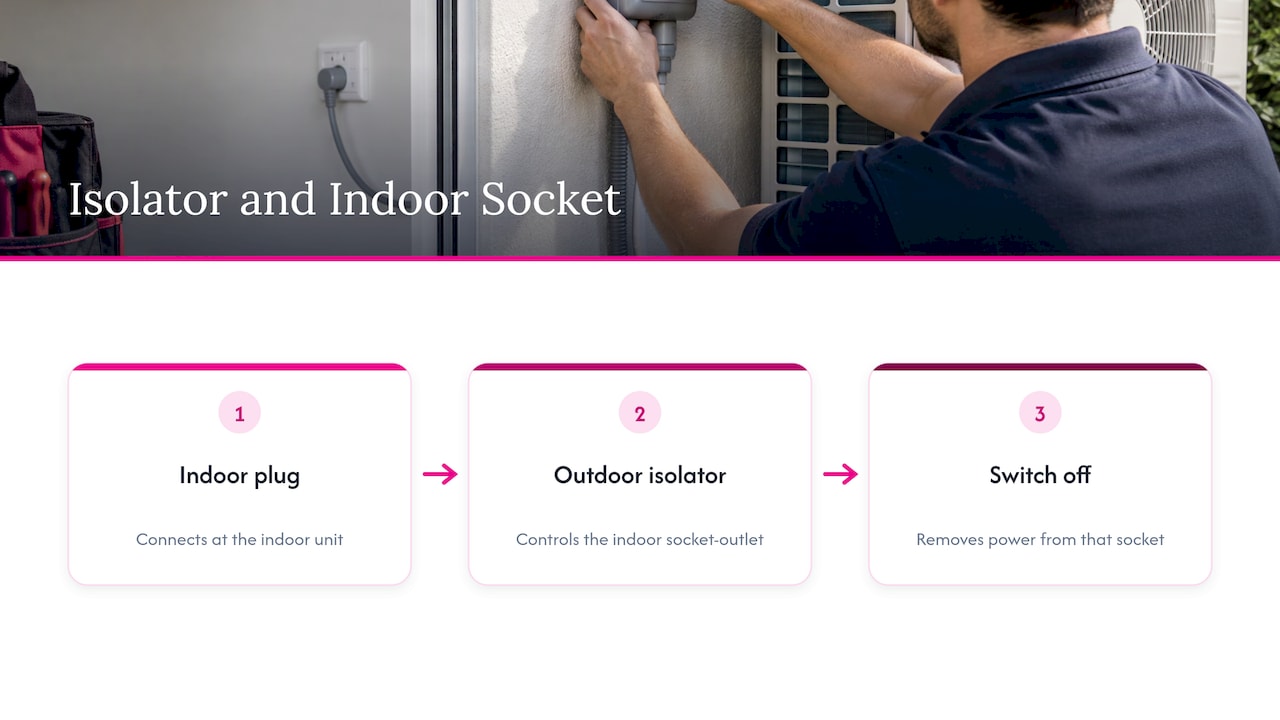
Single units plugged into a power point
A window or portable-style unit that plugs into a general power outlet is treated differently. Summaries of the 2018 changes say that where the outlet is ‘readily accessible’, that is enough and no separate isolator is needed. Most homes with a ducted or split system are a different case, because those are fixed-wired or have an outdoor compressor.
Where the isolator goes
For fixed-wired air conditioning and heat pump systems, the guidance is that a readily accessible, lockable isolation switch is installed adjacent to each air conditioner, not on the unit. Industry summaries put the practical position at about arm’s length, with one citing 1.25 metres from the unit.
What this means on a real job:
- Next to the unit, not on it. Mounting on the unit would mean removing a panel or the unit to get at it. It sits on the wall or a bracket beside it.
- Readily accessible. Not behind a fence panel, a stack of pool equipment or a locked gate the technician cannot open.
- Within sight of the machine. The person switching it off should be able to see the unit they are isolating. A supplier guide recommends mounting within sight of the machine.
- One location for everything. Where a system has several parts, the isolation must still happen from the same spot.
Roof-mounted and rooftop plant on apartment buildings and commercial sites follow the same principle, and access for service staff matters even more. Property managers should make sure the route to the isolator is safe and clear.
Choosing the right isolator
Single-phase or three-phase
The isolator must match the supply to the unit. One supplier explains that pole count follows the supply: a single pole and neutral for a standard single-phase unit, three pole for three-phase plant. The isolator should be rated above the equipment’s full load current.
Published ranges show how this looks in practice. One Australian weatherproof series comes in 1P, 2P, 3P and 4P versions at 20A, 35A and 63A, suitable for 240V single-phase or 415V three-phase use, and tested to AS3133 with a motor rating for direct control of motors. A retail listing for a basic isolating switch similarly shows single-phase 20A and 35A and three-phase 20A and 65A sizes.
| Unit supply | Typical isolator type | What to check |
|---|---|---|
| Standard single-phase split system | Single-pole or two-pole (with neutral), commonly 20A or 35A | Rating above the unit’s full load current |
| Larger single-phase ducted unit | Two-pole, higher current rating | Nameplate current, cable size, breaker |
| Three-phase ducted or commercial plant | Three-pole or four-pole | Motor rating and current rating suit the load |
On neutral switching: the Wiring Rules best practice guide says the neutral does not have to be switched but it is recommended for a safer installation. We lean towards switching it. Its HVAC isolator range runs from 2-pole to 4-pole with an AC23 utilisation category and IP66 rating.
The nameplate on your outdoor unit lists its electrical details. Your electrician reads that, not a guess, to pick the isolator.
Why single-phase to three-phase matters here
If you are planning a larger system for a home or small business, the supply comes into it. Three-phase supply in Australia delivers 400/415V line-to-line and 230/240V line-to-neutral, and three-phase circuits use 4-pole protection in the switchboard. The same source notes that motors run more efficiently on three-phase and that loads should be balanced across phases so no single phase is overloaded. A big ducted system is exactly the sort of load that prompts a single-phase to three-phase power upgrade, and the isolator is chosen for whichever supply you end up with.
Weatherproof enclosures and IP ratings
The isolator lives outdoors, so the enclosure has to cope with rain, sun and dust. Outdoor isolators are selected by IP (ingress protection) rating. The first digit covers protection against solid objects and hazardous parts, and the second covers water. One Australian weatherproof series is rated IP66, a level commonly used for outdoor HVAC isolation.
A higher second digit means better protection against water. If you want a sense of how outdoor equipment is specified in other markets, this page on wall-mounted air conditioner installation shows the kind of outdoor wall-mounted systems these isolators serve. Sun matters too: UV-resistant polycarbonate housings last better on a north-facing Sydney wall than basic plastic.
Who can fit or replace one in NSW
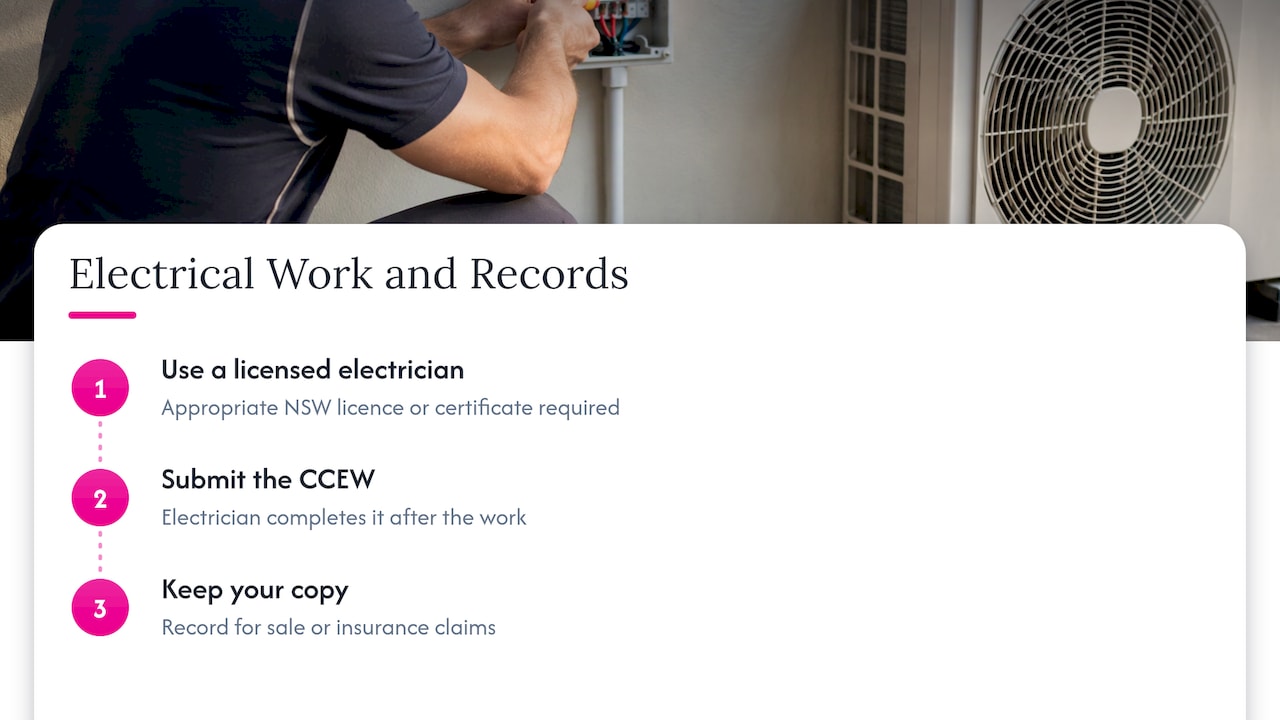
This is not a DIY job. Air conditioning work and its associated electrical wiring must be done by a person with an appropriate NSW licence or certificate. An air conditioning, refrigeration or electrical licence covers this work, and the air conditioning and refrigeration licences include certain associated electrical wiring.
For the electrical side, state scheme guidance says electrical work on an air conditioner must be completed by a licensed electrician. After the work, the electrician completes and submits a Certificate of Compliance for Electrical Work (CCEW). Keep your copy. It is your record that the work was done to the rules, and it matters when you sell, claim on insurance or hand the property to a new manager.
That same guidance notes that AS/NZS 3000 expects a Type A RCD, a local isolator and wiring that meets the system requirements. So an isolator swap is often a good moment to check the circuit’s safety switch too. Our RCD and safety switch testing and electrical maintenance covers that.
For technical or safety questions, NSW Government guidance directs people to a licensed electrician. We agree.
When an isolator needs attention
An isolator is a simple switch, but it sits outside in Sydney weather for years. These are the things worth reporting to an electrician:
- A cracked, brittle or sun-damaged housing, or a lid that no longer closes properly.
- Signs of water inside the box, rust, or insects nesting in it.
- Discolouration, a burning smell or melted plastic around the switch.
- A handle that is loose, stiff, broken or no longer turns fully.
- The air conditioner cutting out or the safety switch tripping when the unit starts.
- No isolator at all next to the outdoor unit.
What to do safely:
- If you smell burning or see scorching, switch the air conditioner off at the switchboard if you can reach it safely, and call an emergency electrician.
- Do not open the isolator box, touch wiring or spray water on it.
- Do not keep running a unit through a damaged switch.
- Keep children and pets away from the area.
- Book a licensed electrician to inspect and replace the switch.
If a safety switch keeps tripping when the air conditioner runs, the cause may be the unit, the wiring or the isolator. Our page on a safety switch that keeps tripping explains what to do. For a wider diagnosis we offer electrical fault finding.
Our perspective
Most isolator problems we see come down to two things: the wrong type for the unit, or a switch left to cook in the sun for a decade. A basic isolator looks like a minor part, so it is often picked off a shelf by whoever is closest. It is a safety device. It has to match the supply, carry the load and survive the weather.
As a certified Level 2 electrical contractor, we look at the isolator as part of the whole circuit: the cable, the breaker, the safety switch and the supply. If a new ducted system will push a home past what single-phase can comfortably deliver, we would rather talk about that at the start than after the unit is on the wall.
Our approach is simple. Check the nameplate. Match the poles and rating. Fit it where a technician can reach it and see the unit. Lodge the CCEW and give you a copy. We work to the strictest NSW standards, and for Level 2 work we offer a free site inspection so you know the scope before anything is done.
Christopher
Get the isolator done properly
High Demand Electrical is a certified Level 2 electrical contractor serving residential, commercial and strata properties across Sydney. Our accredited electricians can inspect your air conditioner’s electrical connection, replace a damaged isolator, upgrade the supply behind a larger system and tidy up defects that turn up on inspection. We offer 24/7 emergency support, a 10-minute callback guarantee, free site inspections for Level 2 work and discounts for seniors.

Start with an aircon electrical inspection and report, or talk to our team about Level 2 electrical work. If the problem is urgent, call our emergency electricians any hour.
FAQ
Is an isolator compulsory for an air conditioner in NSW?
For air conditioning and heat pump systems with a compressor, AS/NZS 3000:2018 Clause 4.19 requires a lockable isolating switch next to the unit. Compliance with the 2018 edition has been mandatory in NSW since 1 January 2019. A plug-in unit on a readily accessible power point is the main exception.
Can I replace a broken isolator myself?
No. Electrical work on an air conditioner must be done by a licensed electrician in NSW, who then submits a Certificate of Compliance for Electrical Work. Switching off at the switchboard does not make it safe for an unlicensed person to open or rewire the box.
What rating should my isolator be?
It depends on the unit. Pole count follows the supply, so single-phase units use single-phase isolators and three-phase plant uses three-pole or four-pole types. The current rating must be above the unit’s full load current, which your electrician reads from the nameplate.
Does the isolator have to be weatherproof?
Yes, for an outdoor unit the isolator is mounted outside, so a weatherproof enclosure is used. These are chosen by IP rating, where the second digit describes protection against water. IP66 is common for outdoor HVAC isolators.
Sources
- Electrical standards, rules and notes, NSW Government
- Air-conditioning units guidance, Access Canberra
- Changes to the Wiring Rules and HVAC installation requirements, Electrical Connection
- Guide to the Wiring Rules changes
- Isolation switch requirements for installations
- Isolator switches, weatherproof and safety isolators
- IPW weatherproof isolators
- Isolating switch product page
- Three-phase wiring basics
- Air conditioning and refrigeration work, NSW Government
- Home energy efficiency retrofits, IPART
- Wall-mounted air conditioner installation
Need Help Fast?
Powering Your Needs with Expertise
If you’re looking for a reliable, experienced, and prompt electrician, look no further than High Demand Electrical. We cater to all your electrical needs, from routine maintenance to emergency repairs and complete system installations. Our skilled team is committed to providing professional service that ensures your electrical systems run smoothly. Whether it's a small task or a large project, give us a call today. Let us meet all your electrical demands with the quality and reliability you deserve.

Licensed Level 2 ASP electricians across Sydney. Same-day service and 24/7 emergency response.
Licence 397193C
ABN 87 051 836 527
