5 causes of flickering and dimming lights, and what to check
Flickering lights aren’t always a sign that a globe is failing. If you’re wondering why your lights are flickering and dimming, common causes include a loose globe, an incompatible dimmer, a circuit under load, a faulty LED driver or an electrical wiring fault. A single light that flickers occasionally may have a simple cause, but flickering across multiple rooms, buzzing, burning smells or discolouration can point to a serious fault.
It’s understandable to worry about whether flickering LED lights are dangerous. The cause matters: a globe or dimmer issue may be isolated, while persistent flickering or changing brightness across several lights warrants prompt attention from an electrician.
This guide explains five likely causes, what you can safely observe, and when to call an electrician. You’ll learn how appliance start-ups, loose connections, LED and dimmer compatibility, and wiring faults can affect your lights, so you can respond calmly and recognise when the problem needs professional attention.
Key Takeaways
• Notice whether flickering affects one light or several, and whether it starts when an appliance switches on. Those patterns can help narrow down the cause.
• Evening flicker may relate to changes in the electricity supply, but persistent or widespread flickering deserves closer attention.
• Buzzing, burning smells, discolouration or changing brightness across rooms are warning signs to treat seriously and raise with an electrician.
• If only one light flickers, a loose globe or a failing LED may be involved; avoid touching wiring or fittings.
• LEDs and dimmers need to be compatible. A mismatch can cause flickering even when the light itself is working.
1. Appliance inrush current and voltage dips
If lights dip when a heater starts or flicker as a fridge cycles, appliance demand may be affecting the circuit. Some appliances draw a brief surge of current when switching on. This is called inrush current. If lighting and power share a circuit, or several high-demand appliances operate together, that start-up load can make lights dim momentarily.
The pattern offers useful clues. Note which lights change and which appliance starts at the same time. For example, a brief dim across one area as a heater switches on points to a different pattern from persistent flickering in several rooms. A fridge cycling may cause a short change in brightness, but repeated or ongoing changes can also indicate unstable voltage or a neutral conductor issue.
A circuit has a limit to the electrical load it can supply safely. When appliances draw more power together than the circuit can manage, lights may flicker or dim. Shared lighting and power circuits can make this more noticeable, including in new builds or renovated homes. Newer fittings don’t rule out a circuit-load issue.
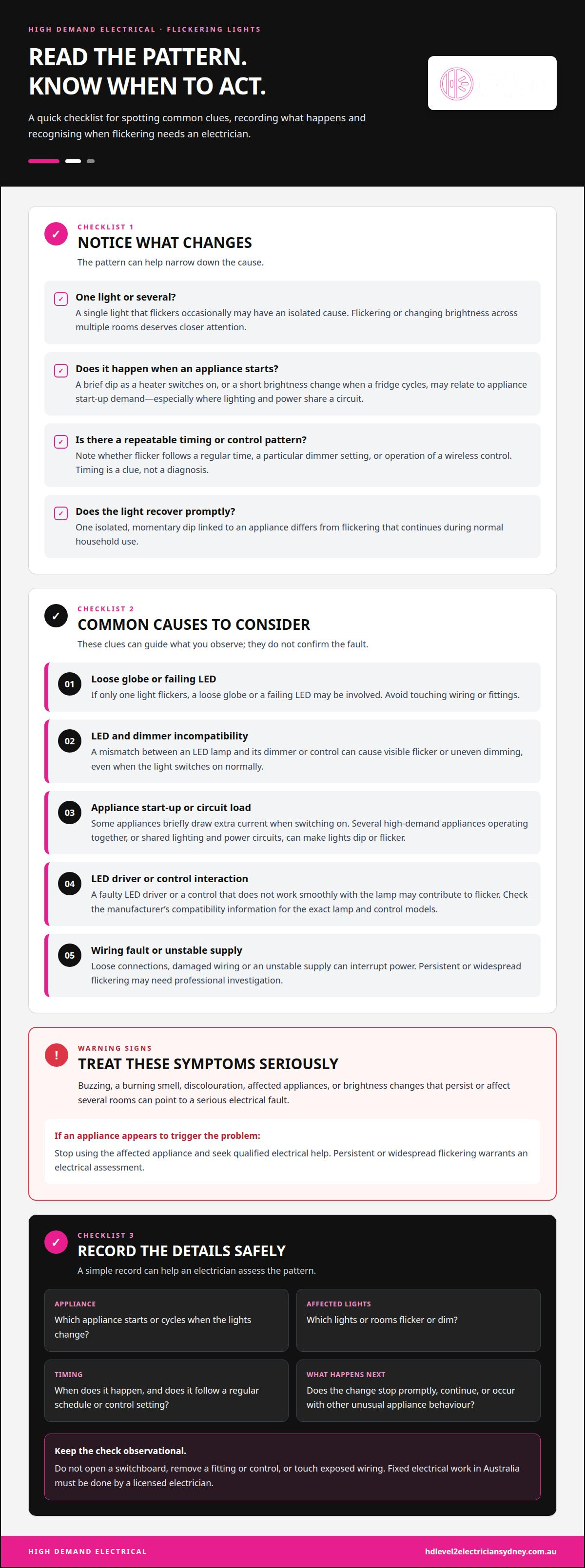
Keep a simple record before arranging an electrical assessment. Note the appliance, affected lights, whether the change happens at start-up or continues, and whether other appliances behave unusually at the same time. This information can help an electrician distinguish a brief response to appliance start-up from a fault that needs investigation. Don’t open a switchboard or remove a fitting to look for the cause.
One isolated, momentary dip linked to an appliance differs from flickering that persists after the appliance starts. If the lights keep changing brightness, more than one room is affected, or the same pattern occurs with different appliances, arrange an electrical assessment. A professional can assess circuit loading and voltage, inspect the switchboard, and check neutral connections. These checks help identify whether appliance demand is contributing to or revealing a wiring problem.
Pay attention to combinations of symptoms. If dimming occurs alongside buzzing, a burning smell, discolouration or affected appliances, treat it as a potential electrical fault rather than ordinary start-up behaviour. Stop using the affected appliance if it appears to trigger the problem, and seek qualified electrical help. The key distinction is whether the lights recover promptly or continue flickering during normal household use.
2. Are flickering LED lights dangerous?
Flickering LEDs aren’t automatically dangerous, but the pattern matters. A brief, predictable change differs from repeated flicker or sudden brightness changes. Note the time, affected lights and whether the flicker follows a regular schedule. For example, compare a hallway light with lighting in a nearby room. This record helps an electrician assess whether the behaviour relates to lighting controls or needs further investigation.
Ripple control may be one possible reason for flickering, but timing alone doesn’t identify the cause. If flickering repeatedly occurs during an evening peak, record the time and whether several LED lights respond together. That timing is a useful clue, but it doesn’t identify the cause by itself. A flicker outside those periods, or one that continues at other times, calls for a broader assessment rather than assuming ripple control is responsible.
Wireless lighting controls work differently: they use radio waves to send signals to lights or control devices. If a recently installed wireless control coincides with flickering, note which lights respond and whether the behaviour changes when you operate the control. The control, LED driver and lamp need to work together. A mismatch can affect dimming or cause visible flicker, even when the light switches on normally.
Before installing or changing a control, check the LED manufacturer’s compatibility information. Lighting manufacturers may publish lists identifying compatible controls and describing how their products perform when paired. Use the exact lamp and control models when comparing those details. A control designed for one LED product may not perform smoothly with another. If the manufacturer’s information doesn’t resolve the issue, an electrician can test the lighting arrangement rather than relying on one lamp as a guide.
Flicker that’s confined to one LED may point to a lamp or control interaction. Flicker across several rooms, brightness changes that persist, or other electrical symptoms need more urgent attention. Don’t remove a switch, fitting or control to inspect its wiring. Fixed electrical work in Australia must be done by a licensed electrician. If you can’t explain a recurring pattern, record the timing and affected lights, then arrange an electrical assessment.
Ripple control and wireless controls aren’t interchangeable explanations. Ripple control involves a timed signal in parts of Australia; wireless controls send radio signals from a local control. Record whether flicker follows a daily schedule, a particular dimmer setting or operation of a wireless control. Those distinctions help narrow the investigation. If the flicker persists or changes unexpectedly, don’t rely on timing alone to rule out an electrical fault.
3. Electrical wiring faults and when to call an electrician
Yes. Flickering or dimming can signal a dangerous electrical fault, particularly when several lights change brightness or the problem persists. A loose connection, damaged wiring or unstable supply can interrupt power and create a fire risk. Buzzing, burning smells, discolouration or appliances behaving unusually alongside flickering are warning signs. Don’t touch exposed wiring or open the switchboard.
If lights flicker across multiple rooms or the whole house, stop using affected circuits if you can do so safely, and arrange prompt electrical help. Note which rooms and appliances are affected, whether brightness rises as well as falls, and when the changes occur. This pattern helps distinguish a fault within the home from a wider supply problem. Avoid removing fittings or attempting wiring repairs.
A problem with the electricity supply or a neutral connection can cause lights to flicker or change brightness. If some lights dim while others brighten, or appliances also behave unusually, treat the pattern seriously. A licensed electrician can assess the wiring and supply connections. In Sydney, an assessment of the service connection may involve Level 2 ASP electrical services.
For flickering streetlights or power problems affecting neighbouring homes, contact your electricity distributor, which manages the local network. Tell them whether nearby properties are affected and describe any visible damage to network equipment from a safe distance. Don’t approach fallen wires or damaged electrical infrastructure. If the issue appears limited to your home, contact a licensed electrician.
Fault finding should test the circuit, not rely only on the light that first showed symptoms. A partial check can miss compatibility problems elsewhere on the same lighting circuit. An electrician may measure circuit load and voltage, inspect the switchboard, check neutral connections, and assess dimmer and LED-driver compatibility. Thermal imaging may also help locate heat associated with a poor connection.
In Australia, all fixed wiring work must legally be done by a licensed electrician. Persistent flickering, changes across multiple rooms, buzzing, burning smells or discolouration warrant professional attention. These symptoms don’t identify one specific fault, but they can indicate a serious electrical problem. Record the affected rooms and appliances, then share those observations when arranging an inspection with a licensed electrical contractor such as GES Greenera. Keep clear of damaged fittings until they’ve been checked.
4. Loose bulbs, connections and dirty sockets
Yes. A loose globe, faulty switch or damaged wiring can interrupt electrical contact and cause flickering. If the problem affects one light, that fitting may be involved; flickering from several lights can point to a wider wiring fault.
Start with the pattern, not the fitting. If one globe flickers while the other lights stay steady, it may not be seated correctly or may be failing. Switch the light off, let the globe cool, then check that it sits securely. Replace it with a suitable, good-quality LED if needed. If the new globe flickers too, stop changing parts and arrange an electrician’s assessment.
A loose connection can occur at a light fitting, switch or junction point. When the connection interrupts the power supply, the light may flicker intermittently, change brightness or stop working. A faulty switch can cause similar symptoms when operated. Don’t remove a switch plate or fitting to look for a loose wire. Fixed wiring needs professional attention.
Dust on the outside of a globe or fitting can be wiped away after the light is switched off and cool. That’s different from dirt, corrosion or damage inside a socket. Don’t put cloths, brushes or cleaning products into the socket, and don’t try to scrape its contacts. A damaged, discoloured or unusually warm socket needs an electrician to inspect it.
Use these observations to describe the fault clearly:
• Whether flicker affects one light or several in the same room.
• Whether it starts after switching the light on or when the switch moves.
• Whether the globe has been replaced and the flicker continues.
• Whether you notice buzzing, a burning smell, heat or visible discolouration.
Those details help distinguish a loose globe from a switch, fitting or wiring issue. For example, one flickering globe that steadies after being seated suggests a different pattern from a light that flickers whenever its switch is used. Replacing the globe won’t fix a faulty connection behind the fitting, so persistent flicker needs investigation.
If you see a spark, smell burning, hear buzzing or notice a darkened socket, stop using that light and seek prompt electrical help. Don’t touch exposed wiring or continue testing the switch. An electrician can inspect the fitting, socket, switch and associated wiring to locate the fault, rather than assuming the globe is the cause.
5. Non-dimmable bulbs on dimmer circuits
An LED globe can flicker when connected to a dimmer that doesn’t suit it. Non-dimmable LEDs aren’t designed for dimming, while dimmable lamps still need compatible switches. A halogen-rated dimmer may also cause flicker after an LED retrofit. If the problem began after changing globes, check whether the new lamps are labelled dimmable and compatible with the existing dimmer.
Older dimmers may need a minimum circuit load of 20-40 W to operate smoothly. A couple of LED downlights rated at 5-9 W each may not reach that threshold. The dimmer can then flicker, pulse or fail to dim evenly, even though each globe works by itself. Adding lamps just to meet a minimum load isn’t a safe fix without checking the dimmer’s specifications.
Minimum load and maximum load are different limits. The minimum is the load needed for the dimmer to function properly; the maximum is the total load it can handle. For example, a dimmer rated at 40 Watts can power 8 x 5 Watt LEDs or 4 x 10 Watt LEDs, provided the lamps are compatible. Count the connected lamps and check their wattage against the dimmer rating, rather than assuming any LED combination will work.
Smart dimmers can also flicker if they don’t match the load. This may happen in a new build or renovation, especially when a control is paired with LED fittings it wasn’t designed to operate. A test installation can show whether particular LED lamps work with the existing dimmer switches before the same combination is installed across the lighting circuit.
Age matters, too. Dimmer switches are commonly rated for five years and can begin to fail after exceeding that rating. An older control that flickers with previously reliable lamps may be wearing out, but an incompatible globe can produce similar symptoms. Note whether the flicker happens at all brightness settings or only when dimmed low. That detail can help distinguish a control fault from a compatibility issue.
Don’t remove a dimmer or change its wiring to test a theory. An electrician can assess the dimmer type, its load limits, lamp compatibility and the wider circuit. If flickering started after an LED change, keep the globe packaging or note its model and wattage. Arrange an electrical assessment if compatible lamps still flicker or the dimmer behaves unpredictably.
High Demand Electrical
High Demand Electrical can help when flickering points beyond a single globe or dimmer to a switchboard or electrical supply concern. Its Level 2 ASP Electrical Services address electrical infrastructure, while Switchboard Upgrades can be relevant when the switchboard needs upgrading. The right next step depends on where the fault lies: a lamp or dimmer issue needs a different response from a supply-side problem.
If flickering affects multiple rooms, continues alongside unusual brightness changes, or appears connected to the supply, describe what you’ve observed and when it happens. This information helps clarify whether the concern relates to electrical infrastructure or another part of the installation. For help with a supply or switchboard concern, contact High Demand Electrical.
Take the next step towards steady lighting
If you’re still asking why your lights are flickering and dimming, focus on what the pattern suggests about the source. A fault limited to one light may need a different investigation from a problem affecting the home’s electrical supply. A licensed electrician can assess the installation and identify whether the concern relates to internal wiring or electrical infrastructure.
High Demand Electrical offers Level 2 ASP Electrical Services, Switchboard Upgrades and Private Power Pole Installation. These services can help address electrical supply and infrastructure concerns, rather than faults with household appliances. Sharing when the flickering began and how widely it affects the property gives the electrician useful context for the assessment.
For a clear next step, contact High Demand Electrical to discuss the electrical concern. Getting the right fault assessed can help you move forward with confidence.
Frequently Asked Questions
Are flickering LED lights dangerous?
They can be, depending on the cause and accompanying signs. A single LED that flickers without other symptoms may have a lamp or control issue, but flickering with a burning smell, buzzing or discolouration needs prompt attention. If you’re asking why your lights are flickering and dimming, note whether the problem affects one light or several, and whether appliances also behave unusually. Don’t handle exposed wiring or damaged fittings.
Can dimmers cause flickering?
Yes. An LED may flicker if it isn’t dimmable, if the dimmer is designed for a different lamp type, or if the connected load falls outside the dimmer’s operating range. Check the globe’s packaging for its dimming status and model details. If the lamp is labelled dimmable but flickers across different settings, an electrician can assess the control and lighting combination without you opening the switch.
Can you fix this without rewiring the whole house?
Often, yes. The required work depends on the fault: an electrician may need to address one circuit or replace a faulty fitting or switch, rather than rewire the property. For example, a fault confined to one lighting circuit can be investigated separately from a problem affecting the home’s wider supply. Testing helps determine the repair scope. Fixed wiring work must be done by a licensed electrician in Australia. If broader electrical upgrades or renovations do prove necessary, homeowners funding property updates often look to unlock value from unused valuables with specialists such as Silver Buyers Sydney.
What causes lights to flicker or dim in a house?
Common causes include a loose globe, a worn switch, an incompatible LED dimmer, appliance start-up demand, or a wiring or supply fault. The pattern can help narrow it down. One light acting up points towards a local fitting or lamp, while changes across several rooms suggest the issue may involve a broader circuit or supply. Note when it happens and which lights are affected.
Why do lights dim when an air conditioner, heater, or other appliance starts?
Some appliances draw a brief surge of current as they start, which can momentarily affect lights sharing the electrical supply. An air conditioner switching on, for example, may coincide with a short dip in brightness. If the change continues, happens with several appliances or comes with unusual appliance behaviour, don’t assume it’s normal start-up demand. Record the appliance and timing for an electrician.
What warning signs mean I should turn off the power and call an electrician?
Burning smells, buzzing, sparks, visible discolouration or flickering across several rooms are warning signs of a possible serious fault. Stop using the affected light or appliance. Turn off the relevant circuit only if you can reach the switchboard safely and without touching damaged equipment. If there’s smoke or fire, move away and call emergency services. Don’t investigate wiring yourself.
How can I safely troubleshoot flickering lights at home?
Observe the problem without opening fittings or switches. Note whether one light or several are affected, when flickering starts, and whether an appliance or dimmer setting changes at the same time. If one globe flickers, switch the light off and let it cool before checking that it is seated securely. Don’t clean inside a socket or touch wiring; persistent flicker needs professional assessment.
When should I call a licensed electrician in Australia about flickering lights?
Contact a licensed electrician for persistent flickering, changes across multiple rooms, or flickering accompanied by buzzing, burning smells, discolouration or appliance problems. Arrange an assessment if replacing a suitable globe doesn’t resolve a single-light issue, or if the flicker began after a dimmer or lighting change. In Australia, fixed wiring work must legally be performed by a licensed electrician.
Need Help Fast?
Powering Your Needs with Expertise
If you’re looking for a reliable, experienced, and prompt electrician, look no further than High Demand Electrical. We cater to all your electrical needs, from routine maintenance to emergency repairs and complete system installations. Our skilled team is committed to providing professional service that ensures your electrical systems run smoothly. Whether it's a small task or a large project, give us a call today. Let us meet all your electrical demands with the quality and reliability you deserve.

Licensed Level 2 ASP electricians across Sydney. Same-day service and 24/7 emergency response.
Licence 397193C
ABN 87 051 836 527
