Tiger Tails for Power Lines: Homeowner's Safety Guide
If you believe those yellow and black striped tubes on your overhead cables are a physical barrier that makes them safe to touch, you're operating under a dangerous misconception. Most Sydney property owners only begin searching for what are tiger tails for power lines after receiving a defect notice from Ausgrid or Endeavour Energy, or when a builder refuses to move equipment onto the site. It's a high-stakes situation that often creates immediate anxiety about project delays and legal compliance.
We understand the urgency of getting your work site back on track while ensuring every person on your property remains protected. This guide will provide the professional reassurance you need by explaining exactly what these visual indicators do, why they are mandatory for certain types of construction, and the strict laws surrounding their installation. You'll learn the difference between visual warning and physical insulation, the specific hire durations required for Sydney sites, and how to secure a qualified Level 2 ASP to handle the process. By the end of this article, you'll have a clear roadmap for resolving your safety requirements and moving forward with your renovation with absolute confidence.
Key Takeaways
• Understand exactly what are tiger tails for power lines and how these high-visibility tubes serve as critical visual warnings on Sydney work sites.
• Clarify the vital distinction between visual warning and electrical insulation, because these devices don't make live wires safe for physical contact.
• Identify the specific legal triggers, such as scaffolding or ladder use near service mains, that require mandatory installation under Ausgrid or Endeavour Energy regulations.
• Recognise why only a Level 2 Accredited Service Provider (ASP) is legally authorised to handle installation and maintenance on the network.
• Learn how to organise a professional site assessment and understand the standard 12-month hire duration for these safety assets.
Defining Tiger Tails: Visual Indicators for Overhead Power Lines
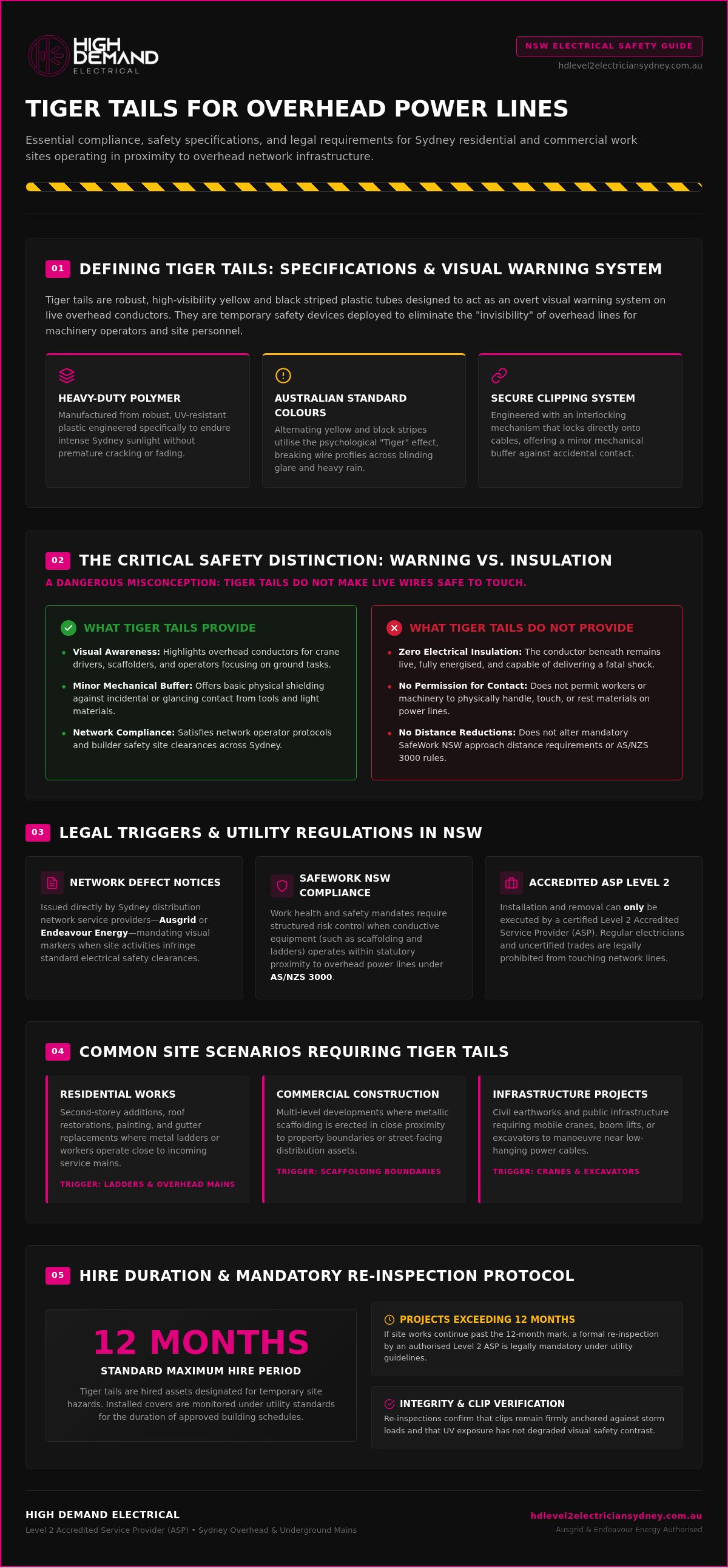
If you've noticed bright, striped tubes attached to the wires running to a home or construction site, you're looking at a critical piece of safety equipment. To answer the fundamental question: what are tiger tails for power lines? They are robust, high-visibility yellow and black striped plastic tubes designed to act as a visual warning system for anyone working in proximity to live electricity. These aren't permanent installations; they are temporary safety measures typically hired for the duration of high-risk construction or maintenance activities.
The physical design of a Tiger Tail is engineered specifically for the harsh Australian climate. These tubes are manufactured from heavy-duty, UV-resistant plastic to prevent cracking or fading under the intense Sydney sun. They feature a unique clipping mechanism that allows a qualified Level 2 ASP to secure them directly onto overhead power lines. By covering the conductors, they provide a minor mechanical buffer, but their primary function is to eliminate the "invisibility" of wires for crane operators, scaffolders, and builders who might otherwise lose track of the line's position while focused on their tasks.
In Sydney, Tiger Tail installation is a standard requirement for many residential and commercial projects. Because they are temporary, they are typically subject to a 12-month hire period. If your project exceeds this timeframe, a re-inspection is mandatory to ensure the clips remain secure and the visibility hasn't been compromised by environmental wear. It's a structured approach to risk management that keeps your site compliant with utility provider standards.
Why the Yellow and Black Stripes?
The high-contrast pattern isn't an aesthetic choice. It utilises the "Tiger" effect, a psychological trigger that signals immediate danger to the human brain. This specific colour convention complies with Australian Standard safety protocols, ensuring the lines remain visible across Sydney's diverse weather conditions. Whether it's the blinding glare of a summer afternoon or the reduced visibility of a heavy rain event, the alternating stripes break up the visual profile of the wire. Tiger Tails are visual safety aids that strictly follow these national colour conventions for maximum risk mitigation.
Where You Will Commonly See Them in Sydney
You will encounter these safety devices across various environments in the Greater Sydney area, particularly where human activity intersects with the electrical grid. Common scenarios include:
• Residential streets during second-storey additions, roof repairs, or gutter replacements where ladders are in use near the service line.
• Commercial construction sites where scaffolding is erected near the property boundary or network assets.
• Public infrastructure projects where heavy machinery, such as cranes or excavators, operates near low-hanging cables.
The Critical Safety Distinction: Visual Warning vs. Electrical Insulation
A dangerous misunderstanding exists among many Sydney homeowners regarding the protective capabilities of these devices. When people ask what are tiger tails for power lines, they often assume the plastic covering transforms a lethal cable into a safe, insulated wire. This is categorically false. Tiger Tails provide a minor mechanical buffer against incidental contact, but they offer zero electrical insulation. The cable underneath remains live, uninsulated, and capable of delivering a fatal shock even with the cover in place.
Complacency is a leading cause of electrical accidents on Sydney work sites. Believing the line is "safe" because it's wrapped in plastic leads workers to take unnecessary risks. Everyone on site must strictly adhere to the SafeWork NSW approach distance requirements. These regulations, alongside AS/NZS 3000 standards, dictate exactly how close people and equipment can get to network assets. Tiger Tails do not grant permission to work closer to the lines; they simply make it easier to see where those lines are located.
What Tiger Tails Can and Cannot Do
Understanding the limitations of these safety tools is essential for effective risk management. They serve a specific purpose but cannot replace comprehensive safety protocols.
Can
Alert crane operators and truck drivers to the presence of overhead cables they might otherwise miss against a busy background.
Can
Help property owners satisfy WorkCover and SafeWork NSW requirements for site safety during renovations.
Cannot
Prevent an electrical flashover or discharge if a person, ladder, or tool enters the immediate danger zone.
Cannot
Replace the legal requirement for a dedicated "spotter" when operating high-risk machinery near the network.
The Danger of the "Safe to Touch" Myth
The line remains live and lethal underneath its plastic housing. Environmental factors can further compromise safety; for instance, moisture, condensation, or a build-up of dirt inside the tube can actually conduct electricity. When explaining what are tiger tails for power lines to your contractors, you must emphasise that the plastic is a warning, not a shield. If a line is physically contacted or damaged, the situation becomes an immediate crisis. In these instances, emergency make-safe services are required to secure the site. If you are unsure about the safety clearances on your property, talk to our Level 2 ASP team for a professional assessment to ensure your project remains compliant.
When is Tiger Tail Installation Legally Required in NSW?
Understanding what are tiger tails for power lines is only the first step; knowing when you're legally compelled to install them is what keeps your project moving. In New South Wales, the requirement is often driven by safety proximity. If you're planning work where people or equipment will come within 4 metres of overhead service mains, you're entering a zone that requires strict risk mitigation. This isn't just a recommendation; it's a core component of your duty of care as a property owner or site manager.
Network operators like Ausgrid or Endeavour Energy frequently mandate these visual aids before they will approve a work permit for high-density areas. This is particularly common in Sydney's Inner West or the Sutherland Shire, where property boundaries are tight and lines are close to structures. Following Essential Energy's tiger tail guidance, these tubes are strictly visual indicators and do not provide a "safe to touch" zone, but they are a prerequisite for legal compliance on many Sydney work sites.
If you have a private power pole installation on your property, you are responsible for the safety of the line from the street to your building. During routine inspections, a utility provider might issue a defect notice if they spot vegetation encroaching on the point of attachment. Resolving this via defect notice rectification often involves installing tiger tails to protect tree loppers as they clear the area. This ensures the contractors can clearly see the live wires while navigating branches.
Scaffolding and Construction Sites
Scaffolding contractors are legally bound by SafeWork NSW to assess overhead risks before erecting any structure. If a scaffold is built within specified clearance zones, tiger tails become mandatory. A "competent person", usually a project manager or site foreman, must conduct this assessment to determine the level of risk. Failing to have these visual aids in place can lead to immediate work stoppages and significant fines from inspectors. They act as the first line of defence in a multi-layered safety plan to prevent accidental contact with the network.
Home Renovations and Painting
Even minor projects like painting gutters or repairing a roof can trigger a legal need for line protection. Metal ladders are highly conductive; if one slips near an unshielded service line, the results are often fatal. By organising electrical safety inspections before your trades arrive, you can identify these hazards early. This proactive approach ensures your contractors aren't left waiting on-site while you scramble to book a Level 2 ASP for an urgent installation, saving you both time and stress.
Why You Must Use a Level 2 ASP for Installation
When property owners investigate what are tiger tails for power lines, they often discover these devices are available for purchase from various industrial suppliers. However, owning the equipment and having the authority to install it are two very different matters. In New South Wales, only a Level 2 Accredited Service Provider (ASP) is legally authorised by network operators like Ausgrid or Endeavour Energy to work on the service lines connecting your home to the grid. A standard electrician does not possess the specific accreditation required to touch these network assets, and attempting a DIY installation is both illegal and life-threatening.
The installation process involves working at heights in the immediate vicinity of live 240V or 415V conductors. This high-risk environment demands specialised training and the use of tested, insulated tools and personal protective equipment (PPE). Beyond the physical danger, there is the matter of strict compliance with the Service and Installation Rules of New South Wales (SIRNSW). An ASP Level 2 ensures that the installation meets these rigorous standards and provides the necessary compliance documentation. This paperwork is your only proof that the site is legally protected, which is essential if a SafeWork NSW inspector visits your property.
The Risks of Unauthorised Installation
The immediate danger of electrocution is the most significant risk when an unqualified person attempts to clip covers onto live overhead mains. Even a minor slip can result in a fatal discharge or a massive electrical arc. Furthermore, unauthorised contact with the network can lead to significant infrastructure damage, resulting in heavy fines from utility providers and the potential for your property's power to be disconnected for safety reasons. High Demand Electrical holds EC Licence 397193C, ensuring that every technician on your site is fully licensed and qualified to handle these high-stakes tasks without compromising the network or your safety.
The Level 2 ASP Advantage
Choosing an ASP Level 2 provides a level of professional reassurance that a generalist electrician cannot offer. At High Demand Electrical, our operations are backed by triple ISO certifications (9001, 45001, and 14001), reflecting our commitment to quality, environmental responsibility, and occupational health and safety. We understand the local regulations across Sydney, providing rapid response services from our Leichhardt base to the Sutherland Shire and beyond. If you have received a defect notice or need to secure your site for upcoming works, book a professional installation with our Level 2 team today to ensure your project remains on the right side of the law.
How to Organise Tiger Tail Installation in Sydney
Transitioning from understanding what are tiger tails for power lines to having them physically installed requires a structured approach to ensure site compliance. The process begins with an initial assessment where our team evaluates the specific risks associated with your project. By contacting High Demand Electrical, you can determine exactly how many tails are required to cover the relevant span of the network and establish the necessary hire duration based on your construction timeline. This proactive step prevents project delays and ensures you have a clear understanding of your safety obligations from day one.
A qualified Level 2 ASP will then conduct a formal site inspection to assess your overhead service mains. This step is critical for identifying any existing damage or clearance issues that might complicate the installation. Once the assessment is complete, we perform a professional installation using insulated high-voltage tools and specialised safety gear. Our technicians ensure each tube is securely clipped to the line, providing the high-visibility warning required by Sydney utility providers. We handle all the technical complexities, allowing you to focus on your renovation or build.
Ongoing maintenance is a mandatory part of the safety lifecycle. In Sydney, the standard hire duration for Tiger Tails is typically 12 months. If your project extends beyond this period, a re-inspection is required to verify that the equipment remains in good condition and hasn't been degraded by UV exposure or high winds. Once your high-risk work is finalised, we return to the site for safe removal. This ensures the network assets are left in their original state and your legal liability is officially closed out.
What Information Do You Need to Provide?
To expedite your quote and ensure we arrive with the correct equipment, please have the following details ready when you call our team:
Your Exact Location
Whether you're in the Inner West, West, South West, or the Sutherland Shire, we need your specific address to coordinate logistics and network notifications.
The Utility Provider
We must know if your property falls under the Ausgrid, Endeavour Energy, or Essential Energy network to ensure all compliance paperwork is filed correctly.
The Nature of the Work
Specify if the installation is for scaffolding, painting, roof repairs, or responding to a recent utility provider defect notice.
Booking Your Installation with HDE
We have designed our booking process to be as direct as possible, mirroring the urgency of your site safety needs. High Demand Electrical maintains 24/7 availability for urgent safety requirements and emergency make-safe services across the Greater Sydney area. We provide comprehensive quotes that include the hire, installation, and eventual removal of all safety assets, giving you professional reassurance that your project is legally protected from start to finish. Contact High Demand Electrical for professional Tiger Tail installation today to secure your site and maintain your construction momentum.
Secure Your Sydney Site with Professional Installation
Prioritising safety on your property means moving beyond the basic question of what are tiger tails for power lines and taking decisive action to manage your site risks. These high-visibility indicators are essential for protecting contractors and ensuring your project complies with SafeWork NSW and utility provider regulations. It is vital to remember that while these striped tubes increase wire visibility, they don't insulate the line; maintaining legal approach distances remains your primary defence against electrical accidents.
As a Level 2 ASP authorised for the Ausgrid, Endeavour, and Essential Energy networks, High Demand Electrical provides the specialised expertise required for compliant installation. Our team holds EC Licence 397193C and maintains triple ISO certifications in Quality, Safety, and Environment, ensuring every job meets the highest regulatory standards across Sydney. Don't let a safety oversight or a utility defect notice stall your construction progress. We are ready to assess your site and provide the professional reassurance you need to proceed with confidence.
Secure your site today-Contact HDE for Tiger Tail Installation
Frequently Asked Questions
Do Tiger Tails make power lines safe to touch?
No, Tiger Tails do not make power lines safe for physical contact. They are designed as high-visibility visual aids to alert workers to the presence of live overhead cables. The plastic tubes provide zero electrical insulation against the voltage underneath. Even with these covers installed, you must maintain the mandatory approach distances required by SafeWork NSW. Thinking they are a physical shield is a dangerous misconception that can lead to fatal electrical accidents on your site.
How much does it cost to have Tiger Tails installed in Sydney?
The cost of installation depends on the number of tails required and the length of the hire period. Because every Sydney property has unique service line configurations, we provide individualised quotes after an initial assessment. Our pricing includes the professional installation by a Level 2 ASP and the eventual removal once your project is complete. Contact High Demand Electrical on 0402 559 777 to discuss your specific site requirements and receive a detailed estimate for your project.
Can I install Tiger Tails myself if I buy them from a hardware store?
No, you cannot legally or safely install these yourself. In New South Wales, only a Level 2 Accredited Service Provider is authorised to touch the network assets of Ausgrid, Endeavour, or Essential Energy. Attempting a DIY installation is illegal and carries an extreme risk of electrocution. High Demand Electrical holds EC Licence 397193C; our technicians are fully qualified to handle these high-risk tasks while adhering to all Service and Installation Rules of NSW.
How long can Tiger Tails stay on the power lines?
Tiger Tails are temporary safety measures typically hired for up to 12 months. If your construction project exceeds this timeframe, a re-inspection by a Level 2 ASP is mandatory to ensure the plastic remains UV-stable and the clips are still secure. Once the high-risk activity on your site is finished, the tails must be professionally removed. We manage the entire lifecycle of the equipment, from the initial fitting to the final removal at your Sydney property.
What is the difference between Tiger Tails and line insulation?
To understand what are tiger tails for power lines, you must recognise they are visual warning devices, not electrical insulation. Genuine line insulation involves a permanent, factory-applied coating on the conductor designed to prevent current leakage. In contrast, Tiger Tails are temporary plastic tubes clipped over the line to break up its visual profile against the sky. They do not prevent electricity from arcing or discharging if a person or conductive tool gets too close to the cable.
Who is responsible for the cost of Tiger Tail installation?
The responsibility for the cost generally falls on the property owner or the party performing the high-risk work. If your renovation requires scaffolding or painting near the service mains, you are responsible for organising a Level 2 ASP to make the site safe. This applies to residential homes and commercial sites across Sydney. Investing in these visual aids is a mandatory part of your duty of care to ensure the safety of every contractor working on your property.
What happens if I work near power lines without Tiger Tails?
Working without these visual aids near live lines creates a severe risk of accidental contact and fatal injury. Legally, you may face immediate work stoppages and heavy fines from SafeWork NSW inspectors if your site is found to be non-compliant. Additionally, utility providers like Ausgrid may issue a defect notice, requiring you to rectify the situation before work can continue. Using an ASP Level 2 for installation ensures your project avoids these costly delays and remains safety-compliant.
Do I need Tiger Tails if I have an underground power connection?
If your property has a full underground service connection, you won't need Tiger Tails on your specific property boundary. However, if there are overhead network lines running across the street or nearby that your machinery or scaffolding might approach, installation may still be mandatory. We recommend a professional electrical safety inspection to determine if any part of the local network poses a risk to your project, even if your building is fed from underground consumer mains.
Powering Your Needs with Expertise
If you’re looking for a reliable, experienced, and prompt electrician, look no further than High Demand Electrical. We cater to all your electrical needs, from routine maintenance to emergency repairs and complete system installations. Our skilled team is committed to providing professional service that ensures your electrical systems run smoothly. Whether it's a small task or a large project, give us a call today. Let us meet all your electrical demands with the quality and reliability you deserve.