Tesla Charger Installation Sydney: Level 2 ASP Guide 2026
Is your Sydney home actually prepared for high-speed charging, or are you risking a catastrophic circuit failure the moment you plug in? While the convenience of an electric vehicle is unmatched, the reality is that a standard residential electrical system often lacks the capacity to handle the sustained high-amperage draw required for a tesla home charger installation. You likely want the fastest possible charge to ensure your vehicle is ready every morning, yet the fear of overloaded circuits or non-compliance with NSW safety standards remains a valid concern for many Sydney homeowners.
We understand that managing the technicalities of this process can feel overwhelming, especially when balancing the specific requirements of Ausgrid or Endeavour Energy. This guide provides the professional reassurance you need to master the technical requirements and local Sydney regulations for a high-performance setup. By leveraging expert Level 2 ASP guidance, you'll ensure your installation meets the AS/NZS 3000 wiring standards while avoiding common pitfalls like switchboard defects. We'll examine the costs of 3-phase power upgrades, the necessity of a Certificate of Compliance for Electrical Work (CCEW), and how to future-proof your infrastructure for the evolving energy demands of 2026.
Key Takeaways
• Identify why standard household power points cannot safely handle sustained high-amperage draws and how a dedicated Wall Connector eliminates the risk of melted circuits.
• Determine when your tesla home charger installation requires a Level 2 ASP to manage mandatory consumer mains upgrades and grid connection points.
• Evaluate the performance differences between single-phase and 3-phase power to select the fastest charging solution compatible with your specific Tesla model.
• Master the site assessment process, including the critical load calculations required to ensure your electrical system remains stable under heavy demand.
• Ensure full compliance with NSW safety regulations by understanding the necessity of a Certificate of Compliance for Electrical Work (CCEW) upon completion.
Why Your Sydney Home Needs More Than a Standard Power Point for Tesla Charging
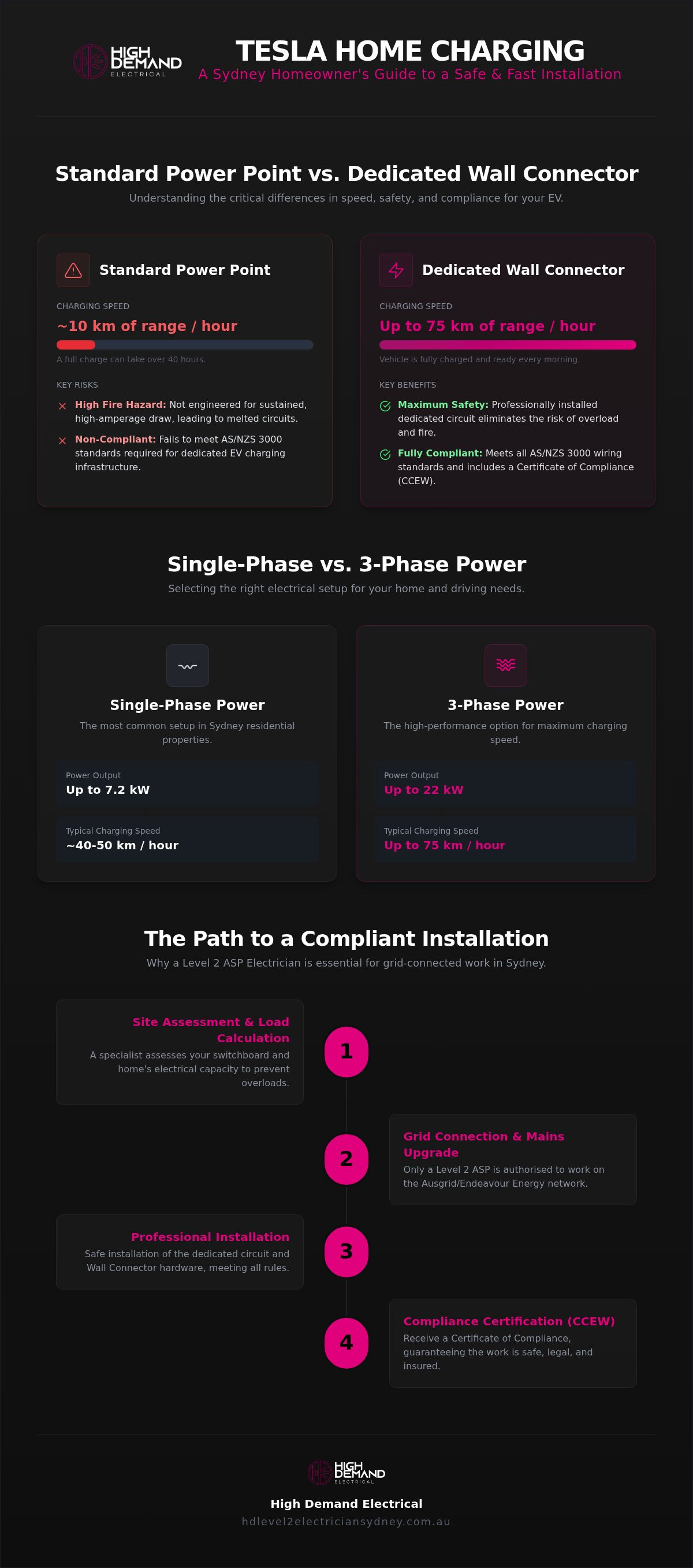
Many Sydney residents assume that because their Tesla arrived with a mobile connector, a standard 10A power point in the garage is sufficient. This is a dangerous misconception that ignores the fundamental physics of electrical loads. A standard outlet is designed for intermittent use, such as powering a kettle or a vacuum cleaner. It is not engineered to withstand the continuous, high-amperage draw required for a tesla home charger installation. Drawing 8 to 10 amps for twelve hours straight creates significant thermal stress on domestic wiring. In older Sydney suburbs, this often leads to charred terminals, melted plastic, and electrical fires that could have been easily avoided with proper infrastructure.
Compliance with the 2026 NSW safety standards is no longer just a recommendation; it is a necessity for insurance validity and property safety. A professional installation ensures your home meets AS/NZS 3000 standards, protecting your property warranty and your vehicle's sensitive battery management system. By transitioning from a basic plug to a dedicated circuit, you move from a high-risk "trickle" method to a controlled, high-performance power system.
The Limitations of Single-Phase Domestic Plugs
Relying on a standard 10A or 15A outlet is a major bottleneck for Model 3 and Model Y owners. These outlets typically add only 10km of range per hour of charging. For a commuter travelling from the Northern Beaches to the CBD, a full recharge could take over 40 hours. Beyond the speed issue, the heat generation during these marathon sessions is a critical failure point. Domestic plugs aren't built for 100% duty cycles at maximum load. Over time, the internal components of the power point degrade, increasing resistance and further escalating the risk of a domestic electrical emergency.
Benefits of a Dedicated Tesla Wall Connector
Installing a dedicated electric vehicle supply equipment (EVSE), such as the Tesla Gen 3 Wall Connector, transforms your charging experience from a liability into an asset. This hardware offers customisable power levels up to 22kW, though most Sydney homes will utilise an 11kW 3-phase or 7.2kW single-phase setup. A professional tesla home charger installation provides several technical advantages:
Charging Speeds
Gain up to 75km of range per hour, ensuring your vehicle is ready every morning.
Smart Features
Integrated Wi-Fi allows for over-the-air firmware updates and remote monitoring via the Tesla app.
Load Sharing
Multiple Wall Connectors can share power from a single circuit, preventing your main switchboard from tripping.
Durability
The hardware is weather-proof and designed for permanent, high-output use in Sydney's varying climate.
Our approach ensures that your charging setup isn't just a gadget, but a robust extension of your home's electrical infrastructure, designed to handle the high-stakes demands of modern EV ownership.
Level 2 ASP vs. Standard Electricians: Navigating Sydney’s Grid Requirements
In NSW, the distinction between a general electrician and a Level 2 Accredited Service Provider (ASP) is a matter of legal authority and safety. While a standard electrician can mount the hardware and run internal cabling, they cannot legally touch the point of attachment or upgrade your consumer mains. A high-performance tesla home charger installation often demands more current than older Sydney homes were ever designed to provide. If your property is located in the Inner West or Eastern Suburbs, your existing infrastructure likely dates back several decades. These systems were built for basic appliances, not the sustained 32-amp draw of a modern EV. Standard contractors often miss this requirement, leaving homeowners with a charger that technically works but violates grid safety protocols.
Working on the Ausgrid or Endeavour Energy networks requires specific accreditation that most domestic electricians don't possess. Without a Level 2 ASP, you cannot legally increase the capacity of your connection to the street. This limitation often leads to "nuisance tripping" where your main circuit breaker shuts down the entire house because the Tesla is drawing more power than the mains can support. Ensuring your home is grid-compliant is the first step in a reliable charging strategy.
Consumer Mains and Point of Attachment Upgrades
Many older residences rely on 6mm consumer mains, which are fundamentally insufficient for modern energy demands. Attempting a tesla home charger installation on these thin cables creates a bottleneck that leads to voltage drops or, in extreme cases, electrical fires within the wall cavities. As Level 2 ASPs, we specialise in upgrading these "power arteries" to 10mm or 16mm alternatives that can safely carry the load. For a deeper look at why this infrastructure is vital, consult our consumer mains guide. Our team manages the entire process at the point of attachment, where the street mains connect to your roof or private pole, ensuring the connection is secure and weatherproof.
Managing Ausgrid and Endeavour Energy Compliance
Every new high-load connection in Sydney requires formal approval from the network distributor. Whether you are on the Ausgrid or Endeavour Energy network, an Application for Connection (AFC) must be submitted to ensure the local grid can handle the increased capacity. Once the work is complete, a Notice of Service Work (NOSW) is mandatory. These documents are your legal proof of compliance and are essential for maintaining your home insurance. Choosing a specialist Level 2 partner ensures the following steps are handled correctly:
Grid Approval
We manage the AFC process to ensure your charger doesn't overload the local transformer.
Safety Documentation
We lodge the mandatory Certificate of Compliance for Electrical Work (CCEW).
Defect Prevention
Our work meets the strict standards required to avoid costly defect notices from network providers.
High Demand Electrical holds the direct authority to perform this work, meaning we don't need to wait for external contractors to finalise your grid connection. This streamlined approach provides the professional reassurance that your system is both high-performing and legally sound.
Single Phase vs. 3-Phase Power: Which Tesla Setup Suits Your Home?
Choosing the right electrical configuration is the most significant technical decision you will face during a tesla home charger installation. Most Sydney residences operate on single-phase power, delivering a maximum of 7.2kW to your vehicle. While this adds roughly 40km of range per hour, which is sufficient for overnight charging, it often leaves the rest of your home’s electrical system strained. If you run a ducted air conditioner and an induction cooktop simultaneously, adding a high-draw EV can easily trip your main breaker. Upgrading to 3-phase power increases your capacity to 22kW, providing the necessary headroom to run a high-performance household without compromise.
It's vital to understand your vehicle’s internal hardware limits before committing to an upgrade. Current Tesla Model 3 and Model Y units feature an onboard charger capped at 11kW. This means even on a 22kW 3-phase connection, the car will only draw 11kW. However, older Model S and Model X vehicles, or future multi-EV setups, can utilise the full 22kW. Beyond charging speeds, 3-phase power facilitates better solar energy management. It allows you to export more excess energy back to the grid and balances the electrical load across three wires instead of one, reducing the risk of voltage fluctuations and equipment wear.
Calculating the ROI on 3-Phase Upgrades
While the initial outlay for a 3-phase conversion is higher than a standard setup, the long-term return on investment is substantial in the competitive Sydney property market. A home equipped with 3-phase power is "EV-ready" for the next decade, a feature that significantly boosts resale value as petrol vehicles are phased out. When you calculate the time saved over five years of ownership, the convenience of faster turnaround times becomes clear. We view 3 phase power installation as a core infrastructure investment rather than a mere accessory, ensuring your home can support two or more electric vehicles simultaneously without needing further grid intervention.
Switchboard Modernisation for EV Loads
A high-performance tesla home charger installation is only as safe as the switchboard protecting it. Many older Sydney homes still rely on dangerous ceramic fuses that offer zero protection against electrocution or modern electrical fires. To meet 2026 safety standards, these must be replaced with modern RCDs (Residual Current Devices) and RCBOs. These components detect minute leakage currents and shut off power in milliseconds, preventing disaster. For detailed transparency on these requirements, you can review our switchboard upgrade cost Sydney guide. Modernising your board also allows for the integration of smart meters, providing real-time data on your Tesla's energy consumption and helping you take advantage of off-peak electricity rates.
The Installation Process: From Site Assessment to Sydney Grid Compliance
A successful tesla home charger installation is not merely a matter of bolting a device to a wall; it is a complex infrastructure project that begins with a precise maximum demand calculation. We perform a rigorous audit of your home’s existing electrical load to ensure the system remains stable when the vehicle draws its full 32-amp capacity. Without this calculation, you risk nuisance tripping the moment your air conditioner or induction cooktop engages while the car is charging. Our goal is to provide a seamless integration that handles high-performance demands without compromising your home's daily functionality.
The physical phase involves installing heavy-duty conduit and specialised cabling designed to withstand sustained thermal stress. Once the Wall Connector is mounted, we move into the testing and commissioning phase. We use dedicated EVSE testing equipment to simulate vehicle communication and verify that the earthing system and RCD protection are functioning perfectly. This level of precision ensures that your tesla home charger installation is safe from the first moment you plug in. We conclude the technical work by filing the mandatory Notice of Service Work (NOSW) with your network distributor, whether you are on the Ausgrid or Endeavour Energy network.
The Site Audit: More Than a Quote
Our site assessment involves a thorough inspection of your Point of Attachment (POA). In many Sydney suburbs, we must verify the structural integrity of the fascia or roof bracket to ensure it can support the tension of the service lines under increased load. We also evaluate the cable run distance from your switchboard to the garage, as excessive length can cause voltage drops that slow down charging. For larger properties on the rural-fringe of Sydney, we often identify the need for private power poles to bridge the gap between the street mains and the home safely while meeting strict distributor height and safety clearances.
Safety Certification and Compliance
Every project we complete is formalised with a Certificate of Compliance for Electrical Work (CCEW). This document is your legal evidence that the installation adheres to the AS/NZS 3000 wiring rules and NSW Fair Trading requirements. You must keep this certificate for your records; it is often the first thing a home insurance provider will request in the event of a claim. High Demand Electrical provides a professional guarantee that all work is performed by accredited Level 2 ASPs, ensuring your system is both high-performing and fully compliant with 2026 safety standards. If you are ready to secure your home's electrical future, book a professional site assessment with our specialist team today.
High Demand Electrical: Sydney’s Specialist Tesla Installation Partner
Choosing a general electrician for a high-performance infrastructure project is a risk many Sydney homeowners cannot afford. A tesla home charger installation is not a standard appliance hook-up; it is a complex integration into the NSW power grid. At High Demand Electrical, we bridge the gap between the street connection and your charger plug. Our team operates as authoritative rapid responders, specialising in the high-stakes infrastructure that generalists often overlook. We don't just install hardware; we secure your home's energy future by ensuring every component from the consumer mains to the wall connector is engineered for sustained, high-amperage performance.
Our commitment to regulatory excellence means we handle the entire compliance burden for you. From initial grid notifications to the final safety certification, we ensure your system meets the most stringent 2026 NSW protocols. We understand the urgency of getting your vehicle on the road, which is why our processes are designed for speed without sacrificing technical precision or safety.
Expertise Across the Sydney Metropolitan Area
Our reach extends across the entire Sydney basin, serving residents from the Northern Beaches down to the Sutherland Shire and out to the Greater West. We maintain deep, working relationships with Ausgrid, Endeavour Energy, and Essential Energy, which allows us to navigate their varying technical requirements with absolute confidence. Because we are accredited Level 2 ASPs, we have direct access to the specialised equipment needed for complex pole-to-home connections. If your property requires a private pole or a consumer mains upgrade to support your new Tesla, we manage the entire project in-house, eliminating the need for third-party contractors and reducing your project timeline.
Future-Proofing Your Home for 2026 and Beyond
The electrical landscape is shifting rapidly. As we move through 2026, the focus is transitioning toward bi-directional energy management, including Vehicle-to-Home (V2H) and Vehicle-to-Grid (V2G) technologies. We prepare your switchboard today for these upcoming innovations, ensuring your tesla home charger installation is compatible with future energy-sharing hardware. Our specialists also excel at integrating your charging setup with existing residential solar arrays and battery storage systems. This holistic approach allows you to maximise your self-consumption of renewable energy, lowering your running costs while reducing your reliance on the grid. We provide the professional reassurance that your infrastructure is ready for whatever the next decade of EV technology brings.
Don't leave your home's safety to chance with an unaccredited installer. Book your Level 2 ASP site assessment for Tesla charging today and ensure your system is handled by Sydney's infrastructure experts.
Securing Your Sydney Home’s Electrical Future
Your property’s electrical capacity is the foundation of a high-performance EV experience. A successful tesla home charger installation requires far more than just a wall-mounted unit; it demands a robust infrastructure capable of handling sustained high-amperage loads without compromising safety. From upgrading consumer mains to navigating the specific grid requirements of Ausgrid and Endeavour Energy, the technical details are critical for your property’s long-term value and insurance validity. By choosing a specialised partner, you ensure your system remains compliant with the latest 2026 standards.
Don't risk your property's safety with unaccredited work. High Demand Electrical provides the professional reassurance of being NSW Level 2 ASP Accredited and fully insured and compliant. As Sydney local infrastructure experts, we guarantee that your setup is ready for the complex energy demands of the future. We are ready to transition your home into a high-speed charging hub with absolute precision and technical excellence.
Get a Professional Level 2 ASP Quote for Your Tesla Installation and secure a faster, safer, and more reliable charging solution today.
Frequently Asked Questions
Do I legally need a Level 2 electrician for a Tesla charger in Sydney?
Yes, a Level 2 Accredited Service Provider (ASP) is legally required whenever the installation involves work on the service lines or the point of attachment to the grid. While a general electrician can mount the hardware, they lack the authority to upgrade your consumer mains or manage the connection to the Ausgrid or Endeavour Energy networks. Most Sydney homes require these infrastructure upgrades to safely support the high-amperage draw of a tesla home charger installation.
How much does it cost to install a Tesla Wall Connector in Sydney?
The total investment depends on your property’s existing electrical capacity and the distance between your switchboard and the charging location. While the hardware itself has a set retail price, the labour component varies based on whether your home requires a consumer mains upgrade or a switchboard modernisation to meet AS/NZS 3000 standards. We recommend a professional site audit to identify any hidden infrastructure requirements that could influence the final compliance costs for your specific Sydney property.
Can I install a Tesla charger if I live in a strata-managed apartment?
You can install a charger in a strata-managed building, but you must obtain formal approval from your owners' corporation first. This process involves a technical review of the building’s common power supply to ensure it can handle the additional load. We specialise in providing the detailed electrical reports and load management plans that strata committees require to approve a tesla home charger installation, ensuring the project meets all safety and insurance obligations for multi-unit dwellings.
How long does the installation process take from start to finish?
A standard physical installation typically takes between three and five hours to complete. However, the total timeframe is often dictated by the administrative requirements of the Sydney network distributors. Filing the mandatory Notice of Service Work (NOSW) and waiting for grid connection approvals can add several days to the project lifecycle. Our Level 2 ASP status allows us to streamline this process by handling both the technical installation and the regulatory paperwork in-house without delay.
Will a Tesla charger work with my existing solar panel system?
The Tesla Gen 3 Wall Connector integrates seamlessly with existing residential solar systems to maximise your energy independence. By configuring the system correctly, you can prioritise charging your vehicle using excess solar generation rather than drawing expensive power from the grid. This setup is particularly effective for Sydney homeowners with 3-phase power, as it allows for better load balancing and higher export limits, ensuring your EV becomes a productive part of your home’s energy ecosystem.
What happens if my home fails the initial electrical load assessment?
If your property fails the initial assessment, it usually indicates that your current consumer mains or switchboard cannot safely support a sustained 32-amp draw. This is a common issue in older Sydney suburbs. We resolve this by performing a mandatory infrastructure upgrade, which might include installing high-capacity cabling or modernising your switchboard with RCD protection. These steps are essential to prevent house fires and ensure your tesla home charger installation remains compliant with NSW Fair Trading standards.
Is 3-phase power necessary for a Tesla Model Y or Model 3?
While 3-phase power is not strictly necessary for a Model 3 or Model Y, it is highly recommended for future-proofing your home. Single-phase charging is limited to 7.2kW, which adds roughly 40km of range per hour. A 3-phase setup increases this to 11kW for these models, providing faster turnaround times. More importantly, 3-phase power provides the electrical headroom needed to run high-draw appliances like air conditioning and ovens simultaneously without risking a total power failure.
Does High Demand Electrical handle the Ausgrid paperwork for me?
We manage the entire regulatory process, including all necessary applications and notifications for both the Ausgrid and Endeavour Energy networks. This includes submitting the Application for Connection (AFC) and the mandatory Notice of Service Work (NOSW) upon completion. Our team also provides the Certificate of Compliance for Electrical Work (CCEW), which is your legal proof that the work meets all NSW safety standards. This comprehensive service ensures you don't have to navigate complex grid bureaucracy alone.
Powering Your Needs with Expertise
If you’re looking for a reliable, experienced, and prompt electrician, look no further than High Demand Electrical. We cater to all your electrical needs, from routine maintenance to emergency repairs and complete system installations. Our skilled team is committed to providing professional service that ensures your electrical systems run smoothly. Whether it's a small task or a large project, give us a call today. Let us meet all your electrical demands with the quality and reliability you deserve.