Sydney EV Charger Installation: 2026 Homeowner Price Guide
Did you know that for many homeowners in the Inner West or Eastern Suburbs, the most significant factor in the cost of installing EV charger at home Sydney isn't the sleek unit on the garage wall, but the decades-old infrastructure feeding it? While it's tempting to focus solely on hardware, the reality of Sydney’s aging grid means that a standard plug-and-play setup is rarely an option for properties requiring a dedicated high-draw circuit.
You’re likely feeling the pressure to get your home ready for a new vehicle while worrying if your existing switchboard can actually handle a continuous 32A load without risking a thermal event. We understand that this technical uncertainty is stressful. This 2026 guide provides a definitive breakdown of the critical cost drivers you'll face, from essential hardware selection to the specialised Level 2 ASP infrastructure upgrades required by NSW regulations. You'll gain a clear understanding of why ISO-certified safety management and official compliance are non-negotiable for your peace of mind. As a Level 2 Accredited Service Provider (EC Licence 397193C), High Demand Electrical ensures your installation transitions from a complex technical hurdle to a seamless, compliant reality.
Key Takeaways
• Determine how hardware selection and the cable distance from your switchboard dictate the total cost of installing EV charger at home Sydney.
• Identify why older Sydney homes often require specialised Level 2 ASP intervention for consumer mains and switchboard upgrades to ensure electrical safety.
• Evaluate the performance gap between single-phase and three-phase power to decide if a 22kW charging upgrade is a viable long-term investment for your property.
• Learn how site-specific variables, such as double-brick construction or overhead service lines, affect the complexity and labour requirements of the project.
• Gain confidence in navigating NSW safety regulations and the importance of ISO-certified compliance for high-draw residential installations.
Understanding the Components of Your Sydney EV Charger Investment
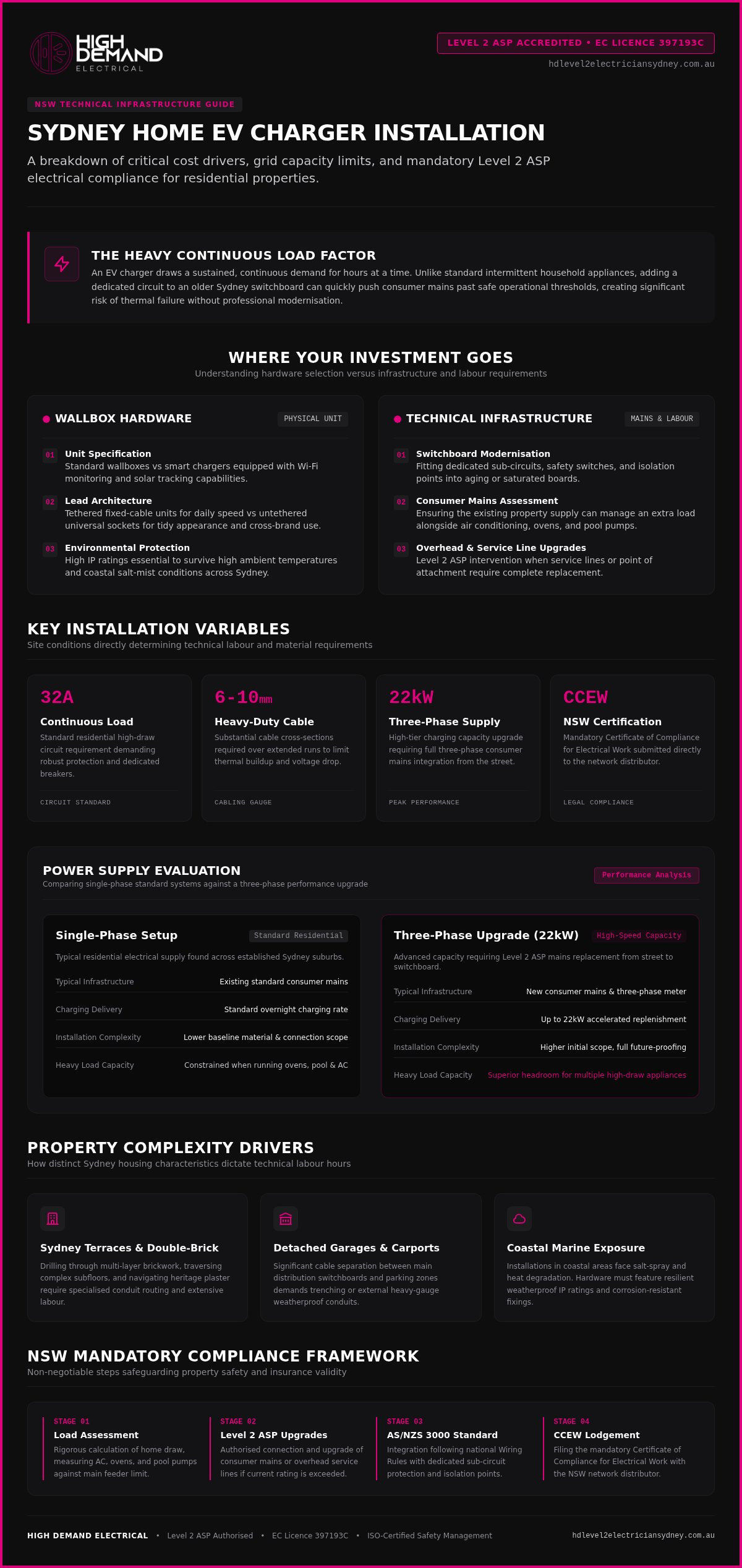
Your total investment in a residential charging station splits into two distinct categories: the physical unit and the technical labour required to integrate it safely into your home’s electrical network. While hardware prices vary based on features, the primary variable in the cost of installing EV charger at home Sydney is often the physical distance between your parking spot and the main switchboard. A charger mounted directly adjacent to a modern board requires minimal cabling; however, routing heavy-duty 6mm or 10mm cables through double-brick walls or under floorboards in a classic Sydney terrace significantly increases the material and time requirements.
To better understand this concept, watch this helpful video:
Beyond the cable length, the type of conduit used and the number of wall penetrations required influence the final quote. Proprietary units like the Tesla Wall Connector offer seamless integration for specific brands, whereas universal Type 2 stations provide flexibility for households with multiple EV makes. High Demand Electrical ensures every component, from the isolation switch to the final mounting bracket, meets rigorous Australian standards.
Hardware Selection: From Basic to Smart Chargers
Choosing between a standard wallbox and a smart charger depends on your energy goals. Smart chargers equipped with Wi-Fi and solar tracking allow you to charge exclusively on excess rooftop generation, which reduces long-term running costs. In Sydney’s coastal suburbs, hardware durability is paramount; high-heat and salt-mist environments require units with superior IP ratings to prevent premature failure. You must also decide between tethered units, which have a fixed cable, and untethered units that require you to provide your own lead. Tethered units offer daily convenience, while untethered sockets provide a cleaner aesthetic and future-proof compatibility.
Labour and Compliance Costs in NSW
In New South Wales, electrical safety is strictly regulated. Every installation must comply with AS/NZS 3000 Wiring Rules to ensure your home insurance remains valid. A standard installation involves a dedicated final sub-circuit, but complex routing through multi-storey homes or detached garages demands high-level technical skill. Upon completion, a Certificate of Compliance for Electrical Work (CCEW) is mandatory. This document proves the work meets state safety standards and is lodged with your distributor. As an authorised Level 2 ASP (EC Licence 397193C), High Demand Electrical manages these compliance hurdles, ensuring your high-draw appliance doesn't compromise your property's safety.
The Hidden Infrastructure Costs: Why Level 2 ASP Expertise is Essential
Sydney’s heritage properties in the Inner West and North Shore often hide electrical systems designed for a bygone era. When you evaluate the cost of installing EV charger at home Sydney, you aren't just buying a wallbox; you’re often funding a necessary modernisation of your home’s power supply. An EV charger pulls a heavy, continuous load for hours. This isn't like a kettle that runs for two minutes. If your property’s existing infrastructure is legacy-grade, the risk of cable insulation failure or switchboard fires is a genuine concern that requires professional mitigation.
Calculating the total cost of installing EV charger at home Sydney requires an expert look at your mains capacity. Adding a dedicated 32A circuit to a home that is already running air conditioning, electric ovens, and pool pumps can easily exceed the safe operating limits of older consumer mains. We perform a rigorous load assessment during every site visit to ensure your home can support the new demand without compromising the safety of your family or the integrity of your electrical system.
Switchboard Modernisation and Safety
Many older Sydney residences still rely on ceramic fuses. These are fundamentally incapable of protecting a modern EV circuit. A comprehensive switchboard upgrade replaces these outdated components with modern RCBOs, which combine safety switches and circuit breakers into one unit. Beyond simple protection, we focus on thermal management. High-draw appliances generate significant heat within the switchboard enclosure. We ensure there is adequate physical space and ventilation to prevent nuisance tripping or heat-related damage. Every installation we conduct follows the Service and Installation Rules of NSW (SIRNSW) to the letter, ensuring your home remains compliant and insurable.
Mains Power and Metering Requirements
The ultimate bottleneck for EV charging is your consumer mains; these are the cables running from the street to your meter. If these cables don't meet the thickness requirements specified in AS/NZS 3008 for a continuous 32A load, a new consumer mains installation is mandatory. Standard electricians are legally prohibited from touching the network side of your meter. As an authorised Level 2 ASP (Accredited Service Provider) for Ausgrid, Endeavour Energy, and Essential Energy, High Demand Electrical is licensed to handle service line and metering work that others cannot. This includes performing smart meter upgrades so you can access specialised off-peak electricity tariffs. Our triple ISO certification (ISO 9001, 45001, 14001) guarantees that this high-stakes work is performed with meticulous attention to safety and environmental standards.
We frequently identify existing network defects during these assessments, such as frayed overhead service lines or inadequate earthing. Addressing these issues during your charger installation prevents future emergencies. If you want to verify your home’s readiness, arrange a technical site audit with our specialised team today. (EC Licence 397193C).
Single-Phase vs. Three-Phase Power Upgrades: Cost vs. Performance
The performance gap between single-phase and three-phase charging is a primary variable when calculating the total cost of installing EV charger at home Sydney. While a standard 7kW single-phase wallbox provides approximately 40 kilometres of range per hour of charge, a 22kW three-phase system can effectively triple that output. However, speed isn't the only factor. Most Sydney residential properties are historically limited to single-phase power. Transitioning to three-phase requires a significant infrastructure investment, including new service lines from the street and specialised metering. This decision should be based on your daily mileage and whether your vehicle’s onboard charger can actually accept 22kW of AC power.
Is Single-Phase Sufficient for Your Daily Commute?
For the vast majority of Sydney drivers, single-phase charging is entirely adequate. If you cover the average Australian daily commute, an overnight charging window of eight to ten hours easily restores 300 to 400 kilometres of range. Smart load balancing technology also offers a cost-effective alternative to a full power upgrade. These systems dynamically adjust the charger's amperage based on your home's total demand, ensuring that running your air conditioning or oven doesn't trip the main fuse. This approach preserves your existing household capacity while avoiding the higher infrastructure fees associated with network upgrades. It's a pragmatic solution for those who want fast charging without the overhead of a total property power overhaul.
The Three-Phase Advantage for Multi-EV Households
A single-phase to three-phase upgrade becomes a logical investment for households planning to operate two or more electric vehicles simultaneously. It also facilitates the integration of large-scale solar PV systems, allowing you to capture and utilise more renewable energy. The cost drivers for this transition are split between internal wiring and mandatory network connection fees charged by distributors like Ausgrid or Endeavour Energy. These fees cover the application and connection to the upstream asset, which is a cost independent of the electrical labour.
The infrastructure requirements for three-phase power are extensive. You aren't just adding a circuit; you are replacing the physical connection to the Sydney grid. This involves installing new four-core consumer mains and potentially replacing your private power pole if it cannot support the additional weight of three-phase service lines. Because this work involves the point of attachment and service lines, Level 2 ASP accreditation is vital. High Demand Electrical (EC Licence 397193C) manages the entire process, from the initial network application to the final connection, ensuring your high-performance charging setup meets all NSW safety protocols and ISO-certified quality standards.
Sydney Site Factors and NSW Rebates Impacting the Final Quote
Sydney’s architectural diversity creates significant variance in the cost of installing EV charger at home Sydney. A modern timber-framed residence in the Hills District poses fewer labour challenges than a heritage double-brick terrace in Paddington or a sandstone property in the Eastern Suburbs. Harder construction materials require specialised diamond-core drilling and significantly more labour hours to achieve a discrete, compliant finish. Beyond the building itself, limited site access in high-density areas often introduces a "Sydney Premium" due to the logistical complexity of managing equipment and materials in narrow streets.
Homeowners frequently ask about government assistance in 2026. While the $3,000 purchase rebate and stamp duty exemptions ended on 1 January 2024, the current landscape focuses on infrastructure. As of late 2026, there are no direct cash subsidies for standalone private homes. However, the NSW EV Ready Buildings grant program remains active, providing co-funding up to $80,000 for strata apartment backbone infrastructure. For business owners, the EV Fleets Kick-Start Incentive is extended through November 2026. Understanding these nuances ensures you don't base your budget on outdated information.
Overhead vs. Underground Connection Challenges
The method by which power reaches your property dictates a large portion of the infrastructure budget. If your home relies on overhead service mains installation, we must ensure the point of attachment can support the mechanical tension of new cabling. For properties on the rural-fringe or those with long driveways, a private power pole installation may be necessary to meet Ausgrid or Endeavour Energy clearance requirements. Conversely, underground connections often require trenching. Industry benchmarks for trenching through concrete or established landscaping typically range from $80 to $150 per metre. Aerial cabling is often faster, but it must strictly adhere to network boundary regulations that standard electricians aren't authorised to manage.
Navigating Strata and Apartment Challenges
Strata installations have become significantly more accessible following the July 2025 reforms. NSW regulations now allow for "sustainability infrastructure" to be approved by an ordinary resolution, requiring only a simple majority rather than the previous 75% special resolution. Before you approach your committee, conducting comprehensive electrical safety inspections is non-negotiable. This audit determines if the building's main switchboard can support individual lot connections or if a shared backbone model is required. High Demand Electrical provides the technical documentation needed to secure these approvals, ensuring your installation meets both strata bylaws and ISO-certified safety standards.
If you're ready to navigate these site-specific challenges with an accredited specialist, request a compliant site assessment from our Level 2 ASP team today. (EC Licence 397193C).
Choosing a Specialist: The High Demand Electrical Advantage
Selecting the right specialist is the final, most critical step in managing the cost of installing EV charger at home Sydney. High Demand Electrical (HDE) operates with a triple ISO certification: ISO 9001 for Quality Management, ISO 45001 for Health and Safety, and ISO 14001 for Environmental Management. These certifications are your assurance that every high-draw installation meets rigorous global standards for safety and reliability. While a generalist electrician might handle basic internal wiring, our team manages the entire technical lifecycle of your project. We perform the initial site audit, manage the physical installation, and execute the final network connection work that standard electricians are legally restricted from performing.
Ensuring long-term reliability requires high-quality components and expert labour that understands the specific demands of continuous 32A loads. We don't cut corners on cable thickness or circuit protection. Our process is designed to eliminate technical surprises and provide a seamless transition to electric vehicle ownership. If you want a tailored quote that accounts for every technical variable discussed in this guide, contact Christopher Ng and the team directly on 0402 559 777 or via email at chris@highdemandelectrical.com.au. We are ready to secure your home’s energy future with precision and speed.
Authorised Level 2 ASP Expertise
By choosing HDE, you eliminate the need for multiple contractors. We are authorised Level 2 ASPs for the Ausgrid, Endeavour Energy, and Essential Energy networks. This means we manage the point of attachment and service lines ourselves, providing a true end-to-end service. If your property has received a defect notice rectification order during a previous inspection, we can resolve these issues concurrently with your EV upgrade. This integrated approach saves time and ensures your home’s connection to the Sydney grid is robust, safe, and fully compliant.
Quality Assurance and Safety Compliance
Safety isn't a suggestion; it's a legal requirement for high-stakes electrical work. Our adherence to AS/NZS 3000 and the Service and Installation Rules of NSW (SIRNSW) provides you with total peace of mind. We operate under EC Licence 397193C, which serves as your guarantee of professional standards and technical competence. Every project concludes with the lodgement of a Certificate of Compliance for Electrical Work (CCEW) and formal notification to your network provider. This documentation is essential for your home insurance validity and protects your property's long-term value. We handle the paperwork so you can focus on the road ahead.
Secure Your Sydney EV Charging Future Today
Understanding the total cost of installing EV charger at home Sydney requires looking beyond the wallbox. The real investment lies in ensuring your property's electrical backbone can handle a continuous 32A load safely. Whether you require a switchboard modernisation or a three-phase upgrade for a multi-EV household, technical complexity demands specialised expertise that generalist electricians simply cannot provide.
As a Level 2 ASP authorised for Ausgrid, Endeavour Energy, and Essential Energy, High Demand Electrical (EC Licence 397193C) manages the entire process from street connection to final mounting. Our triple ISO certifications (9001, 45001, and 14001) provide the professional reassurance that your installation meets the highest safety and quality standards in NSW. Don't leave your home's safety to chance. Get a professional EV charger installation quote from HDE and ensure your vehicle is powered by compliant, high-performance infrastructure. We're ready to help you make the switch to electric driving with absolute confidence and technical precision.
Frequently Asked Questions
Do I really need a Level 2 electrician for an EV charger in Sydney?
You need a Level 2 Accredited Service Provider (ASP) if the cost of installing EV charger at home Sydney involves upgrading your connection to the grid. While a standard electrician can mount the wallbox, only an authorised Level 2 specialist can legally upgrade consumer mains or service lines. High Demand Electrical is authorised for Ausgrid, Endeavour Energy, and Essential Energy networks, ensuring your high-draw setup doesn't overload the street connection.
How much does it cost to upgrade my switchboard for an EV charger?
The investment for a switchboard modernisation depends on the age and capacity of your existing board. Older Sydney homes with ceramic fuses require a complete upgrade to modern RCBOs to meet AS/NZS 3000 safety standards. We assess the physical space and thermal management needs during a site audit. Because every property is unique, we provide tailored quotes rather than fixed rates, ensuring your system handles the continuous 32A load safely.
Can I install a Tesla Powerwall and an EV charger at the same time?
You can certainly coordinate the installation of a Tesla Powerwall and an EV charger simultaneously. Combining these projects is highly efficient because both systems require similar infrastructure upgrades, such as high-capacity consumer mains and switchboard modifications. High Demand Electrical specialises in these complex setups, ensuring your solar, battery storage, and charging station work in harmony under ISO-certified safety protocols. This approach often reduces the total labour time required.
Is a three-phase power upgrade necessary for my Sydney home?
A three-phase upgrade is not mandatory for every Sydney residence but is recommended for high-mileage drivers or multi-EV households. A standard single-phase 7.4kW charger adds about 40km of range per hour, which is sufficient for most overnight charging windows. However, if you require 22kW charging speeds or plan to install multiple units, a three-phase connection provides the necessary bandwidth. We help you evaluate your vehicle's AC rectifier limits before you commit to this infrastructure change.
Will my EV charger installation require a new smart meter in 2026?
Most Sydney EV installations in 2026 involve a smart meter upgrade to facilitate specialised time-of-use electricity tariffs. These meters allow you to take advantage of super off-peak rates, typically between midnight and 4:00 AM. As an authorised Level 2 ASP, HDE manages the metering work directly, eliminating the need to wait for your energy retailer to send a separate contractor. This streamlines the process and ensures your billing is accurate from day one.
How long does a professional EV charger installation typically take?
A standard professional installation typically takes between four to six hours to complete. However, the duration increases if your project requires complex cable routing, trenching, or a total switchboard modernisation. If we are performing a single-phase to three-phase upgrade, the process involves network applications and service line replacement, which may take a full day. We provide a clear timeline during our initial technical site audit so you can plan accordingly.
Are there any NSW government rebates still available for home chargers?
There are currently no direct NSW Government cash rebates for individual homeowners installing private EV chargers in 2026. The previous $3,000 purchase rebate expired in early 2024. However, apartment residents can benefit from the NSW EV Ready Buildings grant, which co-funds backbone infrastructure for strata schemes. We recommend checking with your strata committee or employer about novated leasing options, which can sometimes include the cost of installing EV charger at home Sydney.
What happens if my home is issued a defect notice during the installation?
If your property is issued a defect notice by Ausgrid or Endeavour Energy, High Demand Electrical specialises in rapid rectification. These notices often arise from frayed service lines or inadequate earthing found during the charger assessment. As a Level 2 ASP (EC Licence 397193C), we are authorised to repair these network-side issues immediately. We ensure your home meets the Service and Installation Rules of NSW (SIRNSW), providing a Certificate of Compliance for Electrical Work (CCEW) upon completion.
Powering Your Needs with Expertise
If you’re looking for a reliable, experienced, and prompt electrician, look no further than High Demand Electrical. We cater to all your electrical needs, from routine maintenance to emergency repairs and complete system installations. Our skilled team is committed to providing professional service that ensures your electrical systems run smoothly. Whether it's a small task or a large project, give us a call today. Let us meet all your electrical demands with the quality and reliability you deserve.