Switchboard Upgrade for EV Charger Sydney: The 2026 Homeowner’s Guide
What if your new electric vehicle arrives tomorrow, but your home's electrical system is still living in the 1980s? It is a common frustration for Sydney homeowners who find that while they have purchased a "Level 2" charger, their existing infrastructure cannot handle the massive industrial-grade load. You likely already suspect that a standard power point won't cut it, and you're right to worry about the safety of your old wiring. A professional switchboard upgrade for EV charger sydney is often the only way to ensure your home remains safe and your charging remains fast without constantly tripping the mains.
In this 2026 guide, you'll discover exactly how to prepare your property for high-speed charging while meeting strict NSW Fair Trading and network provider regulations. We'll clear up the confusion between Level 2 chargers and Level 2 ASP electricians, helping you avoid hidden costs and potential fire hazards from overloaded circuits. This article explains the technical requirements for a future-proofed system that complies with AS/NZS 3000:2018 standards and keeps your household protected from the risks of outdated electrical components.
Key Takeaways
• Understand why specific safety components like RCBOs and Type B RCDs are non-negotiable for protecting your property from the high-current demands of modern electric vehicles.
• Learn why a switchboard upgrade for EV charger sydney is the foundational step to ensure your home's infrastructure can handle the highest-load appliance you will likely ever own.
• Discover how upgrading to 3-phase power and modernising your consumer mains can eliminate charging bottlenecks and significantly reduce vehicle downtime.
• Recognise the legal necessity of engaging a Level 2 ASP to manage the critical connection between your switchboard and the Sydney electrical network.
• Master the step-by-step compliance process, from initial maximum demand calculations to final coordination with network providers like Ausgrid or Endeavour Energy.
Do You Need a Switchboard Upgrade for an EV Charger in Sydney?
For many Sydney homes built before the turn of the century, the answer is a firm yes. An EV charger is the single highest-load appliance you will ever install. Unlike a kettle or a toaster that runs for minutes, electric vehicle supply equipment (EVSE) draws a continuous, heavy current for several hours at a time. This sustained demand places immense pressure on your electrical infrastructure, testing every connection point from the street to your garage.
The distinction between "charging" and "safe charging" is vital for property protection. While you might technically be able to plug in a portable charger, doing so on an outdated circuit invites significant risk. A dedicated switchboard upgrade for EV charger sydney ensures your home meets the current AS/NZS 3000:2018 wiring rules. These standards mandate that new high-draw circuits include modern protection to prevent thermal stress, which remains a leading cause of electrical fires in older Sydney suburbs.
The "Load Limit" Problem in Sydney Homes
Most residential connections in suburbs like Marrickville, Epping, or Ashfield were designed for basic lighting and modest appliances. Adding a 7kW single-phase or a 22kW three-phase charger changes your energy profile entirely. If you attempt to charge your vehicle while the ducted air conditioning and induction cooktop are running, you risk tripping the main switch or damaging the service fuses. Maximum demand is the calculated highest total electrical load that a property is expected to draw from the network at any single point in time, determined by the sum of all installed appliances and circuits adjusted by diversity factors.
Signs Your Current Switchboard is Not EV-Ready
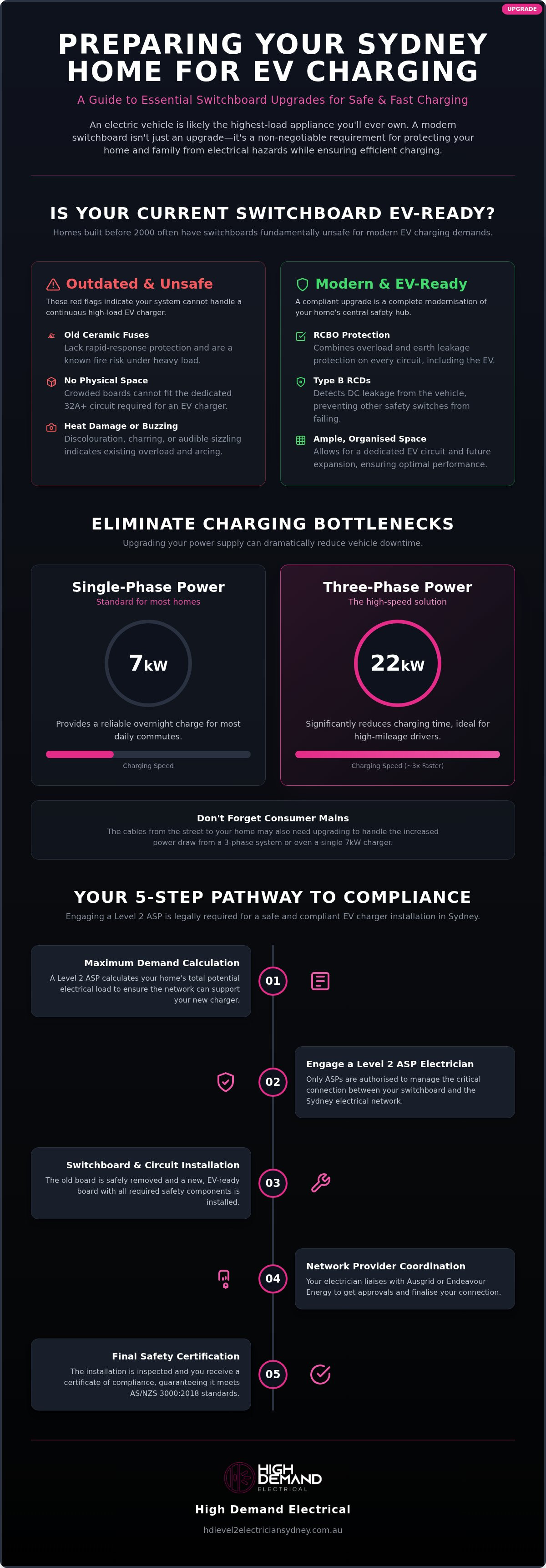
Identifying an inadequate system is often a matter of a quick visual inspection. If your board still features ceramic fuses with replaceable wire, it's fundamentally unsafe for modern EV charging requirements. These legacy components lack the rapid-response capabilities of modern circuit breakers and RCBOs. You should also check for these critical red flags:
Lack of physical space
A dedicated EV circuit requires its own 32-amp or 40-amp breaker, which won't fit on a crowded, old-style board.
Heat damage
Visible charring, discolouration, or melted plastic around terminals indicates your system is already struggling with its current load.
Audible warnings
Persistent buzzing or "sizzling" sounds when heavy appliances are active suggest loose connections or arcing.
Frequent tripping
If your main switch already cuts out during peak times, it certainly won't handle the additional 32 amps required by a fast charger.
Ignoring these warnings is a high-stakes gamble with your home's safety. A modern switchboard acts as the central safety hub of your property. Upgrading this infrastructure is a non-negotiable requirement for homeowners who want to ensure their vehicle charging is both efficient and legally compliant with NSW safety regulations.
Essential Safety Components of an EV-Ready Switchboard
A standard switchboard upgrade for EV charger sydney involves more than just adding a new breaker. It's a complete modernisation of your home's safety infrastructure. Every installation must now include RCBOs (Residual Current Breaker with Overcurrent protection). These advanced devices combine the functions of a circuit breaker and a safety switch, protecting your home from both electrical overloads and potentially fatal earth leakage. Since an EV charger pulls a heavy current for hours, the risk of thermal stress is high. RCBOs are the first line of defence in preventing heat-related failures within your board.
Specific European electric vehicle models often require Type B RCDs. Unlike standard Type A switches, Type B variants can detect smooth DC residual currents. If your car leaks DC current back into the system, a standard safety switch can "go blind" and fail to trip during a fault. Adhering to guidelines for safe and efficient EV charger installation ensures your setup is compliant with 2026 Australian standards. Furthermore, we prioritise high-quality metal or fire-resistant polycarbonate enclosures. These materials are superior for heat dissipation, ensuring your components don't degrade prematurely under the constant load of a 32-amp charger.
Dedicated Circuits vs. Shared Loads
It's a dangerous mistake to "daisy-chain" an EV charger off an existing garage power point. These circuits aren't built for the sustained 7kW or 22kW demand of a modern vehicle. A dedicated circuit is mandatory, typically requiring 6mm or 10mm heavy-duty cabling depending on the run length and installation environment. This ensures the cable doesn't overheat behind your walls. You must also ensure your safety switch installation is performed by a professional who can issue a Certificate of Compliance for Electrical Work (CCEW), which is a legal requirement in NSW.
Smart Load Management Devices
Many Sydney homes have a limited 63-amp main supply. If you're charging your car while running a ducted air conditioner and an electric oven, you'll likely trip the main switch. Smart load management solves this by using CT (Current Transformer) clamps to monitor your total household power draw. The system automatically throttles the charger's speed when other high-load appliances are active, prioritising your home's essential functions. Hard-wired load management is the gold standard for reliability, providing a fail-safe connection that doesn't rely on potentially unstable Wi-Fi signals. If you're concerned about your property's current capacity, it's best to get a professional load assessment before committing to a specific charger model.
Beyond the Board: Consumer Mains and 3-Phase Power Upgrades
The physical charger mounted on your wall is only the tip of the iceberg. True electrical readiness starts at the street. If your Sydney home was built before the mid-90s, the cables connecting your property to the Ausgrid or Endeavour Energy network are likely 6mm or 10mm copper. These were never intended to carry the continuous, high-amperage load required by modern electric vehicle supply equipment. Attempting to force a high-speed charge through these "bottleneck" cables can lead to dangerous thermal stress and significant voltage drops across your entire property.
Upgrading your supply to 100 amps provides the necessary overhead for an EV, solar battery, and induction cooking. However, this level of work requires a specific accreditation. A standard electrician is not legally authorised to touch the service fuses or the point of attachment. You must hire a level 2 asp electrical specialist to handle these high-risk connections. This ensures your home is safely integrated with the Sydney grid and compliant with local network standards, protecting your property from the risks associated with outdated infrastructure.
The Case for 3-Phase Power in Sydney
A single-phase 7kW charger typically adds about 40km of range per hour. For many, this is sufficient. However, a 3-phase 22kW setup can triple that speed, provided your vehicle supports it. We are seeing a significant trend across the Northern Beaches and North Shore where homeowners choose 3-phase upgrades to future-proof their properties. While the upfront infrastructure cost is higher than a standard switchboard upgrade for EV charger sydney, the long-term value and convenience of rapid home charging often outweigh the initial expense. It effectively transforms your garage into a genuine high-speed refuelling station that can handle multiple vehicles simultaneously.
Upgrading Consumer Mains
Think of your consumer mains as the primary arteries of your home's power system. Older 6mm mains are a distinct fire risk when subjected to the relentless draw of an EV charger. We typically recommend pulling new 16mm or even 25mm XLPE-insulated cables through your existing conduits. This upgrade ensures your system remains cool under pressure and eliminates the risk of cable insulation melting within your walls. It's a critical safety step that ensures your new switchboard has the raw capacity it needs to perform without straining the rest of your household's electrical supply.
The Switchboard Upgrade Process: A Step-by-Step for Homeowners
A professional switchboard upgrade for EV charger sydney follows a strict sequence to ensure both technical performance and legal compliance. We don't simply swap out components; we re-engineer your home's power distribution to handle the 2026 demands of high-speed charging. The process is methodical, transparent, and designed to minimise downtime while maximising safety.
Step 1: Initial site inspection and maximum demand calculation.
We assess your current infrastructure to determine if your consumer mains and existing board can support the additional 32-amp load. This step involves a formal calculation to ensure your total household draw won't exceed the capacity of the street connection.
Step 2: Quotation and coordination with network providers.
If your upgrade requires work on the street side of the meter, we coordinate directly with Ausgrid or Endeavour Energy. This removes the administrative burden from you and ensures all applications are lodged correctly.
Step 3: Physical installation and board modernisation.
We remove legacy ceramic fuses and install a new enclosure equipped with RCBOs and high-quality circuit breakers. This stage includes the installation of the dedicated EV circuit and any necessary smart load management devices.
Step 4: Testing, commissioning, and submission of compliance paperwork.
Once the hardware is in place, we perform rigorous safety testing under load. We then issue the required legal documentation to certify that the installation meets all Australian standards.
Compliance: The CCEW and NOSW
In NSW, every switchboard upgrade must be documented through a Certificate of Compliance for Electrical Work (CCEW). This isn't just a receipt; it's a critical legal document that proves your installation is safe and compliant with the law. You must receive a copy of this certificate to maintain your home insurance validity. Additionally, for any work involving the network connection, we lodge a Notice of Service Work (NOSW) with the relevant network provider to ensure their records reflect your property's upgraded capacity.
Managing Ausgrid and Endeavour Energy Defects
During a switchboard upgrade for EV charger sydney, we occasionally identify pre-existing defects in the service mains or the point of attachment. If left unaddressed, these issues can lead to an official defect notice from Ausgrid or Endeavour Energy, which may result in power disconnection. Only an ASP Level 2 is legally authorised to work on the network side of the meter because this involves high-risk tasks like disconnecting the point of attachment and managing the service fuses. We resolve these defects immediately during the upgrade process, ensuring your home remains powered and your new charging system is fully authorised. If you suspect your current board is outdated, you should book a professional electrical inspection to identify potential defects before they become emergencies.
Why a Level 2 ASP is Critical for Your Sydney EV Setup
Many Sydney residents are surprised to learn that a standard electrician's authority ends at the meter. When you commit to a switchboard upgrade for EV charger sydney, you're often increasing your home's total electrical footprint beyond what a standard license covers. A Level 2 ASP (Accredited Service Provider) is the only professional authorised to work on the "service" side of your installation. This includes managing the connection to the street, upgrading service fuses, and handling live power safely. Without these specific credentials, an electrician cannot legally complete the essential work required to support a high-amperage EV circuit.
The "Point of Attachment" Responsibility
The physical connection point is often the most neglected part of a home's electrical system. Whether it is a riser bracket on your roof or a power pole installation on your property, these components are your legal responsibility to maintain. We frequently encounter frayed overhead wires or corroded attachment points that would fail an Ausgrid safety audit. By engaging a specialist who can handle both the internal board and the external connection, you ensure the entire system is robust enough for 2026 standards. We don't just plug in a charger; we secure the entire power supply chain from the street to your garage.
Total Energy Management
Your switchboard is no longer just a box of fuses; it is a gateway to total energy management. Integrating a high-speed charger with an existing solar system requires precise load balancing and smart circuitry. We design your upgrade with the next decade in mind, ensuring compatibility with emerging V2H (Vehicle-to-Home) technology. This allows your vehicle to serve as a backup power source during grid outages, a feature that is becoming increasingly valuable in Sydney's changing climate. A smart, modernised board acts as the central hub for your car, your solar, and your household appliances, optimising energy flow and reducing your long-term costs.
High Demand Electrical is the preferred choice for Sydney homeowners who refuse to compromise on safety or technical depth. We thrive in complex environments where standard solutions fall short. Our team manages every aspect of the project, including the legal notifications and network coordination that often overwhelm generalists. Ensure your home is safe, compliant, and ready for the road ahead. Contact High Demand Electrical for a Sydney switchboard assessment today to secure your property's electrical future.
Power Your New Vehicle with Absolute Confidence
Transitioning to an electric vehicle is a significant step toward a sustainable future, but your home's infrastructure must be ready to support it. A professional switchboard upgrade for EV charger sydney isn't just about convenience; it's a critical safety measure that protects your property from the sustained thermal stress of high-amperage charging. By modernising your consumer mains and installing advanced RCBO protection, you eliminate the risks associated with outdated wiring and legacy fuses while ensuring your system can handle the massive industrial-grade load of modern charging equipment.
As accredited Level 2 ASP electricians, we specialise in high-demand infrastructure that standard generalists aren't authorised to manage. We provide comprehensive Sydney-wide coverage, including the Northern Beaches and Inner West, ensuring your entire system from the street to the garage is compliant and future-proofed. Don't leave your property's safety to chance with a standard setup that wasn't designed for 2026 demands. It's time to secure your home with a system built for performance.
Book Your Sydney Switchboard & EV Readiness Audit today to ensure your property is fully prepared for the road ahead. Your journey toward faster, safer home charging starts with a reliable, high-capacity electrical foundation.
Frequently Asked Questions
Do I legally need a switchboard upgrade to install a Tesla Wall Connector in Sydney?
You legally require an electrical system that can safely manage the 32-amp continuous load of a Tesla Wall Connector. Most older Sydney homes have main switches or service fuses rated for only 60 amps, which cannot support a high-speed charger alongside air conditioning and cooking appliances. A switchboard upgrade for EV charger sydney ensures your property complies with AS/NZS 3000 safety standards and prevents the risk of fire from overloaded circuits.
How much does an electrical switchboard upgrade cost in 2026?
The total investment depends on your current board's condition, the number of circuits requiring modernisation, and whether your consumer mains need an increase in capacity. For a detailed breakdown of current industry rates and factors that influence the final price, please refer to our comprehensive electrical switchboard upgrade cost guide. We provide transparent assessments to ensure your system is built for long-term reliability without hidden expenses.
Can I charge my EV from a standard 10-amp power point instead?
While you can use a portable "trickle" charger, it is not a recommended long-term solution for Sydney homeowners. Standard power points are not designed to run at maximum capacity for 12 or more hours daily, which can lead to heat fatigue in your wall wiring. Additionally, you'll only gain roughly 10km to 15km of range per hour of charging, making it impractical for daily commuting compared to a dedicated 32-amp circuit.
How long does a switchboard upgrade take, and will my power be off all day?
A typical residential upgrade takes between four and eight hours to complete. Your power will be disconnected for the majority of this window to allow our technicians to safely remove legacy components and install modern RCBO protection. We coordinate the outage to minimise disruption to your household and ensure all testing is finalised before we restore supply and commission your new charger.
What is the difference between an electrician and a Level 2 ASP for EV charging?
A standard electrician is qualified to install the charger unit and internal wiring. However, a Level 2 ASP is required for any work involving the service fuses, the point of attachment, or the consumer mains cables that connect your home to the Sydney grid. Since most EV installations require an increase in total property capacity, an ASP Level 2 is usually necessary to ensure the entire power chain is legally authorised and safe.
Will a switchboard upgrade increase the value of my Sydney property?
Yes, EV readiness is a high-priority feature for buyers in the 2026 Sydney real estate market. A modernised switchboard and a dedicated charging circuit demonstrate that the property's infrastructure is future-proofed and safely maintained. It removes a significant technical hurdle for the growing number of electric vehicle owners, making your home more attractive during a sale or lease process.
What happens if my home is in a heritage-listed area of Sydney?
Heritage properties often require careful planning to ensure the switchboard upgrade for EV charger sydney doesn't impact protected aesthetics. While internal board modernisations are generally straightforward, external work like new consumer mains or point of attachment repairs may require specific placement or materials. We are experienced in navigating these local council requirements to ensure your upgrade is both compliant and sympathetic to your home's character.
Do I need to notify Ausgrid or Endeavour Energy before installing a charger?
Yes, all new high-load installations must be reported to the relevant network provider through a Certificate of Compliance for Electrical Work (CCEW). If your upgrade involves work on the service mains or meter, we also lodge a Notice of Service Work (NOSW). This documentation is vital because it ensures the network provider can manage the local transformer load and provides you with the necessary proof for your home insurance policy.
Powering Your Needs with Expertise
If you’re looking for a reliable, experienced, and prompt electrician, look no further than High Demand Electrical. We cater to all your electrical needs, from routine maintenance to emergency repairs and complete system installations. Our skilled team is committed to providing professional service that ensures your electrical systems run smoothly. Whether it's a small task or a large project, give us a call today. Let us meet all your electrical demands with the quality and reliability you deserve.