
Strata EV charger installation in NSW: who approves and pays
The key issue in strata EV charger installation regulations in NSW is whether the work affects common property: if it does, strata approval is required. The proposed Strata Schemes Legislation Amendment (Miscellaneous) Bill 2026 would create a specific right for owners to install a charger on their lot under sections 132D and 132E. As of October 2026, it has passed the Legislative Assembly and is before the Legislative Council; under the proposed rules, the owner pays installation costs and indemnifies the owners corporation for specified reasonable costs and damage.
Before buying equipment or raising the issue with your strata committee, clarify how the proposed charger affects the building and its shared property. Approval depends on the charger location, cabling route, whether the system is individual or shared, and any impact on the building’s electrical infrastructure. This guide explains the approval process, costs and ongoing responsibilities, and what to consider when common property is involved. You’ll be better placed to understand the decisions your building needs to make and the practical steps involved.
Key Takeaways
• Work affecting common property needs strata involvement. Understand how the proposed NSW right to charge changes the approval pathway before planning an installation.
• The approval process can differ for an individual charger and shared infrastructure, so clarify the proposed setup and applicable vote before work begins.
• Individual owners generally pay for their charger, installation and related electrical upgrades; shared infrastructure may involve owners corporation expenditure.
• Assess the building’s electrical capacity before choosing a charger. Potential upgrades and the way power is supplied can shape the suitable approach.
• Set clear arrangements for electricity costs, access, maintenance and responsibility for damage so charging works smoothly after installation.
Can an Owner Just Install a Charger in Their Car Space?
An owner generally needs to consider strata approval before installing a charger, particularly if the work affects common property. There is no single installation cost: the owner generally pays for the charger, installation, ongoing maintenance and any electrical upgrades needed to connect it to their meter.
Owner, tenant and owners corporation responsibilities
The owner is responsible for the individual charger’s costs and must account for any impact on shared building property. A car space may be privately owned, while walls, cabling routes and electrical infrastructure remain common property.
Before work begins, discuss the proposal with the strata manager and owners corporation. Cover the charger location, cabling route, electricity supply and any required upgrades. Owners are also responsible for maintaining their personal charger and meeting specified reasonable costs or addressing damage under the proposed rules.
Tenants need their landlord’s approval to install a charger. The landlord can then act on the tenant’s behalf with the owners corporation. For example, a tenant proposing a wall-mounted charger should obtain the landlord’s consent first, then follow the building’s approval process rather than arranging installation independently.
The owners corporation manages shared property and building-level decisions. Its role can include considering how proposed work affects common electrical infrastructure and other residents. An individual owner’s responsibility for payment does not remove the need to address impacts on shared property.
Consultation and approval for common property
Before work starts, discuss the charger location, cabling route and electrical impact with the strata manager and owners corporation. Fixing equipment to a common-property wall or connecting it through shared infrastructure involves more than the owner’s car space.
Under the Strata Schemes Management Act 2015, work affecting common property requires owners corporation approval. For an individual charger, a by-law can authorise the work and set conditions. Existing legal guidance describes a by-law motion and a 51% resolution for a simple installation in an owner’s garage; a charger fixed to common property may require a by-law and special resolution at the 51% level.
The proposed Strata Schemes Legislation Amendment (Miscellaneous) Bill 2026 would establish a specific owner right under sections 132D and 132E. As of October 2026, it has passed the Legislative Assembly and is before the Legislative Council. Under section 132D, a strata committee must respond to an installation notice within three months, unless regulations specify a longer period.
If the proposed rules apply, an owner carrying out work on common property may proceed after receiving a no-objection notice. A committee objection must give reasonable grounds in writing; an owner who considers those grounds unreasonable can apply to NCAT. Under section 132E, the owner pays installation costs and indemnifies the owners corporation for specified reasonable costs and damage.
What vote is needed to install EV chargers in an apartment building?
The vote depends on whether the proposal covers an individual lot, shared parking or the whole strata building. The Strata Schemes Management Act 2015 classifies EV charging as sustainability infrastructure under Section 132B. Owners asking about the “strata EV charger installation regulations NSW” are usually trying to identify which approval pathway applies to their building.
For sustainability infrastructure, a resolution passes unless at least 50% of the value of votes cast are against it. Individual installations may also need a by-law at a general meeting to authorise the work and set conditions. The motion should distinguish equipment for one lot from shared infrastructure, and describe any common-property work it covers.
The Strata Schemes Management Amendment (Sustainability Infrastructure) Bill 2020 categorised EV charging infrastructure as sustainability infrastructure, replacing the previous special-resolution requirement described for section 108. The “strata EV charger installation regulations NSW” question therefore turns on the work’s legal category, scope and effect on common property, not simply the charger’s location.
NSW strata installation requirements sit within the Strata Schemes Management Act 2015, including sustainability infrastructure under Section 132B. Common-property changes have separate approval considerations, while proposed sections 132D and 132E would establish a specific owner right to install a charging station on their lot.
For electrical safety, use a licensed electrician to install EV chargers in strata buildings. An electrical infrastructure assessment can identify capacity limits and potential upgrades before owners vote. It should consider the charger’s power demand, supply arrangement and cabling route.
In apartment car parks, consider the charging proposal alongside the building’s fire-safety arrangements and emergency access. The installation layout should account for equipment placement, cabling and access through the parking area.
A building survey or energy assessment can help owners compare individual chargers with shared or whole-of-building infrastructure. Consider whether electricity will come from the grid, solar panels or a battery, and how demand may change when several vehicles charge at once.
Individual charging gives one owner dedicated equipment; shared charging raises questions about access and electricity billing. Modular infrastructure can expand in stages, while a whole-of-building plan coordinates distribution, metering and future demand. For buildings with 100 or more lots, a whole-of-building approach can coordinate planning. Owners may plan for 10% of car spaces to have charging capability within the next five to ten years.
Before the owners corporation votes, make sure the motion reflects the assessment findings and proposed scope. Discussing the building’s electrical requirements helps clarify the technical considerations behind the proposal.
Individual and shared charging infrastructure
Strata schemes can provide charging through equipment assigned to one lot or shared infrastructure in common parking areas. The choice affects resident access, how electricity use is measured and how the owners corporation manages ongoing costs.
Individual and shared charging options
An individual charger serves a particular resident’s car space, while shared chargers are available for residents to use in common areas. Shared access requires clear arrangements for charging sessions, electricity use and responsibility for the infrastructure.
A dedicated Level 2 charger rated at 22 kW is one example of shared common-property equipment. The owners corporation manages charging sessions of up to 8 hours in this model. A shared station can suit residents without a private charger, but the building needs an agreed way to manage access and usage.
Modular infrastructure offers another approach: an example divides expansion into phases of 6 EVSEs per infrastructure step. Each EV readiness box, or equivalent, supports approximately 6 EVSEs. This staged arrangement lets a scheme plan capacity in increments rather than treating every parking bay as an immediate installation.
Building size can shape the technical design. In schemes with fewer than 10 lots, the outlined approach uses individual metered circuits per bay and basic load management if there are 3 or more chargers. That requirement connects the infrastructure plan to both the number of chargers and how each bay receives power.
Metering and cost recovery
Metering records the electricity used for charging; cost recovery sets how residents pay for it. The owners corporation needs a transparent way to allocate electricity costs between users and the wider scheme.
For shared parking, the owners corporation should decide whether to meter charging electricity and how to charge for usage. Individual metering can link consumption to a particular bay; a shared arrangement needs a clear way to attribute use. These choices affect billing, resident access and ongoing administration.
An owners corporation may supply electricity to lot owners for a charge under an agreement. The agreement can set out who may use shared equipment, how charges are calculated and how residents pay.
Before choosing a model, align the infrastructure plan with the legislation and proposed operating arrangements. A building choosing shared chargers, for example, needs a policy covering access, charging sessions and electricity charges. Individual circuits, shared stations and modular expansion each have different metering and cost-recovery requirements.
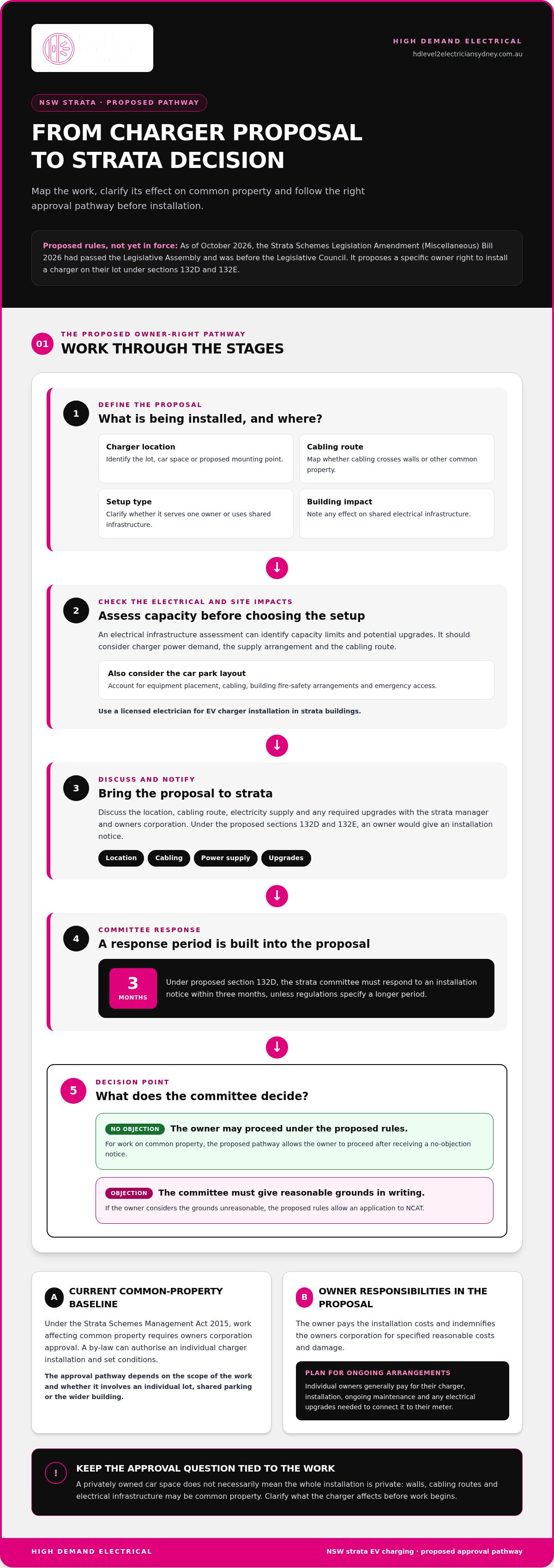
Charging station installations affecting common property
A charger can affect common property through its mounting point, cabling route, meterboard connection or changes to the building’s electrical supply. In NSW strata schemes, identifying these impacts early helps clarify the approval process and responsibility for each part of the work.
Section 108 of the Strata Schemes Management Act 2015 sets steps for changes to common property, including electrical services and infrastructure. An installation that uses a shared wall or alters the common meterboard therefore needs more than access to an owner’s car space. The owners corporation must consider the proposed work and its effect on shared property.
The proposed Strata Schemes Legislation Amendment (Miscellaneous) Bill 2026 would create EV charger provisions under section 132D. As of October 2026, the Bill has passed the Legislative Assembly and is before the Legislative Council. Under the proposed provision, the strata committee must respond to an installation notice within three months, unless regulations specify a longer period.
Under the proposed rules, an owner could carry out work on common property after the committee issues a no-objection notice. If the committee objects, it must provide its reasons in writing, and those reasons must be reasonable. An owner who considers an objection unreasonable can apply to NCAT, which can order the committee to issue a no-objection notice.
Common-property impacts can be physical and electrical. A charger fixed to a shared wall may change the building’s external appearance, while a higher-demand station may require a dedicated EV distribution board. Older schemes may also need a meterboard upgrade to support the installation. Assessing capacity and cabling routes helps the owners corporation understand the full scope before deciding.
Appearance alone has limits as a reason for blocking work. From 1 July 2025, NSW by-laws that block EV charger installations solely on aesthetic grounds are prohibited, except in heritage-listed buildings or buildings within a heritage conservation area. The proposed EV provisions also state that by-laws unreasonably blocking installations have no force or effect.
Responsibility should be clear in the approval documents. Under proposed section 132E, the lot owner pays installation costs and indemnifies the owners corporation for specified reasonable costs and damage. For example, conditions can address repair of affected common property and responsibility for costs arising from damage. This keeps individual work distinct from shared infrastructure obligations.
Before work proceeds, the scheme needs to understand the supply path, equipment location and any changes to common property. These details help owners assess whether the proposed charger suits the building’s electrical infrastructure and approval arrangements.
EV charging policies, maintenance and liability
Disputes in NSW strata schemes can involve charger access, electricity charges, building capacity or damage to common property. Under the proposed Right to Charge rules, a committee must give reasonable reasons in writing for an objection. An owner disputing those reasons can apply to NCAT.
A written charging policy sets out how residents use equipment and who manages it. The owners corporation can define access to a shared station, charging-session limits, booking arrangements and how residents report faults. For example, the policy can explain who may use a common-area charger and how the committee handles competing requests.
Maintenance responsibility depends on whether the charger serves one lot or the whole scheme. Residents generally pay to maintain personal chargers, while the owners corporation manages shared infrastructure. Approval conditions can assign responsibility for upkeep, repairs and damage, helping distinguish a fault in one resident’s equipment from a shared-system issue.
Capacity also needs ongoing attention. Load-management systems can adjust charging rates from chargers at or above Level 2 when several vehicles charge together. This helps manage the building’s power supply and reduce strain. A policy should explain how charging may be managed during periods of high demand, particularly where multiple residents share the infrastructure.
Liability arrangements should reflect the installation and its impacts. Under proposed section 132E, the lot owner pays installation costs and indemnifies the owners corporation for specified reasonable costs and damage. For a charger connected through common property, approval records should identify the affected infrastructure and clarify who addresses damage caused by the installation.
Electricity billing also needs a defined process. An owners corporation may supply charging electricity to lot owners for a charge under an agreement. The agreement can explain how usage is measured, who receives payment and how residents can query a charge. A clear metering method helps distinguish an individual vehicle’s use from general building consumption.
Review the policy when the scheme adds chargers or changes its electrical setup. A new shared station, for example, may affect access rules, energy management and maintenance responsibilities. Recording these changes gives residents and the committee a consistent basis for handling faults, costs and disputes.
High Demand Electrical: Level 2 ASP Electrical Services
High Demand Electrical can help when an approved strata EV charger project needs electrical installation or infrastructure work. Its Tesla and home EV charger installation service supports individual charging projects, while Level 2 ASP Electrical Services can address relevant electrical infrastructure requirements.
If a building assessment identifies switchboard capacity as an issue, a switchboard upgrade may form part of the project. The required work depends on the proposed charger, existing supply and any common-property work approved by the owners corporation. Aligning electrical planning with strata approval helps keep the installation suited to the building’s needs.
For electrical work connected with your strata charging plans, contact High Demand Electrical to discuss the project.
Plan the next move with confidence
Understanding strata EV charger installation regulations in NSW helps you move from approval discussions to a practical electrical plan. Next, align the owners corporation’s decisions with the building’s supply, infrastructure and intended charger use, so responsibilities are clear before work starts.
High Demand Electrical offers Level 2 ASP Electrical Services and Switchboard Upgrades for relevant electrical infrastructure work. Its Private Power Pole Installation service may also be relevant where a project involves a private power supply. The right scope depends on the building’s existing setup and the work approved by the owners corporation.
Bring your strata and electrical project requirements together with contact High Demand Electrical about your EV charging plans. A considered plan gives your scheme a clear basis for moving forward.
Frequently Asked Questions
What Is the Right to Charge?
It’s a proposed NSW pathway allowing a strata lot owner to install an EV charging station on their lot. Sections 132D and 132E appear in the Strata Schemes Legislation Amendment (Miscellaneous) Bill 2026, which has passed the Legislative Assembly and is before the Legislative Council as of October 2026. The proposed process includes notice to the strata committee and conditions addressing installation impacts and owner responsibility.
Can the Strata Committee Say No?
Under the proposed Right to Charge rules, the committee can object only for reasonable reasons and must provide them in writing. For example, an objection could identify a documented impact on building infrastructure rather than simply reject the proposal. If an owner considers the objection unreasonable, they can apply to NCAT, which can order the committee to issue a no-objection notice under the proposed provisions.
How Can Strata Fund EV Charging Infrastructure?
An owners corporation can consider funding shared infrastructure through its scheme finances, with the approval method depending on expenditure and funding arrangements. An ordinary resolution at a general meeting is usually sufficient for shared charging expenditure. For example, owners can consider whether a shared installation should be funded collectively or phased through a modular plan. The scheme’s capital works fund budgets for capital works over 10 years.
What About Common Property?
Common property includes shared building elements an installation may use or alter, such as a wall, meterboard or electrical service. A charger in a privately allocated bay can still affect these areas if its cabling crosses shared space. Before work proceeds, the scheme should identify the affected property and record arrangements for access, repairs and responsibility for damage.
What approval is required from the owners corporation to install an EV charger in NSW strata?
Approval depends on the installation’s scope and whether it affects common property. An individual installation may need a by-law at a general meeting to authorise the work and set conditions. For sustainability infrastructure, the resolution passes unless at least 50% of the value of votes cast are against it. The motion should describe the equipment, cabling route and any shared electrical work.
Can an NSW strata owner install an EV charger without owners corporation approval?
Not where the work affects common property under the current approval framework. The proposed sections 132D and 132E would establish an owner’s right to install a station on their lot, with a notice and no-objection process for common-property work. As of October 2026, the Bill remains before the Legislative Council, so the proposed process should not be treated as already in force.
Who pays for EV charger installation, electricity, maintenance and repairs in NSW strata?
For a personal charger, the lot owner generally pays for the equipment, installation, electricity and ongoing maintenance, including electrical upgrades needed for their connection. Under proposed section 132E, the owner also indemnifies the owners corporation for specified reasonable costs and damage. For shared equipment, the owners corporation manages the common infrastructure; the scheme’s agreement should clarify how electricity, maintenance and repairs are funded.
How are EV charger costs allocated when multiple owners share strata infrastructure?
The scheme can allocate charging costs through individual metering or an agreed usage charge. Individually metered circuits help attribute electricity to each bay, while shared equipment needs a clear way to record charging sessions and charge users. For example, the owners corporation’s agreement can set out eligible users, how consumption is measured, payment arrangements and who pays for maintenance. This helps prevent one resident’s use being confused with general building consumption.
Powering Your Needs with Expertise
If you’re looking for a reliable, experienced, and prompt electrician, look no further than High Demand Electrical. We cater to all your electrical needs, from routine maintenance to emergency repairs and complete system installations. Our skilled team is committed to providing professional service that ensures your electrical systems run smoothly. Whether it's a small task or a large project, give us a call today. Let us meet all your electrical demands with the quality and reliability you deserve.

