
Solar Net Metering in NSW: How Exports Are Measured and Paid
In NSW, net metering means your meter records only the surplus solar your home sends to the grid, not the power you generate and use on the spot. That surplus is then credited by your retailer at a feed-in tariff the retailer sets. To get it right, you need a compliant smart meter, network approval for your system and a retailer plan that credits exports properly. This guide explains each piece in plain terms, and where a Level 2 electrician comes in.
TL;DR
- Net metering measures only what you export. Power you generate and use on site is never metered or billed.
- NSW retailers are not required to offer a feed-in tariff and choose their own rate, so the plan matters as much as the panels.
- A NSW solar system needs network approval and a Type 4 or 4A smart meter. An old Type 6 analogue meter will not measure solar properly.
- From late 2026, new or upgrading systems on Ausgrid’s network need an internet-connected inverter to export above 1.5 kW.
- If export credits are missing from your bill, start with your retailer. A wrongly configured meter is a known cause.
Table of Contents
- What net metering means in NSW
- The rules before you connect
- How exports are credited on your bill
- Export limits and tariffs on Ausgrid’s network
- Choosing a plan that suits your solar
- Checking that your meter and bill are right
- Perspective
- Get the electrical side sorted
- What this means for different property owners
- FAQ
- Sources
What net metering means in NSW
There are two ways a meter can treat solar. The distinction decides what you see on your bill.
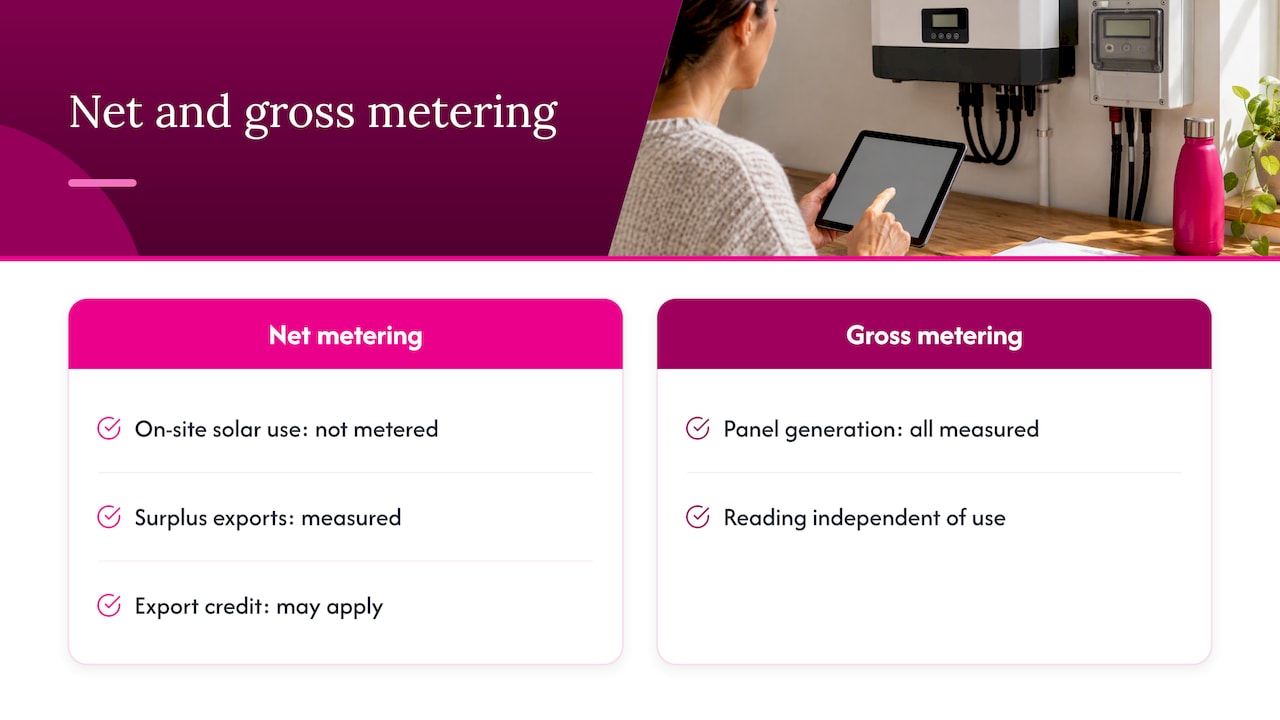
Under net metering, electricity generated and consumed on site is not metered, and only the surplus exported to the grid is measured and may be credited. Your solar runs the fridge, the air conditioner and the lights first. Whatever is left over flows out through the meter and is recorded.
Gross metering works differently. It measures all the electricity your panels generate, independently of what you consume, and most customers on the old subsidised Solar Bonus Scheme have this arrangement. It suits a system where every kilowatt-hour earns a high, fixed premium. That scheme is closed to new customers, so almost every new NSW solar installation is net metered.
You may also see the term net billing in search results. In everyday Australian use, the practical difference is small: you use your own solar first, you are billed for what you draw from the grid, and you are credited for what you export. The credit rate is the number that matters.
How the meter does the measuring
A solar-ready smart meter records two flows at your connection point: power coming in from the grid and power going out to it. These are logged as separate readings, in short intervals, so your retailer can bill the import and credit the export at the right rates and times of day. Because it measures at the point where your property meets the network, anything your panels produce and your home uses before that point never appears.
That is why meter type matters. Before connecting solar to the grid, NSW households must have a Type 4 or 4A smart meter, and a Type 6 analogue meter will not measure solar energy properly.
The rules before you connect
Two approvals sit behind every NSW solar system.
- Network approval. Network approval is required before connecting a solar system to the grid. In most cases the installer applies on the homeowner’s behalf.
- A suitable meter. Your retailer arranges the meter through its metering provider, and a licensed electrician fits and commissions it. If your property still has an analogue meter, the swap is part of the job.
Smart meters are becoming standard anyway. In 2023-24, 76% of export customers in Australia already had smart meters, and the same report notes the AEMC published a rule change in November 2024 to accelerate deployment by 2030.
Switchboard and supply readiness
Meter and inverter work happens at your switchboard. An old board with ceramic fuses, no safety switches or no spare capacity often has to be brought up to standard before solar and a smart meter can go in. If that sounds like your home, our switchboard upgrades service covers it. Larger systems, or homes adding solar plus an EV charger or heavy appliances, may also need more supply capacity, which is where a single phase to three phase power upgrade comes in.
How exports are credited on your bill
This is where most confusion starts. Solar exports are credited based on the electricity exported to the grid, at a rate chosen by the retailer. IPART publishes annual benchmark figures, but retailers are not required to follow them. In NSW, retailers are also not required to offer a solar feed-in tariff at all, and most that do offer a single all-day rate.
Why exports earn less than imports cost
It feels unfair that you are paid a few cents for power you export, then pay several times that to buy it back at night. The reason is structural. Retail prices include network, environmental and billing costs, while feed-in tariffs reflect the market value of electricity at the time of export. The practical lesson is the one IPART’s earlier guidance made: for new solar customers, savings on the retail bill are more significant than revenue from an unsubsidised feed-in tariff.
In other words, size and use your system to cover your own daytime load first. Exports are a bonus.
A worked example
Take an illustrative household. On a sunny weekday your panels produce 28 kWh. The home uses 12 kWh of that directly while the sun is up. The meter sees only the other 16 kWh leaving the property. Each of those kilowatt-hours is credited at your retailer’s feed-in rate. The 12 kWh you used directly avoided a purchase at your full usage rate, which is worth considerably more per unit. These figures are for illustration only, not a quote or a forecast.
Export limits and tariffs on Ausgrid’s network
Much of Sydney sits on the Ausgrid network, and its rules are changing. From late 2026, Ausgrid is introducing a choice of flexible or fixed export connections for new or upgraded systems, and new or upgrading systems must include a complying inverter that can communicate over the internet with the network. Customers with existing systems that are not upgrading are unaffected.
What that means in practice:
- Internet-connected inverter, flexible connection: exports of up to 10 kW per phase, or 30 kW for three-phase properties, are allowed most of the time, with rare adjustments to maintain network stability.
- No reliable internet connection: you can still connect and use all your own solar, but exports are limited to a static 1.5 kW. You can change to a flexible or fixed connection once internet becomes available.
All of this is published on Ausgrid’s solar guidance. Check it before choosing an inverter, because the inverter you buy decides your export ceiling.
Export reward tariffs
Networks can also use two-way pricing. Export reward tariffs began operating in NSW on 1 July 2024, with some network operators introducing them subject to AER approval. Ausgrid’s proposal for its two-way tariff, set out in a fact sheet it lodged with the regulator, would charge 1.2 c/kWh for exports above a monthly free threshold between 10 am and 3 pm, and pay 2.3 c/kWh for exports from 4 pm to 9 pm. Those were proposal figures for 2024-25, so confirm current rates with your retailer and network before you rely on them. The direction is clear: midday exports are worth the least, and evening exports are worth more.
Choosing a plan that suits your solar
A high feed-in tariff on its own is not a good plan. IPART’s advice is to compare the whole plan, including consumption rates, daily supply charges and the feed-in tariff, and it warns that plans with higher feed-in tariffs may carry conditions or higher prices.
A short checklist before you sign:
- Your usage rate per kWh, and whether it varies by time of day.
- The daily supply charge.
- The feed-in tariff and any conditions attached to it.
- Whether you can shift laundry, dishwashing or pool pumps into daylight hours.
- Whether a Solar Sharer Offer suits you.
The Solar Sharer Offer
From 1 July 2026, eligible residential customers with smart meters in NSW can opt into a Solar Sharer Offer with 24 kWh free over three hours. It may suit households able to shift use, such as laundry or dishwashing, into that midday window. Note that it needs a smart meter, another reason to confirm yours is a Type 4 or 4A.
Batteries
If your retailer’s export rate is low and your evening rates are high, a battery changes the maths. A battery can store excess solar power for use when the sun is not shining, when electricity prices may be higher. Battery wiring, isolation and switchboard changes should be done by a licensed electrician.

Checking that your meter and bill are right
If you have solar but see no credits, do not assume the rate is just low. Check the setup.
- Log in to your retailer’s online account or app. You can check your electricity use and download your data.
- Look for a separate export or feed-in line on the bill. If you cannot find one, contact the retailer, which may investigate and arrange meter reconfiguration.
- Compare the meter’s export readings against your inverter’s production figures. Exports should always be less than total generation.
This does happen. In one case reported by the energy ombudsman, a digital meter that was not configured to record solar exports led to missing credits. The retailer arranged reconfiguration and the solar credits appeared on the customer’s bills. If the retailer cannot resolve a fault that sits on the property side, such as a damaged meter panel or a faulty isolator, an electrician can inspect it. Our Level 2 electrician team handles metering services and defect notice rectification across Sydney.
Perspective
We see the same pattern on Sydney jobs. People spend time comparing panel brands and feed-in rates, then discover the real constraint is the switchboard, the supply or the meter position. A solar system is only as good as the connection behind it.
Our view is that net metering rewards the household that plans the electrical side first. That means a board that meets current standards, safety switches that work, enough supply capacity for the system plus whatever you add later, and an inverter that will meet your network’s export rules. Level 2 work covers the connection to the network, which is why we do the inspection before anything is quoted. Our site inspections for Level 2 work are free, so you know what the job involves before you commit.
We are an accredited Level 2 provider with 24/7 emergency support, and we would rather see you get a clean, compliant install the first time than chase missing credits or a rejected application later.
Christopher
Get the electrical side sorted
If you are planning solar, or your current system is not delivering the credits you expect, we can look at the whole connection: switchboard, supply, meter position and safety. High Demand Electrical is a certified Level 2 electrical contractor serving residential, commercial and strata properties across Sydney, with free site inspections for Level 2 work and a discount for seniors.
Talk to us about solar installation in Sydney, or contact the team through the High Demand Electrical homepage. Planning an EV charger alongside solar? See our EV charger installation page, since charging at midday is one of the easiest ways to use your own solar.
What this means for different property owners
Homeowners. Get the meter type confirmed before you buy a system. Ask the installer who is lodging the network application, what export limit you will have and whether the inverter meets your network’s internet requirement.
Businesses. Commercial sites often use more power during daylight hours, which makes self-consumption the main value. Larger systems may be assessed individually: on Ausgrid’s network, applications exceeding 10 kW per phase are assessed on a site-specific basis. Allow time for that assessment in your project schedule.
Property managers and strata. Shared supply, multiple meters and older boards make the electrical groundwork more important. Keep a record of safety inspections and board condition. Our electrical safety inspection service documents the state of the installation before any solar work starts.
Seniors. A fixed daily supply charge hits low-use households hardest, so the plan structure matters more than a headline feed-in rate. We offer discounts for seniors on electrical work.
FAQ
Is net metering the same as a feed-in tariff?
No. Net metering is how the meter measures: it records only the surplus you export. The feed-in tariff is the rate your retailer pays for that surplus. Retailers set that rate themselves, so two households with identical meters can be paid differently.
Do I need a smart meter to get solar in NSW?
Yes. NSW households need a Type 4 or 4A smart meter before connecting solar to the grid. An analogue Type 6 meter will not measure solar energy properly. Your retailer arranges the meter and a licensed electrician installs it.
Why are my solar export credits missing?
The most common cause is a meter that is not set up to record exports. Contact your retailer first, who can investigate and arrange reconfiguration. If the fault is in the meter panel or wiring on your side, a Level 2 electrician can inspect it.
Will the new Ausgrid export rules affect my existing solar?
Not if you are not upgrading. Ausgrid states that customers with existing systems that are not upgrading are unaffected. New or upgraded systems from late 2026 need an internet-connected inverter to export above 1.5 kW.
Can I have a battery with net metering?
Yes. A battery stores surplus solar for evening use, when prices may be higher. It adds wiring and switchboard work, so use a licensed electrician and confirm network requirements before installation.
Sources
- IPART: Solar feed-in tariffs
- IPART: Customers with solar PV units in NSW fact sheet
- NSW Government: Home owners’ guide to solar panels
- AER: Insights into Australia’s growing two-way energy system
- Ausgrid: Choosing a solar system
- Ausgrid export pricing fact sheet (AER submission)
- Energy Made Easy: Solar Sharer Offer
- NSW Climate and Energy Action: Energy tariffs
- NSW Climate and Energy Action: Energy meters
- EWON: Meter providers, retailers and customers
Need Help Fast?
Powering Your Needs with Expertise
If you’re looking for a reliable, experienced, and prompt electrician, look no further than High Demand Electrical. We cater to all your electrical needs, from routine maintenance to emergency repairs and complete system installations. Our skilled team is committed to providing professional service that ensures your electrical systems run smoothly. Whether it's a small task or a large project, give us a call today. Let us meet all your electrical demands with the quality and reliability you deserve.

