Single Phase and Three Phase Power: The Homeowner’s Guide to Sydney Power Upgrades
Is your Sydney home's electrical system actually equipped for the 2020s, or is it struggling to keep pace with the demands of a high-tech lifestyle? Most homeowners don't give their switchboard a second thought until the ducted air conditioning cuts out during a Western Sydney heatwave or an EV charger takes far too long to reach full capacity. It's a common frustration to face frequent circuit breaker trips while simply trying to run a modern, energy-intensive household.
Mastering the technical differences between single phase and three phase power is the first step toward ensuring your property remains safe and functional. We'll help you move past the confusion of Level 2 ASP requirements and NSW regulatory standards to determine exactly what your infrastructure needs. This guide provides a clear decision framework for power upgrades, explaining how to transition from basic supply to a robust system capable of handling everything from rapid vehicle charging to complex solar battery storage. You'll gain the confidence to engage a qualified Level 2 electrician and secure your home's energy future with professional reassurance and technical clarity.
Key Takeaways
• Learn the technical distinctions between single phase and three phase power to determine if your current 230V supply can handle modern electrical loads.
• Identify the "tipping point" appliances, such as rapid EV chargers and large ducted air conditioning units, that make a power upgrade essential for reliable performance.
• Understand the critical role of a Level 2 ASP in navigating Ausgrid and Endeavour Energy regulations for street-side connections and metering.
• Discover the step-by-step process for conducting a load assessment to future-proof your Sydney property against frequent circuit breaker trips.
• Ensure your home remains compliant with the latest NSW Service and Installation Rules by engaging accredited specialists for switchboard and consumer mains upgrades.
Understanding Single Phase and Three Phase Power in Sydney Homes
When evaluating the electrical infrastructure of your property, the distinction between single phase and three phase power determines your home's total capacity and reliability. For decades, the standard for Sydney residences was a single phase 230V supply. This setup was designed for a simpler era of energy consumption. However, as we integrate high-draw technologies into our daily lives, the limitations of older systems are becoming a critical bottleneck for homeowners. The fundamental difference lies in how much electricity can be delivered to your switchboard at any given moment.
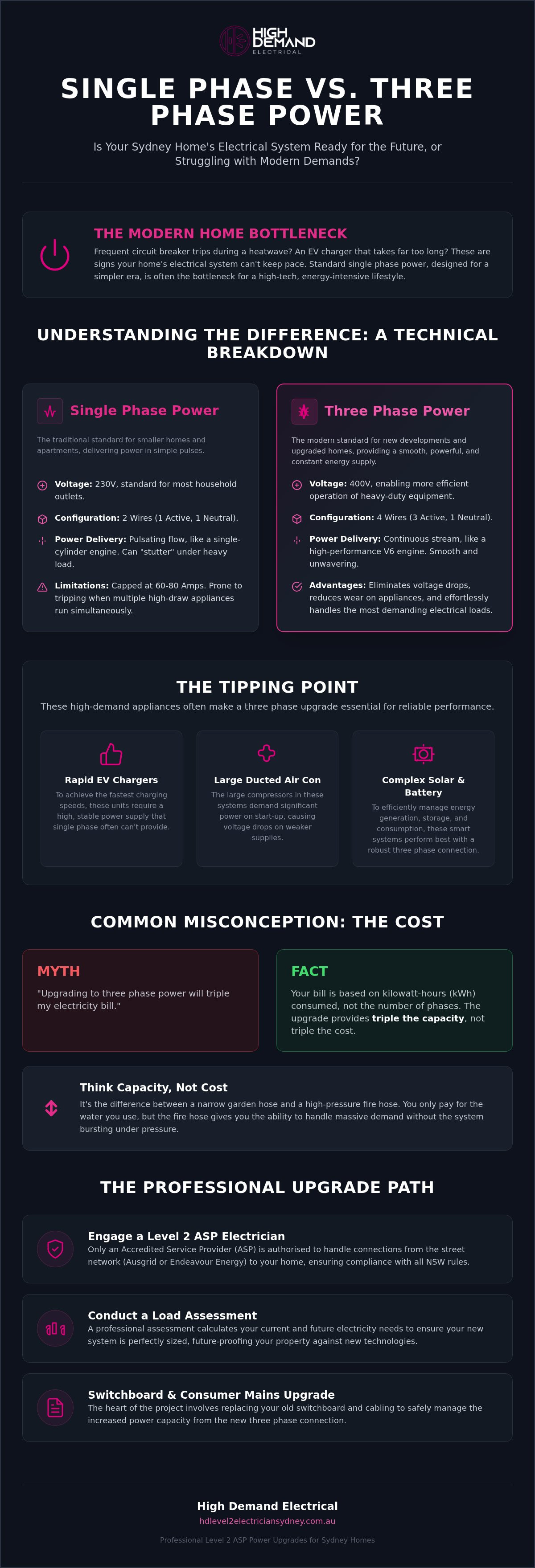
To understand the performance gap, consider the piston analogy. Single phase power operates like a single-cylinder engine; it delivers energy in pulses. While functional for basic needs, it can struggle or "stutter" under heavy pressure. Conversely, three phase power functions like a smooth, high-performance V6 engine. By delivering three separate alternating currents that overlap, it ensures a constant, unwavering stream of energy. This is why most modern Sydney developments now standardise three phase connections from the outset. It is no longer a luxury but a necessary foundation for a functional modern home.
The Basics of Single Phase Electricity
You will commonly find single phase power in smaller apartments and older cottages throughout the Inner West and Eastern Suburbs. This system utilises just two wires: one active and one neutral. While it remains sufficient for standard lighting, basic kitchen appliances, and small split-system air conditioners, it has a finite ceiling. If you attempt to run a rapid EV charger alongside a ducted air conditioning system on a single phase line, you will likely exceed the 60 to 80 Amp limit, resulting in frequent and frustrating circuit breaker trips.
What Makes Three Phase Power Different?
The technical advantage of three phase power comes from its four-wire configuration, consisting of three active wires and one neutral. This setup allows for a 400V supply that provides a continuous, non-pulsating stream of electricity to heavy loads. Understanding what three-phase power is technically helps explain why it is so much more efficient for high-demand machinery. Because the power delivery never drops to zero, your heavy appliances run more smoothly and experience significantly less wear and tear. This configuration also eliminates the risk of voltage drops when high-draw appliances, such as large motors or compressors, first start up, protecting your sensitive electronic equipment from stability issues.
The Technical Breakdown: How Phases Deliver Electricity
Understanding the transition between single phase and three phase power requires a look at the timing of the electrical waves entering your property. In a single phase system, a single alternating current wave delivers energy. This wave peaks and dips constantly. While this happens too fast for the human eye to notice, it creates a "pulsing" effect that can stress high-performance motors. Three phase power solves this by delivering three separate waves, each offset by 120 degrees. As one wave dips, the others are peaking. This ensures your home receives a constant, unwavering stream of electricity without the momentary gaps found in standard connections.
It is a common misconception that upgrading your infrastructure will triple your electricity bill. This is simply not true. Your retailer charges you for the kilowatt-hours (kWh) you consume, regardless of how many phases deliver them. Upgrading to three phase doesn't mean "triple the cost" of usage; it means triple the capacity. It's the difference between a narrow garden hose and a high-pressure fire hose. You only pay for the water you use, but the fire hose allows you to fill a swimming pool in a fraction of the time without the system bursting under pressure.
Voltage and Current Explained for Sydney Homeowners
The standard Australian wall socket provides 230V, which is perfectly adequate for charging a phone or running a toaster. However, three phase systems provide 400V between the active phases. This higher voltage is critical for industrial-grade home equipment, such as high-capacity ducted air conditioning and rapid vehicle charging stations. When you plan an EV home charger installation, having access to 400V allows the charger to pull more power with less electrical "friction" or resistance. By utilizing higher voltage, the system can deliver more energy while keeping the current (Amps) at a manageable level. This efficiency reduces heat buildup in your wiring and extends the lifespan of your expensive appliances.
Phase Balancing: Keeping Your Switchboard Stable
Once three phase power reaches your home, the next challenge is phase balancing. This involves distributing your household loads evenly across the three active wires. If an electrician puts your electric oven, clothes dryer, and air conditioner all on Phase A while Phase B and C sit idle, you've created an unbalanced system. This imbalance often leads to nuisance tripping, where the main breaker shuts down despite the total system being well under its limit. It can also cause equipment failure due to voltage fluctuations. This is why a comprehensive switchboard upgrade is non-negotiable during a phase transition. A modern, balanced board ensures that your home’s infrastructure remains stable and safe even during peak demand periods. If you suspect your current board is struggling, consulting with Level 2 ASP specialists is the most reliable way to assess your load requirements.
Single Phase vs Three Phase: Which Suits Your Lifestyle?
Choosing between single phase and three phase power ultimately depends on your household's total peak demand. A standard single phase connection in Sydney typically caps out at 60 to 80 Amps. While this suffices for a couple in a two-bedroom unit, it quickly becomes a liability for a growing family in a detached home. If you attempt to run the oven, the dryer, and a large air conditioner simultaneously, you're pushing the limits of your infrastructure. These constraints often lead to "nuisance tripping," where your daily routine is interrupted by a switchboard that simply can't keep up.
Upgrading to a three phase system doesn't just increase capacity; it changes the way you interact with technology. For homeowners looking to invest in renewable energy, the difference is stark. In the Ausgrid and Endeavour Energy networks, single phase solar systems are often restricted to a 5kW export limit. By transitioning to three-phase electric power, you can often increase this export capacity to 15kW or more. This allows you to capitalise on your solar investment by feeding more excess energy back into the grid, significantly improving your long-term return on investment.
High-Demand Appliances That Require Three Phase
Several "tipping point" appliances make a three phase upgrade mandatory rather than optional. If your renovation plans include any of the following, your current single phase board will likely fail:
Large Ducted Air Conditioning
Systems with a cooling capacity above 10kW often require three phases to start the compressor without causing light flicker across the street.
High-End Induction Cooktops
Multi-zone cooktops can draw upwards of 30 Amps on their own during peak use.
Instantaneous Electric Hot Water
These units require massive, immediate current to heat water on demand, which can overwhelm standard connections.
EV Charging: The Game Changer
Electric vehicles have fundamentally shifted how we view residential power. A standard single phase charger is limited to roughly 7kW, which might take over 10 hours to fully charge a modern long-range battery. For many Sydney professionals, this is simply too slow. A professional 3 phase power installation allows you to utilise 22kW charging speeds. This cuts charging times by more than two-thirds, making it the gold standard for Tesla owners. Future-proofing your garage today prevents the need for costly trenching and cable upgrades when you eventually add a second electric car to the family fleet.
When and How to Upgrade Your Sydney Property to Three Phase
Transitioning from single phase and three phase power is a methodical infrastructure project that requires strict adherence to NSW safety standards. The process begins with a comprehensive load assessment. This involves more than just counting your current appliances; it requires a professional calculation of your peak demand, accounting for future additions like pool heat pumps or additional EV chargers. Once your requirements are established, you must identify your network provider. In the Sydney metropolitan area, this is typically Ausgrid for the CBD, North, and East, or Endeavour Energy for properties in the Greater West.
After determining your provider, the upgrade follows a specific regulatory path:
Application Submission
Your accredited provider submits a connection application to Ausgrid or Endeavour to secure permission for the increased load.
Infrastructure Upgrade
The consumer mains cables running from the street to your home are replaced to accommodate the additional phases.
Switchboard Transformation
Your main switchboard is upgraded with a triple-pole main switch and balanced circuit protection.
Metering and Connection
A Level 2 ASP performs the final street-side connection and installs the new polyphase smart meter.
How to Identify Your Current Power Supply
You can often determine your current supply with a quick visual inspection of your electrical hardware. Open your switchboard and look at the "Main Switch." If you see a single switch, you have a standard single phase supply. A "triple-pole" main switch, which consists of three switches bridged together to operate as one, indicates an existing three phase connection. You can also inspect your electricity meter; a single phase meter typically has four terminals, while a three phase (or polyphase) meter is wider and features more complex wiring. If you're still unsure, your latest electricity bill will usually list your "Meter Type" or "Supply Type" in the technical details section.
The Role of the Level 2 ASP in Sydney
A critical distinction many homeowners miss is that a standard electrician is legally prohibited from connecting your home to the Sydney grid. While a general sparky can install a power point, you require specialised level 2 asp electrical services to handle the "point of attachment" where the street network meets your property. This work involves high-risk tasks, such as working on live overhead service lines or underground pillars. All such upgrades must comply with the April 2026 edition of the NSW Service and Installation Rules to ensure grid stability and personal safety. To ensure your project meets these rigorous compliance standards, you should always engage Level 2 ASP specialists who are authorised to work within your specific network area.
High Demand Electrical: Accredited Level 2 ASP Power Upgrades
High Demand Electrical functions as your authoritative rapid responder for all complex infrastructure changes across Sydney. Transitioning between single phase and three phase power is a high-stakes technical procedure that goes beyond standard electrical maintenance. It requires an intimate understanding of the Sydney metropolitan network and a commitment to absolute safety. Our team manages the entire lifecycle of your project, from the initial load calculation through to the final street-side connection. We ensure every installation adheres to AS/NZS 3000 standards and the latest April 2026 NSW Service and Installation Rules.
As of July 2026, all Certificate of Compliance for Electrical Work (CCEW) forms must be submitted through the BCNSW eCert portal. We handle this mandatory digital certification on your behalf, ensuring your upgrade is legally recognised by your network provider and insurance company. If you have received a defect notice or are experiencing immediate capacity failures due to modern appliance demands, our Level 2 ASP specialists provide the rapid intervention required to restore and enhance your power supply without unnecessary downtime.
Why Sydney Homeowners Trust High Demand Electrical
Navigating the bureaucratic protocols of Ausgrid and Endeavour Energy requires decades of specialised experience. We provide transparent communication regarding infrastructure requirements, ensuring you understand the technical hurdles and timelines involved. Whether your property requires a complex overhead service upgrade or a delicate underground consumer mains installation, we possess the specialized credentials to execute the work. Our role as a dependable local safeguard means we prioritise your home's safety and regulatory compliance above all else.
Start Your Power Upgrade Today
Don't wait for your system to fail during a peak demand period. Many Sydney households are currently eligible for the NSW Home Energy Saver Program, which provides zero-interest loans of up to $15,000 for energy-saving upgrades, including essential switchboard infrastructure. This makes 2026 the ideal time to move from single phase and three phase power to support your long-term electrification goals.
Request a professional site assessment from our Level 2 team to begin your transition. We will evaluate your current consumer mains, assess your future load requirements for EV charging or solar, and provide a clear roadmap for your upgrade. Ensure your Sydney home is ready for the next generation of high-draw appliances by contacting our accredited specialists for a reliable, professional solution.
Future-Proof Your Sydney Home’s Energy Infrastructure
Your home's electrical capacity shouldn't be a barrier to modern living. Transitioning between single phase and three phase power is an essential step for any Sydney property owner looking to integrate high-demand technologies like rapid EV charging and ducted air conditioning. By upgrading your consumer mains and switchboard now, you eliminate the risk of nuisance tripping and ensure your infrastructure remains compliant with the latest NSW safety standards. This investment provides the stability needed for a sustainable, high-performance household while significantly increasing your property's long-term utility.
High Demand Electrical is here to manage the technical complexities of your upgrade. As an Accredited Level 2 ASP and Tesla Certified Installer, we provide a Sydney-wide rapid response to ensure your property meets all Ausgrid or Endeavour Energy requirements. Don't let outdated wiring limit your home's potential. Take the first step toward a more reliable energy future by choosing a team that prioritises safety and technical precision. Request a Level 2 ASP Assessment for Your Sydney Power Upgrade today and secure a robust power supply for years to come.
Frequently Asked Questions
Can I run a Tesla charger on single phase power?
Yes, you can operate a Tesla Wall Connector on a single phase supply, but your charging speed will be limited to approximately 7kW. This means a full charge for a long-range battery can take over 10 hours. Upgrading your infrastructure allows you to access 22kW speeds, which significantly reduces charging times and ensures your vehicle is ready for immediate use.
How much does a 3 phase power upgrade cost in Sydney?
The investment required for a three phase upgrade depends on your specific network provider's fees and the complexity of your property's connection. Factors such as the transition from overhead to underground lines and the required switchboard modifications will dictate the total. Many Sydney residents are now using the NSW Home Energy Saver Program's zero-interest loans of up to $15,000 to fund these critical infrastructure improvements.
Is it possible to upgrade from single to three phase without digging up my yard?
Yes, homeowners with overhead power lines can often complete the upgrade without any excavation on their property. If your electricity is supplied via a street pole to a point of attachment on your roof, we simply replace the service cables. For properties with underground supplies, we use specialised conduit or trenching methods designed to minimise the impact on your landscaping and driveways.
Will my electricity bill increase if I switch to three phase power?
No, switching to a three phase system does not automatically increase your electricity bill. Your retailer charges you based on the kilowatt-hours you consume, not the number of phases delivering the energy. In fact, because three phase motors in large air conditioners and pumps operate more efficiently, you might notice a slight improvement in energy performance for high-draw appliances over time.
How long does the physical upgrade process take at my Sydney property?
The physical installation work at your home typically takes one full day to complete. This timeframe includes the switchboard upgrade, consumer mains replacement, and the final street-side connection. While the on-site work is rapid, the total process involves several weeks of coordination with Ausgrid or Endeavour Energy to manage application approvals and the installation of your new polyphase smart meter.
What happens if my single phase supply is overloaded?
If your demand exceeds the 60 to 80 Amp limit of a single phase supply, your main circuit breaker will trip to prevent your wiring from overheating. Frequent tripping is a serious warning sign that your infrastructure is failing to meet your modern lifestyle demands. Ignoring these overloads can lead to electrical faults, hardware damage, or even fire risks within your switchboard.
Do I need three phase power for a standard solar panel installation?
You don't strictly need it for small systems, but understanding the difference between single phase and three phase power is vital if you want to maximise your solar investment. Sydney network providers often cap single phase solar exports at 5kW. Upgrading allows you to install a larger array and export 15kW or more, which significantly improves your feed-in tariff returns and battery charging capabilities.
Why do I need a Level 2 electrician instead of my regular sparky for this?
You require a Level 2 ASP because standard electricians are not authorised to work on the street network or the point of attachment. Upgrading between single phase and three phase power involves high-risk tasks like handling live service lines and installing network-grade metering. Our Level 2 accreditation ensures your connection is performed safely, legally, and in full compliance with NSW Service and Installation Rules.
Powering Your Needs with Expertise
If you’re looking for a reliable, experienced, and prompt electrician, look no further than High Demand Electrical. We cater to all your electrical needs, from routine maintenance to emergency repairs and complete system installations. Our skilled team is committed to providing professional service that ensures your electrical systems run smoothly. Whether it's a small task or a large project, give us a call today. Let us meet all your electrical demands with the quality and reliability you deserve.