
Recessed Power Points: How They Work and What Sydney Homes Need
A recessed power point sits inside the wall cavity instead of on the wall surface. That lets a TV, fridge, microwave or cabinet sit almost flush against the wall, with the plug and cable tucked out of sight. In NSW, installing one is licensed electrical work. It needs a licensed electrician and a Certificate of Compliance for Electrical Work (CCEW) afterwards, so it is not a weekend DIY job.
This guide covers what recessed points are, how they differ from slimline outlets, where they work and where they don’t, and what to check before you book an electrician.
TL;DR
- A recessed power point is set into the wall cavity so plugs and cables sit flush. A slimline or wafer outlet is thin but still sits on the wall.
- They suit TVs, wall-mounted screens, fridges, microwaves and joinery. They need a cavity deep enough for the product you choose.
- Wet areas follow the AS/NZS 3000 zones. Outlets in bathroom Zone 2 need 30mA RCD protection.
- In NSW, wiring work must be done by or under a licensed electrician, who files a CCEW.
- Choose the product and its mounting kit before the electrician arrives, and have the wall checked first.
Table of Contents
- What a recessed power point is
- Recessed, slimline and wafer: know the difference
- Where recessed power points work well
- Bathrooms, kitchens and wet areas
- Why it must be a licensed electrician in NSW
- Perspective: what we see on site
- How to prepare for the job
- Costs and what changes the price
- Standard sizes and ratings worth knowing
- When a recessed point is a sign of a bigger job
- Getting it done with High Demand Electrical
- FAQ
- Sources
What a recessed power point is
A standard Australian power point mounts on the wall surface or on a mounting block. A recessed one is pushed back into the wall so the faceplate sits level with, or just proud of, the plasterboard. The plug still goes in from the front, but the pins and the bend of the cord disappear into the cavity.
Product pages describe the typical use plainly: installing power connections flush to the wall behind cabinets or televisions. A common recessed box is designed for a cut-out of about 76 x 52 mm, which is why accurate cutting matters.
Two different needs sit under the same search term:
- Function. You want a TV flat to the wall, a fridge pushed hard against the back wall, or a microwave in a tight joinery nook.
- Design. You want a faceplate set neatly into stone, timber or a feature wall so the finish looks intentional.
Most people assume recessed points are purely cosmetic. In practice, they solve tight-space problems that a normal outlet cannot.
Recessed, slimline and wafer: know the difference
This is the mistake we see most often before a job starts. Product listings use “slim”, “wafer”, “flush” and “recessed” loosely, and they are not the same thing.
| Type | Where it sits | Best for | Watch out for |
|---|---|---|---|
| Standard GPO | On the wall surface | General use | Plug sticks out 40 to 60 mm or more |
| Slimline or wafer GPO | On the wall, with a low profile | Replacing a bulky faceplate | Still protrudes, so it will not tuck a TV flat |
| Recessed point | Inside the wall cavity | Behind TVs, fridges, joinery | Needs cavity depth and a correct cut-out |
| Pop-up or floor outlet | In a bench, desk or floor | Kitchens, offices | Different product and different install |
Installers consistently advise that you tell slimline outlets apart from true recessed ones before buying parts. If you want the TV flat to the wall, a thin faceplate alone will not do it.
Another trap is mounting hardware. Some premium architectural ranges need their own flush-mounting assembly or fixing bracket. If you buy the faceplate without the compatible assembly, the electrician cannot complete the flush finish you expect. Check the product page for what is included, or ask us before you order.
Where recessed power points work well
Behind a wall-mounted TV
This is the classic job. A recessed power point and a recessed data or antenna point sit behind the screen, so the bracket can hold the TV close to the wall and no cables hang down. If you are also planning data and AV cabling, plan it as a single job so the wall is opened once.
Kitchen joinery, fridges and microwaves
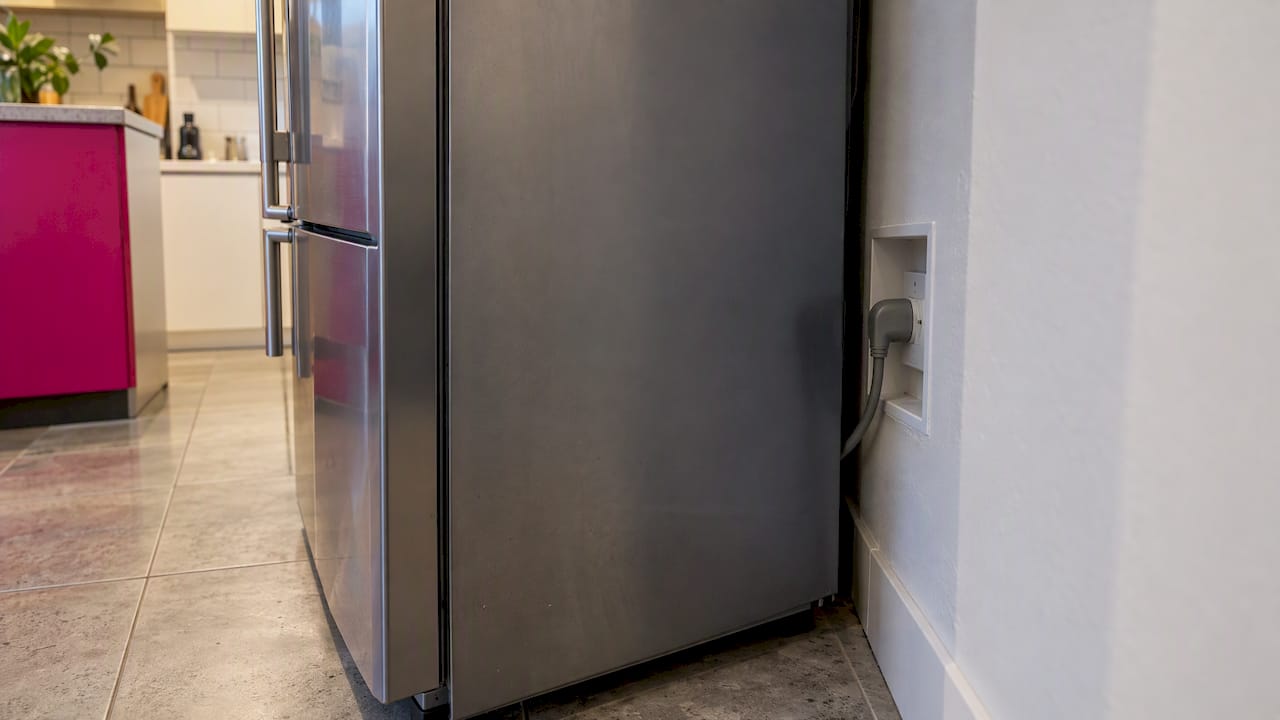
A fridge pushed against a wall often leaves a gap because of the plug. A recessed outlet behind it, or in the cabinet void, closes that gap. The same goes for a microwave in a shelf nook or an appliance cupboard.
Low-line cabinets and feature walls
Low media units and sideboards are a common reason to recess. The outlet sits behind the cabinet and the unit goes flat to the wall. In stone, timber or tiled feature walls, a recessed faceplate can be set to match the finish.
Where they are not the right answer
- Solid or masonry walls. It can be done in some brick walls, but it means chasing into the masonry. A surface-mounted slimline outlet or a different outlet position may be simpler.
- Shallow or obstructed cavities. Studs, noggings, insulation, pipes and existing cables all limit what fits.
- Fire, acoustic or party walls. Cutting into rated walls can compromise them. Raise this with your builder or strata manager before you cut anything.
- Wet areas. Position is governed by the wiring rules, not by appearance.
Bathrooms, kitchens and wet areas
Water changes the rules. Under AS/NZS 3000:2018, bathrooms are divided into zones. In Zone 2, which extends 600 mm beyond Zone 1 and up to 2.25 m high, standard power points are permitted only with RCD protection of 30 mA or less. Electrical equipment is, with limited exceptions, not allowed in Zones 0 and 1. The same source also covers how far outlets must sit from sinks and taps in kitchens.
Those zones depend on your bath, shower, basin and wall layout, so they are not something to estimate by eye. Energy Safe Victoria warns that water and electricity are a high-risk mix and that wet skin lowers the body’s resistance. The NSW Government’s electrical safety advice is blunt: don’t do it yourself, get a professional, keep water away from electricity and use a safety switch.
If you want a recessed point anywhere near a basin, vanity, laundry tub or kitchen sink, have the electrician confirm the position on site before you buy anything. Our safety switch and smoke alarm installation page covers the protection side.
Why it must be a licensed electrician in NSW
Cutting the hole is the easy part. The electrical side is what the law cares about. In NSW, any electrical wiring work must be done by, or under the supervision of, a licensed electrician. The electrician must also submit a Certificate of Compliance for Electrical Work (CCEW) showing the work has been tested and complies. Fair Trading states that from 1 July 2026 all CCEWs must go through the BCNSW eCert portal, and handwritten or PDF forms are no longer accepted.
A recessed point usually involves:
- Locating and avoiding studs, pipes and existing cables in the cavity.
- Cutting the opening to the manufacturer’s size, with no loose edges.
- Running and securing new cable, or extending an existing circuit.
- Checking the circuit has the correct protection and spare capacity.
- Testing, then filing the CCEW.
That fourth step is why a quick swap can turn into a bigger job. If you are adding a point for a large TV, a bar fridge and a sound system, the circuit may already be near its limit. In older Sydney homes we often find overloaded circuits, old ceramic fuses or boards without safety switches. In those cases a switchboard upgrade is the right fix, not another outlet on the same circuit.
Perspective: what we see on site
Most recessed point jobs begin with the wrong part in the box. A customer buys a stylish wafer plate online, the cavity turns out to be shallower than the product needs, or the mounting kit was never ordered. The electrician arrives, and the finish the customer pictured is not possible that day.
Our advice is simple. Decide what you want the wall to look like. Check the cavity depth and what is inside it. Pick the product and its mounting assembly together. Then book the electrician, ideally before you buy anything expensive. As a Level 2 electrical contractor working across Sydney, we would rather look at the wall first, which is why we offer free site inspections for Level 2 work.
We also push back on one habit: adding a recessed point to a circuit that has never been tested. An outlet that looks tidy is no use if the circuit behind it has no safety switch or is overloaded. A safety check costs little compared with a fault behind a finished wall.
— Christopher
How to prepare for the job
A few steps make the visit faster and the result better.
- Mark the position you want. Note the height and which appliance it serves. For a TV, hold the bracket against the wall to find the real centre.
- Confirm the wall type. Plasterboard on studs is the easiest case. Brick, concrete, stone and tiled walls need more work.
- Choose the product and the mounting kit. The cut-out size and cavity depth are on the product page. Keep the model number for the electrician.
- Check the colour and finish. Paintable plates, white, black and metal finishes are all available from the major manufacturers, so choose before the wall is patched.
- Tell the electrician about the other cabling. Data, antenna and speaker leads are best done in the same visit.
- Plan the patching. If the cable is chased into the wall, plastering and painting may be a separate trade, so ask what the quote covers.
If you are renting, ask your landlord or agent first. If you are in a strata building, check the by-laws before cutting into any wall, as the cavity may involve common property or fire-rated construction.
Costs and what changes the price
We do not publish fixed prices for this work, because the wall decides the cost more than the outlet does. The factors that move a quote include:
- The wall type, with plasterboard being the simplest.
- Whether a new cable run is needed or an existing circuit can be extended.
- The cable route, such as through a roof space, a subfloor or a masonry wall.
- The number of points installed in one visit.
- Whether the board needs a safety switch, circuit changes or an upgrade.
- Patching and painting, which are often separate.
The product itself is a small part of the total. A basic recessed wallplate with a GPO is listed at around $15 at one electronics retailer at the time of writing, while premium architectural faceplates cost far more. Retail prices change, so check the current listing. Labour, compliance and testing are what you are paying for. Ask for a written quote that lists what is and is not included.
Standard sizes and ratings worth knowing
Some technical background helps when you read product pages. A standard Australian double GPO has a faceplate of about 116 x 76 mm with 84 mm mounting centres. It operates at 230 to 240 V AC and 10 A, and plugs and sockets follow AS/NZS 3112.
A recessed wallplate does not use the same footprint. It is smaller, and its cut-out is typically around 76 x 52 mm. That is the reason a recessed single point is not a like-for-like swap for a standard double outlet. If you currently have a double GPO and want a flush finish, you may need two recessed points, or a different approach.
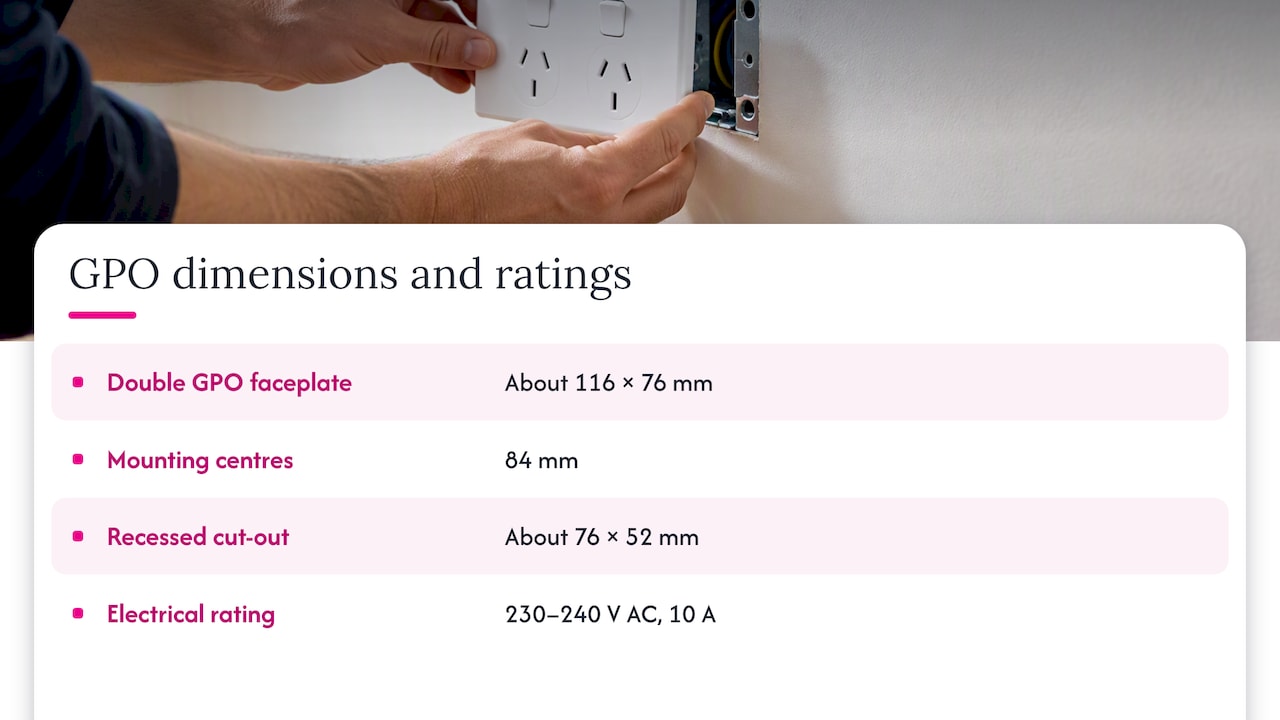
For high-draw appliances, check the rating. A 10 A outlet suits most household appliances. Some larger equipment needs a 15 A outlet or a dedicated circuit, so tell the electrician what you plan to plug in.
When a recessed point is a sign of a bigger job
A recessed outlet request is often the first step towards something larger. Typical examples:
- Renovations. A new kitchen or media wall is the time to check the board, add circuits and fit safety switches.
- Older homes. If your board has ceramic fuses, no RCDs or crowded circuits, fix it before adding outlets. See our electrical maintenance page for safety switch testing and checks.
- Growing loads. Home offices, EV chargers and air conditioning can push a supply past its limit. We handle power supply upgrades, including single phase to three phase.
- Commercial spaces. Shops and offices often want flush outlets behind counters and displays. Our commercial fitout work covers that.
- Defect notices. If an inspection has flagged a problem, a Level 2 electrician can rectify it and issue the paperwork.
Getting it done with High Demand Electrical
We are a certified Level 2 electrical contractor serving residential, commercial and strata customers across Sydney. We are triple ISO certified, have over 300 five-star reviews and offer free site inspections for Level 2 work. Seniors can ask about our discounts.
For a recessed point, we will check the wall and cavity, confirm the position against the wiring rules, test the circuit and file the compliance paperwork. If the job turns into a board or supply problem, we can handle that too, so you deal with one team. Our emergency line runs 24/7 with a 10-minute callback guarantee, which matters if a fault turns up while the wall is open.
To book an inspection or ask about a job, start with our Level 2 electrician page. If something is sparking, hot or has tripped repeatedly, go straight to our emergency electrician service.
FAQ
Can I install a recessed power point myself?
No. In NSW, electrical wiring work must be done by or under the supervision of a licensed electrician, who then lodges a CCEW. Fair Trading’s compliance page sets this out, and the NSW Government advises against doing electrical work yourself. You can choose the product and mark the position, but leave the cutting, wiring and testing to a licensed professional.
What is the difference between a recessed and a slimline power point?
A recessed point sits inside the wall cavity, so the plug and cable are tucked away. A slimline or wafer point has a low profile but still sits on the wall surface. If your goal is a TV or fridge flat to the wall, you want a true recessed point.
Can I put a recessed power point in a bathroom?
Only where the AS/NZS 3000 zones allow it. In Zone 2, a standard power point needs RCD protection of 30 mA or less, and equipment is not permitted in Zones 0 and 1 apart from limited exceptions. An electrician must confirm the zones for your bathroom layout before any outlet goes in.
Can a recessed power point go in a brick wall?
Sometimes, but it means chasing into the masonry, which is slower and messier than plasterboard. Single internal brick walls are the most workable case. An electrician should check the wall first, as a surface slimline outlet or a different position may be a better answer.
Sources
- Electrical compliance requirements, NSW Fair Trading
- Avoiding electrical accidents, NSW Government
- Using electricity safely, Energy Safe Victoria
- Distance between water and power points, BUILD.com.au
- Power Point GPO Slim Wafer Extra Thin Flush Mounted, Transco
- Wallplate Recess Box With 240V Mains GPO, Aus Electronics Direct
- Classic C2000 Series Power Outlet Twin, Clipsal
Powering Your Needs with Expertise
If you’re looking for a reliable, experienced, and prompt electrician, look no further than High Demand Electrical. We cater to all your electrical needs, from routine maintenance to emergency repairs and complete system installations. Our skilled team is committed to providing professional service that ensures your electrical systems run smoothly. Whether it's a small task or a large project, give us a call today. Let us meet all your electrical demands with the quality and reliability you deserve.

