Free Level 2 Inspection for NSW Private Poles, Avoid Defect Fees
Private power poles in NSW must be inspected and repaired by an accredited Level 2 ASP electrician, not a network operator or a general sparky. If your pole shows visible damage, leans after a storm or you've received a defect notice from your network operator, book a Level 2 inspection immediately. High Demand Electrical, a Sydney-based Level 2 provider, offers free site inspections for this exact work.
Table of Contents
- Who is responsible for private power pole inspection NSW compliance?
- How often should you inspect a private power pole?
- What does a private pole inspection actually check?
- What do pole markings and defect notices mean?
- Found a defect? Here's what to do next
- How to book a private power pole inspection in Sydney
- A Level 2 electrician's view on Sydney's private pole problems
- Book a Level 2 inspection with High Demand Electrical
- Sources
Who is responsible for private power pole inspection NSW compliance?
If a power pole sits on your property and feeds your home directly, you own it, and NSW places the maintenance burden squarely on you. That surprises plenty of homeowners who assume anything with a wire on it belongs to the network. It doesn't work that way once the pole crosses onto private land. For a plain-English rundown of the ownership line between the two, see our private power pole vs network pole guide.
This maintenance falls under what the industry calls "contestable work". Essential Energy's guidance makes it clear that network operators generally won't touch a private pole's upkeep except in narrow circumstances, such as when a defect poses an immediate public safety risk. Instead, you're expected to engage an Accredited Service Provider, specifically a Level 2 ASP electrician licensed to work on live, high-voltage infrastructure.
Here's what that means practically for a NSW homeowner:
- You cannot legally hire a standard Level 1 electrician for pole repairs or rectification work.
- Network operators can and do inspect visible private assets during routine patrols, and may issue a defect notice as a result.
- Ignoring a defect notice doesn't make it disappear. The network can eventually step in and bill you for the work.
- Your first move if you suspect an issue is checking your letterbox and email for any notice, then arranging a Level 2 inspection before it escalates.
How often should you inspect a private power pole?
Routine inspection timing in NSW generally follows a simple rhythm that includes regular checks and additional inspections before bushfire season ramps up. Essential Energy's own advice to private-pole owners backs this pattern, and it lines up with how fire risk builds through spring in areas like the Blue Mountains, the Hawkesbury, and outer Sydney suburbs bordering bushland.
Beyond the calendar, certain events should trigger an inspection regardless of when your last one happened:
- After a major storm. Wind loading and waterlogged ground are two of the fastest ways to destabilise a timber pole.
- Following any vehicle impact, even a minor knock from a reversing trailer or ute.
- After lightning strikes or nearby fire, both of which can weaken a pole's internal structure without obvious external signs.
- When trees begin encroaching on clearance zones, since branch contact creates both a fire risk and a mechanical stress point on the pole. Where a full trim isn't possible straight away, a tiger tail installation over the conductor can reduce the fire risk from branch contact as an interim measure until the vegetation is properly cleared.
A network asset inspection can also prompt action out of nowhere. If an Essential Energy inspector spots frayed wiring, an unauthorised alteration, or an obvious lean during a routine patrol, you'll get a defect notice regardless of your own inspection schedule.
What does a private pole inspection actually check?
A proper inspection starts before anyone gets close to the pole. Pre-approach checks establish whether it's even safe to proceed: is there conductor sag, exposed wiring, insulator cracking, or any sign of electrical leakage that would make touching the structure dangerous? ISSC 29 guidance treats this pre-climb assessment as the non-negotiable first step, and for good reason. Private poles tend to be older and less consistently treated than network-owned ones, which raises the stakes on getting this part right.
Once it's confirmed safe to approach, the above-ground inspection covers different territory depending on the pole's material:
- Timber poles: splits, deep checking, knot clusters, visible termite galleries, fungal decay at the ground line, and any noticeable lean.
- Concrete poles: spalling (where surface concrete flakes away exposing reinforcement), cracking, and discolouration that hints at internal moisture ingress.
- Steel poles: rust bloom, section loss at the base, and any dents or deformation from impact.
Inspectors also use physical tests to catch what a visual check might miss. Hammer sounding, where a firm strike reveals a dull or hollow tone consistent with internal decay, and a controlled rocking test to check base stability, are both standard techniques described in inspection methodology used for wood poles. That guidance comes from a US utility context, but the same logic underpins how NSW inspectors assess suspect timber poles before deciding whether more invasive checks are warranted.
For poles that fail these surface tests, below-ground excavation around the base can confirm the extent of decay. This is where core drilling techniques come into play, offering a way to sample the pole's internal condition without full excavation.
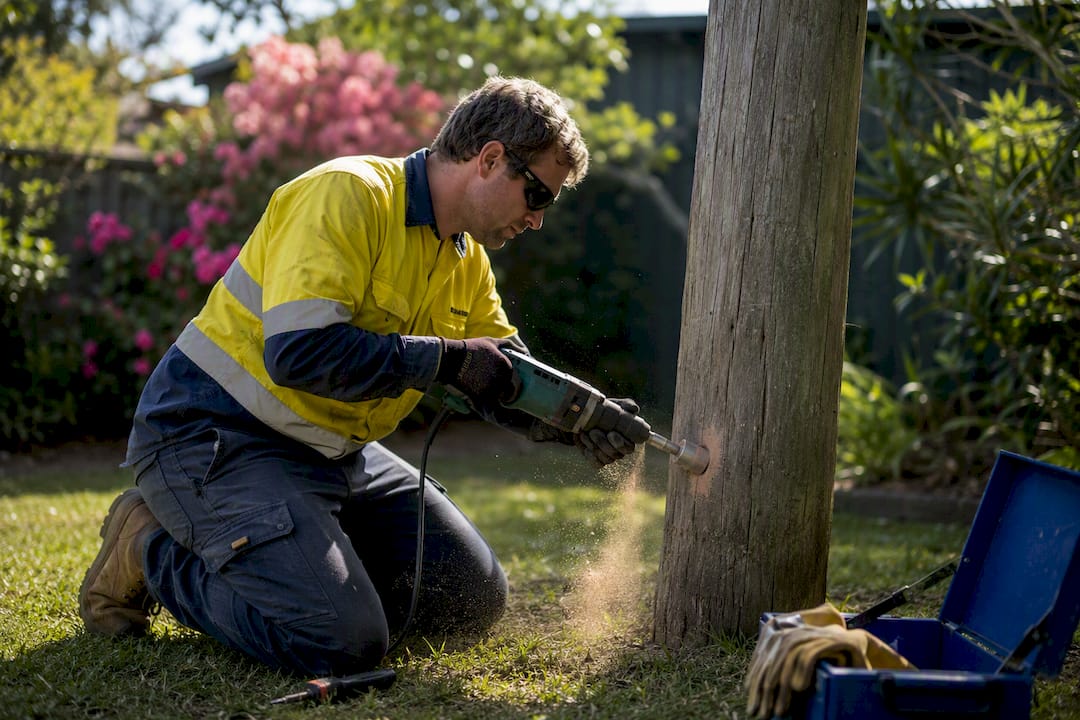
Pro Tip: If a pole sounds hollow when tapped near the base, treat it as compromised until a Level 2 electrician confirms otherwise. Don't lean a ladder against it or let kids play near the base in the meantime.
Private poles often carry less consistent treatment history than network assets, one reason NSW guidance leans so heavily on layered checks, visual, acoustic, and structural, rather than a single pass-fail glance.
What do pole markings and defect notices mean?
Every private pole in NSW should carry a yellow tag reading "Private Pole", distinguishing it at a glance from network-owned infrastructure. That's your first clue when trying to work out who's responsible for what you're looking at.
Beyond the basic tag, inspectors use a colour-coded system to flag condition:
- A yellow "Private Pole" tag confirms ownership and maintenance responsibility sits with the property owner.
- An orange reflective band signals a suspect pole, one that's failed a preliminary check and needs closer assessment before anyone climbs it.
- A permanent "X" marking indicates a condemned pole that requires replacement, not repair.
If a network inspector flags an issue during a patrol, you'll receive a defect notice. These typically outline the specific fault, whether it's frayed wiring, an unauthorised alteration, or vegetation encroachment, and set an expectation that you'll arrange rectification through an accredited provider within a reasonable timeframe. Essential Energy's own position is blunt on what happens next: if you don't act, the network can carry out the work itself and recover the cost from you. Acting early, and using a licensed Level 2 electrician the first time, is almost always cheaper than letting a notice lapse. Our guide to electrical defect notices in Sydney covers the rectification process end to end, and if the issue involves clearance from a building or structure rather than the pole itself, our guide to building near power lines in NSW explains the required setbacks and easements.
Found a defect? Here's what to do next
If your inspection turns up a genuine structural problem, the sequence of events matters more than most homeowners realise.
- Keep everyone clear of the pole, including pets, and don't attempt to touch, climb, or brace it yourself. ISSC 29's own guidance is explicit that a suspect pole should never be climbed unsupported.
- Put up make-safe signage or barrier tape if there's any chance a visitor, delivery driver, or neighbour could wander near the base.
- Call a Level 2 electrician for an emergency make-safe assessment if the damage looks severe, a visible lean, snapped stay wire, or exposed conductor.
- Get a written quote before committing to repair work, and confirm the provider's Level 2 accreditation and insurance cover upfront.
Remediation itself varies by severity. A mild lean might only need reinforcement, extra stays or ground anchors, while advanced decay usually means full replacement. If the pole is being replaced anyway, it's often the most cost-effective time to also address any tired overhead cabling in the same visit — our overhead service mains installation team can scope both jobs together and avoid a second mobilisation fee. Where trees are the underlying cause, coordinating a trim alongside the pole work stops the same problem recurring within a season or two. For an immediate hazard, our emergency make-safe service runs around the clock.
Pro Tip: Ask any prospective Level 2 contractor for a documented inspection report, not just a verbal quote. A proper report gives you a record if the network later queries your compliance history.
How to book a private power pole inspection in Sydney
Booking is straightforward once you know what the contractor needs upfront. Give them the property address, a description of any visible damage, details from a defect notice if you've received one, and the easiest access point to the pole, particularly if it sits behind a fence or through a side gate.
On your end, a bit of preparation speeds things along:
- Clear vegetation around the base where it's safe to do so yourself.
- Secure pets and let household members know work is happening.
- Photograph any visible damage before the inspector arrives, useful for insurance if it comes to that.
- Mark obvious hazards, uneven ground, buried cabling, sprinkler lines, near the access route.
Expect the inspection report to cover pole condition, any immediate safety concerns, and a recommended action, whether that's monitoring, reinforcement, or replacement. Most Level 2 providers can turn around a quote within a few days of the site visit, with repair scheduling depending on parts availability and the severity of what's found.
What's a Level 2 Electrician's View on Sydney's Private Pole Problems?
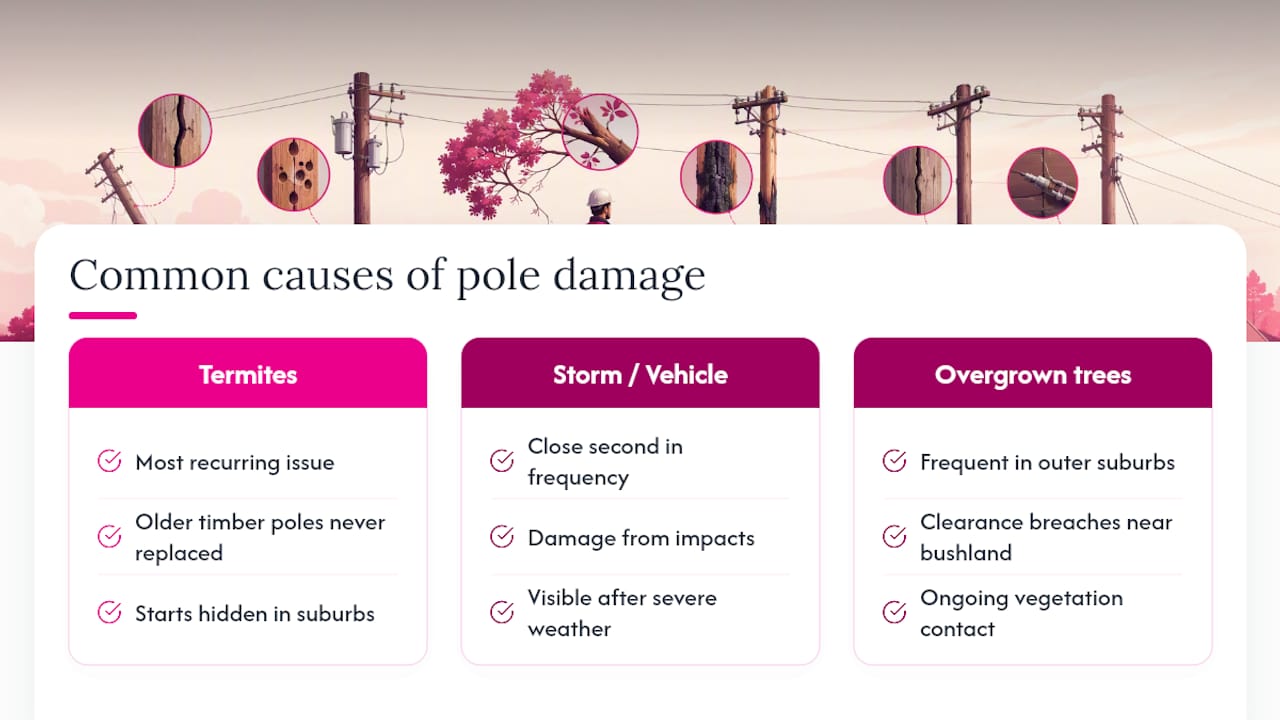
Termite damage is the recurring issue across Sydney's older suburbs, particularly where original timber poles have never been swapped out. Storm and vehicle impacts run a close second, and overgrown trees causing clearance breaches show up constantly in outer suburban blocks backing onto bushland.
The biggest misconception homeowners carry is that pole issues are something you can eyeball and leave alone. They're not. Climbing or testing a pole without training risks contact with live conductors that look perfectly safe from the ground. Every genuine assessment we've fielded through our private power pole installation work starts with a free site inspection precisely because guessing at a pole's condition from the driveway isn't good enough.
— Christopher
Book a Level 2 inspection with High Demand Electrical
High Demand Electrical handles the full scope of private pole work that NSW regulations require: accredited Level 2 inspections, emergency make-safe callouts, and reinforcement or replacement when a pole's beyond saving. Where some providers charge just to look, our site inspections for Level 2 work come at no cost, so you get a clear picture of your pole's condition before spending a cent on repairs.

Every job comes with a written inspection report and a transparent quote, so you know exactly what's being done and why it meets landlord safety inspections: a compliance checklist before any work starts. If you've spotted damage, received a defect notice, or simply haven't had your pole checked this year, book a Level 2 electrician in Sydney today and get it sorted properly the first time.
Sources
Related Services
.webp)
Powering Your Needs with Expertise
If you’re looking for a reliable, experienced, and prompt electrician, look no further than High Demand Electrical. We cater to all your electrical needs, from routine maintenance to emergency repairs and complete system installations. Our skilled team is committed to providing professional service that ensures your electrical systems run smoothly. Whether it's a small task or a large project, give us a call today. Let us meet all your electrical demands with the quality and reliability you deserve.