Private Power Pole Guide for Sydney Homeowners
What if the most significant bushfire risk on your Sydney property isn't the surrounding scrub, but the aging timber pole supplying your electricity? For many homeowners, a private power pole is a "set and forget" asset until an Ausgrid or Endeavour Energy inspector leaves a defect notice in the letterbox. Dealing with a mandatory power pole installation or an urgent repair can feel like a high-stakes race against time, especially when your property's safety and legal compliance are on the line.
We understand that navigating the technicalities of Level 2 ASP requirements and the Electricity Supply Act 1995 is daunting. It's stressful to face unexpected infrastructure costs while worrying about the safety of your family and neighbours. This guide provides the professional reassurance you need by explaining everything from the lifespan of galvanised steel versus hardwood timber to your specific legal responsibilities in NSW. You'll learn how to clear defect notices within the required 60-day window and how to choose the right materials to protect your home for decades to come.
Key Takeaways
• Understand your legal obligations under the Electricity Supply Act 1995, as Sydney property owners are responsible for all electrical assets within their boundary.
• Compare the long-term durability of Koppers-treated timber against the termite resistance of galvanised steel to select the right material for your local environment.
• Learn why a professional power pole installation requires a Level 2 ASP to guarantee compliance with Ausgrid and Endeavour Energy network standards.
• Discover how to manage urgent defect notices by identifying structural warning signs like ground-line rot or base corrosion before they become structural emergencies.
• Explore how to future-proof your property by integrating pole replacement with consumer mains or 3-phase power upgrades for increased electrical demand.
What is a Private Power Pole and Why Do You Need One?
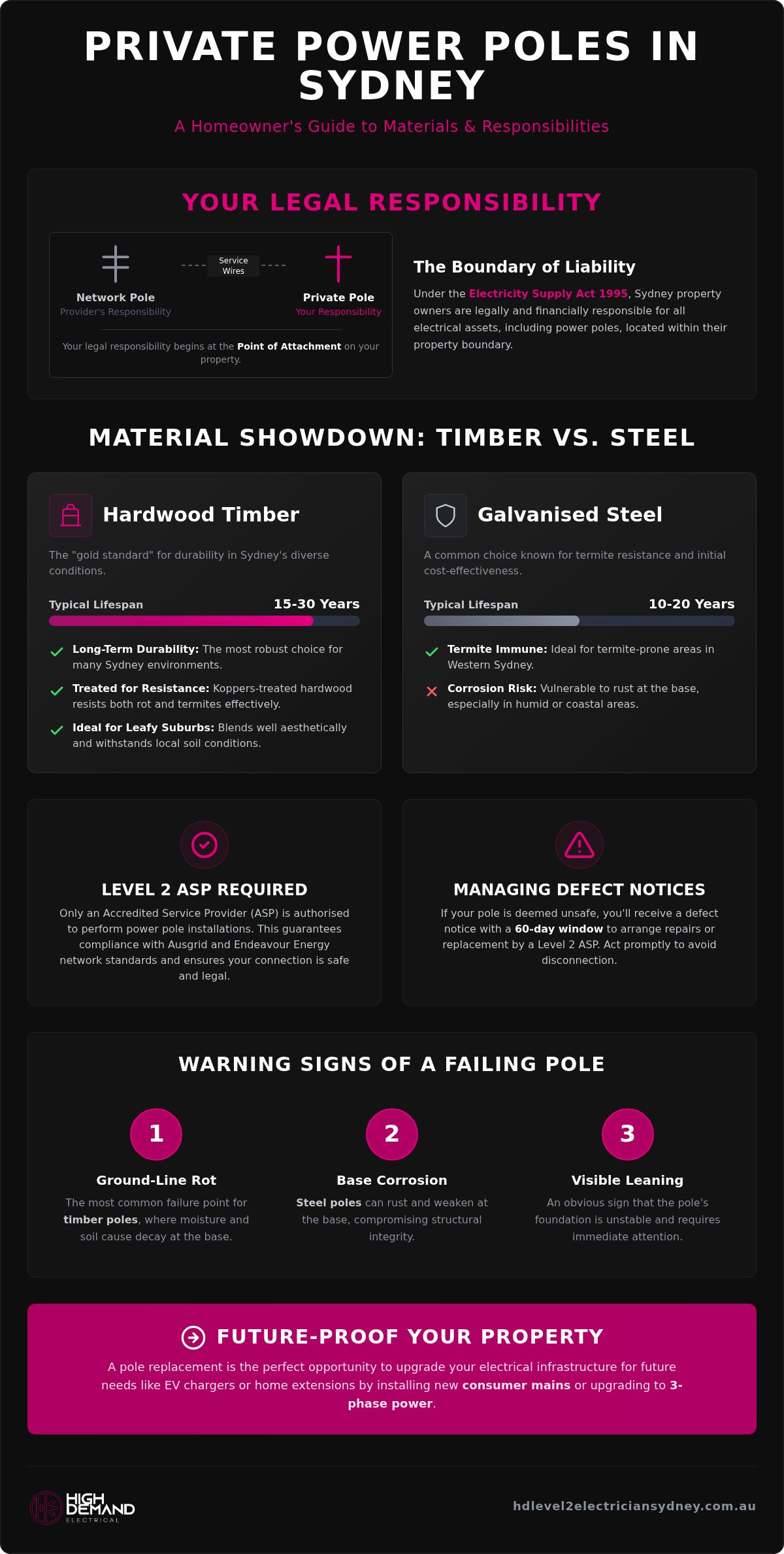
A private power pole is the critical link between the NSW grid and your switchboard. Often referred to as a property pole, it functions as the primary point of attachment on your land; it's the physical structure that receives the overhead service lines from the street and directs that energy into your home's electrical system. For many Sydney residents, this infrastructure is a legal and practical necessity rather than an optional feature. It acts as the gateway for your property's entire power supply.
If your home is set back significantly from the street, a single cable span from the network pole to your fascia board may exceed safe physical limits. Overextending these lines creates dangerous sagging and puts immense physical stress on your building's structure. In these scenarios, a professional power pole installation is required to provide an intermediate support point. This ensures the electrical cables remain at a safe, tensioned height and prevents damage to your roofline during high winds or storms.
The Boundary of Responsibility in Sydney
Understanding where the network provider's liability ends is vital for every homeowner. In the Sydney metropolitan area, Ausgrid and Endeavour Energy are responsible for the network only up to the 'Point of Attachment' (POA). This is the physical location where their service wires connect to your property's equipment. A common Utility pole located on a public street is maintained by the utility provider, but once a pole is situated within your property boundary, the legal and financial burden shifts entirely to you.
Under the Electricity Supply Act 1995, Sydney property owners are legally responsible for the maintenance and safety of all private electrical assets. If your pole becomes unstable or develops a fault, the network provider won't perform repairs. Instead, they'll issue a defect notice requiring you to engage a Level 2 ASP. Neglecting these assets doesn't just risk a power outage; it creates significant bushfire risks and potential legal liability if a failing pole causes damage to neighbouring properties or public infrastructure.
Private Poles vs. Street Connections
A private pole is often the only way to maintain the correct 'catenary' tension in overhead lines. This tension is the physical pull exerted by the weight of the copper or aluminium cables. Without a dedicated pole to manage this force, lines can sag low enough to strike vehicles or pedestrians. This is particularly critical for properties with long driveways where cables must maintain specific height clearances to allow for truck or emergency vehicle access. It's about maintaining a clear, safe corridor for your power supply.
While some homeowners consider moving to underground consumer mains to eliminate overhead risks, this isn't always feasible due to rocky Sydney terrain or high excavation costs. In these cases, a modern power pole installation remains the most efficient method for securing a reliable connection to the grid. It allows you to adhere to strict NSW safety standards while keeping your infrastructure visible and accessible for routine safety inspections.
Choosing the Right Material: Timber vs. Galvanised Steel
Selecting the correct material for your power pole installation is a decision that dictates your property's safety and maintenance costs for decades. In the Sydney metropolitan area, homeowners usually choose between pressure-treated hardwood and galvanised steel. Each material reacts differently to our local micro-climates, from the humid, salt-heavy air of the Eastern Suburbs to the dry, termite-prone pockets of the Greater West. Understanding these environmental factors is the first step in avoiding a premature and costly replacement.
Lifespan expectations vary significantly between the two. Hardwood timber poles generally offer a service life of 15 to 30 years, provided they receive regular inspections. In contrast, galvanised steel poles typically last between 10 and 20 years. While steel is often cheaper to purchase initially, the long-term durability of timber frequently makes it the more robust choice for Sydney's diverse soil conditions. Your choice should balance aesthetic preference with the specific geological and climatic demands of your block.
Hardwood Timber Poles (CCA Treated)
Treated timber remains the "gold standard" for Sydney's rural-residential blocks and leafier suburbs. These assets are crafted from high-density Australian hardwoods and undergo a rigorous Koppers-treatment process. This high-pressure chemical infusion ensures the wood remains resistant to rot and fungal decay, even in moisture-heavy clay soils. Because timber is a natural insulator, it provides an additional layer of safety during electrical faults. These poles are heavy, substantial assets that require specialised equipment for a safe power pole installation, but their natural aesthetic often blends seamlessly with established gardens and bushland landscapes.
Galvanised Steel Property Poles
Modern suburban builds in Sydney often favour galvanised steel for its sleeker, slimmer footprint. These poles are far less obtrusive than timber, making them ideal for properties with limited easement space or contemporary architectural designs. Steel's primary advantage is its total immunity to termites, a critical factor in many wood-boring insect hotspots across NSW. However, steel has a significant vulnerability: salt-induced corrosion. The protective zinc coating can degrade rapidly if you live within five kilometres of the coastline. This environmental stress is why rusted power pole replacement Sydney is such a common requirement in beachside communities like Cronulla or the Northern Beaches.
If you're unsure which material will survive best in your specific soil type, consulting a Sydney-based Level 2 ASP can ensure your infrastructure is built to last. Choosing the wrong material for your environment is a mistake that often leads to a mandatory defect notice much sooner than expected.
The Installation Process: Why You Need a Level 2 ASP
In New South Wales, the legal framework governing electricity infrastructure is uncompromising. While a standard licensed electrician can handle internal powerpoints or lighting, they aren't authorised to touch the street network or the overhead lines connecting to your property. A safe and compliant power pole installation requires a Level 2 Accredited Service Provider (ASP). This accreditation ensures the technician possesses the specialised training and insurance necessary to work with live high-voltage assets. Attempting to bypass these regulations by using an unaccredited electrician doesn't just risk a massive fine; it puts your entire electrical system at risk of catastrophic failure or fire.
The requirements differ slightly depending on whether you're in an Ausgrid or Endeavour Energy territory. Ausgrid, covering Sydney's CBD, Eastern Suburbs, and North Shore, has stringent protocols regarding the Point of Attachment and service line tension. Endeavour Energy, which manages the Greater West and South, focuses heavily on bushfire mitigation and specific pole depth requirements. As Sydney locals, we navigate these differing standards daily, ensuring your project meets the precise local network rules without delay or rejection.
Level 2 ASP Categories Explained
To legally complete a power pole installation, an electrician must hold specific Level 2 categories. Category 1 (Overhead) allows us to safely disconnect and reconnect your property from the street network. Category 4 (Metering) is essential for commissioning the meters that track your usage. High Demand Electrical handles the entire administrative burden, from submitting the Preliminary and Final 'Notice of Service Work' (NOSW) to ensuring all paperwork is lodged correctly with your network provider. This professional management prevents the common bureaucratic delays that can leave properties without power for days.
What to Expect on Installation Day
A professional installation is a heavy-duty operation. We arrive with specialised equipment, including pole-borers and excavators designed to penetrate Sydney's often rocky terrain. For properties with difficult access, we utilise Elevated Work Platforms (EWPs) to manage overhead lines safely. We coordinate with the grid to manage power outages, aiming to keep your downtime to an absolute minimum while we stand the pole and tension the cables to meet NSW safety clearances. Once the physical work is complete, we perform rigorous testing and issue a 'Certificate of Compliance for Electrical Work' (CCEW). This document is your legal proof that the asset is safe, compliant, and officially registered with the network authorities.
Safety, Maintenance, and Managing Defect Notices
A private pole isn't a permanent fixture; it's a hard-working asset that requires regular vigilance. In Sydney's varied terrain, timber poles are frequently compromised by ground-line rot where the wood meets the soil, or internal hollows caused by undetected termite colonies. Galvanised steel poles face different challenges, often exhibiting severe base corrosion at the ground interface where moisture and soil chemicals react. You should regularly check for a 'leaning' pole; any visible deviation from a vertical axis suggests soil subsidence or structural failure at the base. Catching these signs early can prevent a catastrophic collapse that would necessitate an emergency power pole installation.
An Ausgrid defect notice is a legal directive that must be actioned within 21 days. These notices are issued when network inspectors identify safety violations or structural weaknesses during their routine maintenance cycles. Ignoring these warnings is a high-stakes gamble. Failure to comply can lead to mandatory power disconnection, hefty fines, and increased liability if the asset causes a fire or injury. Under the Electricity Supply Act 1995, you have 30 days to contact the distributor to confirm your repair plan, with the final rectification required within 60 days of the notice date.
Dealing with an Ausgrid or Endeavour Energy Defect Notice
Network providers like Ausgrid and Endeavour Energy prioritise grid stability over your convenience. If they find your private pole is leaning, rotting, or too close to vegetation, they will issue a formal defect. The process for private power pole replacement involves a rapid assessment by a Level 2 ASP to determine if the pole can be salvaged or requires total removal. We specialise in clearing these notices quickly, providing the necessary certification to the network provider to keep your power flowing. We understand the urgency of these situations and act as your advocate with the utility companies.
Tiger Tail Installation and Overhead Safety
Safety near live lines is non-negotiable for tradespeople and residents alike. Tiger Tails are high-visibility, yellow and black plastic pipes installed over overhead power lines to provide a clear visual warning. While they don't insulate the wires, they alert people to the presence of danger. Under NSW safety regulations, Tiger Tail installation is often mandatory if you are conducting construction, painting, or scaffolding work within close proximity to overhead cables. We provide rapid installation of these safety covers to ensure your site remains compliant with WorkCover and network standards.
If you've received a defect notice and need an immediate response to secure your property, contact High Demand Electrical for expert Level 2 assistance.
Planning Your Sydney Power Pole Project
Every Sydney property presents unique geographical and electrical challenges that make "one size fits all" pricing impossible for a power pole installation. A quote for a level block in Blacktown will differ significantly from a steep, rocky site in the Northern Beaches. Variables such as soil density, the length of the cable span, and the specific machinery required for site access all dictate the final project scope. Viewing your private pole as a long-term infrastructure investment, rather than a mere utility cost, ensures you select a solution that remains compliant for decades.
Before proceeding, it's vital to assess your property's current and future energy consumption. If you're planning to install high-load appliances like ducted air conditioning, a heated swimming pool, or a fast EV charging station, your existing connection might struggle to keep up. It is far more cost-effective to integrate a 3 phase power upgrade during your pole installation than to pay for separate mobilisations and grid disconnects later. This proactive approach ensures your home's electrical gateway is ready for the next generation of domestic technology.
Future-Proofing Your Connection
Combining a new pole with updated consumer mains is the most effective way to future-proof your home. While the pole provides the physical support, the consumer mains are the "pipes" that carry electricity into your switchboard. If your home still relies on old ceramic fuses, we recommend a switchboard upgrade alongside your pole project to incorporate modern circuit breakers and safety switches. This creates a seamless, high-performance supply chain from the street to your powerpoints. For some homeowners, this planning phase is also the ideal time to evaluate whether an underground conversion is feasible, though a well-maintained private pole remains the most efficient connection method for most Sydney blocks.
Why Choose High Demand Electrical?
As Sydney-based Level 2 ASP specialists, we possess deep technical knowledge of both Ausgrid and Endeavour Energy network standards. We don't just stand poles; we manage the entire lifecycle of your infrastructure project. Our team handles everything from the initial site assessment and hole boring to the final grid connection and the lodgement of mandatory NSW compliance paperwork. We operate as authoritative rapid responders, particularly when a property is facing a mandatory defect notice or structural failure. We ensure your project is completed with meticulous attention to detail and absolute adherence to safety protocols. Contact us today for an authoritative assessment of your property's electrical assets and secure a reliable connection to the Sydney grid.
Securing Your Property's Electrical Future
Managing a private power pole is a significant legal responsibility that requires technical precision and proactive maintenance. From selecting between the long-term durability of treated timber and the sleek profile of galvanised steel to ensuring your infrastructure is ready for high-demand 3-phase upgrades, the decisions you make today will impact your property's safety for decades. It's essential to remember that network providers like Ausgrid and Endeavour Energy hold homeowners accountable for every asset within their boundary; neglecting these assets can lead to mandatory disconnections or structural failures.
If you're facing a defect notice or simply need a professional power pole installation, you shouldn't leave your compliance to chance. As Level 2 ASP Certified technicians and Sydney local infrastructure experts, we provide full defect notice resolution to keep your home safe and connected. We handle the complex paperwork and network protocols so you don't have to. Our team ensures every installation meets the rigorous standards required by NSW authorities.
Secure your property's power supply-get an expert Level 2 assessment from High Demand Electrical today. Taking action now prevents structural emergencies and ensures your electrical system remains a reliable asset for years to come.
Frequently Asked Questions
How much does it cost to install a private power pole in Sydney?
The cost of a professional power pole installation in Sydney is determined by several site-specific variables rather than a flat rate. Factors such as soil composition, the difficulty of site access for heavy machinery, and whether you require a timber or galvanised steel pole all influence the final investment. Additionally, network connection fees and required upgrades to your consumer mains can impact the total project scope. You should always request a detailed, transparent quote from a Level 2 ASP to ensure all regulatory requirements are covered.
How long does a timber vs. steel power pole last in the Sydney climate?
In the Sydney climate, a hardwood timber pole typically lasts between 15 and 30 years, while a galvanised steel pole generally has a service life of 10 to 20 years. These durations depend heavily on your local environment; for instance, steel poles in coastal areas like the Eastern Suburbs may succumb to salt corrosion much faster. Timber poles require regular inspections to detect ground-line rot or termite activity, which can significantly shorten their effective lifespan if left unmanaged.
Can any electrician replace my private power pole?
No, a standard licensed electrician cannot legally perform a power pole installation or work on the overhead network in NSW. Only a Level 2 Accredited Service Provider (ASP) with Category 1 (Overhead) and Category 4 (Metering) certifications is authorised to disconnect your property from the grid and install new infrastructure. Using an unaccredited electrician for this work is a violation of the Electricity Supply Act 1995 and will result in your installation being rejected by Ausgrid or Endeavour Energy.
What should I do if I receive an electrical defect notice from Ausgrid?
If you receive an electrical defect notice from Ausgrid, you must act immediately to avoid a mandatory power disconnection. You have 30 days from the notice date to contact the distributor and confirm that a Level 2 ASP has been booked for the repairs. The actual rectification work must be completed within 60 days. It's critical to engage an authoritative rapid responder who can clear the defect and lodge the required compliance paperwork with the network provider on your behalf.
Who is responsible for the power lines between the street and my house?
As a Sydney property owner, you are legally responsible for all electrical infrastructure located within your boundary, including the private pole and the overhead lines past the Point of Attachment. While Ausgrid or Endeavour Energy maintain the street network, they don't repair assets on private land. This responsibility is mandated under the Electricity Supply (Safety and Network Management) Regulation 2014, meaning you must fund all necessary maintenance, repairs, and safety upgrades for your private connection.
How do I know if my power pole is rotting or unsafe?
You can identify a potentially unsafe pole by looking for visible leaning, large cracks, or significant decay at the ground line where the pole meets the soil. For timber poles, look for evidence of termite tracks or soft, spongy wood near the base. Galvanised steel poles often show signs of failure through heavy rust or flaking metal at the ground interface. If your pole shows any of these warning signs, it's a structural emergency that requires an immediate professional assessment by a qualified technician.
What is a Tiger Tail and do I need one on my power lines?
A Tiger Tail is a high-visibility yellow and black plastic cover designed to provide a visual warning of live overhead power lines. You need these installed whenever you or your contractors are working in close proximity to the lines, such as during roof repairs, painting, or scaffolding. While they don't insulate the wires against electrical contact, they are a mandatory safety requirement under NSW safety guidelines to prevent accidental strikes by machinery or tools during construction work.
How long does the actual installation of a new pole take?
A standard installation typically takes between four and eight hours to complete, depending on the complexity of the site and the soil conditions. This timeframe includes the excavation of the hole, standing the new pole, and tensioning the overhead service lines to meet legal clearance standards. While the physical work is often finished in a single day, we coordinate closely with the network provider to manage the required power outage, ensuring your property's downtime is kept to an absolute minimum.
Powering Your Needs with Expertise
If you’re looking for a reliable, experienced, and prompt electrician, look no further than High Demand Electrical. We cater to all your electrical needs, from routine maintenance to emergency repairs and complete system installations. Our skilled team is committed to providing professional service that ensures your electrical systems run smoothly. Whether it's a small task or a large project, give us a call today. Let us meet all your electrical demands with the quality and reliability you deserve.