Stay 8m Back: NSW Downed Power Lines, Who to Call & Level 2 Fixes
Stay at least 8 metres away from any fallen power line, roughly two car lengths, as recommended by safety authorities. Call Triple Zero (000) immediately if anyone is injured, there’s a fire, or the line is arcing near people or property. For a fallen line that isn’t putting anyone in immediate danger, report it straight to your local electricity distributor, not 000, and keep everyone clear until crews arrive.
TL;DR:
- Stay at least 8 metres away from any fallen power line and avoid touching the line or anything it rests on, even if it appears dead.
- Call 000 immediately for injuries, fires, or sparking lines near people, but report non-urgent fallen lines to your local distributor.
- Do not drive or stay in a vehicle if it contacts a live wire; exit carefully by shuffling away with both feet together.
- After authorities confirm the area is safe, contact a licensed electrician for private repairs involving damage to mains, switchboards, or meters.
- Prepare for outages by registering for life support backup and storing essential supplies, and use properly installed generators for backup power.
Table of Contents
- What to do immediately if you spot a fallen power line
- Who do you call for a downed power line in NSW?
- Why a downed power line is more dangerous than it looks
- What to do if someone is injured or there’s a fire
- After the network is made safe: inspections and next steps
- Getting your household ready before the next outage
- What a Level 2 electrician sees after the callouts come in
- Sorting private repairs once the street is safe again
- Where to check the official guidance
- Sources
- FAQ
What to do immediately if you spot a fallen power line
The first thirty seconds matter more than anything you do afterwards. Get people back, keep them back, and don’t touch a thing.
- Stop and establish a safe perimeter at least 8 metres from the line, roughly two car lengths, in every direction.
- Warn neighbours, keep children and pets well away, and don’t let curiosity pull anyone closer for a better look.
- Never touch the line, or anything it’s resting on, including fences, tree branches, gutters, or puddles.
- Don’t drive across or under a fallen wire, and if you’re already in a car near one, stay put until you get further advice.
- Call the right number for the situation, either 000 or your distributor, and wait for a response before doing anything else.
Pro Tip: Treat every downed line as live, even if it’s silent and shows no sparks. Underground cables and network faults can leave a wire energised with no visible warning at all.
Who do you call for a downed power line in NSW?
For a downed power line in NSW, the answer depends on how serious the situation is right now.
- Life threatening: call 000 for electric shock, fire, serious injury, or a line sparking near people.
- Ausgrid: 13 13 88, covering Sydney, the Central Coast, and the Hunter region.
- Endeavour Energy: 131 003, covering Greater Western Sydney, the Blue Mountains, Illawarra, and the South Coast.
- Essential Energy: 13 20 80, covering much of regional and rural NSW.
Not sure which distributor services your address? Check a recent power bill or use your postcode on your distributor’s website.
More than 8 metres of clearance is the benchmark Ausgrid applies to every fallen line report, life threatening or not. That single number is worth memorising, because in a genuine emergency you won’t have time to look it up.
Why a downed power line is more dangerous than it looks
A fallen line rarely announces itself the way people expect. There’s often no smoke, no crackling, no obvious tell that it’s carrying a lethal current, which is exactly what makes it deadly.
- The wire itself may look completely dead while still fully energised.
- Anything touching the line, metal fences, gates, even a pool railing, can become energised too.
- Floodwater conducts electricity efficiently, so avoid wading through it or paddling a boat anywhere near a downed line, and NSW SES guidance notes that rising floodwater can bring boats dangerously close to overhead wires that would normally sit well clear.
- A vehicle in contact with a live wire can become a conductor itself, so stay inside unless emergency services tell you otherwise.
That last point trips people up constantly. The instinct after a crash is to jump out and check the damage. If your car is touching a downed line, that instinct could kill you. Stay inside, sound the horn to alert people to keep away, and wait for instructions. If the vehicle catches fire and you have no choice but to exit, jump clear with both feet together and shuffle away without letting any part of your body touch the car and the ground at the same time.
What to do if someone is injured or there’s a fire
Speed matters here, but so does restraint. Acting too fast in the wrong way turns one casualty into two.
- Call 000 immediately for electric shock, burns, unconsciousness, or any fire near a downed line.
- Do not touch the injured person, the wire, or anything connected to it. The current can pass straight through you.
- If it’s safe to do so without going near the hazard, move other people further back.
- Wait for emergency services and the distributor to confirm the power is isolated before anyone approaches.
Professional crews isolate the circuit before attempting rescue or repair, and that sequence exists for good reason: touching equipment before isolation is confirmed risks a second electrocution on top of the first.
After the network is made safe: inspections and next steps
Once your distributor confirms the line and immediate area are safe, responsibility splits fairly cleanly into two categories.
- The distributor owns poles, network equipment, and the overhead service line up to your point of supply.
- You’re responsible for everything past that point: internal wiring, consumer mains, your switchboard, and appliances.
- If the incident has damaged your service mains or metering, that’s Level 2 ASP territory, not a job for a general electrician.
- Inspect visually from a distance and resist the urge to touch anything that looks damaged; arrange a professional check before flicking any circuit back on.
If you find damage or ongoing wiring issues once power is restored, contact your distributor for network faults and a licensed electrician for anything on your side of the meter. Storms tend to leave a trail of both, so it pays to have a read of what storm damage typically involves before you decide whether it’s a distributor problem or yours.
Getting your household ready before the next outage
If anyone in your home depends on life support equipment, register that with your distributor where the service is offered, and keep a written backup plan for what happens if power drops for hours rather than minutes. Distributors do prioritise life support customers during major outages, but a personal plan is what actually gets you through the gap.
Generators help, but only when used properly. Run them outdoors with good ventilation, and never backfeed a generator into your household wiring; that’s a licensed job, not a DIY one. A basic kit, torches, charged power banks, a battery radio, and a written list of medications and emergency contacts, should sit somewhere everyone in the house knows to find in the dark.
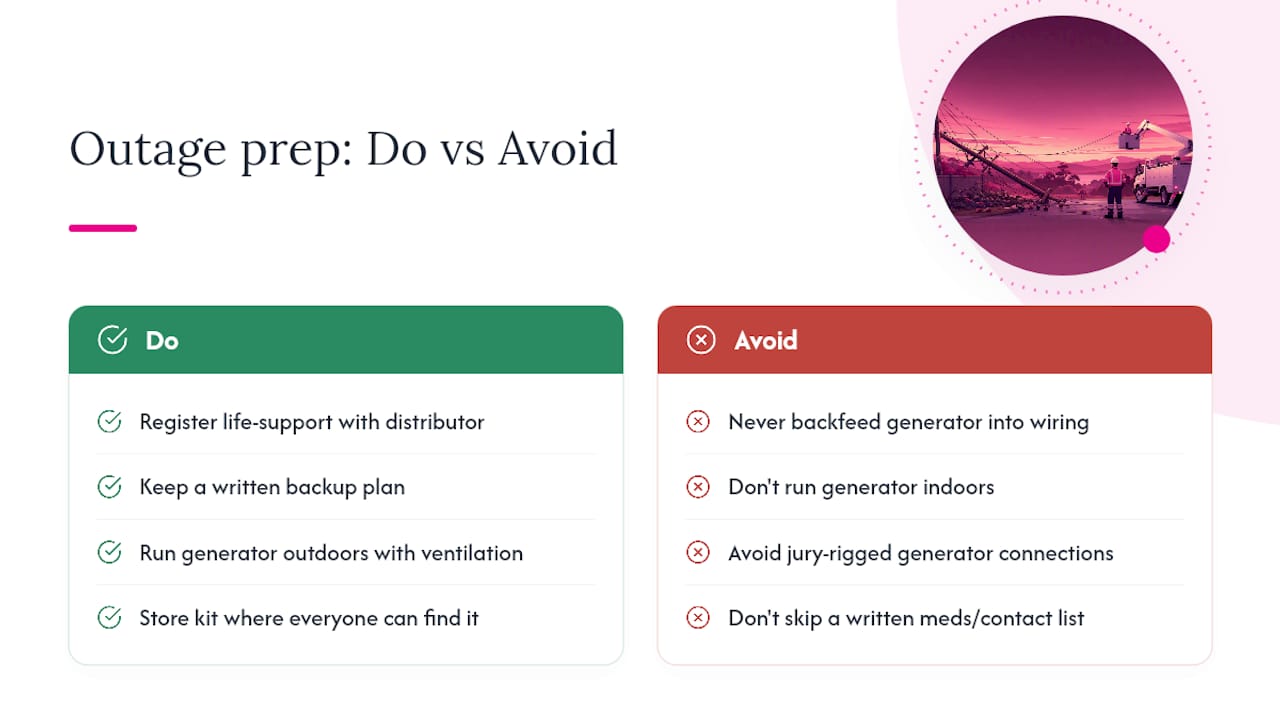
Pro Tip: If you’re planning permanent backup power rather than a portable unit for emergencies, get a licensed generator connection done properly the first time. A jury rigged setup is one of the fastest ways to turn a blackout into a house fire.
What a Level 2 electrician sees after the callouts come in
The most common mistake is impatience. People re-energise circuits, poke at damaged switchboards, or assume a quiet line is a dead one, and every one of those habits carries real risk. After you report a fault, distributors triage by severity, so life threatening jobs and vulnerable customers jump the queue, and widespread storm events can mean real delays for everyone else. Private electricians step in once the network side is confirmed safe, sorting out what’s actually yours to fix.
— Christopher
Sorting private repairs once the street is safe again
There’s a gap that opens up right after a distributor clears the network: your power’s back, but something on your side of the meter still isn’t right. That’s where a certified Level 2 electrician earns their keep. Experienced Level 2 ASP contractors handle service mains repairs, switchboard damage, and metering faults with 24/7 availability and responsive callback services when immediate assistance is needed.

If storm damage has left your switchboard tripping, your consumer mains exposed, or your meter box needing certified attention, an emergency electrician callout gets a fully accredited technician on site fast. Complex service mains or metering work also qualifies for a free site inspection through the Level 2 electrician service, so you know the scope and cost before anything’s touched. Book an inspection or callout today and get your property properly signed off, not just switched back on.
Where to check the official guidance
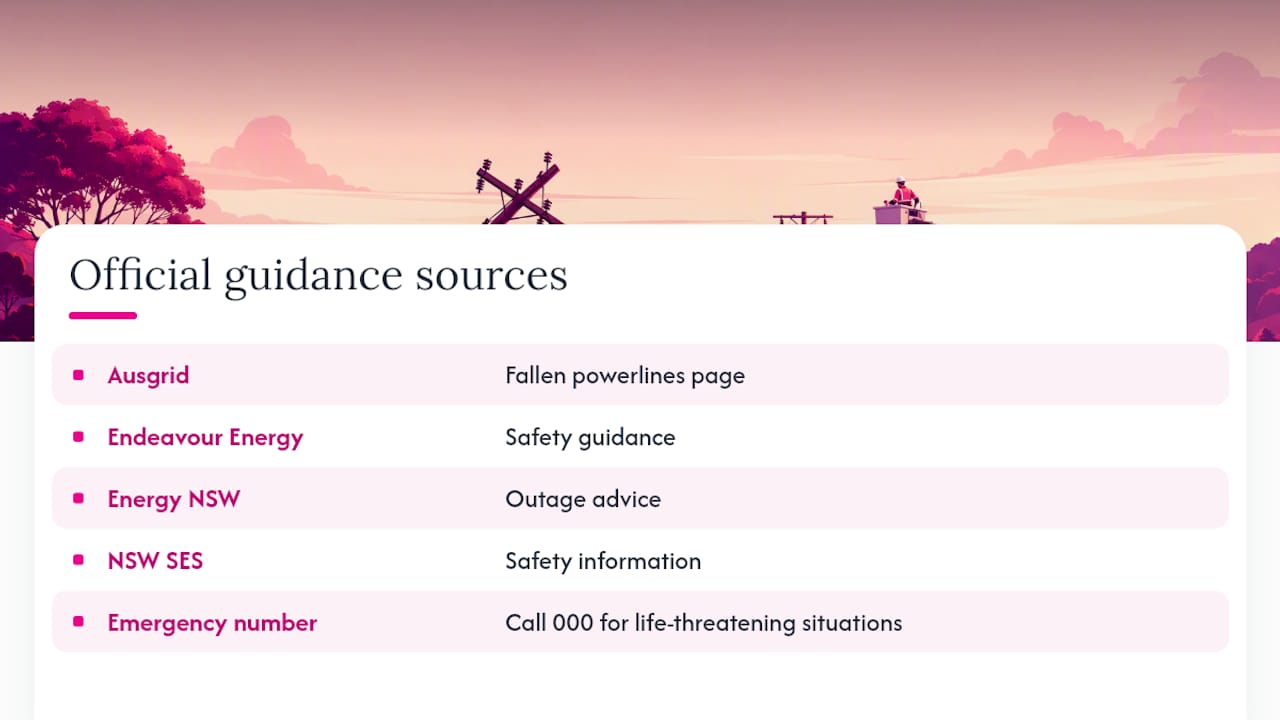
For direct reporting and safety advice, go to Ausgrid’s fallen powerlines page, Endeavour Energy’s safety guidance, Energy NSW’s outage advice, or NSW SES safety information. Always call 000 first for life threatening situations.
Sources
- Fallen powerlines — Ausgrid
- What is a power outage and what to do — Energy NSW
- Electricity, gas and water safety information — NSW SES
FAQ
What do you do if a power line is down?
Stay at least 8 metres away, keep others clear, and don’t touch the line or anything it’s resting on. Call 000 if anyone’s injured or there’s a fire; otherwise report it to your local distributor.
Who should I call if power lines are down in NSW?
Call 000 for life threatening situations. For everything else, contact your distributor directly: Ausgrid on 13 13 88, Endeavour Energy on 131 003, or Essential Energy on 13 20 80, depending on your area.
How long can a fridge go without power in Australia?
A full fridge generally keeps food safe for around four hours if the door stays closed. Check food for signs of spoilage before eating anything once power returns.
How far should a house be from power lines?
Clearance rules for permanent structures near power lines are set by your distributor and vary by voltage and line type, so check with Ausgrid, Endeavour Energy, or Essential Energy before building or renovating near an easement. For a fallen line specifically, the safety distance is 8 metres, or about two car lengths, regardless of where your house sits.
When should I call a licensed electrician after a fallen power line incident?
Once your distributor confirms the network is safe, call a licensed electrician if you notice damage to your switchboard, consumer mains, or meter box. Hdlevel2electriciansydney’s electrical repairs service covers exactly this kind of post-incident private wiring work.
Powering Your Needs with Expertise
If you’re looking for a reliable, experienced, and prompt electrician, look no further than High Demand Electrical. We cater to all your electrical needs, from routine maintenance to emergency repairs and complete system installations. Our skilled team is committed to providing professional service that ensures your electrical systems run smoothly. Whether it's a small task or a large project, give us a call today. Let us meet all your electrical demands with the quality and reliability you deserve.