Point of Attachment Repair Costs in NSW: $250–$3,000, NoSW & Level 2
Most NSW homeowners typically pay within a certain range for minor point of attachment repairs, higher amounts for standard replacements, and the cost increases significantly for cases involving fascia damage, a private pole, or consumer mains work. Level 2 accreditation and Notification of Service Work are commonly required, which is why price alone rarely tells the whole story.
TL;DR:
- Quotes for POA repairs can vary by hundreds of dollars based on scope, with fascia or private pole work pushing costs into the high-cost range of over $1,800.
- Most jobs require an accredited Level 2 electrician and a lodged Notification of Service Work, making compliance and insurance issues critical to avoid delays.
- Expect emergency repairs to be completed within hours, while routine replacements generally take a few days, with fascia repairs possibly extending to two weeks.
- Clarify all costs upfront with an itemised written quote, confirm accreditation, and provide clear photos to get the most accurate and reliable estimate.
- Undergrounding and rewiring are separate, often more expensive jobs, with undergrounding costs depending heavily on site access and length rather than a fixed per-metre rate.
Table of Contents
- Typical cost ranges and what each price band covers
- What affects the price: cost drivers and how they change a quote
- Who does this work: Level 2 electricians and NSW approvals
- How to get an accurate written quote
- Timelines: emergency make-safe vs routine replacement
- Three realistic homeowner scenarios
- How High Demand Electrical handles POA inspections and quotes
- Why most cost guides get this wrong
- Get a free site inspection before you commit to a price
- Sources
- FAQ
Typical cost ranges and what each price band covers
A point of attachment (POA) is the bracket and insulator where your property’s wiring physically connects to the network’s overhead supply. It’s a small piece of hardware carrying a lot of responsibility, and the price you pay depends heavily on what’s actually broken.
Low-cost jobs typically involve minor repairs such as re-terminating a loose or corroded connection, or swapping a cracked insulator or bent bracket. If the mounting point itself is sound and there’s no fascia damage, this is usually a straightforward callout.
Standard replacement covers a full bracket and insulator fit, re-termination of the service cable, coordinated disconnect and reconnect with the network, and lodging the Notification of Service Work (NoSW). This is the most common job type reported across NSW.
High-cost scenarios apply when the fascia or roof structure needs repair before a new POA can be fitted, when a private power pole is involved, or when consumer mains or metering work is required. Undergrounding a service connection sits at the top of this range.
Costs commonly quoted separately include scaffold or elevated access equipment hire, roof or fascia carpentry repairs, council approvals for structural changes, and network operator fees tied to reconnection.
What affects the price: cost drivers and how they change a quote
Two quotes for what looks like the same job can differ by hundreds of dollars, and it’s rarely random. Repair pricing generally follows a simple structure: final price equals parts cost (with a markup) plus labour, a model well established in repair industry pricing guides. Ask for that breakdown and you’ll see exactly where your money goes.
Pro Tip: A contractor who itemises parts and labour separately is usually more confident in their pricing than one who quotes a single lump figure.
Labour is priced either as a flat rate for predictable jobs or hourly with after-hours surcharges for emergencies, a distinction service-pricing frameworks describe as break-even labour-rate calculation applied against billed hours.
Key drivers include:
- Access difficulty (two-storey fascia work costs more than ground-level brackets)
- Whether a cherry picker or scaffold is needed
- Network-side fees for disconnect, reconnect, and defect notice rectification
- After-hours callout loading and travel distance
Who does this work: Level 2 electricians and NSW approvals
Attachment work sits on the network side of the meter, which means a standard electrician’s licence isn’t enough. You need an accredited service provider (ASP), commonly called a Level 2 electrician in NSW.
- Scope of work: Level 2 electricians are authorised to work on live network connections, service mains, and metering, tasks a general electrician cannot legally perform.
- Notification of Service Work: any POA repair or replacement requires a NoSW lodged with the local network operator, along with defect notice paperwork if the job started as a compliance issue.
- Timeline impact: accreditation and network liaison add a short administrative step to every job, but they’re the reason the work is legal and insured.
Skipping this step isn’t a shortcut. It’s a compliance gap that can void insurance and delay reconnection.
How to get an accurate written quote
A vague verbal estimate is the single biggest source of bill shock in this trade. Here’s how to lock in a number you can trust:
- Request an itemised written quote listing parts, labour, network fees, and NoSW lodgement costs separately.
- Confirm Level 2 accreditation and ask for proof of public liability insurance and a written workmanship warranty.
- Ask whether network reconnection fees are included in the quoted price or billed separately by the operator.
- Watch for red flags: no written quote, reluctance to lodge NoSW, or pricing that changes once the job starts.
Pro Tip: Send clear photos of the damaged attachment and any defect notice you’ve received before the site visit. It often lets a Level 2 electrician firm up a fixed quote faster, sometimes before they even arrive.
Fixed pricing works well for predictable jobs, while genuinely variable scope needs a proper site inspection, a distinction well recognised in service pricing models more broadly.
Timelines: emergency make-safe vs routine replacement
A sparking or dangling POA is a same-day problem. A cosmetic insulator crack is not.
- Emergency make-safe: most 24/7 emergency electricians in Sydney aim to attend dangerous faults within hours, isolating the hazard before a full repair is scheduled.
- Routine replacement: typically booked within a few days, with the job itself usually completed in under half a day including network reconnection.
- Extended timelines: fascia repairs, roofer coordination, or council approval for pole relocation can push total completion out to one to two weeks.
Three realistic homeowner scenarios
- Minor re-termination and insulator swap. A homeowner in Penrith notices a loose connection after high winds. The job includes a new insulator, re-termination, and a safety check. Price band: $250 to $600.
- Standard POA replacement with NoSW and reconnect. A Parramatta property has a corroded bracket flagged in a defect notice. The job covers full bracket and insulator replacement, disconnect and reconnect, and NoSW lodgement. Price band: $600 to $1,500.
- Fascia repair with private pole involvement. A Hills District home has fascia rot behind the attachment point plus an ageing private pole nearby. Carpentry repair, pole assessment, and full POA replacement push the price to $1,800 to $3,000+.
How High Demand Electrical handles POA inspections and quotes
High Demand Electrical is a certified Level 2 contractor operating across Sydney, backed by over 300 five-star reviews and 24/7 emergency availability. Site inspections before committing help ensure accurate assessment of the damage.
Transparent quotes ideally itemise parts, labour, network fees, and NoSW costs separately. For homeowners, choosing an accredited provider helps ensure paperwork and network liaison are handled properly.
Why most cost guides get this wrong
Most articles on this topic hand you a single number and call it a day. That’s not useful, because a POA repair without fascia damage and one with a rotted mounting board are barely the same job.
The conventional advice, “get three quotes and pick the middle one”, falls short here because price differences usually reflect scope differences, not padding. A $400 quote and a $1,400 quote for “the same job” often mean one contractor spotted fascia rot the other missed.
What actually matters is asking for an itemised breakdown before comparing figures at all. If a quote doesn’t separate parts, labour, and network fees, you can’t tell whether it’s fair or just incomplete. Prioritise transparency over the lowest headline number, because the cheapest quote that balloons mid-job costs more than the honest one that started higher.
— Christopher
Get a free site inspection before you commit to a price
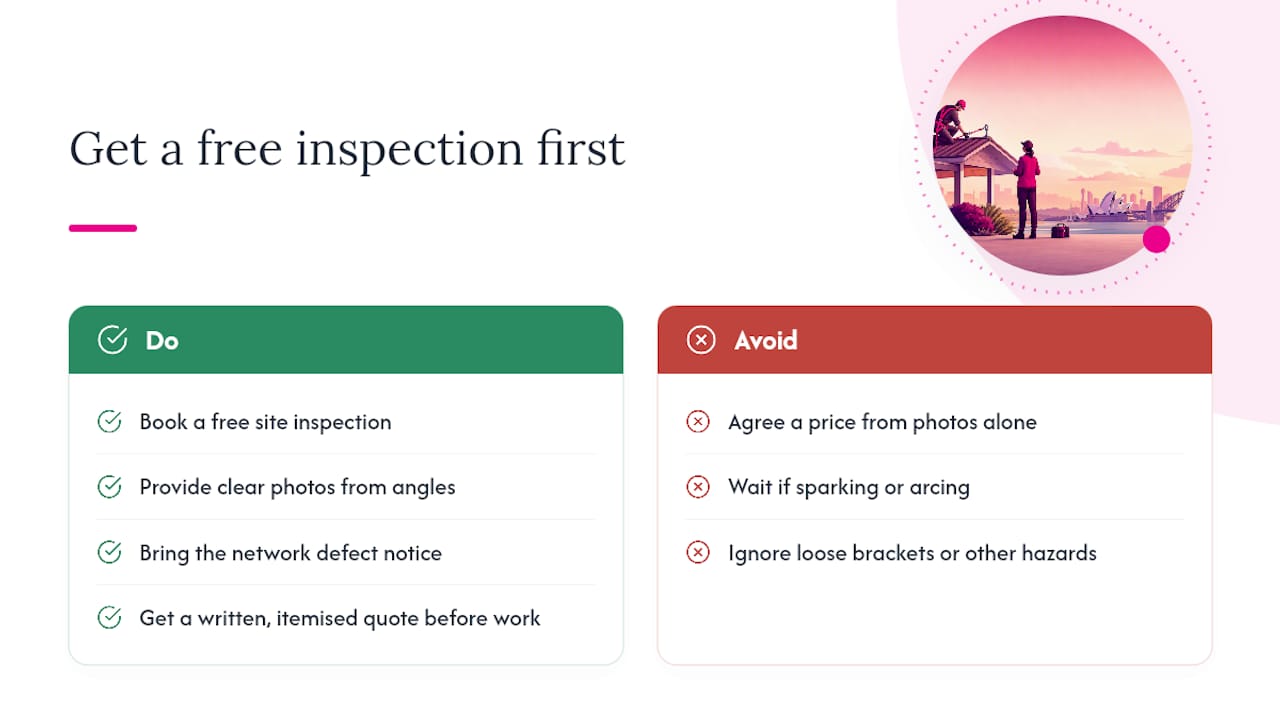
A reputable Level 2 electrician should offer homeowners an in-person look at the actual damage before asking to sign off on a number. That matters most with POA repairs, where the difference between a $400 job and a $2,000 job often isn’t visible from a phone photo alone.

Before you call, have a few things ready: clear photos of the attachment point from a couple of angles, any defect notice the network operator has sent you, and a note on access (two-storey fascia, tight side passage, whatever applies). That’s usually enough for the team to firm up a fixed written quote fast, often before they’ve even arrived on site. If the fault feels urgent, sparking, arcing, a bracket hanging loose, treat it as one and call for an emergency electrician rather than waiting for a scheduled slot.
Ready to get a real number instead of a guess? Book a free inspection through the Level 2 electrician Sydney page and get a written, itemised quote before any work starts.
Sources
Pricing methodology drawn from repair shop pricing frameworks and service pricing models. For formal NoSW and defect notice rules, check directly with your local NSW network operator before booking work.
- Repair Shop Pricing Guide: Set Rates That Stay Profitable
- The Complete Guide to Auto Repair Service Pricing 2026
- Auto Repair Menu Pricing vs Custom Quotes | MySyara OS
FAQ
How much does it cost to underground power lines per metre in Australia?
Undergrounding costs vary widely by site access and distance, and sit well above standard overhead POA replacement, often reaching the $3,000+ high-cost band described above for even short runs. Get a site-specific quote rather than relying on a per-metre average.
How much does it cost to rewire a house in Australia?
A full home rewire is a separate job from POA repair and typically costs several thousand dollars depending on house size and switchboard condition. It’s priced independently of any network-side attachment work.
How much does a sparky charge per hour?
Standard electricians typically charge an hourly rate for general work, but POA repairs need a Level 2 accredited provider, who often quotes flat-rate pricing for standard jobs rather than a simple hourly figure.
Does a 1970s house need rewiring in Australia?
Many homes from this era have ageing wiring or an outdated switchboard that no longer meets current safety standards, so a switchboard upgrade or full inspection is worth booking even if the POA itself looks fine.
Powering Your Needs with Expertise
If you’re looking for a reliable, experienced, and prompt electrician, look no further than High Demand Electrical. We cater to all your electrical needs, from routine maintenance to emergency repairs and complete system installations. Our skilled team is committed to providing professional service that ensures your electrical systems run smoothly. Whether it's a small task or a large project, give us a call today. Let us meet all your electrical demands with the quality and reliability you deserve.