6 Documents NSW Owners Need for a Compliant Overhead Service Upgrade
If your overhead service upgrade involves increasing your maximum demand, changing phases, or altering the connection between your property and the network, an Accredited Service Provider must carry out that work. Only an ASP can legally touch the network connection point under the Electricity Supply Act 1995. The job must also comply with the Service and Installation Rules and AS/NZS 3000:2018.
TL;DR:
- Only an Accredited Service Provider can legally perform overhead service upgrades involving demand increases, phase changes, or network connection alterations in NSW.
- Most delays stem from procedural issues like unconfirmed distributor details or missing landlord permissions rather than technical challenges.
- Preparing key documents and verifying your distributor before the site visit can prevent most common postponements.
- A Level 2 contractor manages both customer-side and network liaison work, often offering free inspections and coordinated scheduling.
- Having a detailed, written quote separating customer and distributor costs and confirming accreditation levels protects against billing disputes.
Table of Contents
- When you need an overhead service upgrade in NSW
- What the Service and Installation Rules and AS/NZS 3000 require
- Step-by-step: from inspection to energisation, what to expect
- Site and documentation checklist owners must prepare
- Choosing and briefing an Accredited Service Provider (ASP)
- How a Level 2 contractor manages an overhead service upgrade
- Typical mistakes and practical fixes
- How High Demand Electrical can help
- Sources
When you need an overhead service upgrade in NSW
Most upgrade requests start with a change in what a property needs to draw or supply. If your load calculations exceed your existing consumer mains capacity, the network operator or your ASP will flag a mandatory upgrade before energisation.
Common triggers we see across Sydney properties include:
- Installing an EV charger that pushes your maximum demand past the existing service rating
- Adding a new meter for a granny flat, secondary dwelling, or tenancy
- Upgrading from single phase to three phase for workshop equipment, air conditioning, or commercial machinery
- Converting from overhead to underground supply during a renovation or streetscape change
- Rectifying a defect notice issued against an ageing or damaged overhead service
Responsibilities split fairly cleanly. You, as the property owner, typically fund and manage everything on your side of the point of attachment, including switchboard work and consumer mains. The distributor retains its network assets and inspects the connection before turning the power back on. A residential example might be a family adding an EV charger that increases their power needs beyond their existing service capacity. A commercial example might be a warehouse needing three phase power for new refrigeration, which almost always means a full phase upgrade assessment.
What the Service and Installation Rules and AS/NZS 3000 require
The Service and Installation Rules set out the technical detail for overhead services in NSW, covering the point of attachment, span lengths, ground clearances, and when an existing service must be replaced rather than repaired. If your alterations push demand higher, the rules generally require the old consumer mains to go.
AS/NZS 3000:2018 governs the calculation itself. It sets out how maximum demand is worked out and mandates that consumer mains be replaced wherever the new load exceeds the current carrying capacity of the existing cable, a detail confirmed in the NSW Government’s own electrical standards guidance.
One rule cuts through most of the confusion: under the Electricity Supply Act, only an Accredited Service Provider may connect or alter the link between your premises and the network. A standard electrician’s licence doesn’t cover this work, regardless of how experienced that electrician is on domestic circuits.
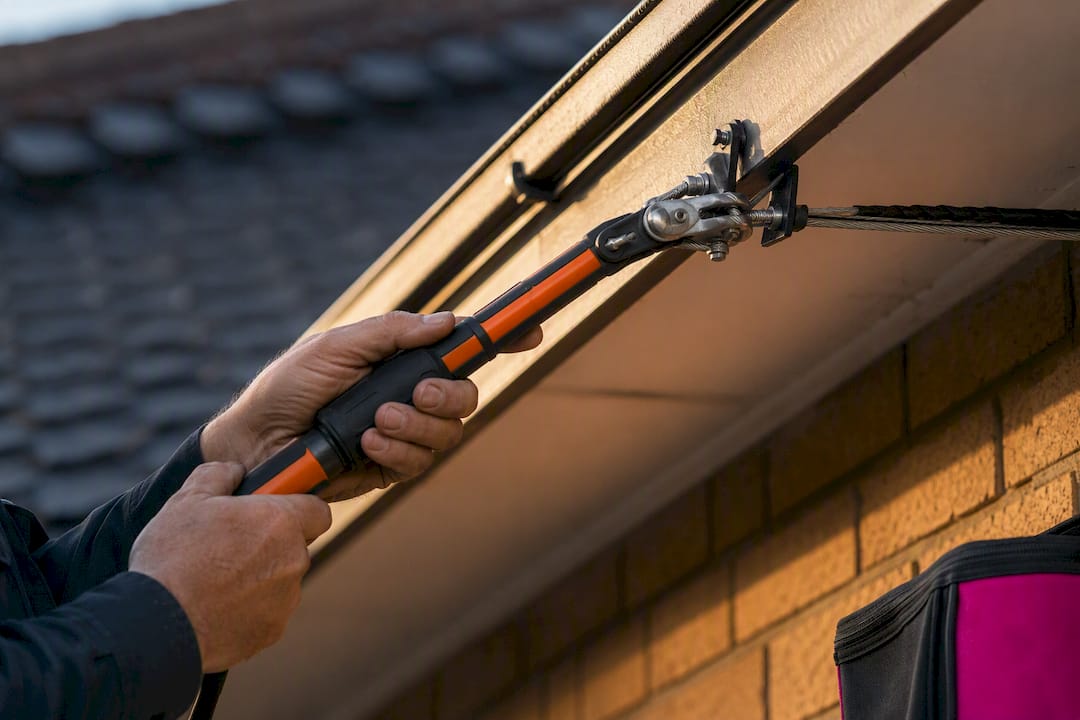
The point of attachment itself, the strain clamp where the service cable meets your property, remains part of the distributor’s asset base. You cannot repair or move it yourself, even in an emergency.
Step-by-step: from inspection to energisation, what to expect
An overhead service upgrade in NSW follows a fairly predictable sequence, even though timing varies between Ausgrid, Endeavour Energy and Essential Energy territories.
- Site inspection and load assessment. An ASP visits, checks your switchboard, and runs a maximum demand calculation against AS/NZS 3000. Our free maximum demand calculator gives you a rough figure before that visit, so you’re not caught off guard by the quote.
- Quoting and approvals. The ASP scopes the job and lodges the necessary approvals with your distributor. Most ASPs handle this liaison on your behalf, so you shouldn’t need to deal with the distributor directly.
- Customer-side works. Your switchboard, consumer mains, and any power supply upgrade elements get completed first.
- Distributor works. The distributor upgrades or replaces the overhead service conductor and point of attachment fittings on its side.
- Inspection and energisation. A final inspection confirms compliance, then the distributor energises the new connection.
Timeframes typically run from a few days for straightforward residential jobs to several weeks for commercial three-phase conversions, depending on distributor scheduling.
Pro Tip: Ask your ASP to confirm your distributor from your energy bill before quoting, since Ausgrid, Endeavour Energy and Essential Energy each run slightly different lodgement timeframes.
Site and documentation checklist owners must prepare
Getting your paperwork and access sorted before the ASP arrives saves real time. Distributors and ASPs consistently flag the same gaps as the biggest cause of delay.
- Confirm your point of attachment location and whether a private pole or post is required for your span
- Clear vegetation and obstructions around the existing overhead line and proposed route
- Lodge a check with Before You Dig Australia if any trenching or pole excavation is involved
- Have proof of property ownership or written landlord permission ready
- Locate a recent energy bill to identify your correct distributor
- Note your existing metering details, including NMI and meter type
Sorting these six items before your first site visit tends to remove most of the avoidable back and forth between you, your ASP, and the distributor.
Choosing and briefing an Accredited Service Provider (ASP)
Not every electrician holds ASP accreditation, and the level matters. Confirm the specific authorised activities listed against the contractor’s accreditation before signing anything.
- Ask to see the ASP’s accreditation number and confirm it covers overhead service connection work, not just internal wiring
- Ask whether the quote includes distributor liaison, lodgement fees, and inspection scheduling, or whether those sit outside the price
- Ask for a written maximum demand calculation as part of the quote, not a verbal estimate
- Treat a refusal to name the accreditation level, or a quote with no mention of the distributor, as a red flag
Pro Tip: Insist the quote separates customer-side costs from distributor charges in writing. Vague, bundled quotes are where most billing disputes start.
How a Level 2 contractor manages an overhead service upgrade
A certified Level 2 ASP typically bundles switchboard, consumer mains, and distributor liaison into one staged quote rather than leaving you to coordinate separate trades and separate approvals.
An experienced Level 2 ASP stages the customer-side and network-side works together, scheduling distributor visits to avoid repeated outages for the property owner.
A certified Level 2 electrical contractor typically offers free site inspections for Level 2 work, switchboard and power supply upgrades, and emergency make-safe services where a defective overhead connection poses an immediate risk. Distributor energisation and network-side asset replacement remain the network operator’s responsibility regardless of which ASP manages your job.
Typical mistakes and practical fixes
The mistakes that cost owners the most time are rarely technical. They’re procedural: not confirming the distributor early, not having landlord permission ready for a private pole, or accepting a verbal quote with no maximum demand figure attached. Fix those three things before your first site visit and most delays disappear.
— Christopher
How High Demand Electrical can help
A certified Level 2 electrical contractor can provide a local alternative to chasing multiple trades and lodging distributor paperwork. Such a team handles the ASP-accredited network liaison, switchboard upgrades, and consumer mains replacement as one coordinated job, often backed by free site inspections for Level 2 work so you know the scope before committing.
If your property needs an EV charger circuit, a phase upgrade, or a full Level 2 electrician assessment, book a free site inspection and get a written quote that separates customer-side and distributor costs upfront. For urgent overhead faults, High Demand Electrical’s emergency electrician service is available around the clock, rain, hail, or shine.
Sources
- Service and installation rules | NSW Climate and Energy Action
- Electrical standards, rules and notes | NSW Government
Recommended
Powering Your Needs with Expertise
If you’re looking for a reliable, experienced, and prompt electrician, look no further than High Demand Electrical. We cater to all your electrical needs, from routine maintenance to emergency repairs and complete system installations. Our skilled team is committed to providing professional service that ensures your electrical systems run smoothly. Whether it's a small task or a large project, give us a call today. Let us meet all your electrical demands with the quality and reliability you deserve.