Overhead Service Clearance in NSW: Heights, Distances and Who Fixes It
Overhead service clearance is the safe space the wires running from the street pole to your house must keep from the ground, buildings, trees, people and equipment. In NSW the distributor owns the service line, but you are responsible for the point of attachment and for keeping clearances on your property. If a line looks low, damaged or too close to your build, a Level 2 electrician is the person who can sort it out.
TL;DR
- An overhead service is the low voltage line between the distributor’s network and your connection point. The distributor owns it. You own the point of attachment and everything downstream.
- Approach distances for work near low voltage service lines range from 0.5 m (hand-held tools) to 4.0 m (handling scaffolding, roofing or metal guttering).
- You must keep clearances between the service and trees, buildings, structures and the ground on your premises.
- Only an accredited Level 2 electrician (ASP/2) can install, alter or repair the supply connection. A defect notice usually gives you about 21 days to act.
- Renovations, pools, driveways and new builds are where clearance problems appear. Plan the electrical side before the build starts.
Table of Contents
- What overhead service clearance actually means
- Safe approach distances for work near a service line
- Ground and road clearances
- Who is responsible for what
- Everyday jobs that put you inside the clearance
- When a Level 2 electrician is required
- Defect notices and the 21-day clock
- Our perspective
- Get a Level 2 electrician to check your service line
- FAQ
- Sources
What overhead service clearance actually means
Two different things get mixed up here. A network powerline is the distributor’s street infrastructure: poles, crossarms and the mains running along the road. An overhead service is the smaller line that peels off from that network and runs to your property.
The NSW Service and Installation Rules define an overhead service as overhead or aerial conductors, operating at low voltage, between the distribution system and the connection point. It is owned, controlled and maintained by the distributor as part of its network, and it includes the strain clamp at the point of attachment. It does not include the bracket or anchor the line is fixed to, or the connection device.
The Rules treat the service main differently: the powerlines connecting your installation to the distribution mains, between the connection point and the point of common coupling. That is customer territory.
Endeavour Energy describes the same thing in plain terms. Its safety clearances publication says low voltage overhead service conductors, sometimes called service mains, run from a distributor pole to a customer connection point on a building, structure or pole.
“Clearance” then covers three questions:
- How high is the line above the ground, driveway, road or pool?
- How far is it from buildings, structures, vegetation and communications cables?
- How close can people, tools and machinery safely work to it?
The first two are about the installation. The third is about the work you or your builder plan to do.
Safe approach distances for work near a service line
The clearest published numbers are the approach distances in the SafeWork NSW Code of Practice for work near overhead and underground electric lines. For low voltage overhead service lines, the approach distances for an ordinary person are:
| Activity | Approach distance |
|---|---|
| Hand-held tools | 0.5 m |
| Driving or traversing mobile plant (stowed position) | 0.6 m |
| Handling non-conductive materials (timber, plywood, PVC pipe) | 1.5 m |
| Operating a crane or mobile plant | 3.0 m |
| Handling conductive materials (scaffolding, roofing, guttering, pipes) | 4.0 m |
Essential Energy publishes the same set of distances in its quick reference guide for work near its assets.
Two things to notice. First, the distance depends on what you are holding, not just where you are standing. A person with a hand tool can work closer than a person carrying a 6 m length of metal guttering. Second, for work near overhead electric lines up to and including 132,000 volts, the Code sets the approach distance for ordinary persons at 3.0 m. If you cannot tell which kind of line you are looking at, treat it as the more dangerous one.
The no-go zone
The no-go zone is the area around overhead lines into which no part of a person, material, crane, vehicle or mobile plant may enter without the written approval of the electricity supply authority. If the work has to happen inside the approach distances, the person running the business must identify the hazards, follow the authority’s written requirements, carry out a risk assessment and put a safe system of work in place.
SafeWork NSW’s advice is to eliminate the risk where possible. After a 2024 incident release, it advised arranging for the electricity supply authority to isolate the supply for the duration of the work, and working near low voltage service lines only within the listed approach distances.
Ground and road clearances
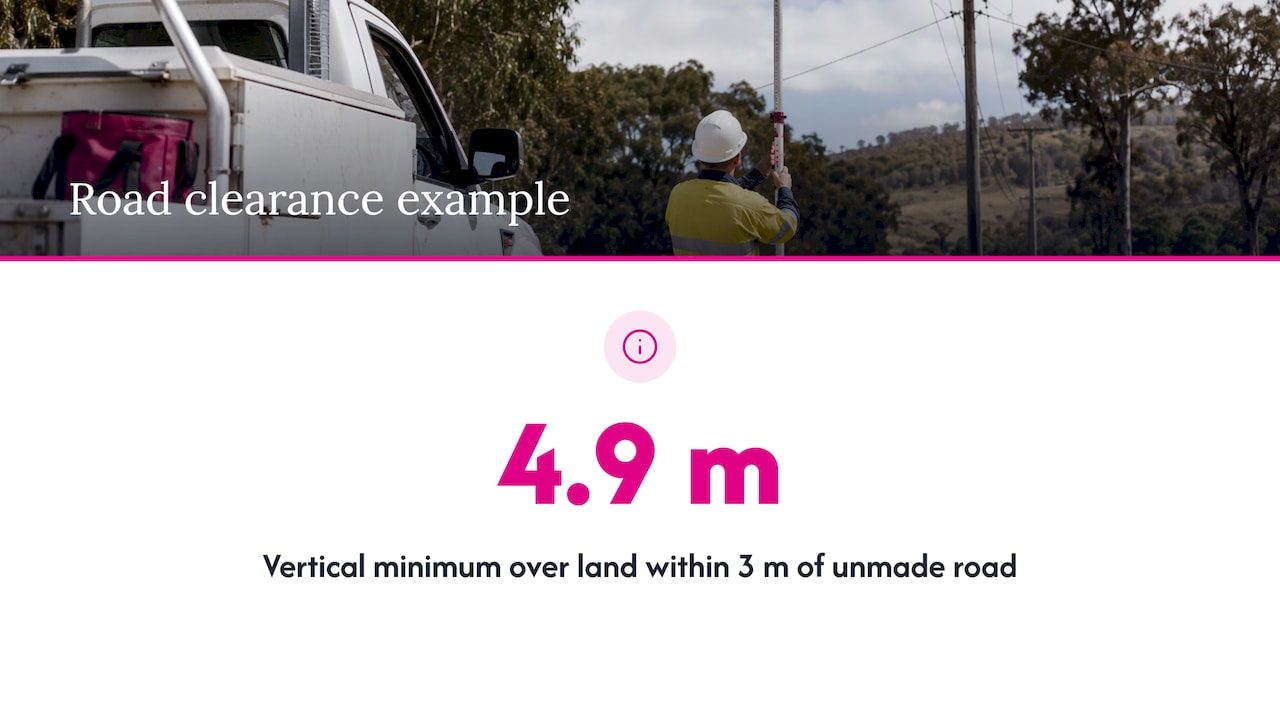
Minimum heights depend on what is underneath the line: a footpath, a driveway, a road or open land. The distributor’s specification sets them. One example from a specification for overhead service connections up to 400 amps: on roads with unmade edges, where there is no clear kerb or gutter and vehicles can drive on the land, the minimum clearance from insulated service conductors to land within 3 m of the formed road surface is 4.9 m vertically. The same document refers back to clause 3.5 of the Service Rules for clearances to ground, structures, communications services and vegetation.
Heights must hold under real conditions, not just on a cool morning. Lines sag in heat and swing in wind, so the clearance has to be met at the worst point of movement. We cover the road-crossing version of this in our guide to overhead line road crossing rules in Sydney.
Distributors can also ask for more. Essential Energy notes that it may increase the required distances to protect the public, and Endeavour Energy says the same about its 3 m minimum safety distance. So the number in a table is a floor, not a promise that your site is fine.
Who is responsible for what
Ownership splits at the point of attachment. Under the NSW Service and Installation Rules:
- The distributor (Ausgrid across most of Sydney, Endeavour Energy in much of the west and south-west) owns and maintains the overhead service up to the point of attachment.
- You, the customer, are responsible for the point of attachment, the consumer mains and everything downstream.
- You are also responsible for installing and maintaining any support the distributor requires for the overhead service on your premises.
- You must maintain the required clearances between the overhead service and trees, vegetation, buildings, structures or ground on your premises.
That last point catches people out. A line that was compliant when it was strung can become non-compliant when a deck goes up, a roof is raised or a tree grows into it. The wire did not move. The surroundings did.
Trees and pruning
On public land, pruning around overhead powerlines is done by distributor contractors. Randwick City Council says Ausgrid’s contractors usually clear at least 1.5 m from bare low voltage mains and 0.5 m from low voltage aerial bundled cable. Ausgrid takes emergency calls on 13 13 88 and general enquiries on 13 13 65.
On your own block, keeping vegetation off the service is your job, but you do not climb a ladder with a pruning saw beside a live wire. If branches hang over a roof or boundary, guidance on safety pruning of overhanging branches explains why the work is best left to trained arborists, and near a service line the distributor’s isolation rules apply.
Everyday jobs that put you inside the clearance
Most clearance incidents are not dramatic construction accidents. They are weekend maintenance jobs near the point of attachment. Essential Energy’s guide singles out painting gutters, fascias and eaves, cleaning leaves from guttering, replacing fascias, attaching aluminium cladding to eaves, and pruning trees and shrubs near the point of attachment.

The common thread is metal and reach. A metal ladder, a length of aluminium cladding or a long-handled tool can bring you inside the 4.0 m distance for conductive materials faster than you expect.
Projects that regularly trigger clearance questions in Sydney:
- Second storeys and roof raises. The point of attachment may end up too low relative to the roofline, or the line too close to new walls.
- Pools, decks and pergolas. New structures change what is underneath and beside the line.
- Driveways and crossovers. Heavy vehicles and tall loads need headroom.
- Scaffolding. Metal scaffold is a 4.0 m item, so scaffolders need a plan before they erect near a service.
- Crane lifts and skip bins on tippers. Crane or mobile plant operation carries a 3.0 m approach distance for a low voltage service.
- New dwellings and granny flats. The new supply point must have a compliant point of attachment from day one.
After a storm, a falling branch or a vehicle strike can drag a service line low or pull the attachment from the wall. Keep well clear, call the distributor on its emergency line, and keep people and pets away. Once the network side is made safe, the property side needs inspection. If appliances were affected, these safe checks after a power surge are a sensible follow-up for air conditioning gear.
When a Level 2 electrician is required
Not every electrician can touch the supply connection. The NSW Climate and Energy Action page on altering supply explains that an Accredited Service Provider, authorised by the local distributor, can connect, disconnect or change the supply between your premises and the network, including new or altered service lines, new connections, temporary builder’s supply and relocation of network assets. ASPs hold Level 1, 2 or 3 accreditation, and not all can do every job.
Ausgrid says an ASP/2 can install, repair or maintain overhead or underground service lines between a customer installation and its network, and must submit a Notification of Service Work after the job, with cables, joints and conduits recorded on the diagram.
In practice, call a Level 2 electrician when:
- the service line looks low, sagging or damaged near your property
- the point of attachment is loose, corroded or pulling away from the building
- you are planning a renovation, extension, pool or deck near the line
- you have received an Electrical Defect Notice
- you want to move from single phase to three phase, or add an EV charger or large air conditioner that needs more capacity
Street-crossing poles and private poles
When your building is a long way back from the street, the span from the network pole can exceed the allowed length. In that case, Endeavour Energy’s ASP2 guidelines say it may install a street-crossing pole, and the customer’s ASP installs the overhead service from that pole to the point of attachment. The customer must still provide a compliant point of attachment meeting all clearances. A private power pole on the property is another way to bring the supply to a compliant, safe position.
Does a three phase upgrade change clearances?
It can. The Service and Installation Rules state that alterations, additions or upgrades to an existing overhead service required by or for the customer must comply with the Rules. A single phase to three phase upgrade usually means a new or altered service, so the point of attachment, the route and every clearance get checked against current requirements, not the ones that applied when the house was built. The distributor itself can maintain or renew an existing network service without reference to the Rules, but customer-driven changes do not get that allowance.
Defect notices and the 21-day clock
If a distributor inspects and finds a problem on your side of the connection, you may get an Electrical Defect Notice. The Service and Installation Rules summary of the process is that the defect must be repaired within a set timeframe, typically 21 days, and a Level 2 ASP is required where the work involves the electrical supply connection.
What to do on the day the notice arrives:
- Read the notice for the exact defect and the deadline.
- Call a Level 2 electrician quickly, before the deadline pressure builds.
- Arrange an inspection and a scope of work.
- Complete the repairs or installation.
- Submit the compliance documentation.
Property managers and strata committees should treat a notice the same way, with the added step of telling the owner or owners corporation what the work involves.
Our perspective
Most clearance problems we are called to were avoidable. The line was fine until a deck, a second storey or a scaffold arrived. The fix is rarely hard when it is planned. It becomes expensive and stressful when it happens under a defect notice or after someone has already come too close to a live wire.
Our advice is simple. Before you sign off a build, a pool or a roof job near a service line, get a Level 2 ASP electrician to look at the point of attachment, the route of the line and the heights. We offer free site inspections for Level 2 work, so you know what is needed before you commit to anything. Our electricians are fully accredited Level 2 ASPs, and we work to NSW standards on every job, from point of attachment upgrades to private pole installations.
If the situation is urgent, such as a low or damaged line, we are available 24/7 and our commitment is a 10-minute callback. Rain, hail or shine, the network side belongs to your distributor and the customer side belongs to a qualified electrician. We are happy to be that electrician.
Christopher
Get a Level 2 electrician to check your service line
We are a certified Level 2 electrical contractor serving residential, commercial and strata properties across Sydney. For overhead service work we handle point of attachment problems, consumer mains, private power pole installation, defect notice rectification and power supply upgrades, including single phase to three phase. Our Level 2 work starts with a free site inspection.

If a line is down, low or sparking, use our emergency electrician service and keep everyone well clear. For planned work or a notice you have received, see our Level 2 electrician page or start at High Demand Electrical.
FAQ
How close can I work to an overhead service line in NSW?
For low voltage service lines, the SafeWork NSW Code sets 0.5 m for hand-held tools, 1.5 m for non-conductive materials, 3.0 m for cranes and mobile plant, and 4.0 m for conductive materials like scaffolding and metal guttering. If the work must go inside those distances, you need the electricity supply authority’s written requirements and a risk assessment, and often an isolation.
Who owns the overhead service line to my house?
The distributor owns and maintains it up to the point of attachment. In most of Sydney that is Ausgrid, and in parts of the west and south-west it is Endeavour Energy. You are responsible for the point of attachment, the consumer mains and the clearances on your property.
Can I trim a tree touching my service line myself?
No. Keep clear of any vegetation in contact with a service line and do not climb or reach into it. Contact your distributor, and arrange isolation or qualified work. The clearance is your responsibility to maintain, but how the work is done near live conductors must follow the approach distances.
What happens if I get an Electrical Defect Notice?
You typically have about 21 days to have the defect repaired. Where the work involves the supply connection, it must be done by a Level 2 ASP, who completes the repair and provides compliance documentation. Call a Level 2 electrician as soon as the notice arrives.
Do I need a Level 2 electrician for a three phase upgrade?
Yes, because the work alters the supply connection between your premises and the network. Accreditation levels differ, and the work must be done by an ASP authorised by your local distributor, with the overhead service meeting the current Service and Installation Rules.
Sources
- NSW Service and Installation Rules (June 2025)
- NSW Service and Installation Rules (2018 edition)
- Endeavour Energy: Where to draw the line on safety clearances
- Endeavour Energy: ASP2 Contestable Work Guidelines
- SafeWork NSW: Work near overhead and underground electric lines
- SafeWork NSW: Working near overhead electrical service lines
- Essential Energy: Working near Essential Energy assets
- Specification for overhead service connections up to 400 amps
- Randwick City Council: Trees on public land
- NSW Climate and Energy Action: Installing or altering electricity supply
- Ausgrid: Installation and service
- Safety pruning of overhanging branches
- Safe checks after a power surge
Need Help Fast?
Powering Your Needs with Expertise
If you’re looking for a reliable, experienced, and prompt electrician, look no further than High Demand Electrical. We cater to all your electrical needs, from routine maintenance to emergency repairs and complete system installations. Our skilled team is committed to providing professional service that ensures your electrical systems run smoothly. Whether it's a small task or a large project, give us a call today. Let us meet all your electrical demands with the quality and reliability you deserve.

Licensed Level 2 ASP electricians across Sydney. Same-day service and 24/7 emergency response.
Licence 397193C
ABN 87 051 836 527
