Oven Circuit Requirements in NSW: Cable, Breaker, RCD
In NSW, an electric oven is a fixed appliance that needs correctly sized cable, the right circuit protection, RCD protection and a licensed electrician to connect it. Many ovens, especially larger built-in models and those paired with a cooktop, are best on their own circuit. The exact breaker and cable size depend on the oven’s rating, the cable run and your switchboard. Here is what the rules say, how the sizing works and what to sort out before the new oven arrives.
TL;DR
- Any electrical wiring work in NSW must be done by a licensed electrician, including connecting a hardwired oven or adding an oven circuit.
- Ovens and cooktops commonly sit on their own circuit, with cable and breaker sized to the appliance rating, voltage drop and how the cable is installed.
- AS/NZS 3000:2018 requires RCD protection on all domestic and residential final sub-circuits, and Type AC RCDs can no longer be installed in new work.
- After the work, the electrician must test the circuit and lodge a Certificate of Compliance for Electrical Work (CCEW) within 7 days.
- If your switchboard or supply is at its limit, the oven may trigger a switchboard or power supply upgrade.
Table of Contents
- Do ovens need their own circuit?
- Are ovens 30 amp or 50 amp?
- Breaker size: what decides it
- Cable size and wiring arrangements
- RCD protection for oven circuits
- When an oven means a switchboard or supply upgrade
- Who can do the work in NSW
- Testing and paperwork after the installation
- Our perspective
- Planning an oven circuit with us
- Checklist before you buy or install
- FAQ
- Sources
Do ovens need their own circuit?
In most kitchens, yes, it is the sensible and common arrangement. A built-in oven is a high-load, fixed appliance. Putting it on a circuit shared with general power points risks nuisance tripping and overloaded cable, so electricians normally give ovens, cooktops and similar cooking appliances a circuit of their own. A freestanding or built-in oven that is plugged into a standard 10 A outlet is a different case, because it is sized to that socket, but larger ovens and combined oven and cooktop setups are hardwired.
What decides it in practice:
- The appliance rating. The rating plate (usually inside the oven door frame or on the back) states the power in watts or kilowatts and often the current in amps.
- Whether the cooktop shares the circuit. An electric cooktop and oven can sometimes be supplied from one circuit, but the combined load must be assessed by the electrician. It is not a case of simply adding another appliance to the cable already in the wall.
- What is already installed. An older house may have a circuit that suited a small oven decades ago and cannot carry a modern one.
The design call belongs to the electrician who signs off the work. We size every oven circuit from the real appliance data, not from a rule of thumb.
Are ovens 30 amp or 50 amp?
Neither figure is a safe default in NSW. The 50 amp oven circuit you see in many online guides comes from North American practice, where supply is 240 V split-phase and cable is sized in AWG. In NSW, supply is 230 V and circuits are designed under AS/NZS 3000.
To find out what your oven needs:
- Check the rating plate or the installation manual for the rated power and current.
- Check the manufacturer’s installation instructions, which often state the minimum supply requirement.
- Ask your electrician to confirm the existing circuit’s cable, breaker and route before you buy, not after the oven is on the kitchen floor.
As a rough guide, dividing watts by 230 volts gives the approximate current. A 7.2 kW load, for example, works out at roughly 31 A, which is why 32 A circuits are common for larger ovens and cooktop combinations. A smaller single oven draws far less. Treat this as a sanity check only, because the electrician applies diversity, installation method and other factors when designing the circuit.
If you are comparing ovens before you buy, oven power consumption measured per cycle rather than by wattage alone helps you judge running cost, though the circuit still has to be sized to the appliance’s rated load.
Breaker size: what decides it
There is no single minimum breaker size that applies to every oven in NSW. The breaker has to protect the cable, carry the appliance’s normal load without nuisance tripping, and suit the installation. In practice that means:
- The breaker rating must not exceed what the cable can safely carry in its installed conditions.
- The breaker must be at least equal to the circuit’s design current.
- The device must have a suitable breaking capacity for the supply at your switchboard.
That last point is set by your electricity distributor as well as the standard. The NSW Service and Installation Rules say distributors can impose conditions on an installation, such as minimum breaking capacity for protection devices or load balancing, particularly for larger loads. Distributors also keep the right to specify requirements for service protection fuses and circuit breakers so that an installation does not adversely affect the wider network. For a single oven in a normal house this rarely changes the outcome, but it is why the answer is always checked against your actual supply.
Cable size and wiring arrangements
Cable size depends on three things: the design current, the allowable voltage drop over the run from the switchboard, and the installation method. The last one matters more than most people expect. A cable buried in insulation, bunched with others in a roof space or run through a hot cavity behind a cooktop carries less current than the same cable clipped in free air.
Typical practice in Australian homes:
- A 32 A oven or cooktop circuit is commonly wired with 6 mm² cable.
- A smaller oven with a lower design current may suit a smaller cable, if the installation method supports it.
- A long run from the switchboard to a kitchen at the far end of a house may need a larger conductor to keep voltage drop in check.
For a hardwired oven, the cable terminates at a suitable connection point or isolating switch near the appliance, usually not directly behind it where it is hard to reach. Your electrician will choose the position based on the cabinet layout and the oven’s installation instructions.
Why existing wiring is often the problem
The biggest surprise in kitchen upgrades is old wiring. Common situations we see:
- A previous oven circuit that was sized for a smaller appliance.
- Cable that has been run through insulation or a tight cavity that was never assessed for the new load.
- Tails and connections at the old oven outlet that have been heated for years and have deteriorated.
- A kitchen renovation that moved the oven to the other side of the room, so the old cable no longer reaches without a joint.
A licensed electrician can inspect the existing circuit, test it and tell you whether it can be reused or should be replaced. If you suspect old or damaged wiring, our electrical repairs team can look at the problem before the new appliance is installed.
RCD protection for oven circuits
This is the rule people most often miss. The NSW Government confirms that AS/NZS 3000:2018 requires RCD protection for all domestic and residential final sub-circuits. An oven circuit is a final sub-circuit, so in a home it needs RCD protection, whether that is a separate safety switch upstream or an RCBO combining overcurrent and residual current protection in a single device.
Two details matter:
- Device type. As of 1 May 2023, installing Type AC RCDs is prohibited in Australia. Electricians must use Type A or Type B for new work. According to Building Commission NSW, the reason is that Type AC devices do not detect the pulsating DC leakage currents that modern appliances can produce.
- Overcurrent protection must still be there. An RCD alone detects earth leakage but does not protect the cable from overload. The circuit needs a circuit breaker as well, which is why an RCBO is a common solution on a new oven circuit.
If your switchboard is old, has no RCD protection or is full, adding the oven circuit is a good time to deal with it. See our switchboard upgrades page, or have your existing safety switches checked through our electrical maintenance service, which includes RCD or safety switch testing.
When an oven means a switchboard or supply upgrade
Most oven replacements need nothing more than a like-for-like swap. A bigger job is more likely when:
| Situation | Likely outcome |
|---|---|
| New oven has a higher rating than the old one | Circuit cable and breaker reassessed, possibly replaced |
| Switchboard has no spare way or no RCD protection | Switchboard upgrade or board extension |
| Moving from gas to an all-electric kitchen | New circuits for oven and cooktop, plus a check of total demand |
| Adding induction cooktop, EV charger and air conditioning together | Maximum demand review, possible supply upgrade |
| Supply is single phase and the home already runs near its limit | Discussion of a single phase to three phase upgrade |
Going all-electric is the common trigger. Each new large appliance adds to your maximum demand, and the supply that suited a gas kitchen may not cover an electric oven, induction cooktop, heat pump hot water and an EV charger running together. That is the point at which a single phase to three phase power upgrade can make sense. The distributor’s conditions apply, so it is worth raising early rather than discovering it on the day.
Who can do the work in NSW
Only a licensed electrician. NSW Government guidance is plain that any electrical wiring work must be done by a licensed electrician. That covers running a new oven circuit, replacing the cable, fitting a new breaker and connecting a hardwired oven. It is not a job for a handy friend, a cabinet maker or an appliance delivery driver, and self-installation is illegal.
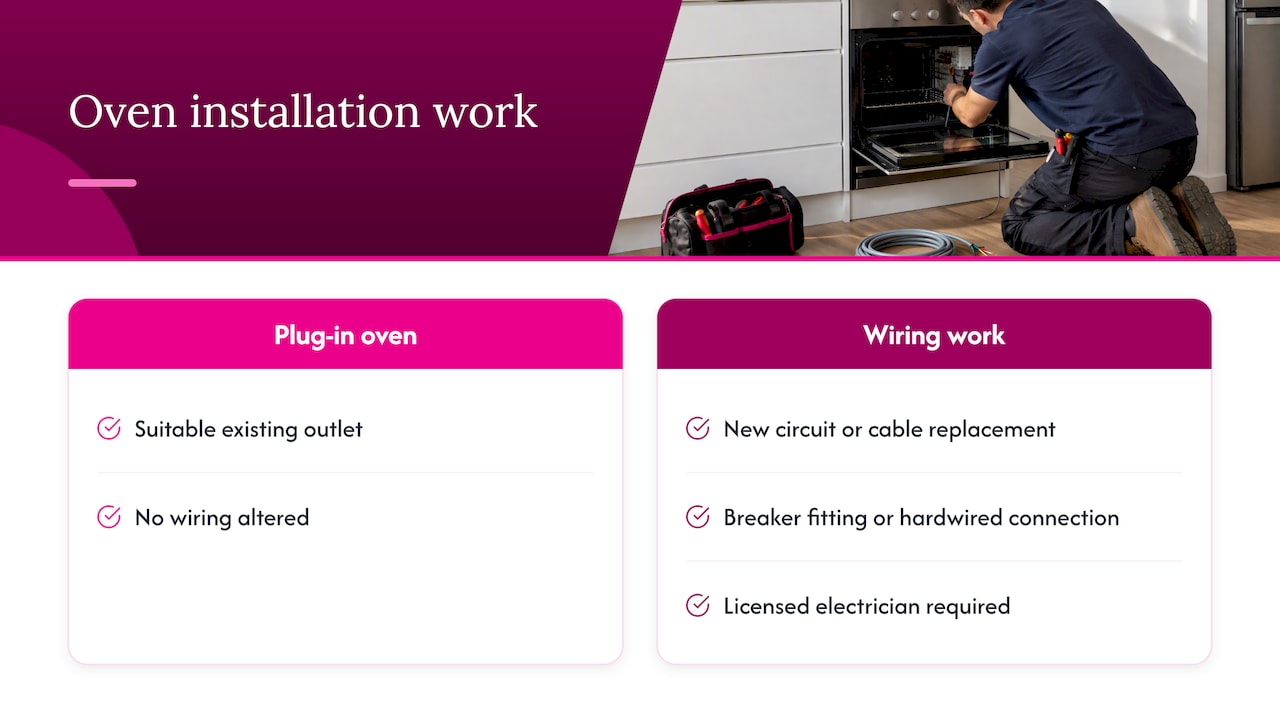
A plug-in oven on an existing, suitable outlet is a different matter, because no wiring is altered. If you are not sure whether your oven is plug-in or hardwired, check the installation manual or ask an electrician before delivery day.
Testing and paperwork after the installation
A finished oven circuit is not just a working oven. The electrician has to test it and record it.
- Testing. A qualified person must carry out a safety and compliance test. It verifies continuity of the earthing system, insulation resistance, polarity and circuit connections.
- Certificate. The tester must lodge the Certificate of Compliance for Electrical Work (CCEW) through the BCNSW eCert portal no later than 7 days after completing the test.
Ask for a copy of the certificate for your records. It is useful when you sell, when an insurer asks questions and when a property manager or strata committee needs proof that work was done properly.
Our perspective
Most oven problems we are called to are not faulty ovens. They are old circuits asked to do a new job: a 15-year-old cable, a switchboard with no safety switch, a kitchen that has quietly gone all-electric.
That is why we start with the circuit, not the appliance. As a certified Level 2 electrical contractor, we can look at the oven, the cable run, the switchboard and the supply together, and tell you in one visit whether a simple connection will do or whether the board or the supply needs attention. Doing it in that order avoids the expensive surprise of an oven that is installed but cannot be safely switched on.
Our advice is to call before the oven is ordered. We offer free site inspections for Level 2 work, so you can find out what your property needs before you commit to a kitchen schedule. Everything we do is aimed at compliance with NSW standards, and every job should end with tested work and the paperwork to prove it.
Christopher
Planning an oven circuit with us
We are a certified Level 2 electrical contractor in Sydney, and our team handles oven circuits, switchboard upgrades and power supply upgrades for homes, strata properties and businesses. We offer free site inspections for Level 2 work, a 10-minute callback guarantee for urgent calls and 24/7 emergency support. Seniors can ask about our discounts. We do not publish a fixed price for oven circuit work, because the cost depends on your cable run, your board and your supply.

If your new oven is not on the existing circuit’s rating, or you want your kitchen checked before an appliance order, book a Level 2 electrician through our site. If an oven or kitchen circuit is tripping, smells hot or has lost power, go straight to our emergency electrician service.
Checklist before you buy or install
- Find the rating plate or installation manual for the oven you plan to buy.
- Note whether it is plug-in or hardwired.
- Photograph your switchboard, including any safety switches and spare ways.
- Find out whether your home is single phase or three phase.
- Tell your electrician if you plan to add a cooktop, EV charger or air conditioning soon.
- Book the electrician before the appliance is delivered.
- After the job, ask for the Certificate of Compliance for Electrical Work.
FAQ
What size circuit breaker does an oven need in NSW?
It depends on the oven’s rating, the cable size and how the cable is installed. A 32 A breaker with 6 mm² cable is a common arrangement for larger ovens and cooktops, but a smaller oven may need less. The electrician designs and signs off the circuit under AS/NZS 3000, and the distributor can set extra conditions.
Does an oven need an RCD in NSW?
Yes, in a home. AS/NZS 3000:2018 requires RCD protection on all domestic and residential final sub-circuits, and oven circuits are included. New work must use Type A or Type B devices, because Type AC RCDs have been banned for installation since 1 May 2023.
Can I install an oven myself in NSW?
Not if it involves wiring. Any electrical wiring work in NSW must be done by a licensed electrician. Plugging an oven into an existing suitable outlet is different, but connecting a hardwired oven or altering a circuit is licensed work.
Will a new oven need a switchboard upgrade?
Sometimes. If your board has no spare way, no RCD protection or is at its limit, the oven circuit can prompt an upgrade. A free site inspection from a Level 2 electrician will tell you before you buy.
Sources
- NSW Service and Installation Rules, NSW Government
- Electrical standards, rules and notes, NSW Government
- Residual Current Device (RCD) compliance, NSW Government
- Electrical safety requirements and consumer rights, NSW Government
- When to submit a Certificate of Compliance for Electrical Work, NSW Government
Recommended
Need Help Fast?
Powering Your Needs with Expertise
If you’re looking for a reliable, experienced, and prompt electrician, look no further than High Demand Electrical. We cater to all your electrical needs, from routine maintenance to emergency repairs and complete system installations. Our skilled team is committed to providing professional service that ensures your electrical systems run smoothly. Whether it's a small task or a large project, give us a call today. Let us meet all your electrical demands with the quality and reliability you deserve.

Licensed Level 2 ASP electricians across Sydney. Same-day service and 24/7 emergency response.
Licence 397193C
ABN 87 051 836 527
