
Office Lighting Lux Levels: What Australian Standards Require
For routine office work such as reading, writing and typing, Australian guidance recommends a maintained illuminance of 320 to 400 lux at the work surface. Screen work sits lower, at 240 lux, and difficult tasks like proofreading or drafting climb to 600 lux. Those figures come from AS/NZS 1680.1:2006, the standard that NSW regulators point to when they talk about workplace lighting. This guide explains what each number means, how to check your own office, and when a fix needs a licensed electrician rather than a new lamp.
TL;DR
- Routine desk tasks: 320 to 400 lux. Computer-based work: 240 lux. Difficult visual tasks: 600 lux. Moving around and orientation: 40 lux.
- In NSW, the employer (the PCBU) must make sure lighting lets each worker do the job safely, move around safely and evacuate in an emergency.
- Lux is measured at the work surface with a lux meter, ideally by a competent person, not guessed from how bright a room feels.
- Glare, flicker, reflections and daylight swings matter as much as the raw lux figure.
- If readings fall short or fittings are failing, a licensed electrician can correct the circuits, fittings and controls behind the problem.
Table of Contents
- What a lux level actually measures
- Recommended lux levels for Australian offices
- What NSW law requires of employers
- Beyond the number: glare, flicker and daylight
- How to measure lux in your office
- What to do when readings fall short
- Our perspective
- When to call a licensed electrician
- Getting your office lighting sorted
- FAQ
- Sources
What a lux level actually measures
Lux measures the amount of light falling on a surface. When a standard talks about 400 lux, it means the light arriving at a desk, a keyboard or a floor, not the output of the lamp itself. SafeWork NSW’s lighting guidance frames lighting in these terms: the question is what reaches the task.
That is why two offices with identical fittings can feel completely different. Ceiling height, wall and desk colours, dirty diffusers, blinds and the distance from the window all change the number at the desk. A brand-new LED panel in a dark, wood-panelled room can deliver less than an older fitting in a pale open-plan space.
Two more terms are worth knowing:
- Maintained illuminance: the level you must still have just before lamps are cleaned or replaced. Fittings lose output over time, so a design must start higher than the target.
- Task area: the part of the desk where the visual work actually happens. Standards allow lower levels in surrounding areas as long as the transition is comfortable.
Recommended lux levels for Australian offices
There is no single “office lux” number in Australia. Levels depend on the visual task. The table below uses the figures published by SafeWork NSW and WorkSafe Victoria from AS/NZS 1680.1:2006.
| Area or task | Recommended illuminance | Source |
|---|---|---|
| Movement and orientation | 40 lux | SafeWork NSW Code of Practice |
| Computer use (moderately easy visual task) | 240 lux | WorkSafe Victoria |
| Routine reading, writing, typing | 320 to 400 lux | WorkSafe Victoria |
| Difficult tasks (drawing boards, proofreading) | 600 lux | SafeWork NSW Code of Practice |
Treat these as the figures to design to and test against, not as a ceiling. Many ranking pages quote 500 lux as an office benchmark, and you will see 300 to 500 lux repeated across overseas guides. Those come from other standards and regions. For an NSW workplace, the Australian standard is the reference your regulator uses.
Why screen work is lower than paper work
It surprises people that computer tasks are rated at 240 lux while reading and writing are 320 to 400. Screens emit their own light, and strong overhead lighting washes out the display and creates reflections. Most modern offices mix screens and paper at the same desk, which is why a design target in the 320 to 400 range is common, paired with good glare control so the screen stays readable.
Where the detailed office standard sits
The general principles are in AS/NZS 1680.1. Recommendations specific to offices and screen-based tasks are in AS/NZS 1680.2.2:2008, published by Standards Australia. A lighting designer or electrician working on a fitout will work from both.
What NSW law requires of employers
NSW has no law that says “every office must have X lux”. Instead, the Work Health and Safety Regulation sets a duty. Under it, a person conducting a business or undertaking must ensure lighting enables each worker to carry out work safely, move around safely, and evacuate safely in an emergency, as set out in the SafeWork NSW Code of Practice on managing the work environment and facilities.
The Code of Practice then points readers to AS/NZS 1680.1:2006 for the specific levels. In practice, that makes the lux figures above the yardstick for whether your lighting is adequate. The same code says the right level depends on the nature of the work, the hazards and the environment.
If you manage a building or tenancy, that duty covers more than desks:
- Stairwells, corridors and amenities, where you need safe movement.
- Emergency egress routes, where lighting must work when you need to leave quickly.
- Reception, meeting rooms and kitchens, where tasks vary through the day.
For wider obligations on commercial premises, see our overview of commercial electrical compliance in Sydney.
Beyond the number: glare, flicker and daylight
A room can measure 400 lux and still be unpleasant to work in. The SafeWork NSW code lists the factors that shape suitable lighting: the nature of the work, natural light changes through the day, artificial lighting, glare, contrast and reflections. WorkSafe Victoria adds that lighting should be free from flicker and stroboscopic effect and from glare.
Glare
Glare comes from bare bright sources in the line of sight and from reflections on screens or glossy desks. Common culprits are fittings directly above the screen, unshielded windows behind a monitor and polished benchtops. Positioning desks side-on to windows and using blinds solves most of it without any electrical work.
Flicker
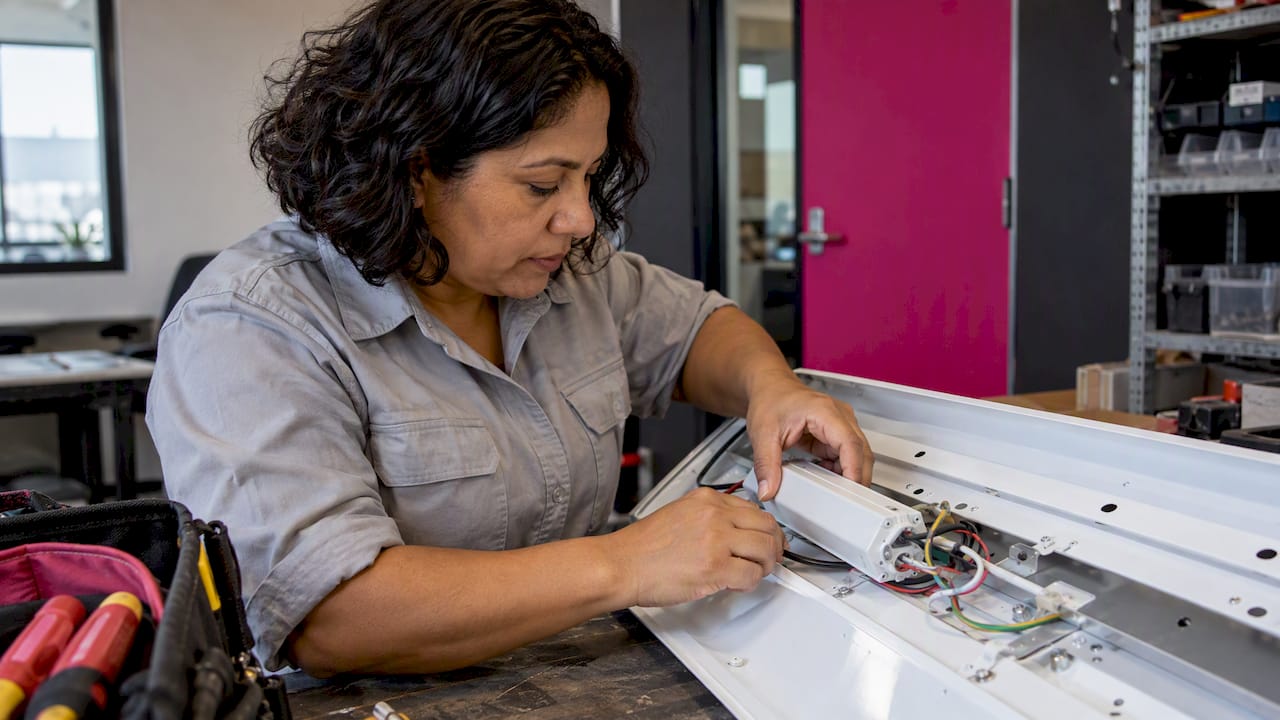
Cheap or ageing drivers can cause visible or invisible flicker, which workers describe as headaches or tired eyes. If complaints cluster around one area, the fittings or their drivers are the first thing to check. This is a job for an electrician, since the driver sits inside the fitting and on the circuit.
Daylight
Window-side desks may exceed the target at noon and fall well short on a grey afternoon. Lighting controls that dim fittings near windows, or zone switching, keep levels steady and avoid paying to light a space that is already bright.
How to measure lux in your office

Measurement is the only way to know. WorkSafe Victoria’s guide for employers says light levels are measured with a light meter, also called a lux meter, and that a competent person should take the readings.
A sensible walk-through looks like this:
- Pick the task areas. Desks, meeting tables, reception, print areas, corridors and stairs.
- Measure at the work surface. Hold the meter at desk height, sensor facing up, not at head height.
- Avoid shadowing the sensor. Stand to one side so your body does not block light.
- Test at different times. Take readings in the morning, midday and late afternoon, and once after dark, to see the effect of daylight.
- Record the results. Note the location, time, blinds position and which fittings were on, so you can compare after any fix.
- Compare to the task level. 320 to 400 lux for routine desk work, 240 lux for pure screen tasks, 600 lux for difficult tasks, 40 lux for movement areas.
Phone apps can give a rough idea, but sensors vary a lot between handsets. For a compliance record or a dispute, use a calibrated meter.
What to do when readings fall short
Not every shortfall needs new fittings. The SafeWork NSW code suggests employers consider movable lamps, repositioning lights or workstations, changing diffusers, and using blinds to control low or excessive light, glare or reflections. Start with the cheap options:
- Clean fittings and diffusers. Dust and discoloured covers cut output noticeably.
- Replace failed lamps. SafeWork NSW’s lighting page says damaged or ineffective lamps should be repaired or replaced, with regular inspection, testing and maintenance by a competent person.
- Move desks or add task lamps for staff doing detailed work.
- Control daylight with blinds or film.
If those do not close the gap, you are looking at an electrical job: new or relocated fittings, additional circuits, better controls, or replacing a failing driver. WorkSafe Victoria also suggests employers consider consulting a lighting designer when planning lighting for a new office area, which makes sense for a full fitout.
Our perspective
We are a Level 2 electrical contractor, and most of the office lighting problems we see are not about the lamp. They come from the wiring and switching behind it. A tenancy gets a new layout, desks move, and the old circuits still switch rows of fittings that no longer match where people sit. Half the room is over-lit and the other half is dim.
Our advice is to measure first and spend second. Walk the office with a meter, write down the numbers at each desk, and compare them with the task levels in AS/NZS 1680.1. Then fix the cheapest causes: dirty diffusers, failed lamps, badly placed desks. Only when the readings still fall short should you rewire, add circuits or change fittings.
There is also a safety side that lux tables do not cover. Flickering fittings, warm switches, buzzing drivers and tripping circuits are electrical faults, not lighting design issues. If a lighting complaint comes with any of those signs, treat it as an inspection job first. Our team responds to urgent faults 24/7, and for Level 2 work we offer free site inspections, so you understand the scope before you commit.
— Christopher
When to call a licensed electrician
You can clean a diffuser or move a desk yourself. Anything involving fittings, circuits or switching is work for a licensed electrician in NSW. Call one when:
- Fittings flicker, hum or fail repeatedly, which can point to driver or circuit problems.
- You are adding or relocating lights after a layout change.
- Readings fall short and you need extra circuits or a lighting redesign.
- Dimming, sensors or zone controls need installing or fixing.
- Your switchboard cannot carry new loads. A switchboard upgrade may be part of a larger fitout.
- Lights go out across an area and you need power restored quickly. Our emergency electricians are available around the clock.
Regular testing also helps. A routine electrical maintenance check covers safety switch testing and picks up fittings that are ageing before they fail, which fits with the inspection and maintenance expectation in the SafeWork NSW guidance.
Getting your office lighting sorted
If you have measured your office and the numbers are low, or you are planning a fitout and want lighting that meets the recommended levels from day one, we can help. We are a certified Level 2 electrical contractor serving residential, commercial and strata properties across Sydney, with over 300 five-star reviews, 24/7 emergency support and a 10-minute callback guarantee.
For office and shop lighting, our lighting installers design and install fittings and controls, and our electrical safety inspection checks the wiring behind them. Free site inspections are available for Level 2 work, so you can see what is involved first.
To book an inspection or talk through a fitout, start at High Demand Electrical.
FAQ
How many lux should an office have in Australia?
For routine reading, writing and typing, AS/NZS 1680.1:2006 recommends 320 to 400 lux. Computer-based work is rated at 240 lux, and difficult tasks such as proofreading are 600 lux. Circulation areas need around 40 lux for safe movement.
Is there a legal minimum lux level in NSW?
The NSW WHS Regulation sets a duty, not a number. Employers must ensure lighting allows safe work, safe movement and safe evacuation. The Code of Practice refers to AS/NZS 1680.1:2006 for specific levels, so those figures are the practical benchmark.
What does 400 lux mean?
It means 400 lux of light is falling on a surface, such as a desk. It describes light arriving at the task, not how powerful the lamp is. It sits at the top of the recommended range for routine office tasks.
How do I check my office lux levels?
Use a lux meter held at desk height, facing up, and take readings at several desks and at different times of day. A competent person should do it if the results will be used for compliance. Record the readings so you can compare them after any changes.
Who fixes office lighting that is too dim or flickering?
Simple causes such as dirty diffusers or failed lamps can be dealt with by maintenance staff. Flicker, repeated failures, and new or relocated fittings need a licensed electrician. A lighting designer can help for larger fitouts.
Sources
- SafeWork NSW: Code of Practice, Managing the work environment and facilities
- SafeWork NSW: Lighting
- WorkSafe Victoria: Office health and safety, designing a healthy and safe working environment
- WorkSafe Victoria: Office health and safety, a guide for employers (December 2024)
- Standards Australia: AS/NZS 1680.2.2:2008 preview
Need Help Fast?
Powering Your Needs with Expertise
If you’re looking for a reliable, experienced, and prompt electrician, look no further than High Demand Electrical. We cater to all your electrical needs, from routine maintenance to emergency repairs and complete system installations. Our skilled team is committed to providing professional service that ensures your electrical systems run smoothly. Whether it's a small task or a large project, give us a call today. Let us meet all your electrical demands with the quality and reliability you deserve.

