
Meter Isolation Links in NSW: What They Are and Who Can Work on Them
A meter isolation link is a fuse holder with a removable link that sits next to your metering equipment. Pull the link and the supply to that meter is isolated, so the meter can be installed, tested or replaced without leaving the rest of the board live. In NSW, the link, the service fuse and the network equipment around them are not a DIY zone. If you need isolation for a meter change, a switchboard upgrade or a single phase to three phase upgrade, the work has to be planned with an accredited Level 2 electrician and, where required, your electricity distributor.
This guide explains what the link does, where it sits, how isolation differs from a disconnection or a new connection, who is allowed to operate it, and what happens before and after the work.
TL;DR
- A meter isolation link is an isolation point beside whole-current metering. It lets one meter be made dead without affecting other customers on the same board.
- Isolation is a temporary, targeted safety step. It is not a disconnection, a meter alteration or a new connection.
- In NSW, work on service fuses and network equipment needs an accredited service provider (ASP). Live isolation is exceptional and heavily restricted.
- A single phase to three phase upgrade uses isolation as the safety step, but whether a link is used depends on the design and your distributor’s requirements.
- Book a Level 2 ASP early. Do not remove fuses, links or seals yourself.
Table of Contents
- What a meter isolation link actually is
- What the rules require around whole-current metering
- Isolation, disconnection, alteration and new connection: four different things
- Who can install, remove or operate a meter isolation link in NSW
- Safety rules that apply on the day
- Where isolation fits in a single phase to three phase upgrade
- What to do if you need meter isolation
- What happens after the work: notifications
- Our perspective: treat isolation as part of the plan, not an afterthought
- Getting a Level 2 ASP to handle it
- FAQ
- Sources
What a meter isolation link actually is
Industry guidance describes a meter isolation link as a fuse holder with a link that serves as an isolation point next to whole-current metering equipment, so that equipment can be installed or replaced safely. Whole-current metering is the common type in homes and small businesses, where the full load current passes through the meter rather than through a current transformer.
The idea is simple. Electricity meters cannot be safely handled while the circuit feeding them is energised. The link gives the person doing the work a defined, accessible point where that supply can be cut, and a visible way to show it has been cut.
You will usually find it in or near the meter panel, close to the meter itself. In a house it may sit in a meter box on an outside wall. In a unit block it is typically in a communal meter room with a row of meters, which is where the link earns its keep.
Why it matters most in multi-meter buildings
The NSW Government’s 2019 digital metering consultation explains that isolation devices separate a customer’s supply so a meter can be serviced or replaced without interrupting other meters on the same board. That is particularly important in apartment buildings. Without individual isolation, replacing one meter could mean switching off a whole building.
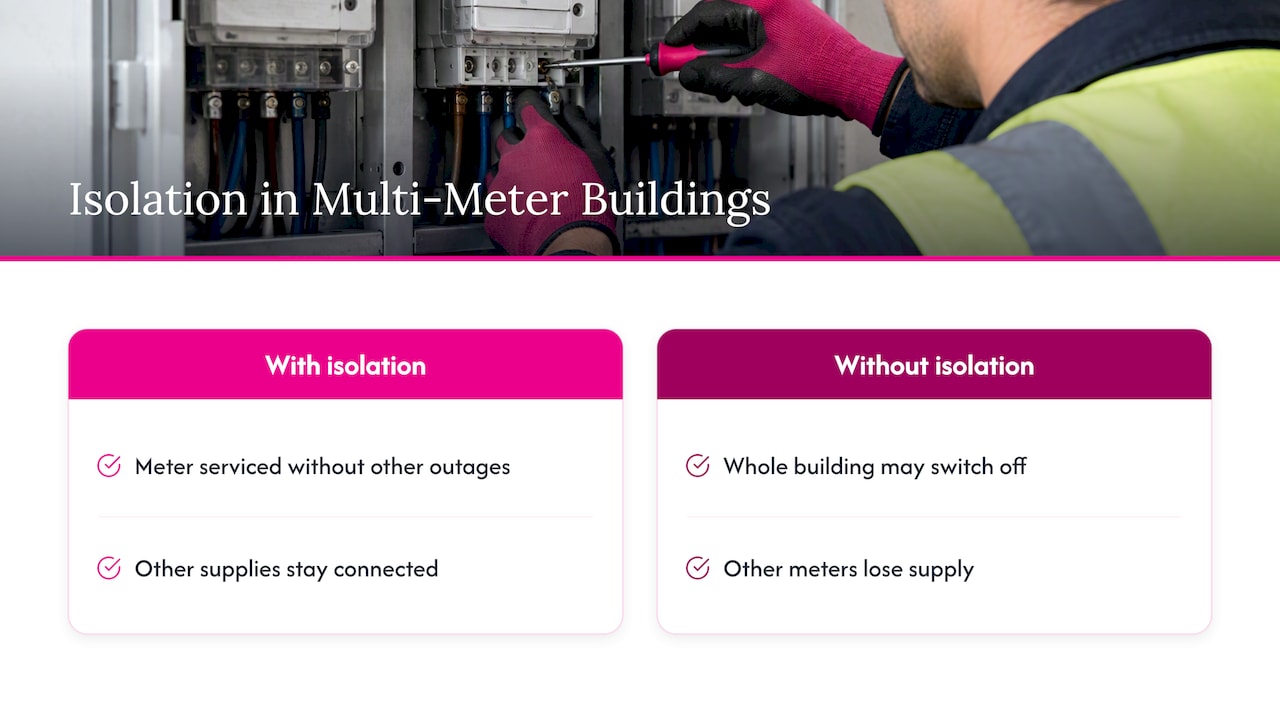
The same industry code says the isolation point lets each individually metered customer tariff be isolated without affecting any other customer’s supply. For strata managers, that translates into fewer outages for residents and fewer complaints on the day of the work.
What the rules require around whole-current metering
The NSW Code for safe installation of direct-connected metering says whole-current metering must have accessible isolation before and after it, with the isolation point next to the metering equipment so it can be installed or replaced safely.
The national metering installation requirements published in 2024 go a step further. They state that whole-current metering and associated network devices need an independently operable line-side isolation device for each NMI (the National Metering Identifier, the number that identifies a meter point). Where jurisdictional rules do not permit an 80-ampere HRC fuse, a switch, circuit breaker or meter isolation link may be used, provided suitable upstream protection is in place.
Two practical points follow:
- The link is one option among several. Depending on the installation and the distributor, the isolation device may be a fuse, a switch, a circuit breaker or a link.
- Isolation equipment must be sealable. The 2020 industry requirements say all isolation equipment must be capable of being sealed. A broken seal is a sign someone has been in the equipment, and it is not something an owner should break to “check” a meter.
Isolation, disconnection, alteration and new connection: four different things
People searching this topic often mix these up, and the mix-up can cost time and money on a job. Here is how they differ.
| Term | What it means | Typical purpose |
|---|---|---|
| Isolation | A temporary, targeted interruption at the meter’s supply point | Make the meter safe to install, service, exchange or alter |
| Disconnection | Supply to the premises is cut off | Non-payment, vacant premises, demolition or a requested shutdown |
| Meter alteration | Change to the metering equipment | Replace a meter, change meter type, add or remove a tariff |
| New connection | A physical network link established where none existed | New build, subdivision, new supply point |
The IPART review of retailers’ metering practices indicates that isolation is a safety and metering-access operation, not automatically a change to the customer’s network connection. It is normally done at an isolation point before meter work begins.
The National Electricity Rules draw the legal lines. A connection is the physical link between a distribution system and premises. A connection alteration changes an existing connection, and a new connection is one established where none exists. A connection service does not include providing, installing or maintaining a metering installation.
Why this matters to you: if you are upgrading an existing home from single phase to three phase, you are altering an existing connection. You are not applying for a brand new one. That affects which forms are needed and who does what.
Who can install, remove or operate a meter isolation link in NSW
The short answer: not you, and not just any tradesperson.
The NSW metering code says metering providers cannot remove service fuse carriers that require an ASP or work on equipment mounted on or within distributor network equipment. If isolation cannot be achieved, an appropriately qualified accredited service provider is required to isolate the supply.
The 2019 consultation paper adds that customer connection services in NSW require distributor-authorised ASPs, and that ASP work on distributor-owned devices and electrical work on third-party devices carry different qualification requirements. It also notes that metering providers can engage an ASP to act on their behalf for isolation work, provided they hold the customer’s written consent.
What this means in practice
- The retailer or metering provider handles the meter itself.
- An ASP with the right authorisation handles anything on the network side of the isolation point, including service fuses.
- You, as the owner, tenant or strata manager, may need to give written consent and arrange access to the meter room or box.
A Level 2 ASP covers the network-side work that a standard licensed electrician cannot do on their own. Our Level 2 electrician and metering services page sets out what that covers.
Safety rules that apply on the day
Electrical safety in NSW rests on one principle: do not work on live equipment. The metering code prohibits work on an energised installation except for specified testing, and metering safety systems must describe isolation and testing to confirm de-energisation. The provider’s safety management system must also describe acceptable isolation methods and how isolation is secured.
SafeWork NSW is blunt about the final step. Even after isolation is applied, you must test to prove equipment is de-energised, the “test for dead”, before any physical work begins. It also says convenience is no excuse for live electrical work.
When live isolation is allowed
IPART’s 2018 report says live isolation may be needed only in limited circumstances, for example when there is no operable fuse or operating the fuse would be unsafe. NSW workplace safety rules generally prohibit live work on energised equipment, with narrowly defined exceptions. If an electrician tells you the fuse is missing or stuck, that is a stop-work moment, not a shortcut moment.
SafeWork NSW’s guidance for meter installation is to isolate at the service protection device. If it is missing or inoperable, stop work and arrange a network isolation through the distributor.
Rules can differ by distributor
Sydney is served mainly by Ausgrid and Endeavour Energy, with Essential Energy covering much of regional NSW. Each publishes its own technical requirements. Essential Energy’s 2026 handbook, for example, sets service-order procedures for temporary group-supply isolations. A reputable ASP already knows which distributor’s rules apply to your address and builds the job around them.
There is also a narrow rule for equipment that is only temporarily out of circuit. Under the NSW Service and Installation Rules annexure, certain Type 5 or 6 meters may, at the distributor’s discretion, be refixed in the same or similar location if they are not faulty or impaired, are not moved to another connection point, and distributor requirements are met. That is a decision for the distributor and the ASP, not a convenience you can assume.
Where isolation fits in a single phase to three phase upgrade
Moving a property from single phase to three phase is one of the most common reasons Sydney owners meet this topic. A new EV charger, ducted air conditioning, a workshop or a granny flat can push a single phase supply past its limit.
In that upgrade, isolation is the safety step that allows the existing metering and connection equipment to be made dead while the authorised electrical and network work is carried out. The upgrade changes an existing connection, so it counts as a connection alteration or metering alteration. It is a new connection only if the premises had no connection before.
Whether a meter isolation link is installed or used depends on the installation design, the distributor’s requirements and the line-side isolation device available. Do not assume the answer from a neighbour’s job. Two houses on the same street can need different arrangements.
A typical sequence
- Site inspection. The ASP inspects the mains, service fuse, meter panel and switchboard to see what is there and what the distributor will need.
- Design and application. The ASP confirms the load, the new supply arrangement and the paperwork the distributor requires.
- Coordination. The retailer or metering provider is engaged for the meter changeover, with your consent where needed.
- Isolation and test for dead. The supply is isolated at the correct point, secured and proven dead before work starts.
- Upgrade works. Mains, switchboard and meter connections are completed. A switchboard upgrade often happens in the same visit.
- Reconnection and testing. Supply is restored, circuits are tested and seals are replaced.
- Notifications. The required paperwork is lodged.
If your upgrade involves the board too, see our switchboard upgrades page. For the supply side, the details are on our power supply upgrades page.
What to do if you need meter isolation
You will usually need isolation in one of these situations: a meter exchange, a smart meter installation, a switchboard replacement, a supply upgrade, or a defect notice that touches the metering area.
- Do not open the meter box or break seals. Sealed equipment belongs to the network or the metering provider.
- Do not pull service fuses or links yourself. Handling them without the right authorisation is unsafe and may breach NSW rules.
- Tell your electrician early. The earlier an ASP knows the job involves isolation, the sooner they can book the distributor or retailer side.
- Plan for a short outage. Isolation is normally temporary. Warn tenants, staff or residents, and think about fridges, medical equipment, alarms and servers.
- If a fuse is missing or will not operate, stop. The correct step is to arrange isolation through the distribution network, not to work live.
- Strata and property managers: get committee approval and notify residents where more than one lot is affected. Individual isolation at each meter exists to limit that, but the board or meter room may still need to be accessed.
If the situation is urgent, such as a burning smell at the meter box, a damaged service fuse or a meter panel that is hot or sparking, treat it as an emergency. Keep clear, switch off at the main switch only if it is safe to reach, and call 000 for fire or immediate danger. For a loss of power or a fault that is not an immediate danger, our emergency electrician team is available 24/7.
What happens after the work: notifications
Completed work is not finished until the paperwork is lodged. Essential Energy, for example, requires the ASP to submit a Notification of Service Work (NOSW) and the metering provider to submit a Notification of Metering Work (NOMW) within two business days of completed work. Ausgrid and Endeavour Energy have their own processes, and your ASP handles the one that applies to your address.
Ask your electrician what will be lodged and when, and keep a copy of the compliance paperwork for your records or for your property file. Property managers in particular should keep these alongside inspection reports.
Our perspective: treat isolation as part of the plan, not an afterthought
Most of the delays we see on supply and metering jobs do not come from the electrical work itself. They come from isolation and coordination being left until the last minute: a meter room that is locked, a retailer not yet engaged, a service fuse that will not operate, or a tenant who was never told about the outage.

We approach every Level 2 job by looking at isolation first. Where is the isolation point? Can it be operated safely? Who needs to be told, and who needs to give consent? If the answer to the first question is “there isn’t a safe one”, the job changes shape before a tool comes out. We would always rather tell you that at a free site inspection for Level 2 work than discover it on the day.
We also encourage owners to resist the temptation to save a few days by working around the process. Isolation, testing for dead and sealing are not red tape. They are the steps that keep the person on the tools, and everyone downstream of the meter, safe.
— Christopher
Getting a Level 2 ASP to handle it
High Demand Electrical is a certified Level 2 electrical contractor serving Sydney, with accredited Level 2 ASP electricians for supply upgrades, metering services, switchboard upgrades, defect notice rectification and emergency callouts. We offer free site inspections for Level 2 work, so you know what the isolation and connection arrangements look like before you commit. Tell us what you are planning on our Level 2 electrician page and we will confirm the next step.
FAQ
Is a meter isolation link the same as a safety switch?
No. A safety switch (RCD) protects people from electric shock by cutting power when it detects a leakage current. A meter isolation link is an isolation point beside the meter that lets the supply to that meter be made dead for installation or replacement. They do different jobs, and both belong in a safe installation.
Can I remove the meter isolation link myself to turn the power off?
No. Service fuses, links and sealed equipment around the meter are handled by authorised people only, and NSW rules require an appropriately qualified ASP where isolation cannot be achieved by the metering provider. If you need power off in an emergency, use the main switch if it is safe to reach, and call an electrician or 000 if there is danger.
Does every meter in NSW have an isolation link?
Not necessarily. National requirements call for an independently operable line-side isolation device for each NMI, but that device can be a fuse, switch, circuit breaker or link, depending on the installation and distributor rules. An ASP can tell you what is at your property.
Is isolating the meter the same as disconnecting my power?
No. Isolation is a temporary, targeted interruption at the meter’s supply point so work can be done safely. A disconnection cuts supply to the premises for another reason, such as non-payment or a requested shutdown, and is arranged through your retailer and distributor.
Do I need a Level 2 electrician for a single phase to three phase upgrade?
Yes, in NSW the supply-side work is done by a distributor-authorised ASP. A Level 2 ASP can assess your mains, coordinate isolation and the metering changeover, and lodge the required notifications after the work.
Sources
- Code for safe installation of direct-connected whole-current electricity metering (NSW Government, 2016)
- Metering Installation Requirements, CMIG (Master Electricians Australia, 2020)
- National Metering Installation Requirements, Version 2.0 (2024)
- Digital Metering: Improving Service Delivery in NSW (NSW Government, 2019)
- Retailers’ metering practices in NSW (IPART, 2018)
- National Electricity Rules, Chapter 5A (AEMC)
- Dangers of working on or near energised electrical equipment (SafeWork NSW)
- Annexure to Service and Installation Rules of NSW (2018)
- Essential Energy Retailer and Market Participant handbook CECG4505
Powering Your Needs with Expertise
If you’re looking for a reliable, experienced, and prompt electrician, look no further than High Demand Electrical. We cater to all your electrical needs, from routine maintenance to emergency repairs and complete system installations. Our skilled team is committed to providing professional service that ensures your electrical systems run smoothly. Whether it's a small task or a large project, give us a call today. Let us meet all your electrical demands with the quality and reliability you deserve.

