2.0 m, 0.6 m, 200 mm: NSW Meter Box Clearances Homeowners Must Meet
Meter box clearances in NSW are set out in the Annexure to the Service and Installation Rules of NSW, and the numbers are non-negotiable: 2.0 m vertical clearance, a 0.6 m working space, 175 mm front clearance, and 200 mm hinge-open clearance for panel doors. The lowest meter must sit at least 0.6 m off the ground. Get any of these wrong and Building Commission NSW will knock back your Certificate of Compliance for Electrical Work, so use a licensed Level 2 electrician who knows the Annexure clause-by-clause.
TL;DR:
- The vertical clearance for meter boxes in NSW must be exactly 2.0 meters from ground or platform to the top of the meter space to avoid inspection failures.
- The lowest meter must be installed at least 0.6 meters above ground to prevent flood damage and accidental knocks, while the front clearance should be 175 mm for safe servicing.
- Hinged panels require a full 90-degree swing and 200 mm clearance from any obstacle; bolts must not protrude more than 5 mm to prevent contact hazards.
- Placement must be near the connection point, with clear, lit access and proper signage; shared properties have stricter access and labeling rules.
- Before work, verify enclosure de-energization, check for obstacles, confirm safe approach distances from power lines, and document all hazard assessments to ensure compliance.
Table of Contents
- What are the numeric clearance requirements for a meter box in NSW?
- Where can you legally place a meter box in NSW?
- What safety checks must installers do before metering work?
- What are the most common meter box compliance failures?
- What happens if your meter box fails inspection?
- What Sydney electricians see that homeowners miss
- Get your meter box compliance sorted the right way
- Where to check the official NSW rules
- Sources
- FAQ
What are the numeric clearance requirements for a meter box in NSW?
Every figure in the Annexure exists to answer one question: can a meter reader or electrician safely reach, see, and work on this equipment without contorting themselves or touching something live? That’s the lens to view each measurement through, because inspectors certainly do.
The 2.0 m vertical clearance runs from the ground or standing platform up to the top edge of the metering working space. Anything taller and a technician needs a ladder to read or service the meter safely, which the rules are specifically designed to avoid. Paired with that is the requirement that the lowest meter’s bottom edge sits no lower than 0.6 m off the ground, which keeps the equipment clear of flood risk, garden mulch, and accidental knocks from mowers or bins.
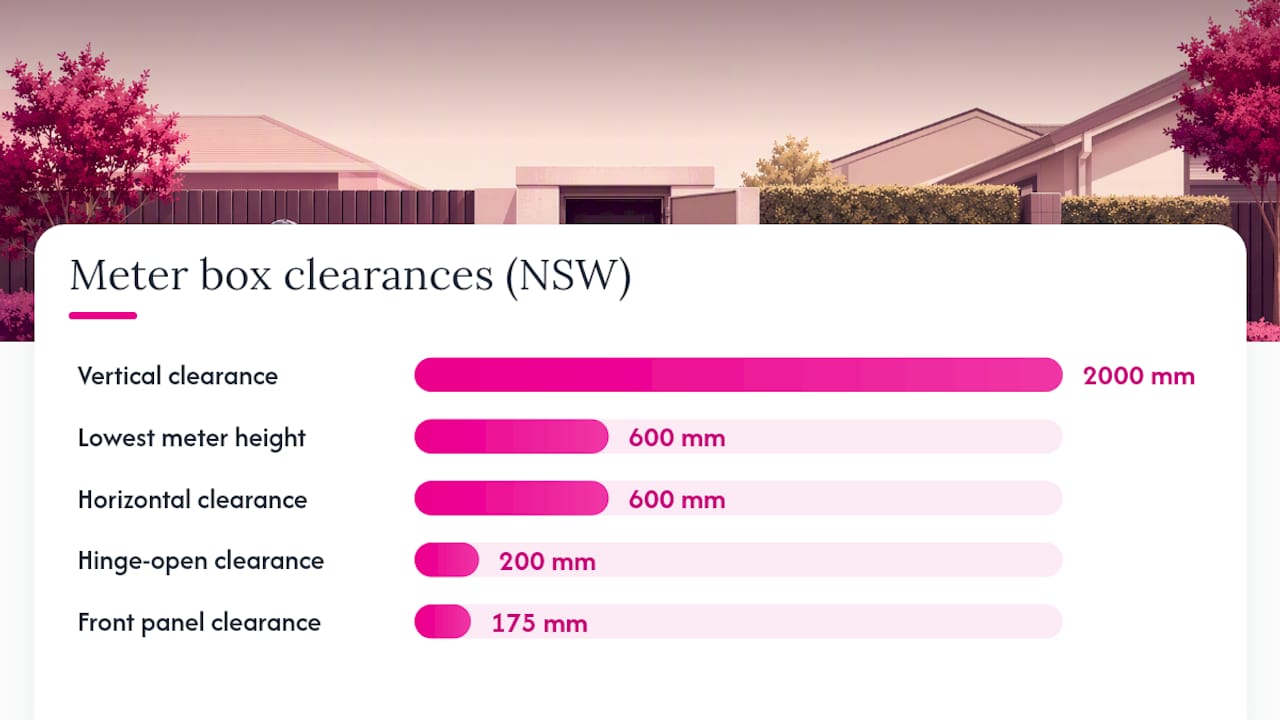
Horizontal space matters just as much. The Annexure calls for a minimum 0.6 m working clearance in front of the switchboard enclosure, plus 175 mm clearance between the panel front and its door. If the meter panel is hinged, it must swing open a full 90 degrees and clear 200 mm from any fixed object once open, whether that’s a wall, a downpipe, or a garden trellis someone installed after the fact.
Recessed installations need their own margin: a 50 mm clearance is required behind the panel for communications equipment, a figure that matters more each year as smart meter rollouts expand. Some Annexure references also cite a 75 mm back clearance for panel mounting, so check the specific clause for your installation type before finalising the fit-out.
- Vertical clearance: 2.0 m from ground/platform to top of metering space
- Lowest meter height: 0.6 m minimum off the ground
- Horizontal working space: 0.6 m
- Front panel clearance: 175 mm
- Hinge-open clearance: 200 mm to any fixed object
- Recessed/communications clearance: 50 mm
One detail trips up plenty of otherwise solid installs: bolt protrusion. Any mounting bolt reachable from the front of the panel must not protrude more than 5 mm past the fixing nut, and where contact is possible, a non-conductive bolt is required instead of standard metal hardware.
Where can you legally place a meter box in NSW?
Placement rules are less about millimetres and more about common sense applied consistently, which is exactly what inspectors check for.
- Position it close to the connection point. The metering point should sit as near as practicable to where the network connects, minimising unnecessary cable runs and simplifying future fault-finding.
- Keep the enclosure clean, lit, and unobstructed. Meter rooms and cupboards can’t double as storage. Building Commission NSW expects clear access with adequate lighting every time.
- Label the space correctly. Signage reading “Electricity Supply Equipment” or “Electricity Meters” needs to be visible and legible, not buried behind a door or faded past readability.
- Understand shared-property differences. Strata blocks with multiple meters face stricter access and labelling obligations than a single dwelling, particularly around shared corridors and fire egress paths.
- Maintain the 50 mm recess allowance. Recessed meter boxes still need that communications clearance, and hinged panels inside a recess must open fully to 90 degrees without hitting the enclosure wall.
Any alteration to an existing building, whether a granny flat, a second dwelling, or a major renovation, triggers a fresh look at whether the existing meter position still meets current rules. Older installations grandfathered in years ago don’t automatically get a pass once work starts nearby.
What safety checks must installers do before metering work?
The Code for safe installation of direct-connected whole current electricity metering requires a documented hazard assessment before anyone touches a metering installation, full stop. That assessment covers whether the enclosure is de-energised where required, whether access is genuinely clear, and whether nearby hazards, unstable fencing, wasp nests, exposed wiring, need addressing first.
Distance from overhead power lines deserves particular respect. SafeWork NSW is blunt about the risk: working near live overhead conductors without observing the distributor’s specified safe approach distance is one of the most common causes of serious electrical injury in the trade. Underground services carry their own controls, and no installer should work on energised equipment without proper authorisation, regardless of how routine the job looks.
- Confirm the enclosure is de-energised or isolated correctly before starting
- Check for physical obstructions, unstable structures, or vegetation encroachment
- Observe the distributor’s safe approach distance for overhead lines
- Record every check in the installer’s safety management system
- Notify the customer in advance if the work requires a supply interruption
Pro Tip: Photograph the hazard assessment and the cleared work area before you start. If a dispute arises later about site conditions, that timestamp is worth more than any verbal explanation.
What are the most common meter box compliance failures?
Most rejected inspections come down to a handful of repeat offenders, not exotic rule violations. Protruding fixing bolts, insufficient hinge clearance, blocked access paths, missing or faded labelling, incorrect neutral identification, and uncovered terminals account for the bulk of failed sign-offs across NSW. Insufficient recessed gap for communications equipment is climbing the list too, as smart meter installations become routine rather than the exception.
A methodical walk-through before the inspector arrives saves time and money on both sides.
- Measure every clearance figure against the Annexure, don’t eyeball it
- Open the hinged panel fully to 90° and check the 200 mm gap with a tape measure
- Inspect every bolt for protrusion beyond 5 mm and swap in non-conductive bolts where needed
- Confirm labelling is present, legible, and correctly worded
- Check lighting and access are unobstructed, front and back
- Document every test result before the inspector’s visit
Pro Tip: Tight corridors and meter cupboards used for storage cause more failed inspections than any wiring fault. If the space is being used to stash bins or garden tools, clear it before you book the inspection, not after.
Have your Certificate of Compliance for Electrical Work, test records, and safety management system evidence ready to hand over. Building Commission NSW inspectors expect this documentation on the spot, not promised for later.
What happens if your meter box fails inspection?
A failed inspection usually means one thing: it’s time to call a licensed Level 2 electrician, particularly if the fix involves relocating the meter, upgrading the panel, or altering anything connected to the network.
- Inspection and diagnosis — the electrician confirms exactly which clause failed and why.
- Quote for remedial work — covering parts, labour, and any switchboard upgrade needed to bring the installation into line.
- Remedial works completed — clearances corrected, bolts replaced, labelling fixed.
- CCEW lodgement — submitted promptly to Building Commission NSW once testing confirms compliance.
- Reinspection — confirms the fix has resolved the original defect.
If the fault poses an immediate safety risk, exposed live parts or storm damage, an emergency make-safe visit takes priority over the standard workflow.
What Sydney electricians see that homeowners miss
Working on metering installations across Sydney week in, week out teaches you where the Annexure’s numbers actually get tested. Two areas cause more grief than anything else: hinge clearance and future-proofing for communications gear.
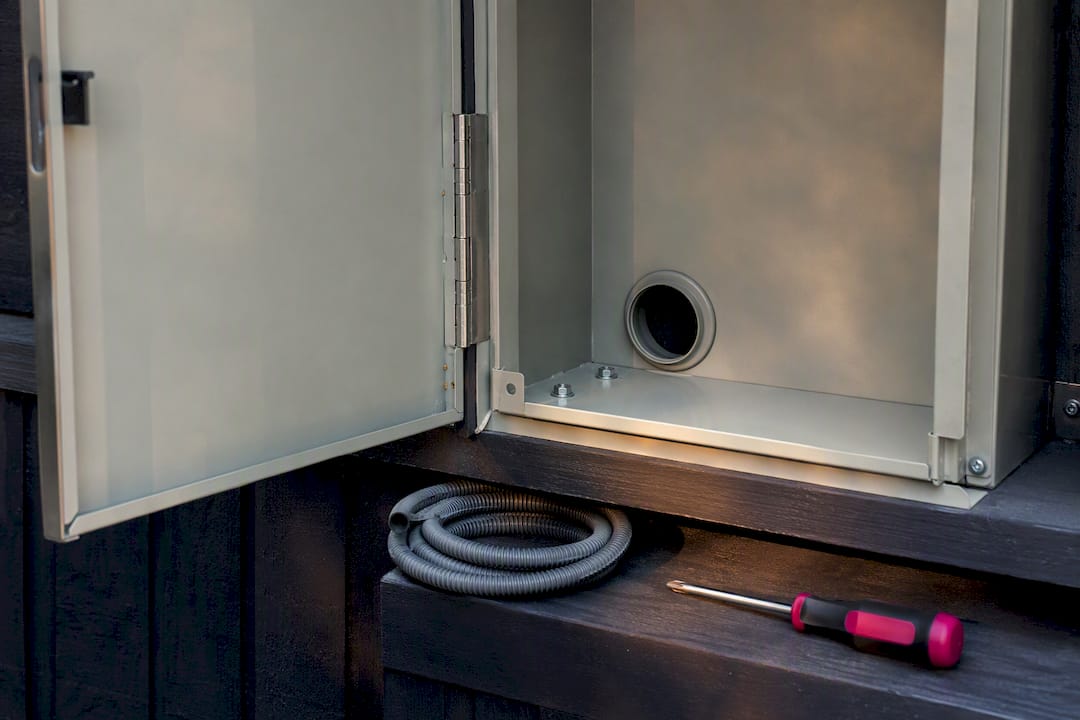
Allow extra room beyond the bare 50 mm recess minimum wherever you can. Smart meter rollouts keep adding communications modules that weren’t imagined when older meter boxes were installed, and a tight recess today becomes an expensive retrofit tomorrow. Check fixing bolts from both the front and back of the panel, not just the visible face, and always test and seal terminals properly before closing anything up. When you’re assessing a hinged panel, physically swing it to 90 degrees and measure the 200 mm gap yourself. Doorframes, ducting, and downpipes installed after the original build are the usual culprits.
Free site inspections for Level 2 work are available, which give homeowners and builders a genuine, no-guesswork answer before committing to a relocation or upgrade.
— Christopher
Get your meter box compliance sorted the right way
Meter box clearance rules leave no room for approximation, and getting one measurement wrong can mean a failed inspection, a delayed connection, or a costly rework. We are a certified Level 2 electrical contractor, available 24/7 for urgent metering faults and offering free site inspections for Level 2 work so you know exactly what’s required before any work starts.

Whether you’re dealing with a relocation, a switchboard upgrade tied to a renovation, or a failed inspection that needs remedial work fast, our team handles the compliance detail from hazard assessment through to CCEW lodgement. If your meter box needs Level 2 attention, get in touch through our Level 2 electrician Sydney page and book a free site inspection today.
Where to check the official NSW rules
For clause-level detail, go straight to the source: the Annexure to the Service and Installation Rules of NSW, the Code for safe metering installation, and Building Commission NSW’s metering compliance guidance. SafeWork NSW’s power line safety pages cover approach distances for overhead services.
Sources
FAQ
What are the regulations regarding electrical meter boxes in NSW?
Meter box clearances in NSW are set by the Annexure to the Service and Installation Rules and the Code for safe metering installation, covering vertical clearance (2.0 m), horizontal working space (0.6 m), and hinge-open clearance (200 mm).
Can a meter box be behind a fence?
A meter box can sit near a fence line, but it can’t be positioned where the fence restricts safe, unobstructed access for reading or servicing, and required clearances must still be maintained in full.
How much clearance do you need from power lines?
SafeWork NSW requires installers to observe the distributor’s specified safe approach distance for overhead power lines, and no one should work on energised equipment within that distance without authorisation.
How close can a switchboard be to a sink?
NSW wiring rules require switchboards and metering equipment to be kept clear of wet areas and water sources; a licensed electrician should always assess sink and plumbing proximity against AS/NZS wiring rules before installation.
Who do I call if my meter box fails inspection?
Contact a licensed Level 2 electrician who can diagnose the failed clause, complete remedial work, and lodge the Certificate of Compliance for Electrical Work with Building Commission NSW for reinspection.
Recommended
Powering Your Needs with Expertise
If you’re looking for a reliable, experienced, and prompt electrician, look no further than High Demand Electrical. We cater to all your electrical needs, from routine maintenance to emergency repairs and complete system installations. Our skilled team is committed to providing professional service that ensures your electrical systems run smoothly. Whether it's a small task or a large project, give us a call today. Let us meet all your electrical demands with the quality and reliability you deserve.