
Main Switch Rating in NSW: What Size You Need and Who Decides
Your main switch rating in NSW is matched to your installation and your supply. It does not set how much power you are allowed to use. The NSW Service and Installation Rules put the approved supply capacity in the hands of your electricity distributor, which assesses maximum demand when you apply. A bigger switch on your board does not give you more power.
That one point clears up most of the confusion we hear from Sydney homeowners, strata managers and builders. Below we cover what the main switch does, how to read its rating, where the service protection device fits in, and when a change needs a Level 2 electrician and a written application.
TL;DR
- The main switch isolates your whole installation. Its rating is chosen to suit the installation and the supply. It is not a way to buy extra capacity.
- Your approved supply capacity is decided by your distributor from a maximum demand assessment, not by the amp number printed on your switch.
- The service protection device (SPD) is often mistaken for the main switch. It must be clearly labelled, and where safety services are present it must be locked in the on position.
- Replacing a main switch alone is rarely enough. Older boards often fail current rules on RCDs and clearances, so the whole board should be assessed.
- Anything that raises your maximum demand, such as an EV charger, ducted air conditioning or a move to three phase, needs a formal application to the distributor first.
Table of Contents
- What a main switch does
- How to read a main switch rating
- The rating does not set your supply capacity
- Main switch versus service protection device
- Why a main switch swap alone is rarely enough
- When you need your distributor’s approval
- What this means by property type
- Our view: the rating is the last thing we decide
- Booking help with your main switch or board
- Checklist before you change a main switch
- FAQ
- Sources
What a main switch does
The main switch is the device that isolates the entire electrical installation in your home, shop or unit. Under AS/NZS 3000:2018 (the Wiring Rules), it must control the whole installation and be separate from any safety service switches. The NSW Government advisory note on the location and identification of the main switch sets this out, based on non-compliances found in Building Commission NSW inspections.
In practice that means:
- you or an emergency responder can cut power to everything on the board in one action
- the switch is easy to identify, not hidden among circuit breakers that look the same
- the device is separate from the switches serving fire pumps, lifts or similar safety systems
A main switch is an isolation and protection device. It is not a meter, and it does not limit what the network will deliver to you.
How to read a main switch rating
The rating is printed on the front of the device in amps, for example 63A, 80A or 100A. It is the current the switch is built to carry continuously. A retailer such as Sparky Direct lists 80A as a common rating for standard residential switchboards and 100A for larger residential or commercial loads. Treat that as a general guide only. Your own installation depends on the supply and on your maximum demand.
A few other markings matter as well:
| What you see | What it tells you |
|---|---|
| Amp rating (63A, 80A, 100A) | Continuous current the device is rated for |
| Number of poles | Whether it switches one phase and neutral, or all three phases on a three phase supply |
| kA rating | The fault current the device can safely interrupt |
| Labels such as “main switch” | Whether the device is identified correctly for emergency personnel |
On a three phase installation, the main switch must isolate all phases together. If you are not sure whether your board is single phase or three phase, a licensed electrician can tell you in a few minutes by looking at the incoming mains and meter.
The rating does not set your supply capacity
This is the part most people get wrong. Many owners assume that fitting a bigger main switch increases the power available to the property. It does not.
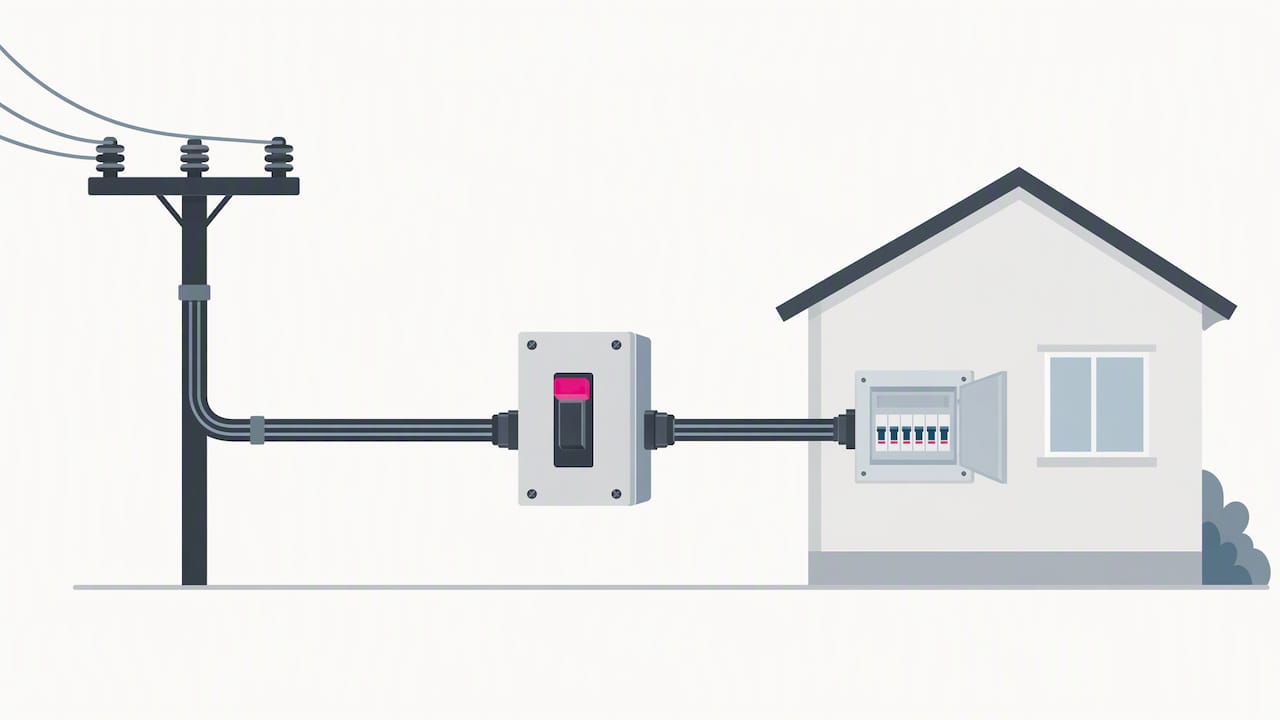
The NSW Service and Installation Rules say your approved supply capacity is determined by the electricity distributor when you make a formal application. It rests on maximum demand calculations under AS/NZS 3000, not on the nominal rating of your main switch or service protection device. In Sydney, the distributor is most often Ausgrid or Endeavour Energy, depending on your suburb.
Two consequences follow:
- A larger switch is not permission. Increasing the load beyond your existing connection agreement needs a written application, even if a bigger device physically fits in the enclosure.
- Skipping the application has costs. Overloading the network connection can bring connection problems, and there can be legal and insurance consequences for the owner if the work was never approved.
If you want to see where your property might land before you ask anyone, our free maximum demand calculator based on AS/NZS 3000 works through the standard tables. For properties where the loads are unclear, a power logging and maximum demand study uses measured data instead of estimates.
Main switch versus service protection device
The service protection device, or SPD, is the other device people confuse with the main switch. The two do different jobs. The SPD sits at the start of the consumer’s installation and protects the supply side. The main switch isolates the installation.
The NSW Government note on the main switch explains the compliance risk. If an SPD is used, it must be clearly labelled. Where safety services are present, it should be locked in the on position, so that no one takes it for a general main switch and turns off power to fire safety systems during an emergency. Building Commission NSW found that poor identification of these devices is a recurring safety problem.
When you look at your board, ask:
- Can I tell which device is the main switch and which is the SPD?
- Are both labelled in a way an emergency responder would understand?
- If the building has safety services, are they on separate switches?
If the answer to any of these is no, get the board looked at. Our electrical safety inspection and maintenance work covers this kind of check.
Why a main switch swap alone is rarely enough
People often ask for “just a new main switch” after a failed inspection or when an old one starts to run hot. The trouble is that the main switch sits on a board that may be 10 or 15 years old, or much older.
Current NSW rules have moved on. The NSW Government’s guidance on electrical standards, rules and notes lists RCD protection as required for all domestic and residential final subcircuits. Its notes on heat pump installations go further on RCD type: Type A RCDs, identified by the dual sine wave symbol, are required on new and upgraded circuits, and Type AC devices are no longer permitted for that work. All final subcircuits in domestic installations need 30 mA RCD protection.
What that means for a board work project:
- Fitting a new main switch alone can leave old RCD problems in place.
- New circuits you add, such as a heat pump, EV charger or oven, need the current RCD type.
- Switches and sockets in bathrooms, laundries and kitchens must respect wet zone clearances. The NSW Government’s note on switches and sockets in wet areas shows how often these are miscalculated.
- Whoever does the work should give you a compliance and test result certificate for the alterations.
This is why we treat a main switch change as a prompt to review the whole board. For aged care and similar facilities with more complex needs, a switchboard upgrade guide for residential aged care shows the same principle applied in a care setting.
When you need your distributor’s approval
Some changes can be done on the board alone. Others need a network application first. As a rule of thumb, ask whether the change raises maximum demand beyond what your property has been approved for.
These commonly do:
- Single phase to three phase. The supply, mains, metering and board all change. See our power supply upgrades page for how we handle this.
- EV chargers with a high charging rate on a small single phase supply.
- Ducted air conditioning, pools or workshops added to an already loaded home.
- New dwellings such as duplexes, granny flats and subdivisions, which need new connections. We cover these on our new electrical connections page.
- Larger underground supplies, including our 200A underground supply upgrades.
- Service relocation, where the point of attachment moves during a renovation.
Ausgrid publishes its process for installation and service work, including a switchboard compliance appointment checklist ahead of inspector visits. If your property is on another network, the same Service and Installation Rules apply, but the distributor’s forms and timeframes will differ.
When a property is being cleared or rebuilt, supply disconnection is its own step with its own paperwork. A guide to proving service disconnection before demolition in NSW explains what owners are asked for there.
What this means by property type
Houses and townhouses
Most houses are on single phase. A standard main switch rating works until you add large loads. If you are planning an EV charger plus ducted air conditioning, the question to ask is not “what main switch do I need” but “what is my maximum demand and what has my distributor approved.”
Strata and multi-unit buildings
Strata buildings have a main switchboard feeding consumer mains, individual unit boards and often common property safety services. The separation between main switch and safety service switches matters most here, because mislabelled devices can cut power to fire systems. Our page on strata main switchboards and consumer mains covers this work.
Commercial and industrial sites
Shops, offices and light industrial units usually run three phase, and the main switch must isolate all phases together. Loads tend to grow with each tenant. See our commercial power supply upgrades for what that involves.
Our view: the rating is the last thing we decide
We get calls that start with “I need a 100A main switch.” Nearly every time, the better first question is what the property is trying to do.
As a certified Level 2 electrical contractor, we start with the supply and the load. We look at the incoming mains, the meter, the existing board and what you plan to add over the next few years. We check whether the SPD and main switch are identified correctly. We look at RCD protection and wet zone clearances. Only then do we talk about the rating of the device that goes on the board.
The reasons are practical:
- A switch sized for a load that the connection agreement does not cover creates false comfort. The property still cannot legally draw that power.
- A switch swapped on a non-compliant board can pass a quick glance and still fail a later inspection.
- Clear labelling is cheap to do at the time and costly to fix after a safety incident.
We offer free site inspections for Level 2 work, so you can find out what the job actually involves before you commit. Our team is also on call around the clock for outages and faults, with a 10-minute callback guarantee.
— Christopher
Booking help with your main switch or board
If you are planning a switchboard change, a supply upgrade or a move to three phase, we can inspect the site, advise what needs a distributor application, and do the work. See our switchboard upgrades page, or talk to our Level 2 electricians about metering, defect notices and network connections. Seniors can ask about our discounts.
If the main switch is tripping, buzzing, hot or burnt, treat it as urgent. Switch off what you safely can, keep clear of the board and call our emergency electricians.
Checklist before you change a main switch
- Confirm whether you are single phase or three phase.
- Identify the main switch and the SPD, and note whether both are labelled.
- List planned loads: EV charger, heat pump, air conditioning, pool, workshop.
- Run a maximum demand estimate and compare it with the current supply.
- Ask a Level 2 electrician whether a distributor application is needed.
- Have the whole board assessed for RCD type, circuit protection and clearances.
- Keep the compliance and test result certificate after the work.
FAQ
Does a bigger main switch give me more power?
No. Your approved supply capacity is set by your electricity distributor after an application and maximum demand assessment. A larger main switch does not change the connection agreement. Increasing load beyond it without approval can lead to connection problems and insurance or legal consequences.
What is the difference between a main switch and a service protection device?
The main switch isolates the whole installation. The SPD protects the supply side at the start of the installation and is often mistaken for the main switch. Under the Wiring Rules the SPD must be clearly labelled, and where safety services are present it should be locked in the on position.
Can I replace the main switch myself?
No. Work on the main switch and consumer mains must be done by a licensed electrician. It involves live supply side conductors that cannot be isolated by your own switch. Call a licensed electrician or a Level 2 contractor if the work touches the supply.
Do I need to upgrade the whole switchboard when I change the main switch?
Often, yes. Current NSW rules require RCD protection on all domestic final subcircuits, and new or upgraded circuits need Type A RCDs. An older board may fail these rules even with a new main switch. A licensed electrician can tell you what applies to your board.
Sources
- Location and identification of the Main Switch, NSW Government
- NSW Standard Electricity Service and Installation Rules
- Electrical standards, rules and notes, NSW Government
- Heat pump installations for electrical work, NSW Government
- Switches and sockets in wet areas, NSW Government
- Installation and service, Ausgrid
- Main switches and isolators, Sparky Direct
Powering Your Needs with Expertise
If you’re looking for a reliable, experienced, and prompt electrician, look no further than High Demand Electrical. We cater to all your electrical needs, from routine maintenance to emergency repairs and complete system installations. Our skilled team is committed to providing professional service that ensures your electrical systems run smoothly. Whether it's a small task or a large project, give us a call today. Let us meet all your electrical demands with the quality and reliability you deserve.

