
Home EV Charger Australia: Compare Prices and Charging Options
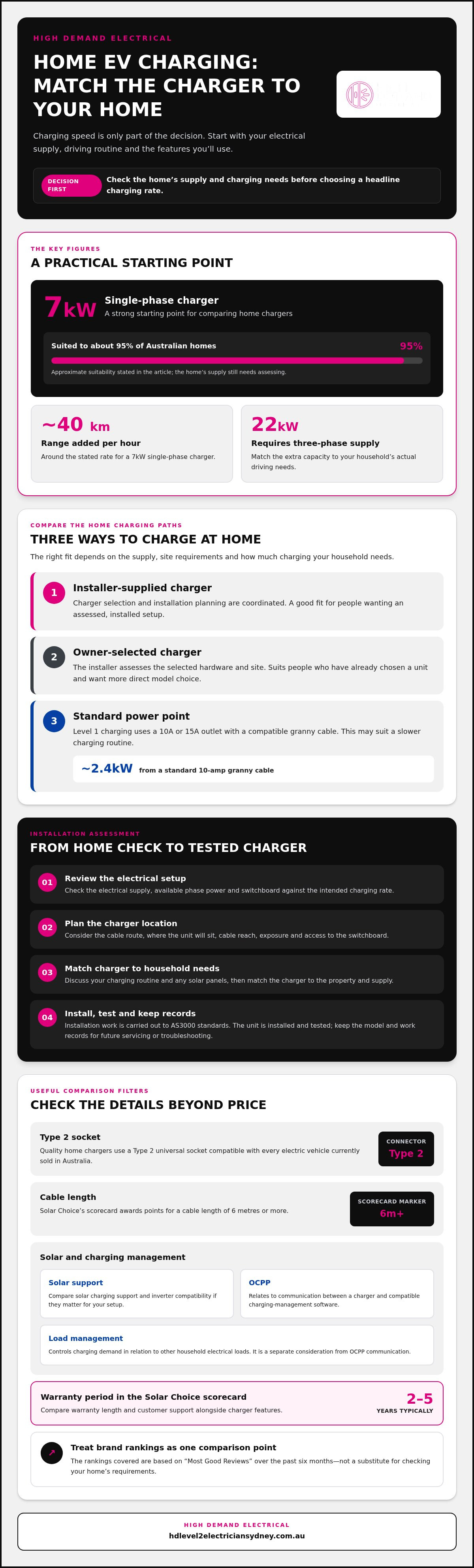
The highest-powered charger isn’t automatically the best fit. A 7kW single-phase charger suits about 95% of Australian homes and can add around 40 km of range per hour, making it a strong starting point for comparing the best home EV charger in Australia for 2026. The right choice depends on your home’s electrical supply, driving routine and the features you’ll actually use.
It’s reasonable to expect a charger comparison to point to one clear winner, but a high brand ranking or fast charging rate won’t suit every household. This guide explains how charger and installation costs vary, what single-phase and three-phase charging mean, and how warranty terms and brand rankings can help you compare options. You’ll also see why charging needs, not just headline specifications, should guide your decision.
Key Takeaways
• Start with your charging routine and home electrical supply; a 7kW single-phase charger suits about 95% of Australian homes.
• Compare charger options by charging speed, solar compatibility and cable length, not just the purchase price.
• A 22kW charger needs a three-phase supply, so match its extra capacity to your household’s actual driving needs.
• Compare warranty length and customer support alongside charger features to understand what you’re choosing.
• Use brand rankings as one comparison point: the rankings covered are based on “Most Good Reviews” over the past six months.
Buying a charger through the electrical installer
To assess a home and install an EV charger, first review the electrical supply, switchboard and proposed charger location. Then match the charger to the property, complete the installation and test its operation.
Having the installer supply the charger can bring equipment selection and installation planning together. If you’re considering supplying your own unit or using an existing outlet, first consider compatibility, site requirements and how much charging your household needs.
Electrical Installation Requirements
Electrical installation requirements determine whether the home’s supply can support the selected charger. An installer assesses the switchboard, available phase power and intended charging rate before deciding on the installation work. Installation work is carried out to AS3000 standards. This criterion differs from charger price or warranty: it concerns the property’s electrical setup and how the unit can be connected safely.
Home Assessment and Installation Steps
A home assessment identifies the practical route from the electrical supply to the charger. The installer reviews the switchboard and cable route, considers where the unit will sit, and discusses your charging routine and any solar panels. The charger and electrical supply are then matched, the unit is installed and its operation is tested. This focuses the decision on your home’s requirements, not just the charger’s specifications.
Installation and Maintenance Considerations
Plan the charger location around daily use. Choose a spot that makes connecting your vehicle straightforward, and consider cable reach, exposure and access to the switchboard. Keep the charger instructions and installation records together for future servicing. Check the unit for visible damage and follow the manufacturer’s maintenance guidance.
Reliability and Installer Callbacks
A callback number alone doesn’t show how an installation will be handled. Ask what the installation includes, how the unit will be tested and what information you’ll receive at handover. Keep records of the charger model and work completed. These details can make troubleshooting easier and help distinguish a hardware issue from a problem with the electrical supply or setup.
The table compares three ways to charge at home. A standard outlet may suit a granny cable, while a dedicated wall charger requires an installation assessment.
| Option | Supply and setup | Choice and coordination | Best fit |
|---|---|---|---|
| Installer-supplied charger | Charger and installation planned together | One coordinated selection process | People wanting an assessed, installed setup |
| Owner-selected charger | Installer assesses the selected hardware and site | More direct control over model choice | People who have already chosen a unit |
| Standard power point | Level 1 charging uses a 10A or 15A outlet | Uses a compatible granny cable | Drivers whose charging routine suits slower charging |
A standard 10-amp granny cable delivers around 2.4kW; choose an installer-supplied wall charger when you want the hardware and site assessment coordinated.
Comparison of home EV charger models and prices
There’s no single home charger for every Australian household. Compare options by price, connector, solar integration and warranty, and check how each one fits your vehicle and electrical setup.
Popular Australian chargers differ in their listed features, but reliability depends on more than a specification sheet. Warranty periods covered by the Solar Choice scorecard typically range from 2 to 5 years.
Charger Models and Prices
Listed charger prices vary with the country of manufacture and the unit’s features. The figures cover charger hardware, not installation, and offer a starting point for comparison. For example, a SolarEdge inverter-compatible model costs more than the listed basic-priced options.
| Charger option | Listed Australian price | Comparison point |
|---|---|---|
| USA-made charger | Lowest listed price | Standard hardware profile |
| China-made charger | Entry-level listed price | Cost-effective entry point |
| UK-made charger | Mid-range listed price | Advanced safety features |
| New Zealand-made charger | Mid-range listed price | Robust regional build |
| Australian-made charger | Locally made option | Designed for local conditions |
| SolarEdge inverter-compatible charger | Inverter compatibility | Optimised for solar setups |
These examples aren’t a complete market ranking. Before comparing listed prices, check that each charger’s features and compatibility suit your household.
Compatibility and Connector Types
Connector compatibility is a practical first filter: quality home chargers use a Type 2 universal socket compatible with every electric vehicle currently sold in Australia. This makes the socket format useful across vehicle choices. A cable-integrated connector is a different setup, so consider how you’ll connect and store the cable. Solar Choice’s scorecard awards points for a cable length of 6 metres or more.
OCPP Compatibility and Load Management
OCPP compatibility relates to communication between a charger and compatible charging-management software. Load management controls charging demand in relation to other household electrical loads. Consider these features if you want coordinated charging management, rather than a basic setup. Compare them separately: OCPP is about system communication, while load management is about handling charging power.
Features, Reliability and Warranty
Feature comparisons should focus on useful differences, such as solar charging support, inverter compatibility and cable length. Solar Choice’s scorecard awards 2 points for direct solar charging support and 1 point for CT clamp or inverter compatibility. Its warranty scoring gives 1 point per warranty year. The scorecard’s warranty periods typically span 2 to 5 years, providing a consistent comparison measure.
A brand ranking is one measure of customer feedback, not a guarantee of how an individual charger will perform. The rankings in this comparison use the “Most Good Reviews” score over the past six months. Consider that measure alongside connector compatibility, management features and warranty terms, then choose based on your vehicle and household priorities.
Single-phase and three-phase charging
Your home’s phase supply affects the charging capacity available to a wall charger. Compare it with your daily driving, vehicle battery and available charging time before choosing a setup.
Single-Phase Charging
Single-phase charging uses the home’s single-phase supply and supports a 7kW charger. This is the common comparison point for households that don’t need the higher capacity of three-phase charging. A 7kW single-phase charger suits about 95% of Australian homes. Its practical advantage is matching substantial home charging capacity to a typical household setup without requiring three-phase supply.
Three-Phase Charging
Three-phase charging can deliver up to 22kW, but a 22kW charger requires a property with three-phase supply. That extra capacity distinguishes it from a 7kW single-phase charger. A higher maximum charging speed can suit households with substantial daily driving, but the supply must support the charger. Consider it if the property already has three-phase supply and the household regularly drives more than 400 km per day.
Single-Phase 7kW Chargers
A 7kW single-phase charger offers a practical middle ground between a standard outlet and higher-capacity three-phase charging. A depleted 60kWh battery can be fully charged in roughly eight hours with a 7kW charger. Actual charging time depends on the vehicle’s charging capability and the battery’s starting charge. This option is suited to overnight charging where the home has single-phase supply.
Use this comparison to match your supply type to your charging needs, rather than choosing capacity in isolation:
| Option | Supply requirement | Maximum charging capacity | Useful decision point |
|---|---|---|---|
| Single-phase 7kW charger | Single-phase supply | 7kW | Fits about 95% of Australian homes |
| Three-phase charger | Three-phase supply | Up to 22kW | Consider for regular driving above 400 km per day |
Solar integration is another factor to consider. If your home has solar panels, check whether the charger supports direct solar charging so you can factor available surplus generation into your setup. The home’s phase supply still affects the capacity available to the charger. Solar capability and charging speed are separate considerations: one relates to using solar generation, the other to supply and vehicle limits.
Before choosing, identify the supply type, check the vehicle’s charging capacity, then match the charger’s rating to your routine. A 22kW unit can’t deliver its full rated capacity from a single-phase supply. For households with three-phase infrastructure, assess whether the extra capacity serves a regular need or simply exceeds the charging speed required at home.
Charger warranties and customer support
Warranty terms and support matter after installation, particularly if you have a fault or connectivity issue. Before choosing a wall charger, compare its written coverage, support channels and the records you’ll need.
Warranty Periods and Terms
Warranty length provides a direct comparison, but the terms explain what that period covers. According to the Solar Choice scorecard, EV charger warranties typically range from 2 to 5 years, and the scorecard awards 1 point per warranty year. Compare the stated period with coverage conditions, exclusions and the process for making a claim.
Read the warranty alongside the installation instructions. Check whether the coverage applies to the charger, its components or both, and whether it sets conditions for installation or use. Keep the purchase record, model details and installation paperwork together. These records provide useful information if a fault develops during the coverage period.
| Comparison point | What to review | Why it matters |
|---|---|---|
| Warranty period | Stated term, typically 2 to 5 years | Shows the length of the manufacturer’s coverage |
| Coverage terms | Covered parts, exclusions and claim process | Clarifies what the warranty addresses |
| Support access | Contact method and information required | Helps owners prepare for troubleshooting |
A longer warranty term doesn’t explain every condition. Compare the wording, not just the number of years, and keep the charger’s serial and purchase details with your household records.
Warranty Connectivity and Customer Support
Connectivity support covers software or network problems, while warranty support concerns claims for covered hardware. Treat them as separate considerations. For example, a charger that stops communicating with its app presents a different issue from a wall connector that won’t start a charging session. Describing the distinction helps you report the fault clearly.
Before choosing, find out how to access support and what details you’ll need to report a fault. Note the charger model, any displayed error message and whether the circuit or switchboard has changed since installation. Clear information can help identify whether the issue involves connectivity, the electrical supply or the charger, without assuming the cause.
Use these steps to organise warranty and support information:
• Save the warranty terms, purchase record and installation documents together.
• Record the charger model and the date the issue first appeared.
• Describe whether the fault affects connectivity, charging or the unit itself.
If an app stops updating while charging continues, report the connectivity issue separately from a charging failure. Clear fault details help you follow the relevant support process and establish whether the next step concerns the app, charger or home circuit.
Home EV charger brand rankings in Australia
A brand ranking can help narrow your options, but its value depends on how the score is calculated. The Australian rankings covered here use the “Most Good Reviews” score over the past six months. Treat this as one comparison signal, not a verdict for every household.
Rebates depend on the scheme, so don’t assume a national payment applies to a home charger. Check whether the relevant state or territory program covers charger hardware or installation. A vehicle incentive doesn’t automatically mean a home charger qualifies.
What the rankings measure
A review-based score reflects customer feedback during its stated period, but doesn’t show on its own whether a charger suits your household, solar system or electrical supply. A highly ranked brand may lack a feature you need, while a lower-ranked option may be a closer fit.
Treat the six-month review window as context. Rankings can change as reviews accumulate, and the score doesn’t replace checks on connector type, solar integration, warranty and charger capacity. Read the criteria behind each ranking before treating a position as a recommendation.
| Comparison signal | What it tells you | How to use it |
|---|---|---|
| “Most Good Reviews” score | Customer-review performance over the past six months | Use as an initial shortlist filter |
| Solar integration | Whether the charger can support direct solar charging | Match features to your panels and solar system |
| Inverter compatibility | Whether the charger can work with relevant solar equipment | Note your inverter brand, such as Fronius, before comparing |
| Charging capacity | The charger’s power rating and supply requirements | Compare your driving needs with options such as 22 kW |
Solar Choice’s scorecard makes feature differences more visible: it gives 2 points for direct solar charging support and 1 point for CT clamp or inverter compatibility. Those scores help distinguish solar-ready features, but they don’t establish that every charger works with every inverter. Record your inverter model and compare the stated compatibility information.
Turn rankings into a shortlist
Use a consistent process to turn rankings into a practical decision. First, check your vehicle’s connector and charging limits. Next, decide whether solar integration matters and how you want to use surplus generation. Then compare warranty terms and compatibility with your home supply. Finally, use customer reviews to compare shortlisted brands, rather than relying on rankings alone.
For example, a household with solar panels and a Fronius inverter should prioritise verified inverter compatibility. A household without solar may place more weight on warranty and suitable charging capacity. The best home EV charger for Australia in 2026 is the one that meets your requirements, not simply the highest-ranked brand.
High Demand Electrical: Level 2 ASP Electrical Services
High Demand Electrical provides Tesla and home EV charger installation for households ready to move from charger comparisons to a planned installation. Its Level 2 ASP Electrical Services can also address electrical infrastructure needs that affect a home’s supply.
If your switchboard needs attention before a charger can be installed, High Demand Electrical provides switchboard upgrades. If the property’s power supply infrastructure needs work, the company also installs private power poles. These services address electrical requirements that may affect the charger installation.
Contact High Demand Electrical to discuss Tesla and home EV charger installation for your home.
Turn your shortlist into a practical plan
Your next step is to connect your preferred charger with the electrical setup at home. Write down your vehicle’s charging needs, where you’d like the unit installed, and whether solar integration matters to your routine. This gives the installation discussion a clear starting point and helps turn your shortlist for the best home EV charger in Australia for 2026 into a practical decision.
High Demand Electrical can help with Tesla and home EV charger installation, alongside Level 2 ASP Electrical Services. If the project involves wider electrical infrastructure, its Switchboard Upgrades and Private Power Pole Installation are relevant services to discuss. The right scope depends on what your property needs to support the charger.
Contact High Demand Electrical about your charger to take the next step. A clear plan puts you in a stronger position to move ahead with confidence.
Frequently Asked Questions
Which Charger Should You Buy?
Choose a charger that suits your vehicle’s charging capacity, home supply and parking routine. For example, if you usually park overnight, you may not benefit from paying extra for capacity you rarely use. Check your vehicle handbook for its AC charging limit, then compare charger compatibility, warranty terms and any solar features you’ll use. Treat review rankings as a way to shortlist options, not the sole reason to choose one.
How does it work?
A home EV charger supplies electricity to your vehicle while it’s parked. With an AC wall charger, the vehicle’s onboard charging system converts that power for its battery. The car and charger coordinate the session, so the vehicle’s AC charging limit affects how much power it can accept. Connect the cable, start charging through the unit or vehicle controls, then disconnect it when charging is complete.
What if I live in an apartment?
For apartment charging, start by identifying whether your parking space is allocated and where the nearest electrical infrastructure is. Discuss the proposed setup with the strata committee or building manager, including cable routing, access and how electricity use will be measured. A shared charging system may be worth considering where parking is shared.
Which Electric Vehicle Charger should you install at your house?
Choose a dedicated wall charger if you want a fixed charging point at home and your vehicle can use its output. Before settling on a model, note where the car parks, which side its charging port is on, and how the cable will reach. A compatible Type 2 socket gives flexibility across EV models sold in Australia. The charger’s power rating should also suit your home supply and vehicle.
What is the installed price of a home EV charger in Australia in 2026?
There isn’t one fixed installed price for every Australian home. The total depends on the charger selected, switchboard capacity, cable route, distance from the switchboard and whether the property needs electrical upgrades. For a home charger installation, the price depends on the property and equipment, and is provided after a quote request. These factors shape the scope, so compare like-for-like installation inclusions rather than hardware alone.
Which home EV chargers support single-phase and three-phase power in Australia?
Single-phase chargers are available for homes with single-phase supply, while a 22kW charger requires three-phase supply. A three-phase charger can offer higher charging capacity, but the vehicle also needs to accept that power level. Check both the property’s supply and the car’s onboard AC charging limit before choosing. A charger’s maximum rating doesn’t mean every vehicle will draw its full output.
How do solar integration, smart charging, and time-of-use tariffs affect charger choice?
Solar integration can help direct available solar generation towards charging, while smart charging can schedule sessions around household preferences. With a time-of-use tariff, the timing of grid charging matters because electricity rates can vary by period under your household plan. Compare solar features, charger scheduling controls and your retailer’s tariff structure. For example, consider whether your vehicle is usually home during solar generation or overnight off-peak periods.
What Australian electrical standards and safety rules apply to home EV charger installation?
Home EV charger installation work is carried out to AS3000 standards. In NSW, relevant frameworks include AS/NZS 3000, the NSW Service and Installation Rules, and network operator rules. The installer needs to assess the home’s electrical supply, switchboard and proposed circuit as part of planning the installation. Keep the installation records and charger documentation together, particularly if electrical work or equipment changes later.
Powering Your Needs with Expertise
If you’re looking for a reliable, experienced, and prompt electrician, look no further than High Demand Electrical. We cater to all your electrical needs, from routine maintenance to emergency repairs and complete system installations. Our skilled team is committed to providing professional service that ensures your electrical systems run smoothly. Whether it's a small task or a large project, give us a call today. Let us meet all your electrical demands with the quality and reliability you deserve.

