
Getting 3-phase power at home in Sydney: costs and steps
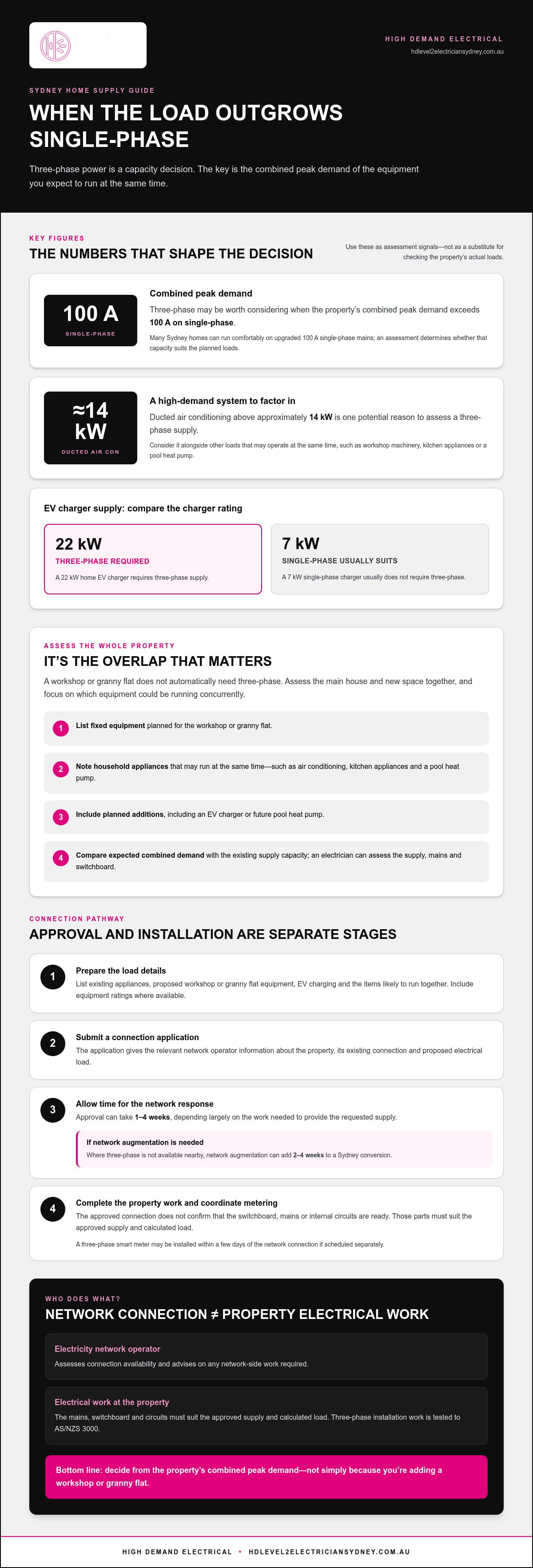
A workshop or granny flat doesn’t automatically mean your home needs three-phase power. Getting 3-phase power to your house in Sydney may make sense if your combined peak demand exceeds 100 A on single-phase, or if you’re adding demanding equipment such as ducted air conditioning above approximately 14 kW. The right decision depends on the loads the property needs to run together.
It’s reasonable to want a clear picture before committing to an electrical upgrade. This guide explains when three-phase supply can suit a workshop, granny flat or EV charger, what the network approval process involves, and how the work is divided between the electricity network and the electrical work at your property.
You’ll also learn which site conditions shape the installation, why assessing your switchboard and mains matters, and what to expect during approval and installation. This gives you a practical basis for deciding whether three-phase is right for your home or your existing supply can meet the demand.
Key Takeaways
• Decide based on the property’s combined peak electrical demand, not simply because you’re adding a workshop or granny flat.
• Allow for a network application and approval stage; whether three-phase is already available at the street affects the process.
• Installation costs depend on the connection, cable route, mains and switchboard work, and any network upgrades required.
• Understand which work sits with the network provider and which is completed at your property before planning the upgrade.
• Match the supply to your equipment: a 22 kW home EV charger requires three-phase, while a 7 kW single-phase charger usually doesn’t.
Can I install three-phase for a home workshop or granny flat?
Yes, you can install three-phase power at a Sydney home, workshop or granny flat. Whether you need it depends on the property’s combined electrical demand and the equipment you plan to run.
Assessing household power needs
To assess your household’s power needs, consider the maximum demand of appliances and equipment that may operate at the same time. A workshop or granny flat can add load to the home’s existing supply, even if each space uses modest power on its own. List fixed equipment first, then note which items might run together during busy periods.
Include the main house as well as the new space. For example, workshop machinery may run while ducted air conditioning, kitchen appliances and a pool heat pump are operating. Combined peak demand is more useful than adding every appliance’s rating without considering when it runs. An electrician can assess your supply, mains and switchboard against the loads you plan to use.
• List the equipment planned for the workshop or granny flat.
• Note which appliances in the house may run at the same time.
• Include future additions, such as a pool heat pump or EV charging.
• Compare the expected combined demand with the existing supply capacity.
Be specific about how you’ll use the space. A workshop with occasional hand-tool use has a different load profile from one with several machines running together. A granny flat does not automatically need a separate three-phase connection. What matters is how its expected demand affects the property’s supply. This assessment helps you avoid choosing an upgrade based on the building’s label alone.
Situations requiring three-phase supply
Three-phase supply becomes a potential requirement when the home’s expected peak load exceeds what its single-phase supply can support. This matters for properties combining several high-demand systems, because those loads can overlap rather than operate separately. Ducted air conditioning above approximately 14 kW is one potential reason to consider three-phase power.
A combined peak load exceeding 100 A on single-phase is another potential reason. For example, a Sydney home with high-demand ducted air conditioning, a pool heat pump and an EV may need more capacity when those systems run together. A large workshop can also change the calculation if its equipment operates alongside household loads. The intended combination, not just the individual appliance, guides the assessment.
Three-phase isn’t automatically the best answer. Most Sydney homes can run comfortably on upgraded 100 A single-phase mains, so the existing supply may be adequate after an assessment. If the property’s service connection or equipment needs attention, a Sydney Level 2 electrician can assess the electrical work involved. Three-phase installation work is tested to AS/NZS 3000.
Connection application and approval process
A three-phase connection requires network approval before the supply can be changed. The application gives the network operator details about the property, its existing connection and the proposed electrical load.
Start by gathering information about how the home will use power. List existing household appliances, planned workshop equipment, granny flat loads and any EV charger. A clear list helps ensure the load calculation accounts for equipment that may operate together, rather than treating each item as a separate addition.
For example, note whether workshop machinery might run while the home uses heating, cooling or cooking appliances. Include equipment ratings where available and how you expect to use each item. This gives the assessment a practical picture of the property’s demand and helps establish whether the proposed supply suits your intended use.
The application process generally follows these stages:
• Prepare the property and proposed-load details, including major appliances and planned additions.
• Submit a connection application for assessment by the relevant network operator.
• Wait for the network’s response on connection availability and any network-side work required.
• Arrange the approved electrical work, then complete the connection and metering requirements.
Approval can take one to four weeks. The timeframe depends largely on the work required to provide the requested supply. If three-phase power is already available in the street, the network assessment may have a different scope from one for a property that needs local network changes.
Approval and installation are separate stages. A network response determines the connection requirements; it doesn’t mean the property’s switchboard, mains or internal circuits are ready. Those parts must suit the approved supply and the calculated load. If the application identifies network augmentation because three-phase isn’t available nearby, that work can add 2-4 weeks to a Sydney conversion.
Keep your appliance list consistent throughout the process. If your plans change, such as adding a larger EV charger or more workshop machinery, the expected demand changes too. An updated load calculation can help align the application and electrical design with the project, rather than an outdated equipment list.
Before scheduling work, clarify the approved connection scope, the electrical work at your property and how metering will be coordinated. A three-phase smart meter may be installed within a few days of the network connection if scheduled separately. Planning these stages together helps avoid treating network approval, electrical upgrades and metering as a single task.
How much does 3 phase power cost to install in Sydney?
The price depends on the property and is provided after a quote request. The connection, cable route, switchboard, mains and network work all affect the scope.
For a useful estimate, distinguish the network connection from the electrical work at your property. A short overhead connection with three-phase already available involves different work from an underground route, a long cable run or required network augmentation. A single-phase switchboard cannot accept three-phase supply, so it must be replaced or fully re-boarded.
Network connection and meter installation
The network connection and metering provide the approved three-phase supply to your property and record electricity use. Coordinating these stages matters because the connection, switchboard and meter must all suit the new supply.
A three-phase smart meter may be installed within a few days of the network connection if scheduled separately. Plan for a separate meter visit after the connection, rather than assuming both will happen on the same day. Include meter timing alongside the network work and property-side installation in your project plan.
Level 2 ASP installation process
A Level 2 ASP completes the relevant network-side work for a Sydney three-phase conversion, alongside the associated electrical work at the property. The Level 2 paperwork process typically takes 10-15 business days.
Once the scope and approvals are in place, the physical installation takes 1-2 days. Work may involve consumer mains and switchboard changes, depending on the existing arrangement. A clear sequence matters: the supply connection, property electrical work and meter installation must be coordinated to complete the conversion.
For a typical Sydney conversion, allow 3-5 weeks from the first site visit until power is restored. The physical work is only part of that period; paperwork, connection arrangements and scheduling also contribute. A single-phase to three-phase upgrade needs its scope planned around the property and connection requirements.
Upgrade risks and ongoing costs
Unexpected work can change the project scope, and the changeover may interrupt the supply. The price depends on the property and is provided after a quote request. Connection conditions, cable route, mains and switchboard work are among the factors that shape the scope.
In NSW, three-phase power costs the same per kWh as single-phase power, so the ongoing electricity-use rate does not increase simply because the supply changes. However, the project may require additional work if the service line, switchboard or network connection needs upgrading.
Plan for a temporary outage while the existing supply is disconnected and the new connection is completed. Consider how the changeover fits your household’s needs, particularly if refrigeration, working from home or workshop equipment depends on continuous power. Scheduling the outage lets you arrange these activities around the installation.
Network provider and electrician responsibilities
The network distributor manages the supply connection, while an electrician handles the electrical work at your property. For a Sydney address, the responsible distributor depends on the network area. Ausgrid is responsible if your property is within its network.
Dividing network and electrician responsibilities
Network-side work connects your property to the electricity network; property-side work prepares your home to receive three-phase supply. Approval, the physical connection and switchboard work are related, but separate parts of the upgrade.
In NSW, network-side work involving the service line, point of attachment, consumer mains cable and three-phase metering must be performed by an Ausgrid-authorised Accredited Service Provider (Level 2 ASP). The property’s electrician coordinates the on-site electrical work, such as fitting suitable consumer mains and adapting or replacing the switchboard. The approved scope determines how these tasks fit together.
Network availability and augmentation
Network availability means whether three-phase supply can be accessed at the street and connected to your property without additional network upgrades. This matters because a nearby connection may require less network work than a location that needs augmentation.
If three-phase isn’t available at the street, network augmentation may be required before the connection proceeds. In Sydney, this can add 2-4 weeks to the conversion process. The network assessment identifies whether the existing local infrastructure can support the requested connection or needs changes first.
This distinction affects planning. A home with three-phase supply available nearby may mainly need a property connection and electrical upgrades. If network augmentation is required, that becomes an additional stage before connection. The application outcome clarifies the required work and helps sequence the project.
Identifying the local network distributor
The local distributor is responsible for the electricity network serving a particular address. Identifying it matters because the distributor assesses connection applications and determines the network-side requirements.
Use the property address to establish which network area applies. A Sydney suburb name alone may not identify the responsible distributor. If Ausgrid serves your address, its network requirements inform the connection assessment. The distributor’s response also clarifies whether three-phase is available nearby or augmentation is needed.
Keep the distributor’s connection requirements separate from the electrician’s work scope. The network may need to change its service connection, while your home may need compatible mains, a suitable switchboard and coordinated metering. Understanding both scopes helps prevent gaps between network approval and the work at your property.
Three-phase power for EV chargers and workshops
Three-phase can support higher-demand charging and workshop equipment, but the charger rating alone does not determine what your home needs. Match the supply to your vehicle’s onboard charger and the other equipment you plan to use.
When single-phase charging is sufficient
A single-phase connection is often sufficient for a 7 kW home charger, which doesn’t usually require three-phase power. In Australia, single-phase connections typically max out at 63 amps, equivalent to roughly 14 kW of continuous demand. That capacity can suit an EV charged at home overnight, especially when the vehicle cannot accept a faster rate. Consider the charger and car together.
What three-phase adds to EV charging
A 22 kW home EV charger requires a three-phase connection. Residential three-phase supply capacity is typically 63 A or 80 A per phase, providing more capacity for equipment designed to use it. That doesn’t mean every EV will charge at 22 kW. The vehicle’s onboard charger also limits how much power it can accept, so the charger’s headline rating isn’t the only figure that matters.
Check the vehicle’s onboard charger
Compare the EV’s onboard charging limit with the home charger before choosing a supply upgrade. An EV’s onboard charging limit can prevent a higher-capacity home charger from increasing its charging speed. Newer Tesla Model 3 and Model Y vehicles have 11 kW onboard chargers, so they can gain a partial benefit from a 22 kW charger. A 32 A single-phase circuit provides the same charging speed as a 22 kW three-phase charger for an EV limited to 7 kW.
Match workshop equipment to the supply
For a home workshop, check each machine’s electrical requirements and whether several items may run at once. A single machine may suit your existing supply, while several high-demand tools operating together can change the household load calculation. For example, consider a workshop machine running while an EV charges and household appliances are in use. The equipment requirements and combined demand guide the decision.
Choose capacity for the actual use
List the EV model, its onboard charger limit, the home charger rating and workshop equipment. Then consider when those loads overlap. If your EV accepts 7 kW, a 22 kW charger won’t make it charge faster; if you need 22 kW charging, three-phase is required. This comparison helps separate a genuine supply need from a charger rating that exceeds the vehicle’s capability.
For a setup involving a Tesla or home EV charger, discuss your EV charger installation in relation to the vehicle and home supply.
High Demand Electrical: Level 2 ASP Electrical Services
High Demand Electrical provides Level 2 ASP Electrical Services for Sydney homeowners planning a three-phase connection. If your project requires network-side work, a switchboard upgrade or changes to a private power pole, these services can address key parts of the electrical scope.
High Demand Electrical installs Tesla and home EV chargers in Sydney. The work depends on your property’s connection, switchboard and planned equipment. Discuss these details together so the proposed next steps reflect your home’s actual requirements.
Contact High Demand Electrical to discuss your three-phase power project.
Plan the next step for your home
If you’re getting 3-phase power to your house in Sydney, treat the decision as part of your property’s longer-term electrical plan. Consider how the proposed work fits alongside renovations or other planned changes, rather than treating the supply upgrade as an isolated task. Coordinating related work can help clarify the project sequence and avoid revisiting completed areas.
Before moving ahead, define what you need the upgrade to achieve. A clear brief keeps the project focused on your property and intended use, while leaving room to plan related work in a sensible order. It also gives the discussion a practical starting point instead of a general request for more power.
High Demand Electrical can discuss the electrical work involved in your project and help you identify a suitable next step. Contact High Demand Electrical to talk through your plans and move forward with confidence.
Frequently Asked Questions
Do I need a Level 2 electrician for three-phase installation?
A Level 2 ASP is needed for network-side work, such as changing service connections or metering. The work inside the home also needs an electrician to ensure the mains and switchboard suit the new supply. For example, a project may involve both a network connection change and a switchboard replacement. These are distinct parts of the job, so the required work depends on the existing property setup.
How long does the conversion take?
Allow 1-2 days for physical installation work, but the full conversion takes longer because paperwork, network scheduling and connection arrangements also need time. A separate meter appointment can affect when the upgrade is fully completed. If network augmentation is required, that adds another stage. Plan around the full sequence, rather than treating the on-site electrical work as the total project duration.
Is three-phase already at my street?
You can’t reliably establish availability from a suburb name alone. The network distributor assesses the specific property address and determines whether three-phase is available nearby or network changes are needed. Include the full address in the connection application. The distributor’s response identifies the connection requirements, which can differ between nearby properties because of local network infrastructure.
How do I get three-phase power connected to a house in Sydney?
For getting three-phase power to your house in Sydney, begin with a load assessment and a list of planned equipment. The connection application then goes to the distributor responsible for the address. Its assessment sets out the network requirements; electrical work at the property must then align with that approved scope. Keep the proposed loads consistent throughout, especially if an EV charger or workshop equipment is part of the plan.
What are the requirements for a three-phase power upgrade in Sydney?
The upgrade requires an approved connection scope, mains and a switchboard suitable for three-phase, and metering arranged for the new supply. The application should reflect the home’s expected electrical loads, including equipment planned for a workshop or granny flat. If your existing switchboard is single-phase, it cannot accept three-phase supply and must be replaced or fully re-boarded.
How much does a three-phase power upgrade cost in Sydney, including network charges and electrician fees?
Factors include network connection work, any required augmentation, cable route and distance, consumer mains, and switchboard changes. A straightforward overhead connection has a different scope from an underground connection or a long cable route. Separating network charges from electrical work at your property helps clarify what each part of the project covers.
How do I apply to Ausgrid or Endeavour Energy for a three-phase connection?
Apply to the network distributor responsible for your property’s address, rather than choosing based only on its Sydney location. Provide the address and details of the proposed supply and major electrical loads. The distributor assesses the application and advises the connection requirements. A Level 2 ASP can carry out relevant network-side work. The approval process can take one to four weeks.
How long does a three-phase power upgrade take in Sydney?
A typical Sydney conversion takes 3-5 weeks from the first site visit until power is restored. That overall period includes stages beyond the physical installation, such as paperwork, network coordination and scheduling. Network augmentation can add 2-4 weeks if three-phase isn’t available at the street. Allowing for these stages helps you plan household activities around the connection and any planned outage.
Need Help Fast?
Powering Your Needs with Expertise
If you’re looking for a reliable, experienced, and prompt electrician, look no further than High Demand Electrical. We cater to all your electrical needs, from routine maintenance to emergency repairs and complete system installations. Our skilled team is committed to providing professional service that ensures your electrical systems run smoothly. Whether it's a small task or a large project, give us a call today. Let us meet all your electrical demands with the quality and reliability you deserve.

