
Generator Earthing Requirements in NSW: What the Rules Say
In NSW, a generator must be earthed in line with the manufacturer’s instructions. If it feeds a home or business installation, the generator’s frame is connected by an earth conductor to the installation’s main earthing point, and any neutral-to-earth link inside the generator is removed. Connection to fixed wiring is licensed work. A portable generator that runs appliances directly through its own outlets is a different case, and the two are often confused.
This guide explains both cases in plain terms. It covers what the standards and the network operator say, what goes wrong when a generator is earthed or connected incorrectly, and when you need a Level 2 electrician.
TL;DR
- A generator needs proper earthing in line with the manufacturer’s instructions. Ausgrid points to AS 2790 equipment for transportable sets up to 25 kW.
- When a generator is connected to an installation, an existing neutral-earth link in the generator is disconnected. The frame is earthed through a conductor to the installation’s MEN earth bar or point, not to a separate earth stake.
- Never plug a generator into a power point or connect it to a switchboard. A permanent connection needs a licensed electrician and a compliant changeover switch.
- Work on fixed wiring must be done and tested by an appropriately licensed electrical worker, who records the results on a Certificate of Compliance for Electrical Work.
Table of Contents
- Does a generator need to be earthed in NSW?
- How the earthing arrangement changes with the setup
- Isolation and the changeover switch
- RCD protection on generator-supplied circuits
- Who can connect a generator to fixed wiring in NSW?
- What goes wrong when earthing or connection is incorrect
- A practical checklist before you buy or connect
- Our perspective on generator earthing
- Generator installation with High Demand Electrical
- FAQ
- Sources
Does a generator need to be earthed in NSW?
Yes. Ausgrid’s guidance says a generator should be properly earthed in accordance with the manufacturer’s instructions. It also recommends equipment that complies with AS 2790 for transportable generating sets up to 25 kW.
What “properly earthed” means depends on how the generator is used. There are two situations:
- Stand-alone use. The generator runs appliances plugged straight into its own outlets. It is not connected to any building wiring.
- Connected use. The generator supplies a home, shop or office through the fixed wiring, usually via an inlet, a changeover switch or an automatic transfer switch.
The first is something many owners do themselves, within the manufacturer’s instructions. The second is regulated electrical work in NSW, and the earthing arrangement is one of the things the electrician has to get right and then test.
How the earthing arrangement changes with the setup
Earthing is about giving fault current a safe, low-resistance path so protective devices trip quickly and metal parts do not stay live. Most NSW homes use a Multiple Earthed Neutral (MEN) system. The neutral and earth are bonded together at the main switchboard, and that bond is the reference point for the whole installation.
This is why a generator cannot simply be dropped into the system. If the generator has its own neutral-earth bond and the installation has one too, you can end up with two bonds on one circuit. That can leave fault currents travelling on paths nobody designed, and it can stop RCDs and circuit breakers working as intended.
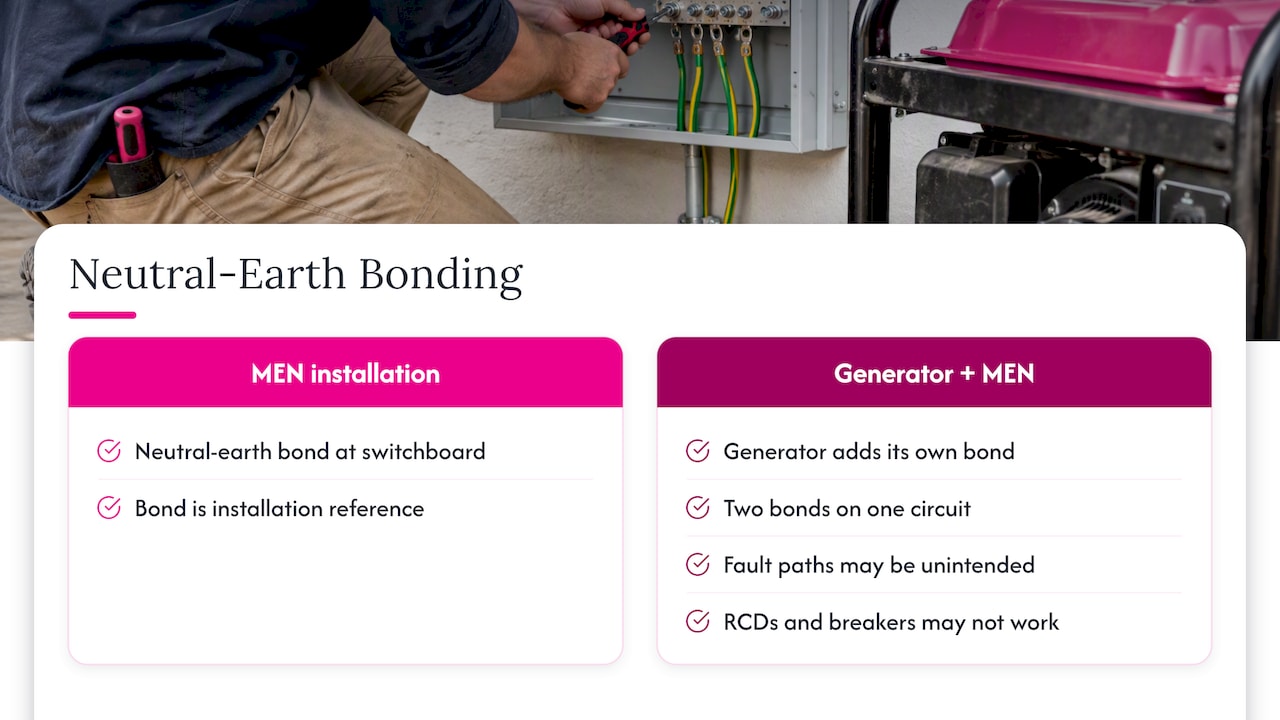
Generator connected to an installation
The summary of Amendment 1 to AS/NZS 3010:2017 sets out the approach for generating sets connected to an installation:
- An existing neutral-to-earth connection in the generator is disconnected.
- The generator frame is connected by an earth conductor to the installation’s MEN earth bar or point.
- An earth electrode is not connected directly to the generator.
In practice, the installation’s own earthing becomes the single reference. The generator’s frame is bonded to it, and the neutral is not bonded a second time at the generator. Some generators ship with a removable link or a switchable bonding arrangement, and the electrician needs to check this against the manual before the first start.
Generator running appliances directly
When the generator is not connected to any installation, the manufacturer’s instructions decide how it is earthed and whether its outlets are protected by an RCD. Ausgrid advises that portable generators should be connected directly to appliances through the generator’s own outlets and used only within their rated capacity.
If you use extension leads, Ausgrid recommends heavy-duty, outdoor-rated leads that are fully uncoiled and undamaged, kept away from water and trip hazards. A coiled lead under load can overheat, and a damaged one can put live conductors where people walk.
A generator earthing and bonding setup that suits one model can be wrong for another. Always read the manual for your model rather than copying a setup from a forum post or a different brand.
Isolation and the changeover switch
Earthing is only one part of a safe connection. The other is making sure the generator and the street network can never feed each other.
Ausgrid is blunt on this: never connect a generator to a home’s wiring, power point, switchboard, meter box or internal wiring. The reason is backfeed. Power flowing back up the supply lines can electrocute network crews working to restore supply, damage equipment and increase fire risk. In its outage guidance, Ausgrid repeats that generators should only run directly connected appliances during an outage.
There is one lawful route to a permanent connection. A generator can only be connected to home wiring when a licensed electrical contractor has installed special facilities including a changeover switch.
The AS/NZS 3010 Amendment 1 summary adds detail on how these devices must work:
- A generating set needs an isolating switch that operates in all live conductors. It must be adjacent to or on the set, and visible to a person working on it. For this purpose, neutral counts as a live conductor.
- Where a generator is connected by plug and socket, the changeover device operates in all live conductors, active and neutral.
- The incoming generator supply needs its own overcurrent protection within the installation.
See the Amendment 1 summary for the wording, and ask your electrician which arrangement suits your switchboard.
The switching of the neutral is the point many people miss. A changeover that only switches the active conductors can leave the generator’s neutral and the grid’s neutral connected, which defeats the purpose of the exercise.
RCD protection on generator-supplied circuits
The NSW Government says RCDs are required on all domestic and residential final sub-circuits, with additional RCD requirements for non-domestic installations. Those rules sit under AS/NZS 3000, which the NSW Government says has been mandatory in NSW since 1 January 2019.
A properly designed generator connection keeps this protection working. Because the generator is bonded through the installation’s MEN point, an earth fault on a protected circuit still has a defined path back. That is how the RCD sees the imbalance and trips.
It is worth testing, not assuming. A switchboard with ageing safety switches or no RCDs on some circuits is a weak point whether the supply comes from the grid or a generator. If you are planning a generator, it is a good time to look at the board itself. Our switchboard upgrade and RCD and safety switch testing work cover this.
Who can connect a generator to fixed wiring in NSW?
Only an appropriately licensed or otherwise authorised electrical worker. The NSW Service and Installation Rules require installations to comply with AS/NZS 3000 and prohibit connection to the electricity network unless the distributor permits it. They also set out that the work is performed and tested by an authorised person, and that stand-alone and generator systems meet the applicable standards.
After the work, the electrician completes a Certificate of Compliance for Electrical Work. The NSW Fair Trading template records tests including:
- earthing system integrity
- RCD operation
- polarity
- insulation resistance
- correct current connections
The same template identifies stand-alone systems as needing to comply with AS 4509 and asks for the installer’s and tester’s NSW licence details. For a homeowner, that certificate is your proof that the earthing and connection were tested, and you will want it for insurance and any future sale.
Level 2 work and the network
Some generator jobs touch more than the board. A larger commercial standby set, a change to the supply or a new connection point can involve the network operator and accredited service provider (ASP) work. That is Level 2 territory, which is our specialty. Our Level 2 electrician service covers the work that sits between your property and the network.
What goes wrong when earthing or connection is incorrect
The risks are not theoretical, and they are not limited to the person standing next to the generator.
- Backfeed. Ausgrid warns that incorrect connection can send electricity along supply lines, potentially injuring or killing neighbours or electricity workers, and severely damaging the generator.
- Shock and fire. A frame that is not bonded properly, or an earthing arrangement that does not match the installation, can leave metalwork live during a fault.
- Carbon monoxide. Ausgrid says to operate portable generators outdoors, away from doors, windows and vents, because carbon monoxide can be life-threatening. A garage with the door open is not outdoors.
- Failed compliance. Unlicensed work on fixed wiring means no valid compliance certificate and a possible problem with insurance.
If a generator has been connected by a plug-in lead to a power point or board, stop using it and have a licensed electrician inspect the installation. In an emergency with no power and no safe way to proceed, our emergency electricians are available around the clock.
A practical checklist before you buy or connect
- Decide the use. Appliances only during an outage, or whole-of-site backup? That decides whether you need a changeover switch at all.
- Check the generator’s standard. For transportable sets up to 25 kW, look for AS 2790 compliance, as Ausgrid recommends.
- Read the bonding details in the manual. Find out whether there is a neutral-earth link and whether it can be removed.
- Check your switchboard. Space, RCD coverage and the condition of the main switch all matter.
- Plan the position. Outdoors, ventilated, away from openings, with a safe cable path.
- Use a licensed electrician for fixed wiring. Ask for the earthing, RCD and polarity test results on the Certificate of Compliance.
- Test periodically. Run the generator and test RCDs on a schedule so you are not discovering faults mid-outage.
Our perspective on generator earthing
Most of the generator calls we see are not about the generator itself. They are about the board. A homeowner buys a portable unit after a storm, finds it does not fit into their setup, and is tempted by a lead with two male plugs. We say no every time, and we explain why backfeed is a real danger for the crews working on the street.
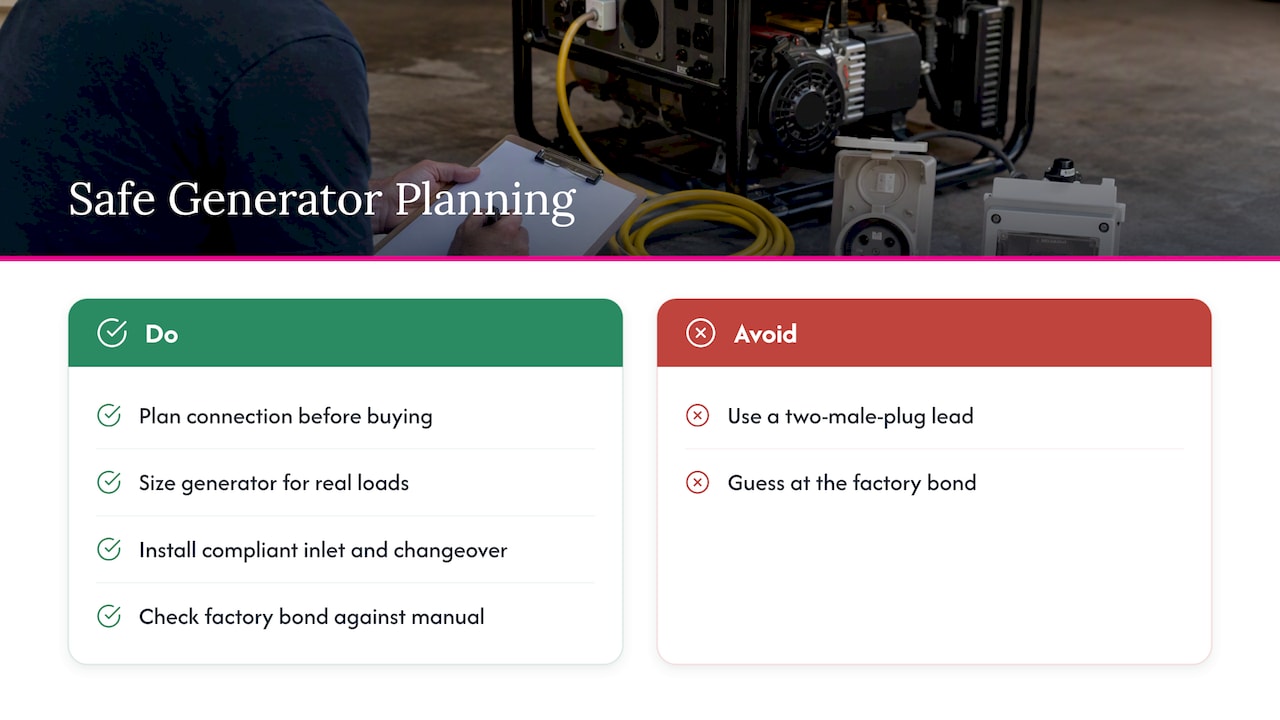
The second pattern is the neutral-earth link. Many portable generators ship bonded for stand-alone use. When one is wired into an installation, that factory bond is exactly what has to be dealt with, and it has to be checked against the manual, not guessed. We test earthing integrity, RCD operation and polarity before we hand a job back, and the results go on the certificate.
Our advice is to plan the connection before you buy the generator. Choose the size around your real loads, put in a compliant inlet and changeover arrangement, and treat the switchboard as part of the project. A generator is only as safe as the installation it feeds.
— Christopher
Generator installation with High Demand Electrical
We are a certified Level 2 electrical contractor serving Sydney. Our team installs and connects generators for homes and businesses, including changeover arrangements and the earthing and testing that go with them. We offer free site inspections for Level 2 work, so you can see what your property needs before you commit.
Start with our generator installation and connection page.
If you want automatic backup for a home, see our home standby generator installation. For three-phase sites, our commercial generator installation page explains the options. If your supply or board needs work first, we also handle power supply upgrades, including single phase to three phase.
FAQ
Can I earth a generator with a metal stake in the ground?
Not when the generator is connected to an installation. The AS/NZS 3010 Amendment 1 summary says an earth electrode must not be connected directly to the generator. The frame is bonded by an earth conductor to the installation’s MEN earth bar or point. For stand-alone use, follow the manufacturer’s instructions.
Can I plug my generator into a power point during a blackout?
No. Ausgrid says never to connect a generator to a home’s wiring, power point, switchboard or meter box. Backfeed can electrocute network crews and start fires. Use the generator’s own outlets for appliances, or have a licensed electrician install a changeover switch.
Do I need a licensed electrician to connect a generator?
Yes, if it connects to fixed wiring. NSW requires that work to be done and tested by an appropriately licensed or authorised electrical worker. They record earthing integrity, RCD operation and polarity tests on a Certificate of Compliance for Electrical Work.
Does the changeover switch have to switch the neutral?
For generator supplies connected by plug and socket, the AS/NZS 3010 Amendment 1 summary says the changeover device operates in all live conductors, active and neutral. Neutral is treated as a live conductor for isolation of a generating set. Your electrician will confirm the arrangement for your board.
Where should I run a portable generator?
Outdoors, away from doors, windows and vents. Ausgrid warns that carbon monoxide can be life-threatening. Keep leads uncoiled, outdoor-rated and clear of water.
Sources
- Ausgrid: Portable generators
- Ausgrid: Generator safety brochure
- Ausgrid: What to expect during an unplanned outage
- Master Electricians: AS/NZS 3010:2017 Amendment 1 changes
- NSW Government: Electrical standards, rules and notes
- NSW Service and Installation Rules (July 2018)
- NSW Fair Trading: Certificate of Compliance Electrical Work template
Powering Your Needs with Expertise
If you’re looking for a reliable, experienced, and prompt electrician, look no further than High Demand Electrical. We cater to all your electrical needs, from routine maintenance to emergency repairs and complete system installations. Our skilled team is committed to providing professional service that ensures your electrical systems run smoothly. Whether it's a small task or a large project, give us a call today. Let us meet all your electrical demands with the quality and reliability you deserve.

