$2,000–$5,000? NSW EV Charger Rules for Property Owners
Any fixed EV charger in New South Wales must be installed by a licensed electrician, comply with AS/NZS 3000:2018 and the relevant NSW technical specifications, and clear any planning or road reserve approvals before work starts. Book a site inspection first, confirm whether SEPP or Roads Act approval applies to your property, check the NSW approved charger list if you want grant funding, and keep the Certificate of Compliance for Electrical Work once the job is done.
TL;DR:
- Installing an EV charger in NSW requires a site inspection, planning advice for non-simple jobs, and approval under relevant laws if the installation affects public land or heritage areas.
- Most domestic chargers can operate on existing single-phase supplies up to 32A, but higher capacities often need a demand assessment and potentially a network upgrade, which can incur significant delays.
- All fixed EV chargers must be installed by a licensed electrician, with compliance confirmed through a Certificate of Compliance, and must meet AS/NZS 3000:2018 wiring standards plus NSW-specific standards.
- Public and kerbside charging installations require council consent, adherence to NSW design guides, and must use hardware listed on approved funding lists to qualify for grants.
- Strata owners can install chargers using new legal pathways, with funding and approval models varying from individual owners to shared infrastructure, but early planning is crucial to avoid costly retrofits.
Table of Contents
- What approvals and planning pathways apply in NSW?
- Who can install an EV charger and what paperwork is mandatory?
- What technical standards govern EV chargers in NSW?
- Do you need a supply upgrade for your EV charger?
- What are the rules for kerbside and public EV charging in NSW?
- How does strata law affect EV charger installation?
- What does an EV charger installation cost in NSW?
- What happens during an EV charger installation?
- What ongoing maintenance and safety checks are required?
- What Sydney electricians see on the ground
- Get your EV charger installed right the first time
- Sources
- FAQ
What approvals and planning pathways apply in NSW?
Most home driveway installations need no planning approval at all, but the moment a charger touches a road reserve, a common area, or a heritage overlay, the rules change fast. The State Environmental Planning Policy (Transport and Infrastructure) 2021 sets out exempt development pathways for certain low-impact infrastructure, but projects that fail to meet those exempt development standards must go through a full development application with council.
Any work in a public road reserve, including pole-mounted or verge-based charging equipment, needs separate consent under Section 138 of the Roads Act 1993. That consent sits with your local council or the relevant roads authority, and it is a different approval to a development application.
Before you commission anything, gather:
- A current title or strata plan search confirming ownership and common property boundaries
- Site photos and a rough electrical single-line diagram from your electrician
- Confirmation from council on whether the site sits in a heritage conservation area or road reserve
- Written planning advice if the installation is anything other than a straightforward domestic driveway install
For anything outside a simple home garage job, get planning advice early. It is far cheaper than a rejected application after equipment has already been ordered.
Who can install an EV charger and what paperwork is mandatory?
Only a licensed electrician can legally install fixed EV charging equipment in NSW, and the Electric Vehicle Council’s installation guideline is explicit on this point. Any job that touches the network connection, the meter, or requires a supply upgrade also needs a Level 2 Authorised Service Provider, because that work sits outside standard retail electrician scope.
Three things must happen for a compliant install:
- Certificate of Compliance for Electrical Work (CCEW) is issued once the job is finished, confirming the work meets AS/NZS 3000 and has been tested.
- Distributor notification happens automatically for standard connections, but any supply change triggers a formal connection enquiry with your network operator under the Service and Installation Rules of New South Wales.
- Protection and testing checks are carried out and documented, including RCD protection, correct earthing, cable sizing for the circuit run, and polarity and insulation testing before energising the charger.
Keep the CCEW with your other property documents. Insurers and future buyers will ask for it.
What technical standards govern EV chargers in NSW?
AS/NZS 3000:2018 is the baseline wiring standard for every fixed EV charger installed in the state, and it requires a dedicated circuit, residual current device protection, and cable sizing matched to the charger’s load. On top of that baseline, Standards Australia released two purpose-built specifications: SA TS 5396:2024 for residential installations and SA TS 5397:2024 for commercial sites, both developed with NSW government input to close gaps that AS/NZS 3000 leaves open around EV-specific installation, testing, and maintenance practice.
The standard picture at a glance:
| Standard | Scope |
|---|---|
| AS/NZS 3000:2018 | Core wiring rules, RCD protection, cable protection |
| SA TS 5396:2024 | Residential EV charger installation and maintenance |
| SA TS 5397:2024 | Commercial EV charger installation and maintenance |
| TfNSW TS 04955 series | Public and transport site equipment, metering, accessibility |
Public and transport-adjacent sites carry an extra layer through the TfNSW TS 04955 series, which covers communications protocols like OCPP, metering accuracy, IP and IK impact ratings for outdoor cabinets, and mounting heights for accessibility. Mode 3 AC chargers (the standard home and workplace type) have different protection and cable requirements to Mode 4 DC fast chargers, so always follow the manufacturer’s installation instructions alongside the standards, not instead of them.
Do you need a supply upgrade for your EV charger?
A standard single-phase domestic supply can usually run a 32A EV charger, which delivers around 7.4kW, without any upgrade, according to the Electric Vehicle Council’s guideline. Push past that, or add a second charger, and you’re generally looking at three-phase supply and a proper demand assessment.
Your electrician works out whether your existing switchboard and consumer mains have the spare capacity, measured in kVA, once diversity and existing loads (hot water, air conditioning, pool pumps) are factored in, using specialized Electrician SEO Services to book more jobs tailored for trades professionals. If the numbers don’t stack up, the next step is a formal enquiry to your local distribution network service provider (DNSP) for a service upgrade quote.
Points worth knowing before you get a quote:
- Single-phase upgrades are generally faster and cheaper than three-phase conversions
- DNSP lead times vary significantly by area and network congestion, so build in buffer time
- Underground services or older switchboards often add cost that a driveway inspection alone won’t reveal
- A three-phase EV charger installation opens the door to faster charging but almost always needs a network-level conversation first
Cost for a supply upgrade varies enormously by site, and there’s no honest flat figure to quote here. The only way to know is a proper on-site assessment.
What are the rules for kerbside and public EV charging in NSW?
Kerbside charging in NSW runs on a different rulebook to a private driveway, and the Transport for NSW kerbside electric vehicle charging design guide is the reference document councils and installers use to decide what’s viable on a given street. It sets out which street typologies suit kerbside charging, acceptable charger types, physical clearances from pedestrian paths, and safety features like bollards or raised kerbs.
Because kerbside installs sit in the road reserve, they need council consent under Roads Act s138, and any change to parking or signage requires separate Local Traffic Committee approval. That approval layer shapes what hardware you can realistically choose, since grant programs such as those listed on the NSW approved EV charger and software list often require specific charger and software combinations to qualify for co-funding.
- Councils generally expect a maintenance plan and a nominated responsible party before approving a public charger
- Uptime and fault response commitments are increasingly a condition of grant funding, not just good practice
- Listing the charger on a mapping platform helps drivers find it and supports usage reporting councils often require
Pro Tip: Check the approved hardware and software list before you sign a procurement contract for any kerbside or grant-funded project. Buying equipment that isn’t on the list can disqualify you from co-funding entirely.
How does strata law affect EV charger installation?
Strata and multi-unit buildings face a different approval chain to a standalone house, but recent changes to strata law in NSW treat EV charging as sustainability infrastructure, which generally lowers the voting threshold needed to approve it compared to older major works rules. Owners corporations typically need a resolution recorded through a by-law rather than unanimous consent, though the exact threshold depends on the specific works proposed.
Buildings generally choose between three rollout models, and the Drive Electric NSW EV ready buildings guide walks through all three:
- Individual on-title installs, where each owner funds and maintains their own charger on their car space
- Shared readiness infrastructure, where the OC installs cabling and metering capacity upfront and owners connect chargers as needed
- OC-owned shared chargers, funded and maintained collectively through strata levies
A practical process looks like: feasibility study, defined scope of works, funding resolution, installation, then an operational plan covering who pays for electricity and who handles faults. Buildings exploring apartment and strata EV charger installation save real money by settling the funding model before any cabling goes in the ground, since retrofitting shared infrastructure after individual installs are already scattered through a car park gets expensive fast.
What does an EV charger installation cost in NSW?
A straightforward Level 2 domestic installation in NSW typically runs $2,000 to $5,000, covering the charger, dedicated circuit, and standard testing. DC fast charging or any job needing a supply upgrade sits well above that band, and there’s no reliable flat figure for those because civil works and DNSP costs vary so much by site.
What drives the price up:
- A switchboard or supply upgrade, often the single largest unpredictable cost
- Civil works, particularly trenching for underground cable runs to a garage or car space
- Metering requirements for shared or commercial sites
- Council or Traffic Committee approval processes adding weeks to the timeline
A simple residential install can often be scoped, approved internally, and completed within one to two weeks of the site visit. A kerbside or commercial project, by contrast, can take months once council consent, Traffic Committee sign-off, and any DNSP works are factored in.
What happens during an EV charger installation?
Every compliant installation follows roughly the same sequence, whether it’s a home garage or a small commercial car park.
- Site inspection and scope. Your electrician assesses supply capacity, checks whether your preferred hardware and software are on the NSW approved list for grant eligibility, and issues a firm quote.
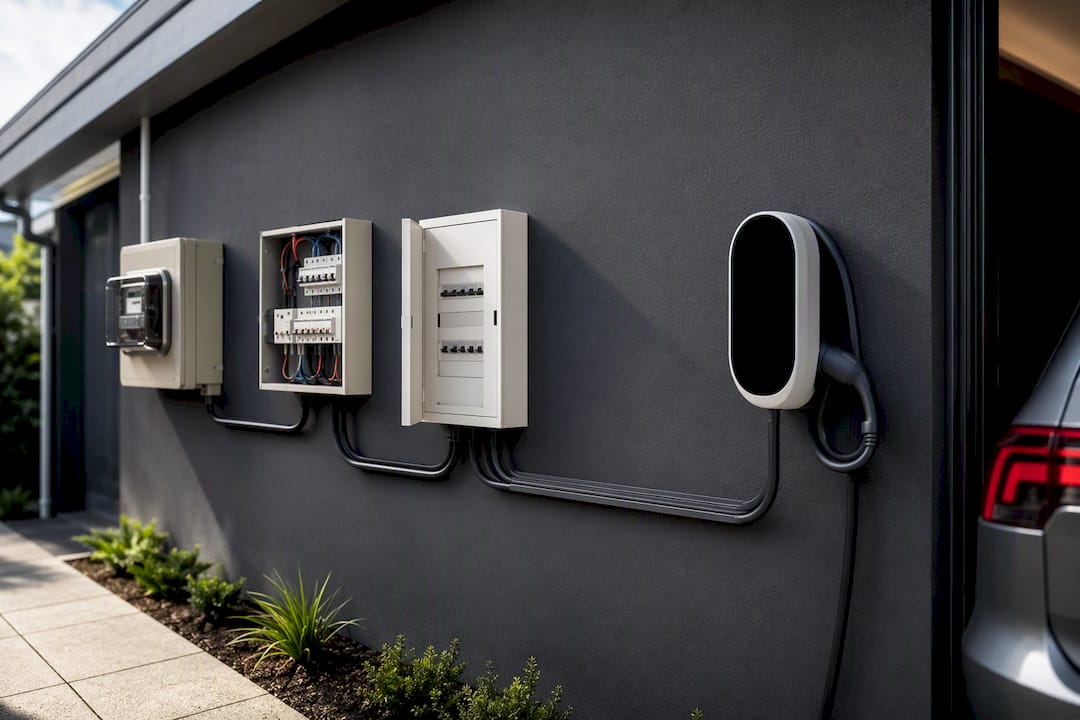
- On-site electrical works. This covers switchboard work, running the dedicated circuit, mounting the charger, and cable routing that meets AS/NZS 3000 protection requirements.
- Commissioning and testing. RCD, earthing, and insulation testing happen before the charger is switched on for the first time.
- Handover and paperwork. You receive the CCEW, and if the charger is public, it gets registered on mapping platforms and handed over with a maintenance schedule.
Pro Tip: Ask for the CCEW and any DNSP correspondence in writing before final payment, not after. It’s the one document that protects you if a future buyer or insurer questions the work.
Homeowners exploring residential EV charger installation should expect this full sequence even for a simple single-phase job. Skipping steps to save a week rarely ends well.
What ongoing maintenance and safety checks are required?
SA TS 5396:2024 and SA TS 5397:2024 both set out periodic inspection and testing expectations once a charger is commissioned, covering RCD function tests, connector wear checks, and cable condition, alongside the general testing regime AS/NZS 3000 already requires for fixed electrical equipment. Fault response times matter here too, particularly for shared or public equipment where downtime affects other people, not just one household.
Responsibility splits differently depending on who owns the charger:
- Private residential chargers are the homeowner’s responsibility, generally through the same electrician who installed it
- Strata-owned shared infrastructure sits with the owners corporation, usually via a maintenance contract
- Public and kerbside chargers are typically the responsibility of the charge point operator or council, not individual drivers
Keep records of every test, firmware update, and OCPP communications patch. A charger with outdated firmware can fail compliance checks even if the wiring is fine.
What Sydney electricians see on the ground
Most delays on EV charger projects come from skipping the capacity assessment, not from anything wrong with the standards themselves. An owner buys a 22kW three-phase charger, only to discover the switchboard and consumer mains can’t take it without a DNSP upgrade that takes weeks to schedule.
Strata jobs stall for a different reason: nobody agrees on funding before the electrician turns up. Get that resolved first.
Before hiring anyone, ask to see their electrical licence and, if the job touches the network, their Level 2 ASP accreditation. Ask what warranty covers the installation itself, not just the charger hardware, and whether ongoing maintenance is included or billed separately. A contractor who can’t answer either question clearly is a red flag, not a bargain.
— Christopher
Get your EV charger installed right the first time
Hdlevel2electriciansydney is the practical alternative to juggling multiple tradespeople for one EV charger job. The team handles the planning check, the DNSP liaison, the switchboard work, and the final compliance paperwork under one roof, backed by site inspections for Level 2 work so you know the real scope before committing to anything.

Whether you need a straightforward EV charger installation, a power supply upgrade to support a higher-capacity charger, or full Level 2 electrician network connection work, book a free site inspection and get a clear scope of works before you buy any hardware. It’s the fastest way to avoid the capacity surprises that stall so many EV charger projects across Sydney.
Sources
- State Environmental Planning Policy (Transport and Infrastructure) 2021
- New guides available for safe and efficient EV charger installation — Standards Australia
- Kerbside electric vehicle charging design guide — Transport for NSW
- EVSE installation guideline — Electric Vehicle Council
FAQ
What are the requirements for a 7.2kW EV charger at home?
A charger around this power draw typically runs on a single-phase 32A circuit, delivering roughly 7.4kW, and needs a dedicated circuit with RCD protection under AS/NZS 3000. Most standard NSW homes can run this without a supply upgrade, but confirm capacity with an electrician first.
Am I allowed to install my own EV charger?
No. Fixed EV charging equipment in NSW must be installed by a licensed electrician, and any network or metering-related work requires a Level 2 Authorised Service Provider under the Electric Vehicle Council’s guideline. DIY installation is both illegal and dangerous given the loads involved.
What are the regulations for EV chargers in Australia?
Regulations vary by state, but in NSW they combine AS/NZS 3000:2018 wiring rules with newer national specifications, SA TS 5396:2024 for residential and SA TS 5397:2024 for commercial sites. Planning consent and Roads Act approvals may also apply depending on where the charger sits.
What are the electrical requirements for an EV charger?
Every installation needs a dedicated circuit sized to the charger’s load, residual current device protection, correct earthing, and full testing before the unit is energised. Higher-power or three-phase installs also require a capacity assessment and, in some cases, a distributor network upgrade through your local network operator.
Does Hdlevel2electriciansydney handle EV charger compliance paperwork?
Yes. Hdlevel2electriciansydney manages the Certificate of Compliance for Electrical Work and any distributor liaison as part of its EV charger installation service, alongside the site inspection and switchboard assessment needed before work starts.
Powering Your Needs with Expertise
If you’re looking for a reliable, experienced, and prompt electrician, look no further than High Demand Electrical. We cater to all your electrical needs, from routine maintenance to emergency repairs and complete system installations. Our skilled team is committed to providing professional service that ensures your electrical systems run smoothly. Whether it's a small task or a large project, give us a call today. Let us meet all your electrical demands with the quality and reliability you deserve.