
Ensuring Your Property Meets Electrical Code in NSW
Electrical upgrades aren’t automatically required just because a property is older. In NSW, the Electricity (Consumer Safety) Act 2004 and AS/NZS 3000:2018, the Wiring Rules, govern electrical installations. Fixed-wiring work must be carried out by a licensed electrician, and safety switches are required on power point circuits in new residential installations and major alterations.
If you’re ensuring your property meets NSW electrical code requirements, it can be hard to know whether an ageing switchboard, worn wiring or overloaded circuit needs attention. Start by understanding which rules apply to the work and noting any signs of a fault. The installation’s condition and the type of work both matter.
This guide explains what can trigger an upgrade, how wiring condition and circuit loading affect compliance, and what to consider when ensuring your NSW property meets electrical code requirements. It also outlines when a professional assessment can clarify the next step.
Key Takeaways
• Use the NSW legal requirements and AS/NZS 3000 Wiring Rules to understand what applies to electrical installations and upgrades.
• Fixed-wiring work must be carried out by a licensed electrician; don’t treat alterations to 230-volt wiring as a DIY task.
• An older property doesn’t automatically need every modern safety feature retrofitted, but landlords remain responsible for safe electrical installations.
• Flickering lights or repeatedly tripping breakers can signal an electrical issue; leave a repeatedly tripping circuit off until it’s investigated.
• Learn how wiring condition, property changes and increased demand can affect compliance and indicate when an upgrade may be needed.
Fixed wiring and electrical installations
NSW electrical installations are governed by the Electricity (Consumer Safety) Act 2004 (NSW) and AS/NZS 3000:2018, the Wiring Rules. Compliance depends on safe wiring and correctly selected protection, especially when fixed electrical work changes. For owners focused on ensuring their property meets electrical code in NSW, the work type and installation condition matter.
Wiring hazards and faulty outlets
Outdated or damaged wiring can create fire and electric shock hazards, particularly where connections deteriorate or insulation fails. Aluminium wiring used roughly between 1965 and 1975 has been identified as a fire risk because connections can fail. Damaged cords, cracked outlets, scorching, buzzing or burning smells also warrant attention. Stop using damaged cords and affected outlets; don’t cover warning signs with tape or continue using them.
NSW wiring rules and compliance checks
Electrical compliance means the installation and fixed wiring meet applicable NSW requirements and the Wiring Rules. A property owner can look for visible damage, an ageing switchboard or recurring faults, but a visual check can’t establish whether concealed wiring complies. Work altering fixed 230-volt wiring isn’t a DIY task. Installing or moving power points and switches, adding circuits, changing fixed light fittings, installing ceiling fans or working inside a switchboard requires a licensed electrician. For supply-side work, a Level 2 electrician in Sydney can address relevant network connections.
Inspections and electrical safety certificates
NSW doesn’t mandate routine periodic electrical inspection certificates for residential rental properties. However, an inspection is recommended at least once a year, particularly for older homes, and can assess code compliance, wear or damage, circuit breakers and RCD function. After electrical wiring work, the electrician must submit a Certificate of Compliance for Electrical Work (CCEW). The CCEW records that work; it isn’t a substitute for inspecting unrelated parts of the property.
Switchboards and circuit protection
Safety switches, also called RCDs, reduce electric-shock risk by disconnecting a protected circuit when they detect a fault. New residential installations and major alterations require safety switches on power point circuits. NSW has required them on those circuits since 1992. That doesn’t create a blanket retrofit deadline for existing rental properties. For rentals, three separate RCDs protecting power, lighting and hardwired appliance circuits are recommended. Repeated trips need investigation, not repeated resetting.
Smoke alarm requirements also matter during property work. NSW rentals must have at least one smoke alarm on each level and in or near every bedroom. New and replacement alarms should be photoelectric; installing a hard-wired alarm requires a licensed electrician. Smoke alarms in new NSW builds have been required to be interconnected since 2014. Ensuring a property meets electrical code in NSW also means considering the electrical work in renovations, extensions and new builds. Fixed wiring must meet applicable requirements, and safety-switch rules apply to new installations and major alterations.
Why is Electrical Safety and Compliance Important?
Electrical licensing helps keep regulated work in qualified hands and protects people and property. In NSW, the electrician’s licence matters for installation work and electrical safety inspections.
Licensed electricians and permitted work
NSW electrical licensing sets who can legally perform electrical work, helping property owners avoid unsafe or undocumented alterations. Electrical wiring work requires an electrical licence or certificate, regardless of the job’s value.
Installing or replacing power points, switches or fixed light fittings, adding circuits, installing ceiling fans, altering wiring and working inside a switchboard require a licensed electrician. Work altering fixed 230-volt wiring isn’t a DIY task. A home owner planning new lighting, for example, should use a licensed electrician rather than attempt fixed-wiring changes themselves.
Electrical safety testing, inspection and reporting in NSW can only be carried out by an electrician holding a current NSW Fair Trading electrical licence. This applies when assessing an installation’s condition as well as when repairing it. Check that the person doing the work holds the relevant current licence, and agree on the work scope and documentation before it begins.
For rental properties, a qualified and licensed electrician can help landlords address maintenance responsibilities and keep a clear record of completed work. Match the licence to the task: fixed wiring and supply infrastructure involve different electrical systems and work scopes.
Risks of non-compliant electrical work
Non-compliant work can leave exposed conductors, faulty connections or inadequately protected circuits in service. These defects can increase the risk of electric shock or fire. Without records of alterations, it can also be harder to understand what changed.
In NSW, electricians must submit a Certificate of Compliance for Electrical Work (CCEW) for electrical wiring work. The certificate records the work; it does not make unsafe work acceptable or replace an inspection of other parts of the property. Keep the CCEW with property records, particularly after a switchboard alteration or new circuit.
There’s no single inspection price that applies to every NSW property. The price depends on property size, age and inspection scope, and is provided after a quote request. For a rental home, an inspection can identify wear, damage and the function of circuit breakers and RCDs, helping owners prioritise issues by their condition and safety impact.
Choose a licensed electrician for regulated electrical work and retain the resulting CCEW. To discuss electrical compliance for your property, contact the electrical team.
Electrical compliance and property investment
For NSW landlords, electrical safety is an ongoing maintenance responsibility, not just a handover task. The Residential Tenancies Act 2010 (NSW) requires rental premises to be fit for habitation and maintained in a reasonable state of repair. The Electricity (Consumer Safety) Act 2004 and Electricity (Consumer Safety) Regulation 2020 also govern electrical safety. These duties make electrical condition checks relevant when buying, managing or repairing an investment property.
A pre-purchase electrical inspection isn’t legally required in NSW, but it can reveal issues that a general property inspection may not assess in detail. Existing installation checks and reporting are covered by AS/NZS 3019:2022. An inspection can examine wiring, switchboard condition, circuit protection and signs of wear or damage. For an investor, this helps distinguish visible faults from concerns that need further assessment before maintenance or replacement decisions.
Rental properties don’t have a NSW requirement for routine periodic electrical inspection certificates. That doesn’t remove the landlord’s duty to keep the installation safe and in reasonable repair. Electrical inspections every two to five years, or when a tenancy changes, are recommended; a five-year cycle is also cited as best practice. These are maintenance recommendations, not a statutory certificate deadline. A faulty outlet, damaged wiring or repeated circuit trips should prompt attention between planned inspections.
Use an inspection report to organise follow-up work, not as a pass-or-fail label for the whole property. Ask for urgent safety concerns to be distinguished from other maintenance items, with each issue’s location and condition recorded. For example, a report identifying a damaged power point in the living area gives the owner a clear repair item. Keeping reports, invoices and Certificates of Compliance for wiring work creates a useful maintenance history.
Appliances and fixed wiring are different parts of a property’s electrical system. A fault may be isolated to an appliance, while a problem affecting a circuit, outlet or switchboard may involve the installation. Record which equipment was affected, what symptoms occurred and whether a circuit breaker or RCD tripped. This information can help an electrician identify the right checks and distinguish an appliance problem from a wider wiring defect.
For strata properties, responsibility can depend on whether the affected equipment serves an individual lot or a common area. NSW strata common-area lighting and power-point circuits must have RCDs fitted. Report faults promptly to the strata manager when shared circuits or common property are involved. Clear records help coordinate repair responsibilities and ensure known electrical issues are not overlooked during a tenancy change.
Electrical upgrade triggers
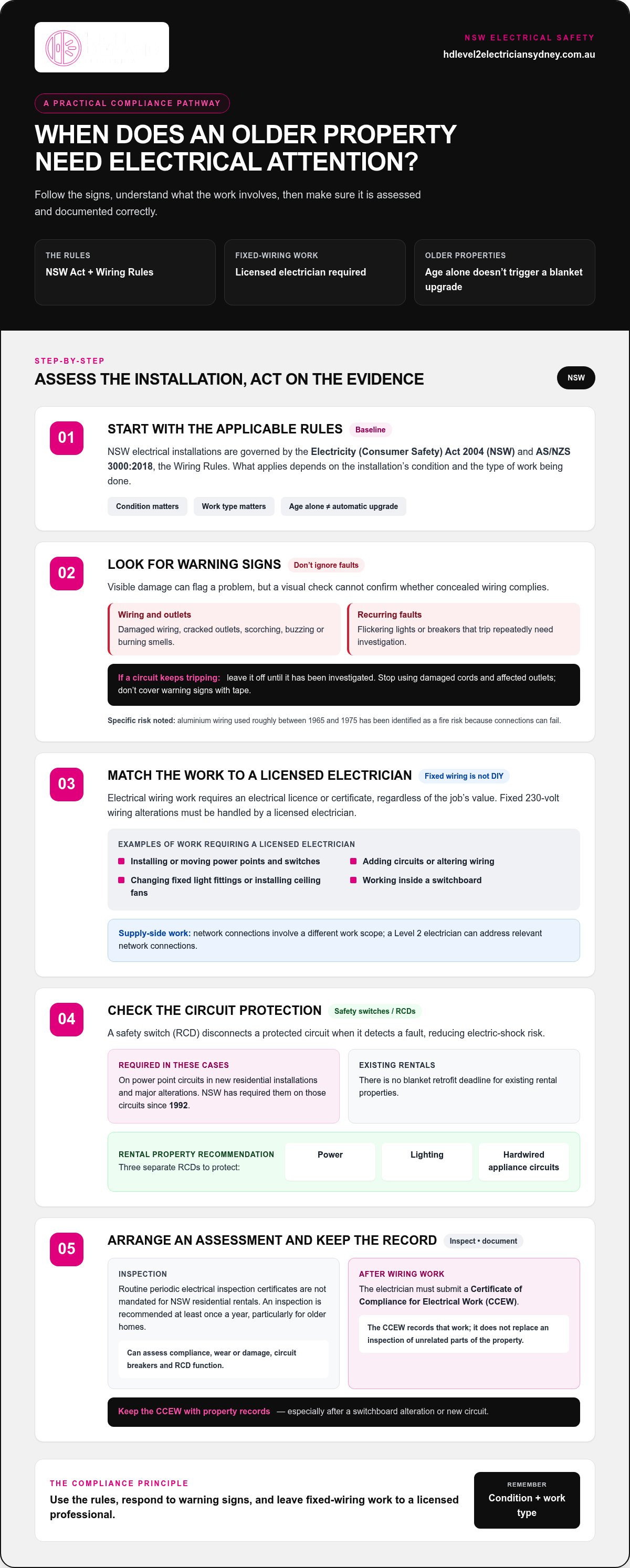
An upgrade may be needed when electrical work changes an installation, safety components fail or existing equipment is damaged. In NSW, the trigger depends on the work and the electrical system’s condition. New residential installations and major alterations require safety switches on power point circuits. An older property does not automatically face a blanket retrofit deadline for every existing circuit.
Renovations and extensions can change how a home uses electricity. Adding circuits or altering fixed wiring requires a licensed electrician, and major alterations bring safety-switch requirements for power point circuits. For example, a renovation that adds power points needs the circuit design and protection considered together. The electrician assesses the proposed work, existing wiring and protective components to determine what needs upgrading.
New electrical loads can prompt a review of supply capacity and switchboard condition. Adding an EV charger or other fixed equipment may require assessment of available capacity, circuit protection and the property’s supply arrangement. The equipment’s demand and the existing installation determine what work is appropriate. An upgrade is not automatic just because a home adds an appliance; the electrical system must be assessed against the proposed change.
Age and visible condition provide another warning. Ceramic-fuse switchboards without RCDs are common in Sydney homes built before 1990. Their presence alone doesn’t prove an immediate legal upgrade is required, but owners should understand the protection available and the condition of the board. Damaged wiring, heat marks, loose components or recurring faults call for assessment. A breaker or safety switch that trips repeatedly should be left off and investigated, not reset over and over.
Testing helps show whether safety components operate correctly. Homeowners are advised to test safety switches quarterly using the test button. The switch should trip and cut power to its protected circuit. If it does not operate, arrange professional attention. A switchboard inspection can also check circuit breakers, RCD function, wiring condition and signs of overheating, helping distinguish a faulty component from a wider installation issue.
Not every recommendation is a legal deadline. NSW has no blanket retrofit deadline requiring existing rental properties to install RCDs, and routine periodic electrical inspection certificates are not mandated for residential rentals. Landlords remain responsible for safe electrical installations. A proactive inspection can still identify deterioration before planned work, a tenancy change or a new load makes the issue more urgent.
Use inspection findings to match the cause with the right response: repair a faulty component, improve circuit protection or plan a broader upgrade if the installation’s condition or planned work requires it. Keep records of testing and electrical work, including the Certificate of Compliance for Electrical Work following wiring work. This documentation helps owners track changes and understand what remains functional.
Overloaded circuits and power points
A circuit can be overloaded when connected equipment demands more current than its wiring and protective devices can safely carry. A power board adds outlets, but it does not increase the capacity of the circuit behind them. Adding more plugs will not solve limited circuit capacity.
Look for patterns rather than treating each symptom as an isolated inconvenience. Flickering lights and frequent circuit trips may point to an underlying electrical issue. For example, if lights dim when several appliances are running, note which devices are on and which rooms are affected. This information helps an electrician assess the circuit, connected load and condition of its components.
If a circuit breaker trips repeatedly, leave it off and arrange an investigation rather than continually resetting it. Repeated trips can indicate overloading or another fault; resetting the breaker without finding the cause leaves the problem unresolved. Do not open a switchboard or try to repair fixed wiring yourself. Electrical wiring work in NSW must be handled by a licensed electrician.
Pay attention to power points that feel hot, are discoloured, make buzzing sounds or have cracked covers. Stop using a visibly damaged outlet and arrange a professional assessment. Tenants should promptly report the fault to the landlord or property manager, especially if lighting or essential appliances are affected. Keep the area clear rather than plugging equipment into a nearby point on the same circuit.
Renovations can change electrical demand. A new kitchen may add several high-use appliances, while a home office can add computers, printers and chargers to existing power points. An electrician can assess whether the circuit arrangement and protection suit the planned use. The response may involve redistributing loads, adding a circuit or repairing a fault, depending on the installation and equipment.
Use extension leads carefully. Unwind them fully before use, and do not use homemade cords. Do not treat an extension lead as a permanent substitute for a fixed power point. Stop using a damaged lead, plug or socket. Pull a plug by its body, not its cord, to reduce the risk of damage that could expose conductors or weaken the connection.
For owners, a useful record includes the affected room, appliances operating, symptoms, and whether a breaker tripped. Give those details to the electrician, then follow the findings and repair advice. If a property needs additional outlets or circuit changes during renovation, have the electrical layout assessed before work proceeds. Arrange an electrical assessment if recurring trips, flickering lights or damaged power points need attention.
High Demand Electrical: Level 2 ASP Electrical Services
High Demand Electrical provides Level 2 ASP Electrical Services for property owners dealing with supply-side electrical infrastructure work. Turn to this service when a property issue involves the connection between the electrical supply and the premises, rather than an appliance fault inside the home.
High Demand Electrical carries out Switchboard Upgrades for ageing or unsuitable switchboards. Relevant services also include Private Power Pole Installation and Tesla & Home EV Charger Installation. The appropriate work depends on the installation and the issue identified, so describe the property’s symptoms or planned upgrade when enquiring.
For help with a supply connection, switchboard concern or planned charger installation, contact High Demand Electrical to discuss the work.
Make your next electrical decision with confidence
Electrical compliance is easier to manage when each planned change is an opportunity to understand the property’s needs. Before arranging work, note what is changing, where it will happen and how the space will be used. Keep relevant electrical records together so the person assessing the work has useful context.
If you’re ensuring your property meets NSW electrical code requirements, make the next step clear: describe the concern or planned project and request an assessment of the electrical work involved. A defined scope helps separate immediate safety concerns from improvements that can be planned alongside future work.
High Demand Electrical can help with relevant electrical and infrastructure needs, including Level 2 ASP work, switchboard upgrades and private power pole installation. Share the details of your property and what you’re planning, then use the assessment to decide how to proceed.
Contact High Demand Electrical to discuss your property’s electrical requirements and take the next step with clarity.
Frequently Asked Questions
When Are Electrical Upgrades Legally Required?
In NSW, safety switches are required on power point circuits in new residential installations and major alterations. Changes to fixed wiring must be carried out by a licensed electrician. Existing rental properties do not face a blanket deadline to retrofit RCDs. For a renovation, the work being added and the existing installation’s condition determine which requirements apply. A new circuit, for example, can bring different compliance requirements from replacing a non-electrical fixture.
What Electrical Work Can You Do Yourself in NSW?
Don’t attempt work that alters fixed 230-volt wiring. Installing or moving power points and switches, changing fixed light fittings, adding circuits, installing ceiling fans and working inside a switchboard require a licensed electrician. Keep to tasks that don’t involve fixed wiring, such as using plug-in appliances as intended. If a job involves opening an electrical fitting or changing a connection, stop and arrange licensed help.
When should you stop and call an electrician?
Stop using an outlet or circuit and call an electrician if you notice a burning smell, scorch marks, buzzing, a hot power point or exposed wiring. Leave a circuit breaker or safety switch off if it trips repeatedly; do not keep resetting it to restore power. Flickering lights can also signal an underlying fault. Tell the electrician which rooms and appliances are affected and when the symptoms occur.
Which electrical standards and regulations apply to properties in NSW?
NSW electrical installations are governed by the Electricity (Consumer Safety) Act 2004 (NSW) and AS/NZS 3000:2018, known as the Wiring Rules. Together, they provide the legal and technical framework for electrical installation work. The applicable requirements depend on the work being done and the type of installation. For example, a new circuit or major alteration must be assessed against the relevant installation rules.
Where can I find a licensed electrician and verify their NSW licence?
Sydney property owners can contact High Demand Electrical on 0402 559 777. Its Electrical Contractor Licence is EC Licence 397193C. For Level 2 work, it is a Level 2 Accredited Service Provider (ASP), authorised for service line, metering and connection work for Ausgrid, Endeavour Energy and Essential Energy. Ask for the electrician’s licence details and verify the current licence with NSW Fair Trading before work begins.
Powering Your Needs with Expertise
If you’re looking for a reliable, experienced, and prompt electrician, look no further than High Demand Electrical. We cater to all your electrical needs, from routine maintenance to emergency repairs and complete system installations. Our skilled team is committed to providing professional service that ensures your electrical systems run smoothly. Whether it's a small task or a large project, give us a call today. Let us meet all your electrical demands with the quality and reliability you deserve.

