Electrician for Power Outage: Your Emergency Response Checklist
Did you know that over twenty percent of unplanned power disruptions in New South Wales are caused by equipment faults on the private side of the meter? While it is easy to assume a blackout is a network-wide issue, many Sydney residents find themselves in the dark because of a failure at their own point of attachment or consumer mains. When the lights flicker out and the fridge starts warming up, knowing exactly when to call an electrician for power outage support is the difference between a quick fix and a prolonged, dangerous emergency.
We understand the immediate stress that comes with a sudden loss of power, especially the fear of electrical hazards or the confusion over Ausgrid versus private responsibility. You need to know whether the fault lies with the network or if you are facing an infrastructure failure that requires a specialised Level 2 ASP. This expert checklist will guide you through the critical steps to identify your outage source and secure the right accredited specialist to restore your property safely. We will also explain how to ensure your repairs meet the latest NSW eCert compliance standards to avoid receiving unnecessary network defect notices.
Key Takeaways
• Identify whether a blackout is a network-wide issue or a private infrastructure failure by locating your property’s point of attachment and checking local outage maps.
• Determine exactly when to engage a Level 2 ASP electrician for power outage recovery, specifically for faults involving consumer mains or damaged overhead service lines.
• Prepare your property for a rapid emergency response by ensuring the specialist has unobstructed access to your meter box and switchboard while keeping the work area secure.
• Avoid recurring electrical failures and network defect notices by upgrading aging infrastructure, such as galvanised private poles, to meet current AS/NZS 3000 standards.
Immediate Safety Checklist: What to Do When the Lights Go Out
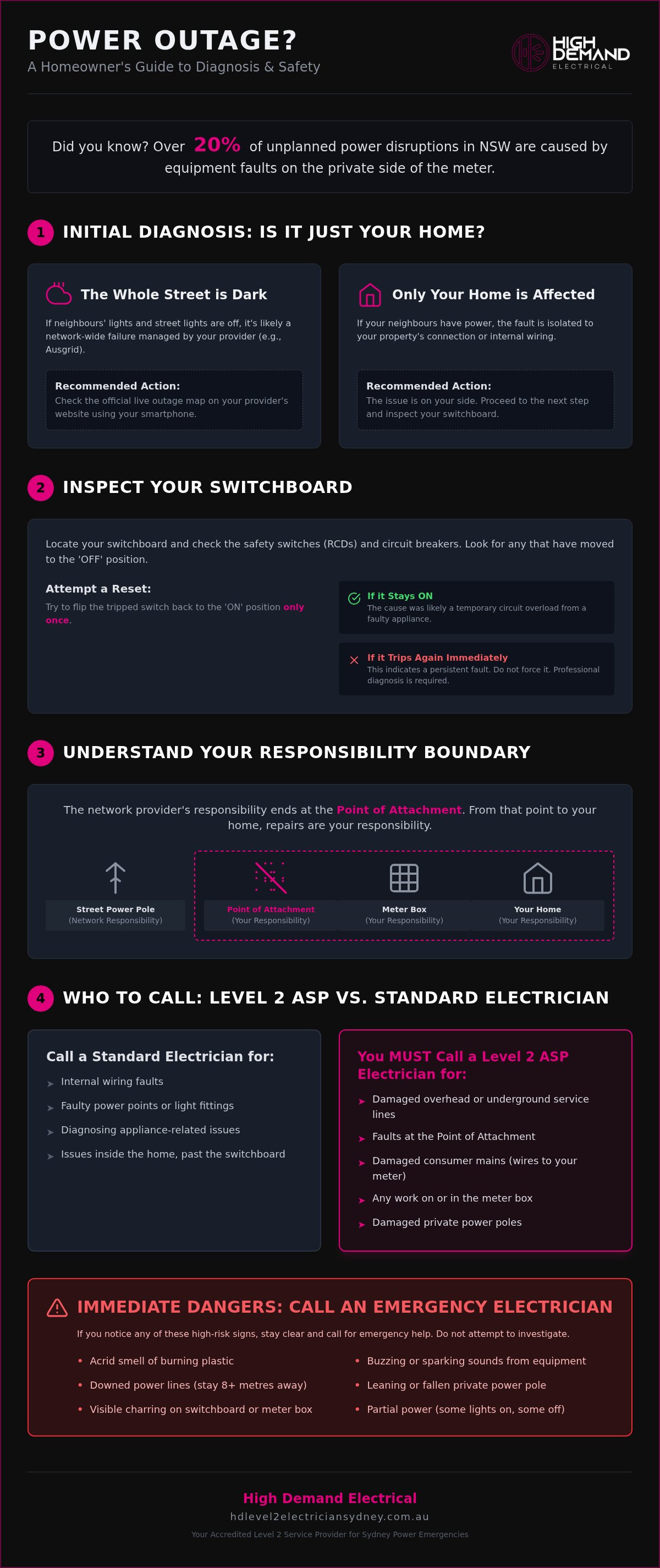
When the power cuts out unexpectedly, your first priority is safety and diagnosis. Start by checking your neighbours. If the street lights are off and the entire block is dark, you are likely looking at a network failure managed by Ausgrid or Endeavour Energy. However, if your property is the only one without power, the issue is internal or involves your specific connection to the grid. You should check the local outage maps on your smartphone to see if a known fault is already being serviced by the network provider. If your address isn't listed, the fault likely lies within your private infrastructure.
Next, locate your switchboard. Inspect the Safety Switches (RCDs) and circuit breakers. If a switch has tripped to the 'off' position, you may have a faulty appliance or a temporary circuit overload. Try to reset the switch once. If it trips immediately again, do not force it. This indicates a persistent fault that requires professional intervention. If the switches won't reset, or if you see visible damage like charred components, you must contact a qualified electrician for power outage diagnosis immediately. Standard electricians can handle internal wiring, but faults at the meter or the street connection require a Level 2 ASP.
Unplug sensitive electronics like computers, televisions, and charging devices. When power is restored, a sudden voltage spike can damage delicate internal components. This is a common cause of post-outage equipment failure in Sydney homes. Finally, perform a quick sensory check of the premises. If you detect a distinct acrid smell of burning plastic or hear buzzing and sparking near the meter box or the point of attachment, do not attempt to investigate further. These are signs of high-voltage electrical failure. In such cases, calling a specialised electrician for power outage resolution is the safest course of action to prevent an electrical fire.
Critical Safety Precautions
Electrical safety is non-negotiable during a blackout. Never touch your switchboard or any electrical component if you are standing in water or have wet hands, as this significantly increases the risk of a fatal shock. If you notice downed power lines or a private power pole leaning at a dangerous angle after a storm, stay at least eight metres away. Keep a high-quality torch with fresh batteries in an easily accessible central location so you aren't reliant on your phone's battery during a prolonged outage. Secure the area to ensure children and pets remain clear of any potential hazards.
Managing Your Food and Comfort
Preserving your food supply is a major concern during extended blackouts. Minimise the number of times you open the fridge and freezer doors; a closed fridge can keep food safe for approximately four hours, while a full freezer can maintain its temperature for up to 48 hours. Avoid using candles for light, as they present a significant fire hazard in dark, unfamiliar conditions. Opt for LED lanterns or headlamps instead. Additionally, take a moment to check on elderly neighbours or those reliant on medical equipment. If their life-support systems are compromised, contact emergency services immediately to arrange medical transport or backup power.
Diagnosing the Outage: Is it a Network Issue or a Private Fault?
Determining responsibility is the critical first step in any blackout. The 'Point of Attachment' rule defines the legal boundary where the network's liability ends and yours begins. This boundary is typically the bracket on your roof or the top of your private power pole where the street's service lines connect. If a fault occurs at this junction or within the consumer mains leading to your meter, the network provider will not perform the repair. You must engage a specialised Level 2 ASP electrician in Sydney to handle these high-voltage connections, as standard electricians lack the necessary accreditation to work on the grid-side of your installation.
Use the live outage maps provided by Ausgrid or Endeavour Energy on your mobile device. If your street is highlighted and the status is 'under investigation' or 'repairing,' the fault is likely on the network side. However, if your address is not listed and your neighbours have full power, the issue is isolated to your property's infrastructure. You may also encounter a 'Phase Failure' in three-phase homes. This occurs when one of the three incoming power lines fails, leaving you with partial power where some appliances work while others remain dead. This is a high-risk situation that requires an urgent electrician for power outage diagnosis to prevent damage to expensive three-phase motors or air conditioning units.
In some instances, a network technician may visit your property and issue a 'Defect Notice.' This official document states that your electrical installation is unsafe or non-compliant and may lead to an immediate disconnection from the grid. Common reasons include rotting private poles or UV-damaged consumer mains. Once a defect notice is issued, you are legally required to hire an authorised specialist to rectify the fault and lodge a Certificate of Compliance for Electrical Work (CCEW) through the NSW eCert portal. Ignoring these notices can lead to a permanent loss of power until the infrastructure is upgraded to current AS/NZS 3000 standards.
Network vs. Private Property Checklist
Network Issue
Streetlights are dark, multiple neighbours report no power, and the official outage map confirms a local grid fault.
Private Fault
Your neighbours have lights, your main switch remains in the 'on' position, or there is visible damage to your private power pole or point of attachment.
Mixed Fault
You are experiencing a 'brownout' or flickering lights. This often indicates a neutral fault or a phase issue at the connection point, which requires an immediate response from a specialised electrician for power outage resolution.
The Role of the Level 2 ASP
Standard electricians are restricted to working on the internal wiring behind your switchboard. They cannot legally touch the service lines, meters, or the point of attachment. High Demand Electrical specialises in this 'hidden' infrastructure that frequently causes outages during Sydney storms. Calling a general electrician for a network-side fault often results in double call-out fees, as they will simply tell you to contact a Level 2 ASP. We provide the specialised equipment and accreditation required to restore your connection directly to the street mains, ensuring your property remains compliant with all local distributor regulations.
When You Must Call a Level 2 ASP Electrician for a Power Outage
General electricians are highly skilled at repairing internal power points or lighting circuits, but they cannot legally disconnect your property from the Ausgrid or Endeavour Energy networks. If your blackout is caused by a fault before the main switchboard, you require a Level 2 Accredited Service Provider (ASP). Finding a specialised electrician for power outage repairs involving overhead lines or underground service mains is essential because these components carry high-voltage current directly from the grid. Attempting to use a non-accredited contractor for these tasks is not only illegal but also voids your building insurance and places your property at risk of fire.
Storm season in Sydney frequently results in fallen branches severing overhead service lines or pulling the point of attachment away from the fascia board. When this occurs, the network provider will often attend the site only to disconnect the power for safety, leaving you with a defect notice and no electricity. You must then engage a Level 2 specialist to reinstall the bracketry and reconnect the service. Similarly, if your smart meter fails or an electrical fire starts within the switchboard, a Level 2 ASP is the only professional authorised to pull the service fuses and safely isolate the property for emergency repairs.
Consumer Mains and Point of Attachment Failures
Consumer mains are the heavy-duty cables that act as the critical link between the street and your home's switchboard. Many older Sydney properties still rely on original wiring that has suffered decades of UV damage, causing the insulation to become brittle and crack. These degraded cables often fail during heatwaves when high air-conditioning loads cause the wires to expand and short circuit. If you notice smoke or buzzing at the point where the wires enter your roof, you need an emergency electrician for power outage restoration who is authorised to replace these high-capacity mains and lodge the required eCert compliance documentation.
Private Power Pole Emergencies
If you have a private power pole on your property, you are legally responsible for its structural integrity and safety. Many homeowners are surprised to learn that Ausgrid or Endeavour Energy will not repair or replace a pole that stands within private boundaries. Signs of imminent failure include a noticeable lean after heavy rain, visible rotting at the base of timber poles, or sparking insulators at the top. We specialise in rapid private power pole installation, replacing dangerous timber structures with durable, galvanised steel alternatives. This ensures your connection remains stable even during severe weather events and prevents the network from issuing a mandatory disconnection notice.
Once you have confirmed that the fault is private and requires a specialised electrician for power outage restoration, you must prepare your property for their arrival. Professional responders work most efficiently when they have immediate, unobstructed access to your electrical infrastructure. Seconds matter during an emergency, especially when dealing with high-voltage failures that could escalate into fire hazards. By following a structured preparation plan, you reduce the time our technicians spend on-site and ensure a smoother path to reconnection.
Start by clearing a path to your switchboard and electricity meter box. These are often located in garages, side passages, or behind garden foliage. If your meter box is locked, ensure the key is readily available or the padlock is removed. You should also gather your latest electricity bill; this document contains your National Metering Identifier (NMI). This unique 11-digit number is essential for our team to verify your connection details with Ausgrid or Endeavour Energy and to lodge the mandatory compliance paperwork required by the Building Commission NSW.
Safety is our primary concern during any emergency call-out. Ensure all pets are secured in a separate room or backyard, and keep children well away from the designated work areas. It is also helpful to document the exact timeline of the outage. Note whether you heard any loud popping sounds, smelled burning plastic, or experienced flickering lights prior to the total failure. These observations provide critical diagnostic clues that allow us to pinpoint the fault location more rapidly. If you are facing a total loss of power and need immediate assistance, contact our Level 2 ASP team to initiate a rapid response.
Speeding Up the Repair Process
Level 2 ASP work often involves heavy equipment or specialised vehicles like cherry pickers for overhead service line repairs. Please move any cars, trailers, or bins that might block access to your driveway or the area beneath your point of attachment. If your property uses underground consumer mains, ensure the technician can access the main switchboard without moving heavy storage items. Providing a clear three-metre radius around the work zone allows our team to deploy safety barriers and tools without delay.
What to Expect During the Visit
Upon arrival, our specialist will perform a comprehensive fault-finding sequence to isolate the dangerous area. Because we are authorised Level 2 providers, we can safely disconnect your property from the Sydney power grid to perform repairs on the service lines or meters. Once the fault is rectified, we will reconnect your power and conduct mandatory safety tests to ensure the installation complies with AS/NZS 3000 standards. Finally, we will lodge a Certificate of Compliance for Electrical Work (CCEW) through the NSW eCert portal, which is a legal requirement for all major electrical repairs as of July 2026.
Preventing Recurring Blackouts: Infrastructure Upgrades for Sydney Homes
While emergency repairs restore immediate service, recurring blackouts often signal that your home's infrastructure is struggling with modern demand. Sydney properties built more than thirty years ago were not designed for the simultaneous load of high-capacity air conditioning and electric vehicle charging. If you frequently find yourself calling an electrician for power outage issues, it is time to consider proactive infrastructure upgrades. Transitioning from reactive maintenance to strategic modernisation ensures your property remains safe and compliant with the latest AS/NZS 3000 standards.
One of the most effective ways to prevent future failures is replacing old galvanised or timber private poles with durable, galvanised steel alternatives. Steel poles offer superior structural integrity against the high winds and heavy rain common in New South Wales. Additionally, increasing your amperage capacity allows your system to handle modern technology like home EV chargers without tripping the main breaker. For overhead lines, installing Tiger Tails provides a vital visual warning for contractors and helps prevent accidental contact with branches, reducing the risk of storm-related disruptions.
Modernising Your Switchboard
Old porcelain fuses are a leading cause of localised power outages because they lack the rapid response times of modern circuit breakers. These antiquated systems often overheat under high loads, creating a significant fire risk within your meter box. A comprehensive Switchboard Upgrade Sydney involves installing Residual Current Devices (RCDs) that disconnect power in milliseconds if a fault is detected. Modern smart meters also play a crucial role, as they provide digital data that helps network providers identify supply issues faster than traditional analogue systems.
Proactive Infrastructure Maintenance
You should not wait for a total blackout to assess the health of your electrical connection. Annual inspections of your private poles and consumer mains allow us to spot UV damage or corrosion before they lead to a catastrophic failure. If you are planning construction or tree trimming near your service lines, we recommend installing Tiger Tails to ensure the safety of all workers on-site. Securing a professional Level 2 ASP inspection is the most reliable way to ensure your home is grid-ready for the regulatory changes coming in 2026. Taking these steps today prevents the high cost and stress of calling an emergency electrician for power outage repairs during the next major Sydney storm.
Securing Your Power Supply Against Future Failures
Navigating a blackout requires more than just waiting for the grid to return. You now have the knowledge to distinguish between a street-wide outage and a private failure at your point of attachment. Only a fully accredited Level 2 ASP is authorised to handle the high-voltage repairs involving your consumer mains or private power poles. By preparing your property and understanding the legal boundaries of the network, you can significantly reduce downtime and ensure your home remains compliant with NSW safety regulations.
If your lights are out and the fault lies on your side of the meter, you need a rapid responder who understands the specific requirements of the Sydney metropolitan area. You shouldn't risk your safety with unaccredited contractors or wait hours for a generalist who cannot legally fix the problem. Our team provides the specialised expertise required for emergency response involving private poles and mains across the entire city. We ensure every repair is lodged correctly through the eCert portal to maintain your property's compliance.
Restore your power now with Sydney's Level 2 ASP experts at High Demand Electrical. We are ready to secure your property and get your life back on track with professional, compliant electrical solutions. Stay safe and stay connected.
Frequently Asked Questions
Why is my power out but my neighbours have lights?
This indicates an isolated fault within your property's electrical infrastructure rather than a network-wide blackout. It is often caused by a tripped safety switch (RCD), a blown service fuse at the point of attachment, or a failure in your consumer mains. You should check your switchboard first. If the breakers are in the 'on' position but you still have no power, you require an authorised specialist to investigate the grid connection.
Can a standard electrician fix a power outage caused by street wires?
No, a standard electrician is legally restricted to working on the internal wiring behind your main switchboard. Any fault involving street wires, overhead service lines, or the connection to the Ausgrid or Endeavour Energy network requires a Level 2 ASP. These accredited specialists have the specific training and authority to disconnect and reconnect your property to the grid, ensuring all work complies with strict distributor safety protocols.
How much does an emergency Level 2 electrician cost in Sydney?
Costs for an emergency response depend on the time of the call-out and the technical complexity of the infrastructure failure. Factors such as the need for specialised machinery, like a cherry picker for overhead lines, or the replacement of a private power pole will influence the final invoice. It is standard practice for specialists to charge an initial call-out fee plus hourly rates for diagnostic work and any required materials to restore safety.
What is a 'Defect Notice' and why did Ausgrid leave one on my door?
A Defect Notice is an official warning issued by a network provider like Ausgrid when they identify a safety hazard or non-compliant component on your property. This commonly occurs after a storm if your point of attachment is damaged or your private pole is rotting. You are legally required to engage a Level 2 ASP to rectify the specified faults within a set timeframe to avoid a mandatory disconnection from the grid.
Is it safe to turn my main switch back on after a storm?
You should only attempt to reset your main switch if there is no visible damage to your electrical infrastructure. If you notice downed lines, water ingress in the meter box, or a leaning private pole, leave the switch off and stay clear of the area. Attempting to restore power to a compromised system can lead to electrical fires or fatal shocks. Contact an electrician for power outage assessment to ensure the system is safe for energisation.
How long does it take for a Level 2 electrician to restore power?
Most localised power restorations are completed within two to four hours once the technician arrives on-site. Simple tasks like replacing a blown service fuse or resetting a smart meter are relatively quick. However, complex infrastructure repairs, such as replacing damaged consumer mains or installing a new private power pole, may take a full day. Our priority is always to isolate the fault immediately and restore a safe connection as efficiently as possible.
Does insurance cover emergency electrical repairs for power outages?
Many Australian building insurance policies cover repairs for electrical damage caused by lightning strikes, storms, or electrical fusion. However, coverage often excludes failures caused by gradual wear and tear or lack of maintenance, such as a rotting timber pole. You should check your Product Disclosure Statement (PDS) and document the damage with photos. We provide the necessary compliance certificates required by insurers to process these emergency claims.
What happens if my private power pole falls over?
A fallen private power pole is a high-risk emergency that requires immediate isolation from the network. If this occurs, stay at least eight metres away from any downed lines and contact an authorised Level 2 ASP immediately. We will coordinate with the network provider to safely disconnect the supply before removing the old structure and installing a durable steel replacement pole. This process ensures your property meets current NSW safety standards for reconnection.
Powering Your Needs with Expertise
If you’re looking for a reliable, experienced, and prompt electrician, look no further than High Demand Electrical. We cater to all your electrical needs, from routine maintenance to emergency repairs and complete system installations. Our skilled team is committed to providing professional service that ensures your electrical systems run smoothly. Whether it's a small task or a large project, give us a call today. Let us meet all your electrical demands with the quality and reliability you deserve.