Electrical Upgrade for Old Sydney Homes: 2026 Guide
Is your charming Federation terrace or mid-century bungalow actually a fire risk waiting for a single modern appliance to push it over the edge? Many homeowners across the harbour city cherish the character of their heritage properties, yet they live with the constant frustration of tripping circuit breakers and the underlying fear of brittle VIR cabling or outdated porcelain fuses. If you're planning an electrical upgrade for old house sydney installations, you've likely realised that yesterday’s wiring cannot support today’s high-draw demands like induction cooktops or rapid EV chargers.
We understand the stress of receiving an Ausgrid or Endeavour Energy defect notice and the urgency of making your home safe for your family. This 2026 guide provides a clear roadmap to modernising your infrastructure, ensuring your property is both reliable and fully compliant with the latest Electricity Supply (Safety and Network Management) Regulation 2026. You'll learn how a professional Level 2 ASP can transition your home from a Victorian-era relic to a future-ready powerhouse. We will cover everything from switchboard modernisations and consumer mains upgrades to the mandatory new digital eCert reporting requirements that now govern every Sydney renovation project.
Key Takeaways
• Identify the critical risks associated with legacy Vulcanised Indian Rubber (VIR) cabling and porcelain fuses that are no longer fit for modern power demands.
• Understand why a comprehensive electrical upgrade for old house sydney residences often requires modernising the switchboard with RCD safety switches to prevent electrocution and fires.
• Learn the difference between general electrical work and the "heavy lifting" infrastructure upgrades, such as consumer mains, that only a Level 2 ASP can legally perform.
• Discover how to future-proof your heritage property for high-draw technology like induction cooktops and Tesla or home EV chargers by transitioning to 3-phase power.
• Navigate the resolution of Ausgrid or Endeavour Energy defect notices through professional site audits and mandatory digital compliance procedures.
Why Your Heritage or Mid-Century Sydney Home Needs an Electrical Upgrade
Sydney is famous for its stunning Federation terraces and mid-century bungalows, but beneath the ornate plasterwork and heritage timber often lies an infrastructure crisis. If you live in an older suburb like Paddington, Marrickville, or Mosman, your property’s wiring was likely designed for a different era. Decades ago, a single light circuit and a few power points for a radio or toaster were sufficient. Today, as we fill our homes with modern technology, the average household load has increased exponentially. Attempting an electrical upgrade for old house sydney installations is no longer just a matter of convenience; it is a critical safety requirement to prevent catastrophic failure.
The Risk of Outdated Wiring and Porcelain Fuses
The most significant threat in Sydney’s older housing stock is Vulcanised Indian Rubber (VIR) cabling. This type of wiring, common in homes built before the 1950s, features a rubber insulation that becomes incredibly brittle as it ages. Over time, the rubber cracks and flakes away, leaving live copper conductors exposed inside your walls or ceiling cavities. This deterioration often occurs out of sight, meaning you won't know there is a problem until a short circuit causes a fire. While modern materials follow strict global electrical wiring standards, VIR is a legacy hazard that requires urgent removal.
Compounding this risk are "re-wireable" porcelain fuses. These devices were designed to protect the wiring from melting, not to protect people from electrocution or sensitive electronics from surges. They trip far too slowly compared to modern RCDs. Many Sydney homeowners also find that insurance providers are now asking specific questions about switchboard types and wiring age. Failing to modernise can lead to denied claims or significantly higher premiums because insurers recognise the high probability of an electrical fire in unrenovated heritage homes.
Meeting the Demands of a 2026 All-Electric Lifestyle
The way we power our lives has fundamentally changed. With the NSW government’s shift toward all-electric homes and the gradual phasing out of residential gas connections, your home’s "heart" is under more pressure than ever. A standard mid-century 30-amp or 40-amp supply simply can't cope with 2026 essentials such as:
• High-capacity ducted air conditioning and heat pumps.
• Induction cooktops that require dedicated high-current circuits.
• Home offices with multiple monitors, servers, and high-speed networking gear.
• Electric vehicle (EV) charging stations.
If you notice flickering lights when the fridge kicks in, warm power point covers, or a faint metallic burning smell, your system is already failing. These are not minor inconveniences. They are signs that your current circuits are being pushed beyond their physical limits. Scheduling a professional electrical upgrade for old house sydney residents is the only way to ensure your family remains safe while enjoying the comforts of a modern, high-tech home.
Modernising the Heart: Switchboard Upgrades and Safety Switches
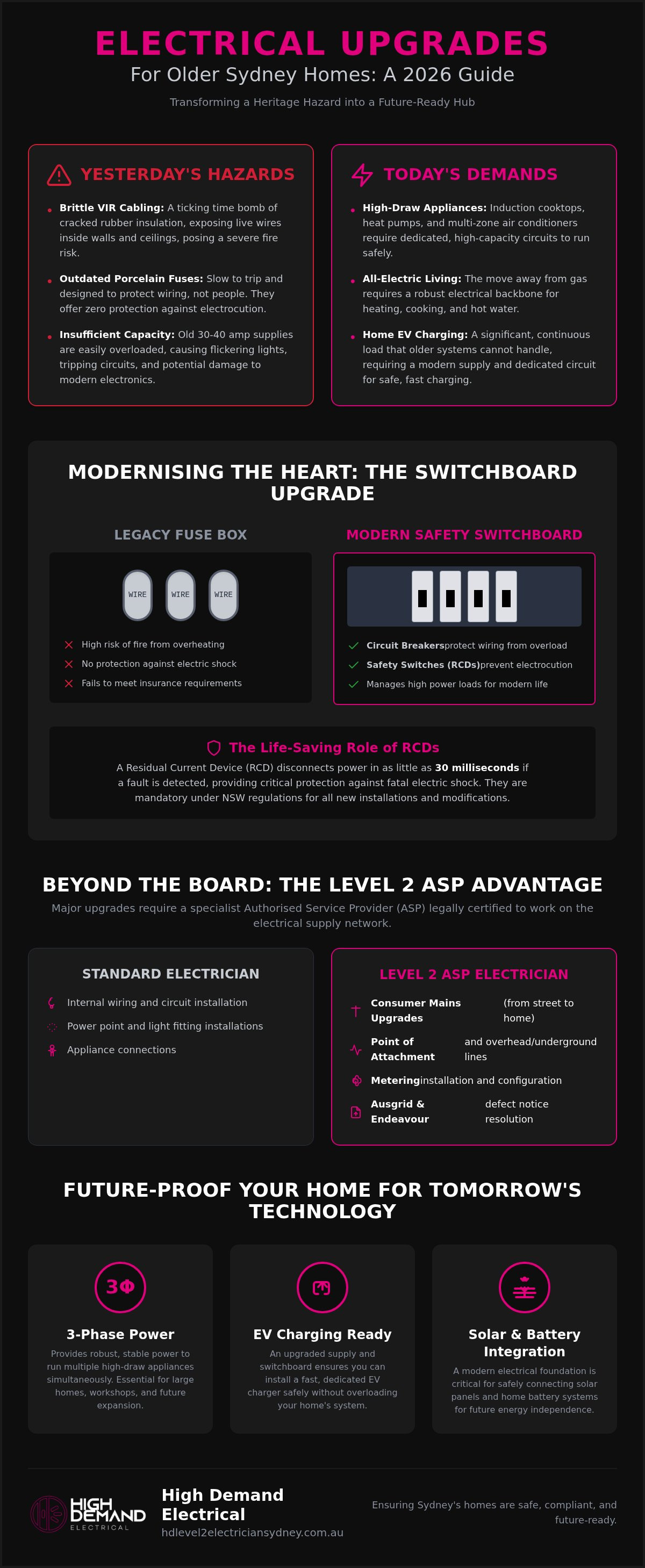
The switchboard is the command centre of your home’s electrical infrastructure. In many older Sydney residences, this "heart" is still pumping power through outdated ceramic fuses that were never intended to handle the load of a 21st-century lifestyle. A professional switchboard upgrade involves removing these antiquated components and installing a modern DIN-rail system equipped with circuit breakers and Residual Current Devices (RCDs). This modernisation ensures your home can manage higher currents without the risk of overheating or constant circuit failure. If you are planning an electrical upgrade for old house sydney installations, the switchboard is your first point of intervention.
The Mandatory Role of Safety Switches (RCDs)
While a circuit breaker is designed to protect your home’s wiring from melting, a safety switch is designed to save your life. An RCD constantly monitors the flow of electricity through a circuit. If it detects a leakage to earth, such as current flowing through a person, it disconnects the power in as little as 30 milliseconds. This rapid response is the most effective way to prevent electrocution and electrical fires. Under the mandatory NSW wiring rules, RCD protection is now required on all final sub-circuits during any significant electrical renovation or upgrade project.
Smart Meters and Energy Monitoring
As of 2026, the transition to digital smart meters is no longer optional for most Sydney households. Replacing the old "spinning disk" analogue meters with a digital unit allows for real-time energy tracking and access to more competitive time-of-use tariffs. This physical replacement is often the catalyst for a wider infrastructure review. If your existing meter panel is made of asbestos or is too small for modern equipment, you may need to look at your Consumer Mains in Sydney to ensure the "arteries" feeding your board are up to the task.
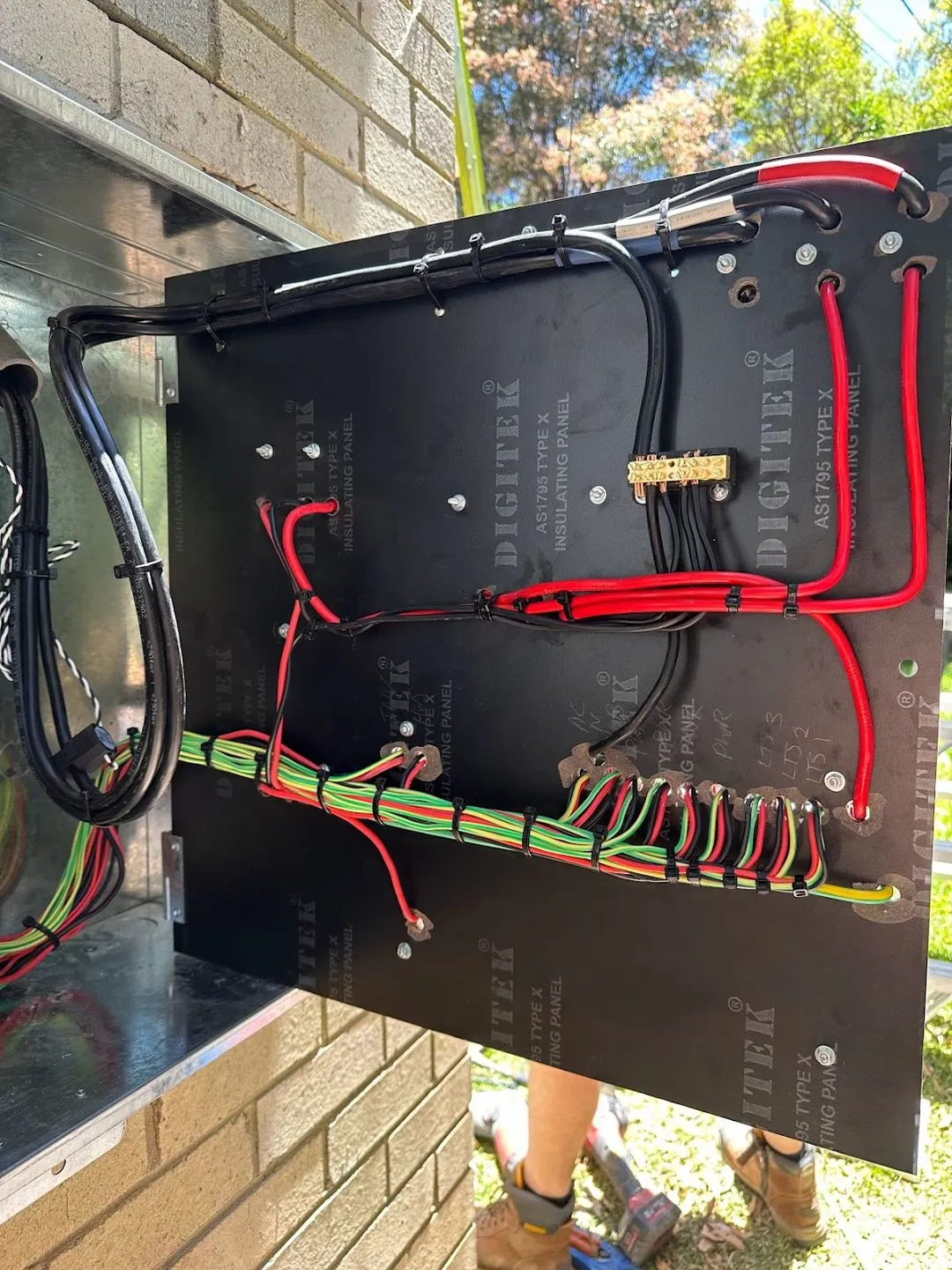
Organising your new board is just as vital as the hardware itself. A modern installation features clear, professional labelling and dedicated circuits for high-load areas like ducted air conditioning or induction cooktops. This prevents the "tripping" problem where a single kettle or hair dryer shuts down half the house. If your current board looks like a chaotic mess of wires and fuses, a professional switchboard modernisation is the only way to guarantee safety and reliability for your family.
Beyond the Board: Upgrading Consumer Mains and Point of Attachment
If the switchboard is the heart of your home, the consumer mains are the arteries. In a typical electrical upgrade for old house sydney projects, many owners make the mistake of stopping at the switchboard. However, if your supply cables from the street are undersized, your new board will still struggle under modern loads. Older Sydney homes often have mains cables rated for just 32 or 40 amps. When you install modern ducted air conditioning or an induction cooktop, these old cables can overheat, posing a severe fire risk behind your walls or in your ceiling cavity.
The Point of Attachment (POA) is the physical bracket on your house where the network provider's wires meet your property. Over decades, these brackets can rust or pull away from the fascia, creating a structural and electrical hazard. During a comprehensive renovation, you must decide whether to maintain an overhead connection or transition to an underground supply. While undergrounding is more expensive, it removes the visual clutter of wires and provides a more stable connection during Sydney’s severe storm seasons.
The Level 2 ASP Advantage for Street Connections
A standard electrician is not legally permitted to work on the network side of your installation. To upgrade your consumer mains or repair a Point of Attachment, you require an Accredited Service Provider (ASP) Level 2. This is a critical distinction. We handle the heavy lifting of disconnecting your home from the Ausgrid or Endeavour Energy grid, upgrading the cables, and safely reconnecting the power. This process ensures your infrastructure meets the current load requirements for a 2026 lifestyle, especially if you plan on adding high-draw technology like EV chargers.
Private Power Poles and Overhead Safety
Many Sydney properties, particularly in suburbs with larger blocks, rely on private power poles to bring electricity from the street to the house. These poles are the property owner's responsibility to maintain. Rusted steel or rotting timber poles are common triggers for network defect notices. We provide a comprehensive Private Power Pole Guide for Sydney Homeowners to help you understand your maintenance obligations and avoid unexpected disconnections.
Safety is paramount during any infrastructure work. If you have overhead lines near trees or construction zones, we utilise Tiger Tails. These highly visible yellow and black tubes provide a visual warning to workers and residents, preventing accidental contact with live lines. Whether you are upgrading for safety or capacity, managing these street-side connections is the only way to guarantee a truly future-ready home.
Future-Proofing Your Home for EV Charging and Solar Integration
Transitioning to an electric vehicle is a logical step for many Sydney residents, but your heritage home’s infrastructure may not share that enthusiasm. Most mid-century properties were built with a total supply capacity that is lower than what a single rapid charger requires. When you attempt an electrical upgrade for old house sydney properties without considering these future loads, you risk a system that fails the moment you plug in your car. A Level 2 charger is a high-demand appliance that necessitates a strategic approach to your home’s power distribution.
Integrating solar panels and battery storage also adds complexity. Your switchboard must be capable of handling bidirectional power flow, managing the energy you generate as well as the energy you consume. In many older Sydney suburbs, the existing infrastructure is simply too brittle to manage these sophisticated energy cycles. Modernising now ensures your home remains a functional asset rather than a technical bottleneck as Sydney moves toward a net-zero future.
Preparing for an EV Charger Installation
A Tesla Wall Connector or universal EV charger typically requires a power output between 7kW and 22kW. In an unrenovated home, this load can easily exceed the entire property's current limit, causing the main fuse to blow. A dedicated circuit is non-negotiable for charging safety. It prevents the charger from competing with your oven or air conditioner for current, which reduces the risk of overheating your consumer mains. For a detailed breakdown of technical requirements, consult our EV Charger Installation Sydney: 2026 Homeowner Guide.
Single Phase vs. Three Phase Power Upgrades
If you plan to run a large ducted air conditioning system alongside a fast EV charger, a single-phase supply will likely reach its physical limit. Upgrading to 3-phase power is the gold standard for future-proofing. While single-phase power provides one live wire, 3-phase provides three, effectively tripling your potential load capacity. This allows you to charge your vehicle at the maximum 22kW rate while simultaneously running every other high-draw appliance in your home without stress.
The cost-benefit of performing a 3-phase upgrade during a renovation is significant. It is far more efficient to install 3-phase consumer mains and a compatible switchboard while walls are open or landscaping is underway. This proactive investment prevents the need for expensive remedial work later when your power needs inevitably grow. If you are ready to modernise your property’s infrastructure, contact us for a professional 3-phase power upgrade to ensure your heritage home is ready for the next fifty years of technology.
Navigating the Upgrade Process with a Sydney Level 2 ASP
Executing an electrical upgrade for old house sydney properties is a complex infrastructure project that requires precise coordination between the homeowner, the specialist electrician, and the network provider. It's not just about running new wires; it's about navigating the rigorous regulatory environment of NSW. A professional site audit is the first non-negotiable step. Without a thorough physical inspection of your consumer mains, point of attachment, and switchboard, any quote you receive is merely guesswork. We identify hidden bottlenecks before they become emergency failures during the installation phase, ensuring your project stays on track and within budget.
Resolving Electrical Defect Notices
Receiving a defect notice from Ausgrid or Endeavour Energy can be a high-stress event. These notices are typically triggered by safety hazards like low-hanging service lines, rotting private power poles, or outdated meter enclosures that no longer meet current standards. If you don't resolve these issues within the specified timeframe, the network provider has the authority to disconnect your power to protect the grid. As a Level 2 ASP, we act as your professional liaison. We manage the technical resolution and the administrative reporting, ensuring your property remains connected and compliant with all local safety protocols.
During the physical upgrade, you should expect a planned power outage. This is a necessary safety protocol while we perform the "heavy lifting" on your mains and board. Most residential upgrades are completed within a single day, but the legal paperwork lasts a lifetime. From July 1, 2026, all electrical work in NSW requires a Certificate of Compliance for Electrical Work (CCEW) to be submitted through the mandatory Building Commission NSW eCert portal. Handwritten or PDF forms are no longer accepted. This digital record is your proof of compliance, which is essential for maintaining your home insurance coverage and property value.
Choosing the Right Partner for Your Infrastructure Upgrade
Selecting a partner for your infrastructure project shouldn't be based on the lowest price alone. "Cheap" quotes often ignore the necessary street-side upgrades or fail to account for the mandatory digital reporting now enforced across Sydney. A general electrician cannot legally perform the connection work required for a full modernisation. By choosing a specialised Level 2 ASP, you're investing in long-term safety and absolute regulatory compliance. We provide the technical expertise and the rapid response required to handle complex heritage or mid-century upgrades with minimal disruption. Contact High Demand Electrical for a comprehensive site audit and upgrade quote.
Secure Your Sydney Heritage Home for the Future
Modernising a heritage or mid-century property is a significant infrastructure project that extends far beyond simple repairs. By addressing legacy risks like VIR cabling and upgrading to a modern switchboard with RCD protection, you ensure your family’s safety while meeting the strict 2026 NSW electrical standards. An electrical upgrade for old house sydney residences also provides the necessary capacity for high-draw technologies, including Tesla EV chargers and induction cooktops, transforming an outdated system into a robust, future-ready powerhouse.
High Demand Electrical specialises in the technical "heavy lifting" required for these complex projects. As a Level 2 ASP Accredited provider, we offer 24/7 emergency infrastructure response and unparalleled expertise in Sydney heritage properties. We handle every detail, from street-side consumer mains upgrades to mandatory digital compliance reporting, giving you absolute peace of mind that your home is in expert hands.
Don't wait for a defect notice or a system failure to compromise your home’s security. Get Your Sydney Home Upgrade Quote from High Demand Electrical today. Your home’s character is worth preserving; ensure its electrical system is built to last another generation.
Related Services


Powering Your Needs with Expertise
If you’re looking for a reliable, experienced, and prompt electrician, look no further than High Demand Electrical. We cater to all your electrical needs, from routine maintenance to emergency repairs and complete system installations. Our skilled team is committed to providing professional service that ensures your electrical systems run smoothly. Whether it's a small task or a large project, give us a call today. Let us meet all your electrical demands with the quality and reliability you deserve.