Consumer Mains in Sydney: The Essential Guide to Your Home’s Power Arteries
Have you ever wondered why your lights flicker the moment the ducted air conditioning kicks in or why a standard electrician isn't legally allowed to touch the cables connecting your home to the street? For many Sydney residents, the first time they truly consider their consumer mains is when an intimidating defect notice from Ausgrid or Endeavour Energy arrives in the letterbox. It's a high-stakes situation that leaves you questioning the safety of your property and the reliability of your entire power supply.
We understand that dealing with complex grid connections feels overwhelming, especially when your family's safety is on the line. This guide provides the professional clarity you need to navigate these critical infrastructure requirements. You'll discover how to identify dangerous, outdated VIR cabling and why upgrading to modern XLPE standards is the only way to future-proof your home for EV charging and solar transitions. We'll also outline the specific role of a Level 2 ASP in resolving defects and ensuring your electrical "arteries" can safely handle the heavy-duty demands of a modern Australian lifestyle.
Key Takeaways
• Understand why consumer mains are the critical link between the Sydney grid and your home's switchboard, and why their condition determines your property's safety.
• Learn why only an accredited Level 2 ASP is legally authorised to perform these high-risk upgrades and manage the necessary network provider paperwork.
• Identify the warning signs of deteriorating cables and discover the immediate steps required to resolve an official defect notice from Ausgrid or Endeavour Energy.
• Discover how modern infrastructure upgrades, such as three-phase power, support high-demand additions like Tesla EV chargers and ducted air conditioning.
• Explore the essential compliance requirements within the NSW Service and Installation Rules that protect your property from electrical fire hazards.
What are Consumer Mains? Understanding Your Sydney Home’s Power Supply
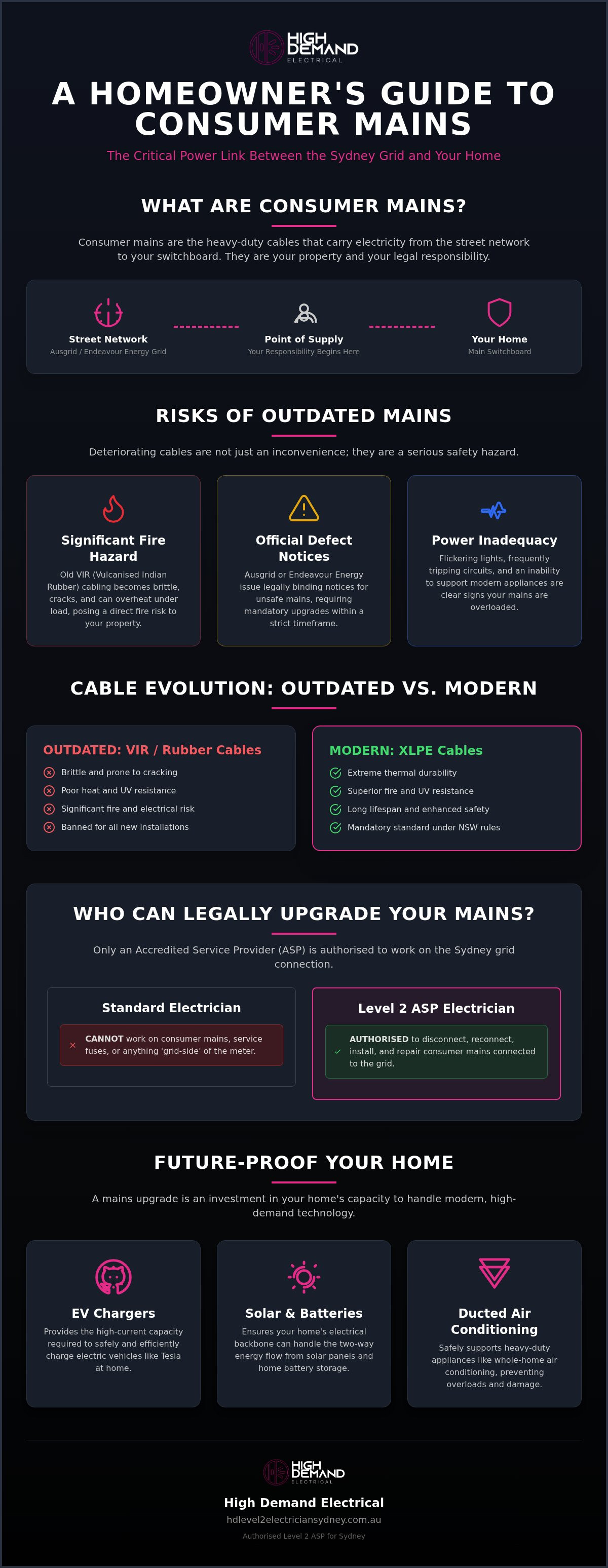
Every Sydney property relies on a heavy-duty electrical connection that acts as the primary gateway for power. These cables, known as consumer mains, are the high-capacity conductors that carry electricity from the street network directly to your main switchboard. While it is easy to assume the utility provider owns everything up to your meter, the reality is different. To understand What are Consumer Mains? you must first understand the concept of the Point of Supply.
The Point of Supply is the specific location where the network provider's responsibility ends and yours begins. In an Australian context, these cables are called "consumer" mains because they are the legal property and responsibility of the homeowner. If these cables fail, degrade, or become a fire hazard, the cost of repair or replacement falls on the property owner, not Ausgrid or Endeavour Energy. The physical path usually starts at a Point of Attachment on your roof or a street turret and terminates at your main switchboard, which houses your meters and safety switches.
Overhead vs. Underground Consumer Mains
Sydney’s diverse architectural history means consumer mains configurations vary significantly between suburbs. In older areas like the Inner West or Northern Beaches, overhead connections are the standard. These involve cables swinging from a street pole to a Point of Attachment (POA) on your home's fascia or a private power pole. While cost-effective to install, they remain vulnerable to UV degradation, heavy storms, and falling branches.
Conversely, underground mains are the modern standard for new developments and major renovations. These cables run through heavy-duty conduits from a street "green pillar" or turret directly into the base of your meter box. Underground systems offer superior aesthetic appeal and are shielded from the elements, though they require specialised excavation and trenching if the conduit is ever breached by tree roots or water ingress.
The Role of the Level 2 ASP
It is a common misconception that any licensed electrician can repair or install consumer mains. Under the NSW Service and Installation Rules, your standard "sparky" is legally barred from performing this work because it involves working on the "grid-side" of the electrical system. This work is high-risk and requires live-line handling capabilities that only an Accredited Service Provider (ASP) possesses.
High Demand Electrical operates as a Level 2 ASP, meaning we are authorised to disconnect and reconnect your home from the Sydney grid. We bridge the gap between the network provider and your internal wiring. Whether you are responding to an emergency defect notice or upgrading your capacity for a new renovation, our accreditation ensures the work meets the strict safety protocols required by NSW regulators. We handle the technical installation and the complex compliance paperwork, providing a seamless resolution to what would otherwise be an intimidating regulatory hurdle.
NSW Standards and Regulatory Requirements for Consumer Mains
Compliance in Sydney isn't just about ticking boxes; it's about protecting your property's structural integrity. The 2026 edition of the NSW Service and Installation Rules (SIRs) provides the technical blueprint for every grid connection in the state. These rules work alongside AS/NZS 3000, the national "Wiring Rules," to ensure your property doesn't become a hazard to the wider network. Adhering to these standards is mandatory for any consumer mains work, as the network providers, Ausgrid and Endeavour Energy, maintain strict oversight of all grid-side infrastructure.
The requirements often vary depending on your specific network provider. If you live in the Eastern Suburbs or Northern Sydney, Ausgrid's specific service rules apply. In Western Sydney, Endeavour Energy has its own set of technical quirks regarding point-of-attachment heights and cable protection. Modern regulations now mandate the use of Cross-Linked Polyethylene (XLPE) insulation for all new installations. Unlike older rubber or PVC coatings that crack under the harsh Sydney sun, XLPE is designed for extreme thermal durability and fire resistance, making it the industry benchmark for safety.
Cable Sizing: Why 6mm is No Longer Enough
Many older Sydney homes still operate on 6mm or 10mm copper mains. This was sufficient for a few light bulbs and a radio, but it's dangerously inadequate for today's high-consumption appliances. As your electrical demand increases, these thin cables struggle to carry the current, leading to overheating and rapid insulation failure. 16mm XLPE is the gold standard for Sydney residential upgrades in 2026, providing the thermal resilience required for high-load modern homes. Upgrading to this size ensures your cables stay cool even when the air conditioner and oven are running simultaneously.
Compliance and the NOSW (Notice of Service Work)
Once an upgrade is complete, it must be officially recorded with the state authorities. A Notice of Service Work (NOSW) is the legal document that certifies your new installation meets all current NSW safety standards. This document is essential for your property's legal record and is often required by insurance companies to prove the home is safe. It's common for electricity meter upgrades to trigger a mandatory review of your existing cables, as the network provider won't install a smart meter if the incoming mains are substandard. Ensuring your documentation is handled by an accredited Level 2 ASP ensures your home remains fully compliant with the latest 2026 regulations.
Risks of Outdated Mains: Fire Hazards and Defect Notices
Receiving an official defect notice from Ausgrid or Endeavour Energy is a stressful experience for any Sydney homeowner. These notices aren't mere suggestions; they are legal directives stating that your consumer mains no longer meet the safety standards required to remain connected to the grid. If the identified faults aren't rectified by an accredited specialist within the specified timeframe, the network provider has the authority to disconnect your power entirely to protect the surrounding infrastructure. This high-stakes situation often arises during routine meter upgrades or after a neighbour reports a sparking connection at your Point of Attachment.
Environmental factors in Sydney play a significant role in cable degradation. For overhead connections, decades of exposure to intense UV radiation causes the protective insulation to crack and peel away. Once the copper is exposed, moisture from rain leads to corrosion and arcing. For underground systems, the primary threat is water ingress within aging conduits. When water sits against old PVC or rubber insulation for years, it eventually breaches the barrier, causing a short circuit that can melt the cable and potentially ignite a fire within the meter box or wall cavity.
Financial risks extend far beyond the cost of the repair itself. If a fire is traced back to a known electrical fault or an ignored defect notice, insurance companies may have grounds to deny your claim. Maintaining your home's "power arteries" is a critical part of your property's risk management strategy. Investing in a timely upgrade prevents the chaos of an emergency power outage and ensures your family remains protected from the hidden dangers of electrical arcing.
The VIR Cable Crisis in Older Sydney Homes
If your home was built before or during the 1950s, you might be sitting on a "ticking time bomb" known as Vulcanised Indian Rubber (VIR) cabling. This outdated insulation was the industry standard for decades, but it has a finite lifespan that has long since expired. Over time, the rubber loses its elasticity and becomes incredibly brittle. In many Sydney meter boxes, you can see the visual signs of VIR degradation, such as black, crumbly rubber that flakes away at the slightest touch to reveal bare, live copper. This creates an extreme fire risk, as the exposed wires can easily arc against the metal enclosure or timber mounting boards.
Signs Your Consumer Mains are Struggling
You don't always need a defect notice to know your system is failing. Your home often provides subtle warnings before a total failure occurs. Watch for these red flags:
• Lights that flicker or dim noticeably when high-wattage appliances like the kettle, dryer, or air conditioner start up.
• The distinct, acrid smell of burning plastic or "fishy" odours near the meter box or main switchboard.
• Main circuit breakers that trip frequently, especially during Sydney heatwaves when the demand for cooling is at its peak.
If you notice any of these symptoms, it's vital to have a professional inspection immediately. Our team acts as an authoritative rapid responder for homeowners facing these safety concerns, ensuring your consumer mains are restored to a safe, compliant state before a minor issue becomes a major emergency.
Future-Proofing Your Home: EV Chargers, Solar, and Air Con
The electrical demands of a Sydney household in 2026 are nearly double what they were thirty years ago. In 1996, a standard home supported a fridge, a television, and basic lighting. Today, the "baseload" includes smart home servers, high-speed internet infrastructure, and sophisticated climate control systems that operate continuously. If you are planning a major kitchen renovation or installing ducted air conditioning, your existing consumer mains will likely reach their thermal limit. These heavy-duty additions draw significant current, and old wiring simply wasn't designed to support the load of a modern "all-electric" lifestyle.
Upgrading to 3-phase power is the most effective way to ensure your property can handle these increasing requirements. While a standard single-phase connection relies on one live wire, 3-phase power utilises three separate conductors to triple your available capacity. This is no longer just for industrial workshops; it's becoming the standard for large Sydney residences to prevent lights from flickering when the oven or dryer kicks in. For a technical deep dive into these requirements, see our Level 2 ASP infrastructure guide.
Consumer Mains and EV Charger Installation
Installing a Tesla Wall Connector or a high-speed universal charger is a major electrical event for any property. Many older Sydney homes still operate on 40-amp or 60-amp consumer mains, which were never intended to manage a continuous 32-amp draw from an electric vehicle alongside other household appliances. Before the installation begins, an ASP must calculate your "Total Connected Load" to ensure the system won't overload. If your mains are undersized, your charger may be "throttled" to significantly slower speeds to prevent tripping the main circuit breaker. Upgrading your infrastructure now ensures you can charge at maximum efficiency without compromising your home's safety.
Solar and Battery Integration
Energy independence requires infrastructure that can handle bi-directional flow. A large solar array doesn't just draw power; it pushes high volumes of electricity back into the grid, creating thermal stress on aging cables. With over 400,000 battery installations recorded under the Small-scale Renewable Energy Scheme since July 2025, the shift toward self-sufficiency is accelerating across NSW. These modern systems require the installation of smart meters, which frequently serve as the catalyst for a mandatory mains review. If you're planning to transition away from gas and toward a fully electric home, you can organise a professional load assessment with our team to ensure your cables are ready for the challenge.
The Upgrade Process: What to Expect from a Level 2 ASP
Upgrading your consumer mains is a high-precision operation that requires meticulous planning and strict adherence to NSW safety protocols. It isn't a simple task for a general electrician; it's a regulated procedure that involves working directly with the Sydney power grid. High Demand Electrical manages this entire lifecycle, ensuring your property transition is seamless, safe, and fully documented for insurance and compliance purposes.
The process begins with a comprehensive site assessment. We don't just look at the cables; we examine the structural integrity of your Point of Attachment and the current load capacity of your switchboard. Once we've determined the optimal path for your new cables, we handle all the bureaucratic heavy lifting. This includes liaising with network providers like Ausgrid or Endeavour Energy to secure the necessary work permits and ensuring every aspect of the project aligns with the latest Service and Installation Rules.
The core of the installation involves a "Cut and Reconnect" phase. During this window, we manage a temporary, controlled power outage. Our team works with speed and precision to disconnect the old, degraded mains at the point of supply and install the new high-capacity infrastructure. After the physical installation is complete, we conduct rigorous safety testing before restoring power. Finally, we issue a Certificate of Compliance for Electrical Work (CCEW), which serves as your legal guarantee that the installation meets the 2026 standards.
Overhead to Underground Conversions
Many Sydney homeowners are choosing to "underground" their consumer mains during major renovations to improve property aesthetics and eliminate the risk of storm-related damage. This process involves professional trenching and the installation of a private pillar or turret near the property boundary. If your home has a long driveway or complex terrain, our private power pole guides provide essential context for choosing the right infrastructure for your specific layout.
Switchboard Modernisation
It's rare to perform a mains upgrade without a simultaneous switchboard upgrade. High-capacity cables require modern protection to function safely. We ensure your new mains connect to high-grade RCBOs and safety switches that provide instantaneous protection against electrical leakage and overloads. This holistic approach ensures your entire electrical system, from the street to the power point, is synchronised for maximum safety. Secure your property’s future and resolve any outstanding safety concerns by booking a professional Level 2 ASP assessment with High Demand Electrical today.
Secure Your Property’s Electrical Foundation
Your property’s safety and capacity are only as reliable as the cables feeding them. We've established that identifying dangerous VIR insulation and upgrading to modern 16mm standards is essential to protect your home from fire risks and ensure compliance with the 2026 NSW Service and Installation Rules. Whether you're responding to an urgent defect notice or proactively preparing for a high-speed EV charger installation, your consumer mains represent the single most important link in your electrical system.
Don't leave your infrastructure to chance or settle for unauthorised work. As accredited Level 2 ASP specialists, we provide the expert oversight needed to manage complex network requirements across Sydney. We're ready to act as your authoritative rapid responder, handling everything from network provider paperwork to high-precision technical installations. Get a Professional Consumer Mains Assessment from High Demand Electrical and enjoy the peace of mind that comes with a future-proofed home. Your journey toward a safer, more efficient power supply starts with a single professional inspection.
Frequently Asked Questions
What is the difference between consumer mains and submains?
Consumer mains are the primary cables that carry the total electrical load from the street network to your main switchboard. Submains are secondary cables that distribute power from that main switchboard to other locations on your property, such as a detached garage, a pool shed, or a granny flat. While consumer mains are the responsibility of the homeowner, they are the specific cables that connect your property directly to the Sydney grid.
Do I need a Level 2 electrician to replace consumer mains in Sydney?
Yes, it is a legal requirement in New South Wales to use an Accredited Service Provider (ASP) for any work involving consumer mains. Standard electricians are only licensed to work on the internal wiring of your home and are strictly prohibited from touching the grid-side connection. High Demand Electrical holds the necessary Level 2 accreditation to safely disconnect and reconnect your property from the Ausgrid or Endeavour Energy networks.
How much does it cost to upgrade consumer mains in NSW?
The total cost of an upgrade is determined by several technical factors, including the length of the cable run and whether the installation is overhead or underground. Underground upgrades often involve additional labour for trenching through soil or concrete, while overhead installations depend on the height and condition of your Point of Attachment. Because every Sydney property has a unique layout, we provide a detailed assessment to determine the specific scope of work required.
What happens if I ignore an electrical defect notice for my mains?
Failure to act on a defect notice will result in the mandatory disconnection of your power supply by the network provider. Ausgrid and Endeavour Energy issue these notices when they identify a safety hazard that poses a risk to the grid or your property. Beyond the immediate loss of electricity, ignoring these notices leaves you with a significant fire hazard and may void your home insurance policy in the event of an electrical fire.
How long does a consumer mains upgrade take to complete?
A standard residential upgrade is usually completed within four to eight hours. This timeframe covers the removal of the old cables, the installation of the new 16mm XLPE infrastructure, and the final mandatory safety testing required for certification. If your project involves complex underground trenching or the installation of a private power pole, the process may take longer, but we always work to minimise the duration of your power outage.
Can I upgrade my mains from overhead to underground?
Yes, you can convert an overhead connection to an underground system to improve your property's aesthetics and eliminate the risk of storm damage. This conversion requires the installation of a private pillar or turret at your boundary and the laying of a protective conduit for the consumer mains. This is a common choice for Sydney homeowners during major renovations as it removes unsightly sagging wires from the front of the home.
Will I lose power during the consumer mains installation?
You will experience a planned power outage while our Level 2 ASP team performs the "cut and reconnect" phase of the installation. We must isolate your home from the street grid to ensure the work is performed safely and in compliance with NSW regulations. We coordinate these outages in advance to minimise disruption, and for most standard residential properties, the power is typically restored within a few hours.
What size consumer mains do I need for a 3-phase EV charger?
16mm XLPE cables are the modern standard required for 3-phase EV charger installations in 2026. This cable size provides the necessary thermal resilience to handle the continuous, high-current draw of a fast charger alongside your home's other electrical demands. Using undersized cables for a 3-phase system is a major safety risk and can lead to overheating, which is why we strictly follow the current NSW Service and Installation Rules for all high-load upgrades.
Powering Your Needs with Expertise
If you’re looking for a reliable, experienced, and prompt electrician, look no further than High Demand Electrical. We cater to all your electrical needs, from routine maintenance to emergency repairs and complete system installations. Our skilled team is committed to providing professional service that ensures your electrical systems run smoothly. Whether it's a small task or a large project, give us a call today. Let us meet all your electrical demands with the quality and reliability you deserve.