Circuit Breaker vs Safety Switch: What Sydney Homeowners Need to Know
Written by Chris · Licensed Level 2 ASP Electrician · Licence 397193C · Published 17 July 2026
What is the difference between a circuit breaker and a safety switch? A circuit breaker protects your home's wiring from overload and short circuits, while a safety switch, also called an RCD, protects people from electric shock by detecting current leakage and cutting power in a fraction of a second. Many Sydney switchboards still mix the two unevenly, which matters because one of them protects your house and the other protects your family.
⚡ Quick Answers: Circuit Breaker vs Safety Switch
- What does each one protect? A circuit breaker protects wiring and appliances; a safety switch protects people from electric shock.
- How do I tell them apart? A safety switch has a small Test (T) button on the front. A plain circuit breaker does not.
- Does one safety switch cover my whole home? No. It only protects the circuit it is fitted to, not every circuit on the board.
- What does NSW law require? AS/NZS 3000 (Clause 2.6.3.2.2) requires safety switch protection on all final subcircuits in a domestic installation, and any switchboard alteration or replacement must bring existing circuits up to that standard too.
- Can I have both in one device? Yes, an RCBO combines circuit breaker and safety switch protection in a single unit.
Circuit Breaker vs Safety Switch: The Core Difference
Circuit breakers and safety switches sit side by side in your switchboard and both cut power when something goes wrong, but they do completely different jobs. A circuit breaker protects your home's wiring: when too much current flows through a circuit, because too many appliances are running at once or there is a short circuit or fault, the breaker disconnects that circuit before the wiring overheats and potentially starts a fire. It is protecting the house, not the people inside it.
A safety switch, or Residual Current Device (RCD), is designed specifically to protect people from electric shock. It monitors the current flowing through a circuit and watches for any imbalance between the live and neutral wires. If current starts flowing somewhere it should not, such as through a person who has touched a live wire, the safety switch detects that leakage in a fraction of a second, typically around 0.03 seconds, and shuts off power to that circuit fast enough to prevent serious injury.
Put simply: circuit breakers stop your house catching fire, and safety switches stop you getting electrocuted. Both matter, and neither can do the other's job.
Key Differences at a Glance
- What it protects: circuit breaker protects wiring and appliances; safety switch protects people.
- What triggers it: circuit breaker responds to overload or short circuit; safety switch responds to current leakage.
- How fast it reacts: circuit breaker in a fraction of a second; safety switch around 0.03 seconds, faster than a heartbeat.
- How to identify it: safety switches carry a small Test (T) button; circuit breakers do not.
- Rating: circuit breakers are rated in amps (10A, 16A, 20A); safety switches are rated in milliamps of leakage current, typically 30mA.
What Does NSW Law Require?
AS/NZS 3000 (Clause 2.6.3.2.2) requires additional protection by safety switches with a maximum rated residual current of 30 milliamps on all final subcircuits in a domestic electrical installation. Where a switchboard is altered or replaced, that requirement extends to bring the existing circuits up to the same standard. Many older homes, particularly those built before 1991, still have circuit breakers with no safety switches at all, or only partial coverage on some circuits, simply because they were wired before this requirement existed for every subcircuit.
Landlords in NSW have obligations too, since rental properties must comply with minimum electrical safety standards and tenants are entitled to a safe electrical system. If you are unsure whether a rental property has adequate safety switch coverage, see our post on electrical safety inspections for Sydney homes.
Does One Safety Switch Cover the Whole Home?
No, and this is one of the most common misconceptions Sydney homeowners have. A single safety switch only protects the circuit it sits on. If your board has one safety switch on the power point circuit but plain circuit breakers on everything else, your lighting, oven, air conditioning and hot water circuits are all left unprotected from electric shock. In a modern or fully rewired home you should see safety switches, or RCBOs, covering every circuit on the board.
Can You Have Both in the Same Device?
Yes. An RCBO (Residual Current Circuit Breaker with Overload protection) combines both functions in a single device, protecting people from shock and wiring from overload at once. Modern switchboard upgrades typically use RCBOs across every circuit, which simplifies the board while giving complete protection without separate devices for each function.
How to Tell What You Have
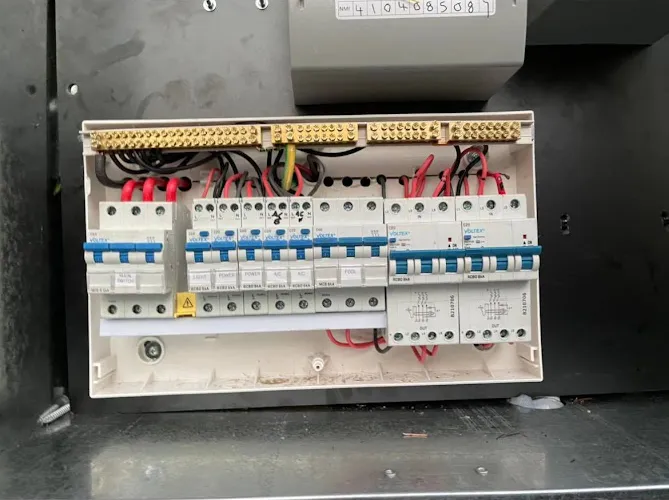
Open your switchboard, usually the grey or cream box near your meter, garage or laundry, and look at each switch. One with a small button labelled T or Test is a safety switch. A plain switch with no test button is a circuit breaker. A switch with a test button that is also rated in amps is likely an RCBO, the combined device. If you are unsure what you are looking at, do not guess. Have a licensed electrician check your board and confirm adequate protection on every circuit.
Testing Your Safety Switch
Test your safety switches every quarter. Press the Test button, and the switch should trip immediately to the OFF position, cutting power to that circuit. Flick it back to ON to restore power. If it does not trip when tested, or trips but will not reset, the device may be faulty and should be checked by a licensed electrician promptly, since a faulty safety switch provides no protection in a real emergency. A simple habit that works well: test your safety switches whenever your electricity bill arrives.
What If Your Safety Switch Keeps Tripping?
Frequent tripping, where the switch cuts power on its own without you pressing Test, usually means current leakage somewhere on that circuit, from a faulty appliance, damaged wiring, moisture in a fitting, or a failing device. It is the safety switch doing its job. See our detailed guide on why your safety switch keeps tripping for step by step help identifying the cause.
What Does It Cost to Add Safety Switches in Sydney?
Adding a safety switch to a single circuit with a spare slot already available typically costs $150 to $300 including labour. Upgrading to RCBOs across a full board, on a typical Sydney home with 8 to 12 circuits, commonly runs $600 to $1,500 depending on the board's age and circuit count. A full switchboard replacement, where the board is old, cramped or below current standards, typically runs $1,200 to $3,000 for a standard residential switchboard, with RCBOs on every circuit as standard. These are indicative figures only. A licensed electrician can inspect your board and give a firm quote once they see what is actually there. See our detailed guide to safety switch installation in Sydney for what the job looks like on the day.
How High Demand Electrical Helps
High Demand Electrical is a licensed local team, not a call centre, servicing homes and businesses across Sydney. Chris holds licence 397193C and has completed hundreds of switchboard inspections and upgrades across the city, from full rewires of homes with outdated fuse boards to targeted safety switch additions on a single circuit. If you are unsure whether your home has the right protection in place, we can inspect your switchboard and tell you exactly what is missing.
Circuit Breaker vs Safety Switch FAQs (Sydney)
Can I replace a circuit breaker with a safety switch myself?
No. All work inside a switchboard in NSW, including replacing circuit breakers or adding safety switches, must be done by a licensed electrician. It is illegal to do this yourself regardless of DIY skill, and unlicensed work is also uninsured.
How do I know if my safety switch is actually working?
Press the Test button on the front of the device. It should trip immediately to OFF. If it does not move, or trips but will not reset, the device is faulty and needs replacing. Test every safety switch every three months.
My safety switch trips when it rains. Is that normal?
It is a recognisable pattern rather than normal behaviour. Moisture getting into an outdoor light fitting, a garden power point or damaged wiring can cause leakage that trips the switch. See our post on safety switches tripping after rain for what to check.
Is it worth upgrading to RCBOs, or is a separate safety switch enough?
Both protect against electric shock. The advantage of RCBOs is that each circuit is independently protected, so a fault on one, say your oven, trips only that circuit rather than a whole group at once. For most Sydney homes doing a switchboard upgrade, RCBOs are the preferred choice.
Book a Switchboard Inspection in Sydney
Call High Demand Electrical on 0402 559 777 to get your switchboard checked. A short site assessment confirms exactly what protection you have and what, if anything, needs adding, whether that is a single safety switch addition or a full switchboard upgrade.
Related Services

Powering Your Needs with Expertise
If you’re looking for a reliable, experienced, and prompt electrician, look no further than High Demand Electrical. We cater to all your electrical needs, from routine maintenance to emergency repairs and complete system installations. Our skilled team is committed to providing professional service that ensures your electrical systems run smoothly. Whether it's a small task or a large project, give us a call today. Let us meet all your electrical demands with the quality and reliability you deserve.