Car Park Lighting: Australia L2 Checklist for Managers & Engineers
Australian car park lighting compliance runs on three main documents: the AS/NZS 1158 series for illuminance and photometric performance, AS/NZS 4282:2023 for glare and obtrusive light control, and AS/NZS 2293.1 for emergency lighting. Add AS/NZS 60598 for luminaire performance and AS/NZS 3000 for wiring safety. Expect maintained lux levels of roughly 5 to 10 lx in general bays, 10 to 20 lx at entrances and drive aisles, and higher targets in enclosed structures, though every design should be checked against the relevant AS/NZS part and local council requirements before sign-off.
TL;DR:
- Compliance requires adherence to multiple AS/NZS standards, including AS/NZS 1158 for lighting levels, AS/NZS 4282 for glare control, and AS/NZS 2293 for emergency lighting.
- Typical maintained lux levels are 5-10 lx in general bays, 10-20 lx at entrances and drive lanes, with higher levels necessary in enclosed or underground garages.
- Proper glare mitigation, luminaire choice, and mounting height are critical to ensure lighting effectiveness and prevent spill onto neighboring properties.
- Councils demand compliance evidence such as photometric plans, spill assessments, and pre-approved luminaire lists before granting approval.
- Regular audits with calibrated instruments, correct measurement grids, and thorough documentation are essential for maintaining ongoing compliance and addressing common faults efficiently.
Table of Contents
- Car park lighting standards Australia: which documents apply
- Illuminance and uniformity: the numbers that matter
- Design decisions that separate a compliant car park from a risky one
- What councils and road authorities expect on top of the standards
- Running a compliance audit: measurements and paperwork
- Lighting, wildlife and the environment
- Practitioner notes: common faults and practical fixes
- Get your car park lighting audited by a certified Level 2 electrician
- Standards and agency pages worth bookmarking
- Sources
- FAQ
Car park lighting standards Australia: which documents apply
Property managers auditing an existing car park, or engineers designing a new one, need to know which slice of the AS/NZS library actually governs the job. It’s not one document. It’s a stack of them, each covering a different piece of the puzzle.
AS/NZS 1158 is the backbone standard for lighting roads and public spaces, and several of its parts apply directly to car parks:
- AS/NZS 1158.1.1 covers vehicular traffic lighting, relevant to driving lanes and ramps.
- AS/NZS 1158.2 addresses pedestrian area lighting, useful for walkways and entry points.
- AS/NZS 1158.3.1 sets out pedestrian lighting for lower-risk categories, often referenced for open surface lots.
- AS/NZS 1158.6 deals with luminaire and lamp performance testing.
Local public lighting specifications, including the ACT’s MITS 12 Public Lighting standard, build directly on the 1158 series and require compliance evidence before a luminaire gets near a pole.
AS/NZS 4282:2023 governs the control of obtrusive light, the standard councils lean on hardest during development approval. If your car park lighting spills onto neighbouring residential windows or throws glare across a road, this is the document that decides whether you pass or fail.
Round out the set with AS/NZS 2293.1 for emergency and exit lighting, AS/NZS 60598 for luminaire construction and test reporting, and AS/NZS 3000 (the Wiring Rules) for the electrical installation itself. Miss any one of these and a compliance report has a hole in it.
Illuminance and uniformity: the numbers that matter
Lux, not footcandles, is the unit Australian designers and certifiers work in. Every photometric report should be expressed that way, and any American guidance referencing footcandles needs converting before it goes anywhere near a council submission.
Typical maintained illuminance ranges sit around 5 to 20 lx depending on the zone, with enclosed and undercover garages often needing higher figures because there’s no ambient skylight to fall back on. General open-lot parking bays with low pedestrian activity can sit toward the bottom of that band, while driving lanes, entrances and ramps need to be brighter to support driver reaction time and hazard perception.
| Car park zone | Typical maintained illuminance | Notes |
|---|---|---|
| General parking bays (open lot, low activity) | 5–10 lx | Lower end acceptable where activity and pedestrian traffic are minimal |
| Driving lanes and vehicle circulation | 10–20 lx | Higher end for busy entrances and merge points |
| Pedestrian walkways and entry points | 10–20 lx | Align with AS/NZS 1158.3.1 pedestrian categories |
| Enclosed or undercover garage driving lanes | Often higher, commonly referenced at elevated levels in some guidance | Confirm exact figure against the applicable AS/NZS part |
| High-security or high-risk areas | Upper end of relevant band | Councils may specify additional requirements |
Pro Tip: Don’t design to the average lux figure alone. A car park can hit its average target while leaving dark pockets near columns or stairwells that fail uniformity checks and feel unsafe to anyone walking through them at night.
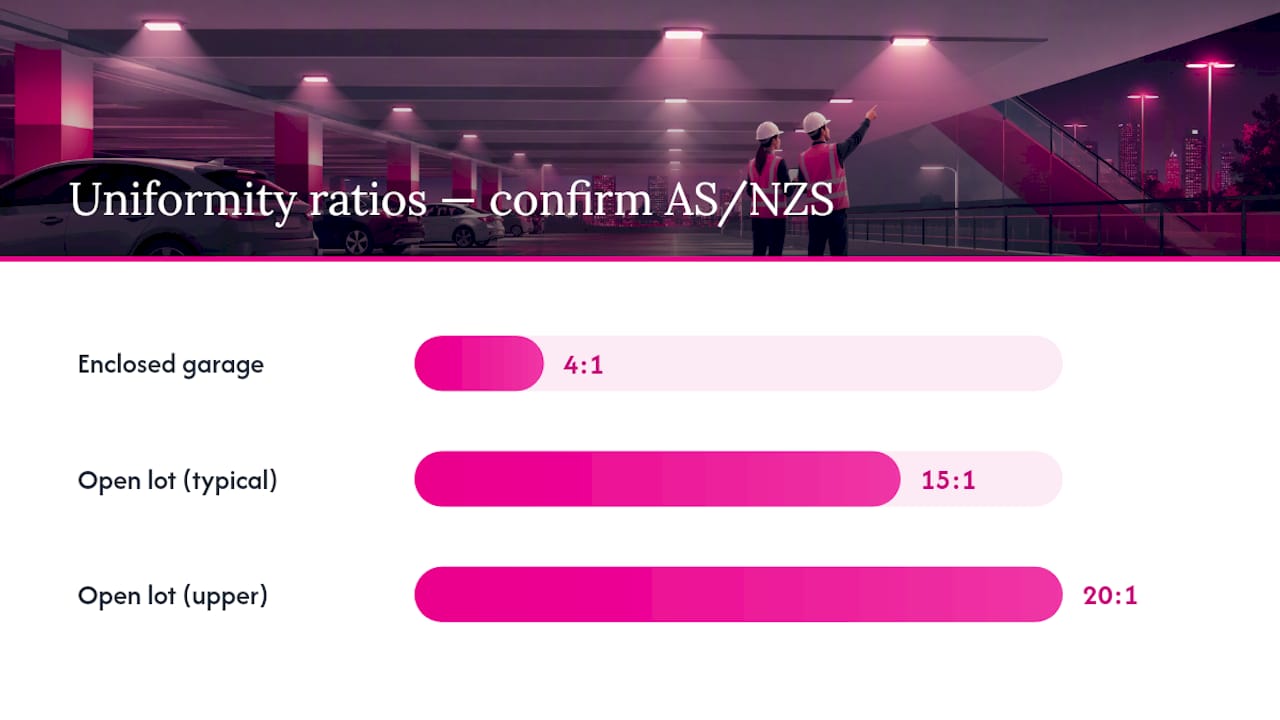
Uniformity is where a lot of designs quietly fall over. Industry guidance commonly used by Australian designers, including IES RP-20, points to average-to-minimum ratios around 4:1 for enclosed garages and maximum-to-minimum ratios in the order of 15:1 to 20:1 for open lots, varying with activity level. These figures are advisory rather than mandated Australian law, so reconcile them against the relevant AS/NZS 1158 part and any local council code before locking in a layout.
Design decisions that separate a compliant car park from a risky one
Getting the lux numbers right is only half the job. Glare, luminaire selection and mounting height decide whether the lighting actually does its job once it’s installed.
Glare control comes straight from AS/NZS 4282. Full cut-off or semi cut-off luminaires, correct aiming angles, and shielding on boundary-facing fixtures stop light spilling into adjoining properties or blinding drivers as they turn into a driveway. Councils treat obtrusive light complaints seriously, and a photometric plan that ignores spill limits gets sent back.
Luminaire selection matters just as much:
- Choose an IP rating suited to outdoor or undercover exposure, typically IP65 or higher for open-air fixtures.
- Confirm surge protection is built in or added, particularly for fixtures on exposed poles.
- Check CMS (central management system) compatibility if the site anticipates dimming or fault reporting.
- Ask suppliers for test reports against AS/NZS 60598 and AS/NZS 1158.6, not just a marketing datasheet.
Colour temperature in the 4000K to 5000K range is common practice for car parks. It renders colour well enough for CCTV identification and gives pedestrians a clearer sense of their surroundings than warmer, yellow-toned light. Finally, specify initial lumen output with headroom. Lumen depreciation over a luminaire’s life means a fixture that just scrapes the lux target on day one will fail uniformity checks well before its rated service life ends, so build a maintenance factor into the design from the outset.
What councils and road authorities expect on top of the standards
AS/NZS compliance gets you most of the way there, but local authorities routinely layer their own technical requirements on top, and skipping this step is one of the most common reasons approvals stall.
Councils typically ask for a photometric plan, a light-spill assessment, and confirmation that proposed luminaires sit on a pre-approved list. The reasoning is straightforward: pre-approved fixtures already have documented photometric and compliance data on file, which speeds up assessment and removes guesswork from maintenance later on.
Two examples worth knowing:
- The NSW Public Lighting Code sets out obligations around design, ownership and maintenance responsibilities for public lighting assets, and interacts with AS/NZS 1158 for performance criteria.
- The ACT’s MITS 12 specification maintains a pre-approved luminaire list tied directly to AS/NZS 1158, and requires documented equivalence evidence for any substitute fixture.
Proposing an equivalent luminaire late in a project is a common way to lose weeks. Confirm approvals with the relevant council or road authority early, and clarify upfront whether the site owner or the road authority carries maintenance responsibility once the lighting is commissioned.
Running a compliance audit: measurements and paperwork
An audit is only as good as the measurement discipline behind it. Get the grid wrong and every subsequent calculation is wrong with it.
- Set a measurement grid at the height and spacing specified by the applicable AS/NZS 1158 part, and take vertical illuminance readings at key points like entrances and pedestrian crossings, not just horizontal readings across the floor.
- Use a calibrated lux meter, ideally a Class B or better photometric instrument, and record calibration dates alongside your readings.
- Calculate uniformity using both average-to-minimum and maximum-to-minimum ratios, comparing the results against the applicable guidance for that car park type.
- Photograph problem zones, particularly near structural columns, stairwells and boundary fences where shadows commonly form.
- Apply a maintenance factor that accounts for lamp lumen depreciation and dirt accumulation so the audit reflects realistic performance over the luminaire’s service life, not just day-one output.
Pro Tip: Keep every audit’s raw data, not just the summary report. If a council or certifier queries a result months later, you want the original grid readings and photos on file, not a reconstructed guess.
Deliverables for a certifier or council typically include the photometric report, luminaire test certificates referencing AS/NZS 60598 and 1158.6, wiring compliance documentation under AS/NZS 3000, and a forward maintenance plan. A certified electrical compliance service can pull these together into one package rather than leaving a property manager to chase four separate contractors.
Lighting, wildlife and the environment
Car park lighting doesn’t stop at the boundary fence, and Australian regulators increasingly treat light spill as an environmental issue, not just a nuisance one. Obtrusive light spilling into bushland, waterways or tree canopy can disrupt nocturnal wildlife, including bats, possums and native birds that rely on darkness for foraging and navigation.
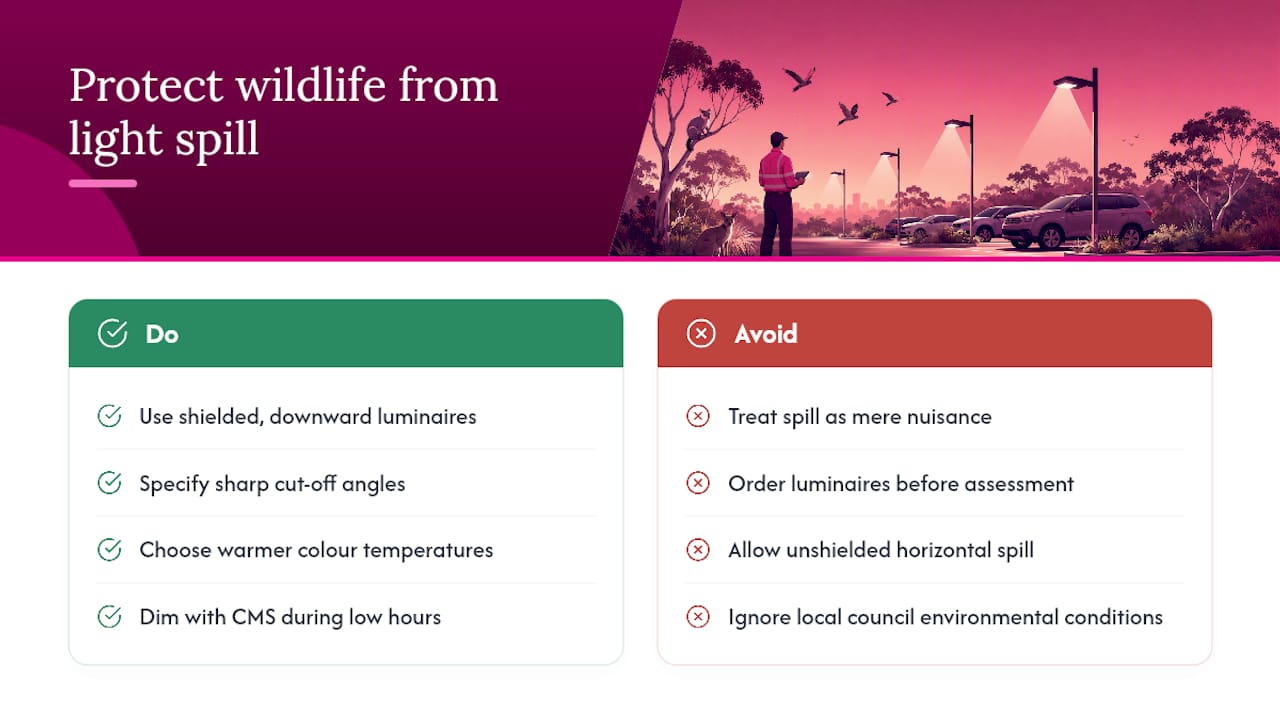
AS/NZS 4282 addresses this indirectly through its obtrusive light limits, and several councils now attach additional environmental conditions to development approvals near sensitive habitat, particularly in bushland-fringe suburbs and near waterways. Shielded, downward-aimed luminaires with sharp cut-off angles reduce sky glow and horizontal spill, which helps both neighbours and wildlife corridors at the same time.
Warmer colour temperatures at the lower end of the acceptable range, and reduced output during low-activity overnight hours through CMS dimming, are practical steps that cut environmental impact without compromising the illuminance a car park needs during peak use. For sites near conservation zones, it’s worth flagging ecological lighting impact assessments as part of the development approval conversation, rather than treating it as an afterthought once the luminaires are already ordered.
Practitioner notes: common faults and practical fixes
Most audits turn up the same handful of faults: poor uniformity near structural columns, under-lit transition zones between undercover and open areas, and emergency luminaire spacing that doesn’t match the fitting’s actual photometric spread. Each is fixable with targeted remediation rather than a full redesign.
I coordinate the photometric testing, compliance certificates and council liaison so property managers aren’t juggling multiple contractors for one report. We offer free site inspections for Level 2 work, 24/7 availability for urgent faults, and a strong track record of customer satisfaction backing that approach.
— Christopher
Get your car park lighting audited by a certified Level 2 electrician
We give property managers and engineers a direct path to compliance, without stitching together a photometric consultant, a separate test-and-tag contractor and a switchboard specialist for one job. We run the illuminance audit, fix emergency lighting gaps against AS/NZS 2293, handle switchboard or supply upgrades where the existing infrastructure cannot support upgraded luminaires, and hand over the certified compliance report your council or certifier needs.
If a car park on your books hasn’t been checked in a while, or you’re designing a new one and want the photometric plan verified before it goes to council, request a free site inspection with a Level 2 electrician. We also handle electrical safety inspections for sites that need a broader compliance check beyond lighting alone. Get in touch and we’ll scope the job and quote it properly, rain, hail or shine.
Standards and agency pages worth bookmarking
- AS/NZS 4282:2023 — Control of the obtrusive effects of outdoor lighting
- MITS 12 Public Lighting standard (ACT)
- Outdoor Lighting Policy — Part Three: Safety (NCA)
Always confirm you’re reading the current edition, and check your local council’s page for any supplementary technical specifications before finalising a design.
Sources
- MITS 12 Public lighting (ACT Transport Canberra & City Services)
- Outdoor Lighting Policy - Part Three: Safety (NCA)
FAQ
What are the Australian standards for car park lighting?
The core standards are the AS/NZS 1158 series for illuminance and performance, AS/NZS 4282:2023 for obtrusive light control, and AS/NZS 2293.1 for emergency lighting, supported by AS/NZS 60598 for luminaires and AS/NZS 3000 for wiring.
What is AS 2890.1?
This standard covers off-street car park design, including geometry, aisle widths and parking module dimensions, and it’s referenced alongside AS/NZS 1158 when planning layout rather than lighting performance itself.
What is the Australian standard for external lighting?
External and outdoor lighting in Australia is governed primarily by AS/NZS 1158 for illuminance performance and AS/NZS 4282:2023 for controlling glare and obtrusive light spill onto neighbouring properties.
How many forward-facing lights can I have?
This relates to vehicle lighting law rather than car park design, and requirements vary by state road rules; car park lighting standards instead govern the fixed luminaires illuminating the site, not vehicle headlights.
How bright should a car park be at night?
Maintained illuminance typically ranges from 5 to 10 lx in general parking bays up to 10 to 20 lx at entrances and driving lanes, with enclosed garages sometimes requiring higher levels depending on the applicable AS/NZS 1158 part.
Powering Your Needs with Expertise
If you’re looking for a reliable, experienced, and prompt electrician, look no further than High Demand Electrical. We cater to all your electrical needs, from routine maintenance to emergency repairs and complete system installations. Our skilled team is committed to providing professional service that ensures your electrical systems run smoothly. Whether it's a small task or a large project, give us a call today. Let us meet all your electrical demands with the quality and reliability you deserve.