7 Day eCert Rule for NSW Cafes: Lodge CCEWs, Schedule 6 Month Tests
If you run a cafe in NSW, any wiring work must be done by a licensed electrician who then lodges a Certificate of Compliance for Electrical Work (CCEW) through the BCNSW eCert portal within the legally required timeframe after testing. You need to keep a copy of that certificate, run regular test-and-tag and RCD checks, and use a Level 2 Accredited Service Provider (ASP) for any meter or network work. If your premises have sat de-energised for six months or more, you’ll need a safety inspection before power goes back on.
TL;DR:
- A CCEW must be lodged through the BCNSW eCert portal within seven days after electrical testing, especially for work like switchboard upgrades or new circuits in cafes.
- Regular test-and-tag should be scheduled every six months for kitchen equipment and annually for front-of-house electronics, with routine RCD checks as part of maintenance.
- Only Level 2 Accredited Service Providers can handle meter or main power work, and proper verification of their license and lodgement is crucial to avoid rejection or penalties.
- Failing to properly lodge or update CCEWs can result in fines up to $1,000 and compromise insurance claims or property transactions, making record-keeping essential.
- Employing a single qualified electrical contractor for ongoing compliance management helps ensure documentation, inspections, and safety standards are consistently maintained.
Table of Contents
- What is a CCEW and when does a cafe need one?
- How do you submit a CCEW, and what’s the 7-day rule?
- How often should you test-and-tag cafe electrical equipment?
- Who is qualified to do electrical work in a cafe?
- What happens if you skip the paperwork?
- Your one-page NSW cafe compliance checklist
- How High Demand Electrical supports cafe compliance day to day
- What NSW cafe managers get wrong about compliance
- Book a compliance check with High Demand Electrical
- Sources
- FAQ
What is a CCEW and when does a cafe need one?
A CCEW is the legal record that electrical work on your premises meets AS/NZS 3000, the wiring rules that set the baseline for every fixed electrical installation in NSW. It’s not paperwork for paperwork’s sake. It’s the document a distributor, insurer, or council checks when something goes wrong, or when you sell or lease the site.
Cafes trigger this requirement more often than owners expect. Fitouts, new coffee machine circuits, split-system air conditioning, or a switchboard upgrade to handle heavier kitchen loads all count as notifiable work under the CCEW scheme.
Common triggers in a cafe fitout include:
- New wiring or additional circuits for kitchen equipment
- Switchboard upgrades to cope with espresso machines, ovens, or fridges
- Meter work or changes to the consumer mains
- Re-wiring after a renovation or shopfit change
The licensed electrician who tests the work, not the owner, issues the CCEW and is responsible for submission. Your job is to confirm it actually happened. Ask for the unique CCEW number and check the BCNSW eCert portal confirmation rather than accepting a verbal assurance that “it’s been sorted.”
How do you submit a CCEW, and what’s the 7-day rule?
BCNSW eCert became the mandatory lodgement system from 1 July 2026, which means handwritten forms and PDF certificates emailed after the fact no longer satisfy the requirement. Every CCEW now has to go through the eCert portal, and the tester must submit it as soon as practical, no later than seven days after the electrical test.
Here’s what to do when work wraps up at your cafe:
- Ask your electrician for the unique CCEW number before they leave the site.
- Request a copy of the certificate for your own records, not just a verbal confirmation.
- Follow up within a week to confirm eCert lodgement has actually gone through.
- File the certificate alongside your maintenance records, not in a drawer with old invoices.
Building Commission NSW built this system specifically because paper certificates were too easy to lose or forget. If your electrician can’t show you evidence of an eCert submission, that’s a red flag worth chasing up immediately, not something to let slide until the next inspection.
How often should you test-and-tag cafe electrical equipment?
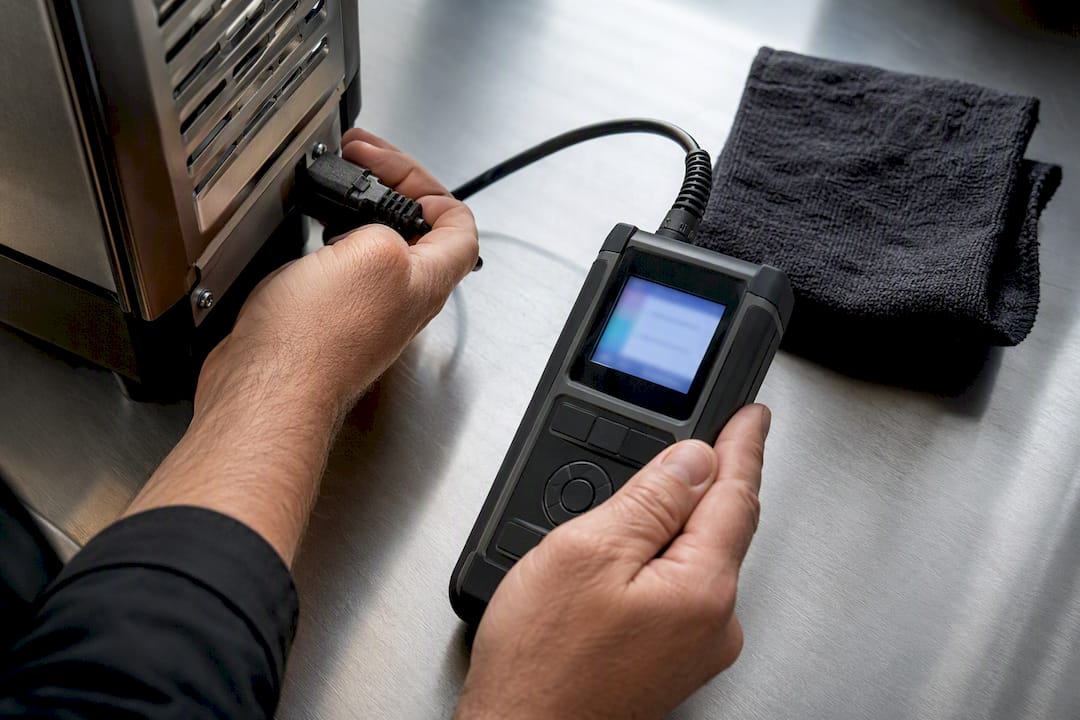
Test-and-tag under AS/NZS 3760 is the practical safety net that sits underneath your CCEW paperwork. It’s what catches a fraying cord on the milk fridge before it becomes an insurance claim or, worse, a fire.
Kitchen appliances in commercial settings typically require periodic testing at intervals guided by relevant standards and risk assessments. Front-of-house items like POS terminals or coffee grinders can usually go longer between checks, assessed by risk rather than a blanket schedule.
- Kitchen equipment (mixers, ovens, urns): test roughly every six months
- Front-of-house electronics: test on a risk-based schedule, often annually
- RCDs and safety switches: test regularly as part of routine maintenance
- Keep a dated asset register with photos, test results, and tester details for every item
SafeWork NSW expects businesses to use competent people for these checks and to use RCDs wherever it’s reasonably practicable to do so. Simple visual checks (a cracked plug, a hot switchboard) can be done by staff day to day, but formal testing needs a qualified electrician.
Pro Tip: Book test-and-tag around your slowest trading day, not your busiest. A cafe that schedules testing for a quiet Tuesday morning loses far less revenue than one squeezing it in before a Saturday rush.
Who is qualified to do electrical work in a cafe?
Not every licensed electrician can do every job on your premises. A standard licence covers general wiring and repairs, but anything touching the service mains, metering, or a change from single-phase to three-phase power needs a Level 2 ASP.
Get this wrong and the consequences aren’t minor. A Level 2 ASP must be engaged for work that changes the consumer mains or service to the property attempting these tasks with a general electrician risks a rejected connection from your distributor and a CCEW that never gets lodged properly.
Before hiring, ask:
- Can you show your licence number and Level 2 ASP accreditation if this job needs it?
- Will you lodge the CCEW via BCNSW eCert, and will you confirm once it’s done?
- Do you carry current public liability insurance?
- Have you worked on hospitality or commercial kitchen circuits before?
What happens if you skip the paperwork?
Non-compliance carries real financial teeth. Missing or improperly lodged CCEWs can attract on-the-spot fines of up to $1,000, and failing to meet technical safety standards can escalate to penalties as high as $550,000.
Beyond the fine itself, missing paperwork can stall an insurance claim after a fire or flood, trip up a council inspection, or hold up a property sale or lease renewal if a buyer’s solicitor asks for compliance records you can’t produce. If you discover a gap in your paperwork today, contact the electrician who did the work, request eCert lodgement immediately, and keep a written record of every call and email until it’s resolved.
Your one-page NSW cafe compliance checklist
Print this, stick it near the office computer, and work through it every time you get electrical work done or plan a maintenance round.
- After any electrical work: get the CCEW number and confirm BCNSW eCert lodgement within seven days.
- Set a test-and-tag calendar: kitchen gear roughly every six months, front-of-house items annually.
- Test RCDs and safety switches on a regular schedule, not just when something trips.
- Before re-energising after a closure of six months or more, arrange an electrical installation safety inspection.
- Before hiring, verify licence details, insurance, and Level 2 ASP status where the job requires it.
| Task | Frequency | Who does it |
|---|---|---|
| CCEW lodgement check | Within 7 days of any wiring work | Licensed electrician (verified by owner) |
| Kitchen equipment test-and-tag | Approximately every six months | Competent tester |
| RCD/safety switch testing | Regularly, per maintenance schedule | Licensed electrician |
| Re-energisation inspection | Before power restored after 6+ months idle | Licensed electrician |
| Consumer mains/meter work | As needed for upgrades or fitouts | Level 2 ASP |
How High Demand Electrical supports cafe compliance day to day
Cafe owners don’t have spare hours to chase paperwork between opening the espresso machine and closing the till. That’s where a contractor who already knows the NSW rules earns their keep.
Free site inspections for Level 2 work can help you understand what a switchboard upgrade or meter change will involve before committing to it. The AS3000 & SIRNSW Clause Finder tool lets you look up the exact wiring rule that applies to your situation instead of guessing.
Practical ways to fold compliance into your calendar:
- Book scheduled test-and-tag rounds around your quietest trading day
- Pair switchboard or Level 2 work with a free site inspection first
- Keep every CCEW and inspection report in one folder, digital or physical, that any staff member can find
What NSW cafe managers get wrong about compliance
Most cafe owners treat electrical compliance as a one-off box to tick during a fitout, then forget about it until something breaks. That’s backwards. The CCEW you get when the espresso machine circuit goes in is a snapshot of one moment, not an ongoing guarantee that your premises stays safe.
The bigger gap I see in how this topic gets discussed is the record-keeping habit itself. Owners will happily spend money on the electrician but won’t spend five minutes confirming the eCert lodgement actually went through. Given BCNSW eCert is now the only accepted lodgement path, that follow-up call matters more than it used to, not less.
If you take one thing from this, prioritise the asset register over anything else. A dated log of test results, photos, and CCEW numbers costs nothing but time, and it’s the single document that speeds up an insurance claim, a council query, or a distributor reconnection when you need it fastest. Everything else on the checklist matters, but that register is what saves you when things go wrong at the worst possible moment.
— Christopher
Book a compliance check with High Demand Electrical
A practical approach to managing cafe compliance is to work with a single Level 2 ASP team that can handle switchboard work, metering, safety inspections, and scheduled test-and-tag under one roof, and offers site inspections for Level 2 jobs so you know the scope before you commit.
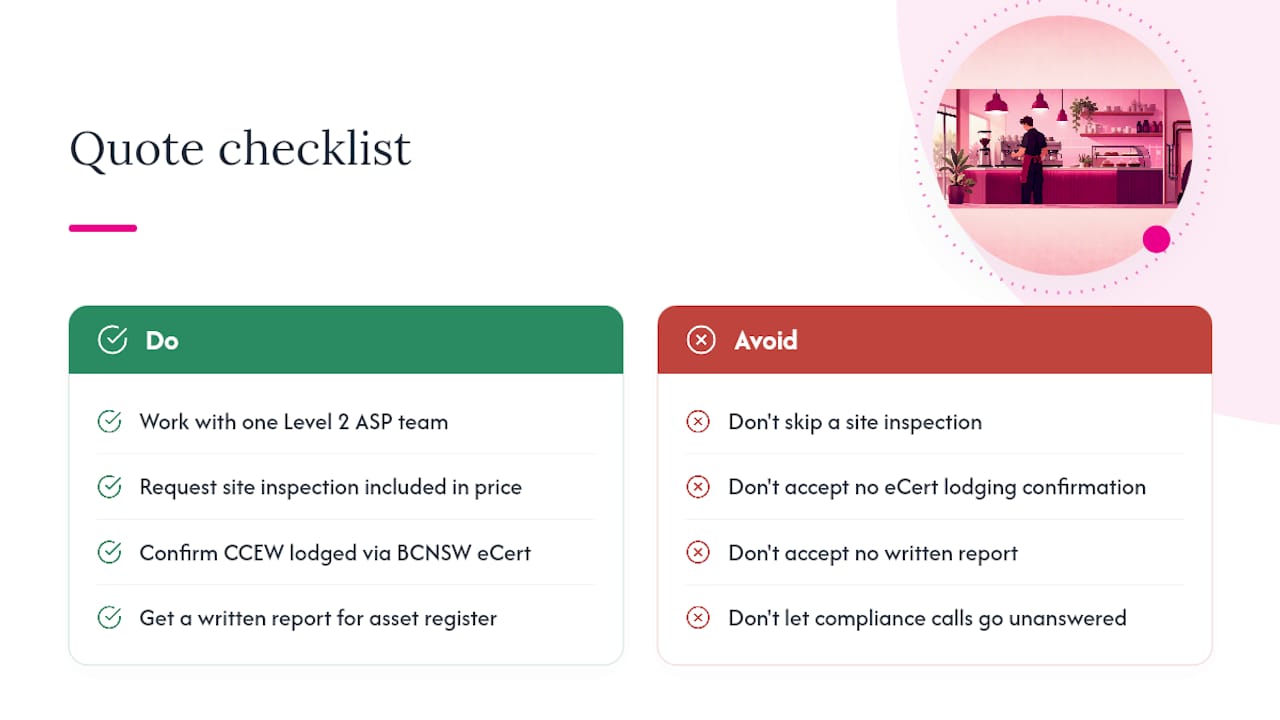
When you request a quote, ask for three things: a site inspection included in the price, confirmation that any CCEW will be lodged via BCNSW eCert, and a written report you can file straight into your asset register. High Demand Electrical’s electrical maintenance and RCD testing service covers the recurring safety-switch and test-and-tag work that keeps a cafe compliant between fitouts, and the team also handles Level 2 metering and defect rectification for cafes upgrading power or fixing outstanding notices. If your business phone rings off the hook during service and compliance calls slip through the cracks, an answering service like Callspace can help make sure those calls don’t get missed either.
Book a free site inspection today and get your cafe’s electrical compliance sorted before it becomes a fine, a stalled sale, or a rejected insurance claim.
This article is general information, not a substitute for advice from a qualified lawyer. Consult a qualified legal professional about your own circumstances before acting on anything here.
Sources
FAQ
What are the electrical regulations in NSW for cafes?
NSW electrical work must comply with AS/NZS 3000, and any notifiable work requires a CCEW lodged via BCNSW eCert within seven days of testing, alongside SafeWork NSW’s duties to manage electrical risk in the workplace.
What are the requirements for electrical equipment compliance in a cafe?
Portable and fixed equipment should be tested according to AS/NZS 3760, with kitchen items typically checked around every six months and RCDs tested regularly as part of routine maintenance.
What are the latest AS/NZS 3000 wiring rules cafe owners should know?
AS/NZS 3000 sets the baseline wiring standard that every CCEW is tested against, and Building Commission NSW publishes advisory notes and standards updates that electricians reference when submitting certificates.
What happens if a cafe doesn’t have an electrical safety certificate?
Missing a CCEW can lead to on-the-spot fines of up to $1,000, with penalties escalating to as much as $550,000 for failing technical safety standards, and it can also delay insurance claims or property settlements.
How much does electrical compliance cost for a NSW cafe?
Costs vary by job, from routine test-and-tag rounds to switchboard upgrades or Level 2 metering work; High Demand Electrical offers a free site inspection for Level 2 jobs, with current pricing available directly through its website.
Recommended
Powering Your Needs with Expertise
If you’re looking for a reliable, experienced, and prompt electrician, look no further than High Demand Electrical. We cater to all your electrical needs, from routine maintenance to emergency repairs and complete system installations. Our skilled team is committed to providing professional service that ensures your electrical systems run smoothly. Whether it's a small task or a large project, give us a call today. Let us meet all your electrical demands with the quality and reliability you deserve.