
Ausgrid Connection Process: Steps, Forms and NMI Changes
The Ausgrid connection process has four parts. You confirm Ausgrid is your network, apply online (usually through your electrician), Ausgrid assesses the application and confirms the requirements, then a Level 2 electrician does the work while Ausgrid finalises the network connection and your retailer sets up the meter and plan. This guide walks through each part for Sydney properties, including single phase to three phase upgrades and NMI changes, so you know what to prepare before you pick up the phone.
TL;DR
- Check your address is in Ausgrid’s area first. Much of Sydney is, but parts of western Sydney sit with a different network.
- A new connection and a change to an existing one use different applications, and a new connection above 100 Amps has its own form.
- Work on the service lines between your property and the network must be done by an accredited Level 2 ASP, and Ausgrid must approve the application before that work starts.
- If you already have a meter and the power is simply off, you usually need your retailer, not a new application.
- For a fault or outage at any hour, Ausgrid’s emergency line is 13 13 88.
Table of Contents
- Step 1: Confirm you are on the Ausgrid network
- Step 2: Work out which application you need
- Step 3: Gather what the application asks for
- Step 4: Ausgrid assesses and confirms the requirements
- Step 5: The electrical work and the network connection
- Single phase to three phase: how the process runs
- NMI changes in NSW
- Common reasons applications get delayed
- Our perspective
- Ready to start your connection or upgrade?
- FAQ
- Sources
Step 1: Confirm you are on the Ausgrid network
Ausgrid supplies electricity across Sydney, the Central Coast and the Hunter. Ausgrid has an online postcode lookup you can use to confirm whether an address falls inside its area. This matters in Sydney because the city is split between two distribution networks. If you apply to the wrong one, you lose time.
As a rough guide, inner suburbs, the CBD, the Inner West, the eastern suburbs, the lower north shore and the northern beaches are Ausgrid territory. Parts of Sydney’s west and south-west are not. Always check the address rather than trusting the suburb name, because boundaries do not follow suburb lines neatly.
You can also identify the network from your bill. Ausgrid NMIs are 11-digit numbers from 41020000000 to 41049999999, and your NMI is printed on your electricity bill. If yours falls in that range, the property is on Ausgrid’s network.
Step 2: Work out which application you need
Before anything is lodged, Ausgrid asks you to consider three things: is this a new connection or a change to an existing one, what are you building or installing, and is the project simple or complex.
In practice most Sydney homeowners land in one of these groups:
| Situation | Usually means |
|---|---|
| New house, granny flat, subdivision lot or new commercial unit | New connection application |
| Single phase to three phase upgrade | Change to an existing connection |
| Larger main supply for EV charging, ducted air conditioning or a workshop | Change to an existing connection |
| Moving an overhead service, replacing a private pole or consumer mains | Usually a change, assessed by Ausgrid on the technical details |
| Meter is installed but there is no power | Retailer contact, often no application |
That last row catches many people out. If a meter already exists and the power is off, a new connection application is typically not required. You contact your electricity retailer to have supply activated.
For new connections there is a size split. A new connection above 100 Amps uses the over-100-Amps application form, so tell your electrician the expected load early. Larger loads change the form, the technical assessment and sometimes the equipment needed on site.
Step 3: Gather what the application asks for
The application is made online. Ausgrid’s application page lists what you need: the property street address, applicant and customer details, the technical specifications of the connection, and payment of an application fee by credit or debit card.
Have these ready before you start:
- The exact property address, including lot and plan details for new lots.
- Applicant and customer details. The applicant is often your electrician or the builder, and the customer is the person the supply will be for. Keep the two straight.
- The load you need. Maximum demand, number of phases, and any big items such as EV chargers, heat pumps, pool equipment or solar.
- Supply arrangement. Overhead or underground service, where the point of attachment will be, and whether a private pole is involved.
- A payment card for the application fee.
The technical details are where homeowners most often stall. Ausgrid says a licensed electrician can help assess your needs, confirm approval requirements, complete the application and provide those technical details. That is exactly the job we do every week, and it is why most applications start with a site visit rather than a form.
Step 4: Ausgrid assesses and confirms the requirements
Once lodged, Ausgrid reviews the technical details and confirms what the connection requires. Simple, standard jobs move through faster. More complex projects can need additional work, and approvals are valid for a limited time, so a project that drags on may have to reapply.
That last point is a real planning issue. If you lodge an application and then wait months for a builder, a switchboard supplier or council sign-off, check the validity period on your approval before you assume it still stands.
Fees and timeframes
Ausgrid does not publish one fee for every connection, because cost depends on the type of connection and what the network needs. Some examples from Ausgrid’s solar charges page show the pattern: solar systems up to 30 kW that comply are automatically approved, while applications that need technical assessment can take longer if more information is needed. Solar application fees vary by system type, and some require part-payment at application with the remainder invoiced.
The practical lesson applies beyond solar. Complete, accurate applications are assessed faster, and incomplete ones come back with questions. Check Ausgrid’s current connection charges page for the figures that apply to your job, and ask your electrician what the site work, materials and any metering will add on top of the network’s own charges.
Step 5: The electrical work and the network connection
After Ausgrid confirms the requirements, the property electrician carries out the electrical work while Ausgrid finalises the network connection, and the retailer provides the meter and energy plan.
This is the stage where the Level 2 distinction matters.
What a Level 2 ASP can do
In NSW, work on the lines between a customer’s installation and the network is restricted to authorised providers. An ASP/2 can install, repair or maintain overhead or underground service lines between the customer installation and Ausgrid’s network. Ausgrid must approve the connection application before service work starts, and the provider must submit a Notification of Service Work (NOSW) afterwards.
The contractor and any workers or subcontractors must be accredited and authorised with Ausgrid at the appropriate level and class. In plain terms: a general electrician can wire your switchboard and circuits, but cannot touch the service connection to the network. Ask any electrician for their ASP authorisation before you accept a quote for mains work. Ausgrid has also flagged a move to a new platform called Ausgrid Connect for provider lodgements, so your electrician will be working to the current portal, not an older process.
The work typically covers:
- Overhead service mains and point of attachment upgrades
- Underground service mains
- Consumer mains installation
- Private power pole installation
- Metering-related work on the customer side
- Defect notice rectification
We cover all of these as a certified Level 2 contractor. See our Level 2 electrician service for the full list.
Single phase to three phase: how the process runs
A single phase to three phase upgrade is a change to an existing connection. You apply online, Ausgrid assesses the application and confirms what is needed, then an electrician does the property work and Ausgrid finalises the network connection.
What that looks like on a typical Sydney house:
- Site inspection. We look at the existing service, the point of attachment, the meter position and the switchboard.
- Load assessment. We work out what you need now and what you may add: EV charger, ducted air conditioning, a workshop, solar.
- Application. Lodged with the technical details.
- Ausgrid confirms requirements. This can include changes to the service or the consumer mains.
- Property work. New consumer mains if needed, a switchboard upgrade to suit three phases, and metering changes coordinated with your retailer.
- Network connection and energisation. Ausgrid finalises its side, then you are on three phases.
Cost and timing depend on things you can check before you start: whether the street service is overhead or underground, the condition and length of the existing consumer mains, whether the switchboard can take three phases, and whether the project is simple or complex. Ausgrid notes that complex projects may need additional work, which is why we inspect first and quote second. Our power supply upgrades page explains what we handle, and for larger loads see our 400A electrical supply specialists.
NMI changes in NSW
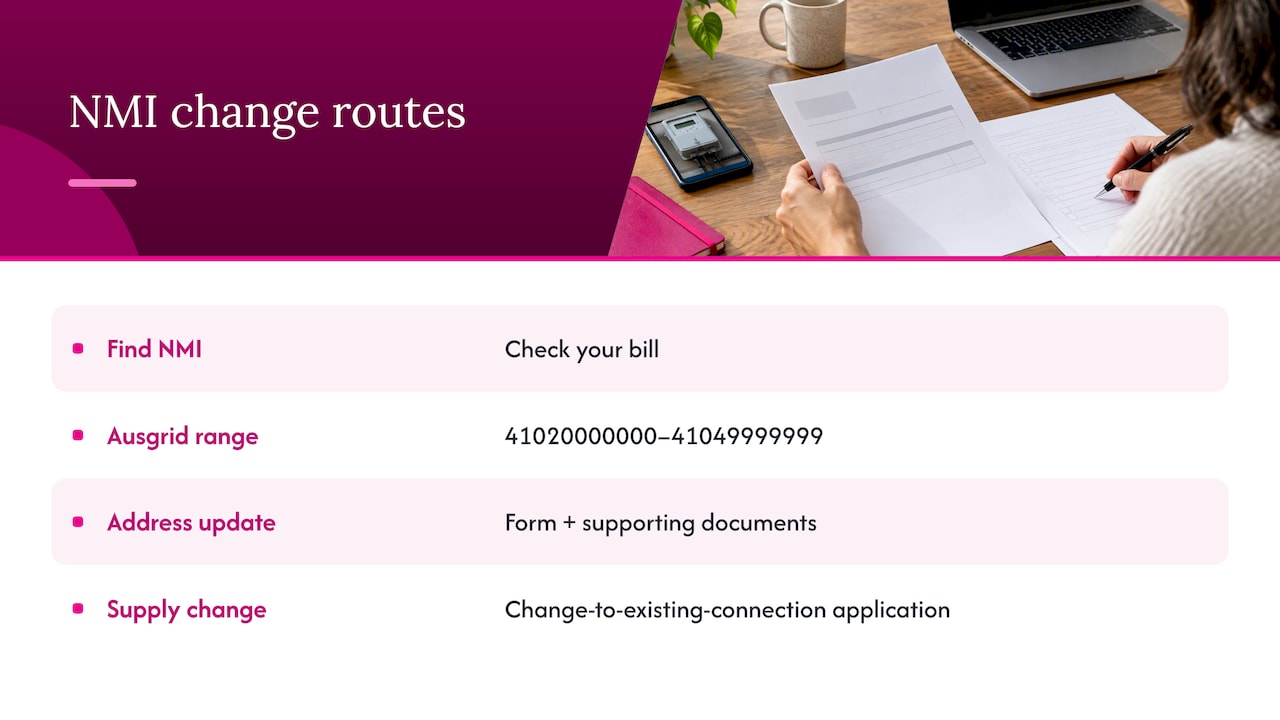
Your NMI is the 11-digit National Metering Identifier for your connection point. People search for an “NMI change” for a few different reasons, and the right path depends on which one applies to you.
You need to find your NMI. Look at your bill. On the Ausgrid network it falls in the 41020000000 to 41049999999 range, as covered above.
The address on the NMI is wrong or outdated. This happens with new subdivisions, renumbered streets and rural properties. To request an address update for an NMI within Ausgrid’s network, complete the form and provide supporting documents. These can include a rates notice, a council letter or a lease agreement, accompanied by photos of the meter, meter box or property frontage. The page sits under Ausgrid’s retailer section, so ask your retailer whether they will lodge it for you.
You are altering the supply. A phase upgrade, a new meter arrangement or a changed point of supply is handled through the change-to-an-existing-connection application above, and your retailer sorts out metering and your plan once the work is done.
If you are unsure which of these you are in, a short call to your retailer plus a look at your last bill usually settles it.
Common reasons applications get delayed
From the Level 2 work we do around Sydney, these are the patterns worth avoiding:
- Applying to the wrong network. Confirm the address first.
- Vague load details. “A bit more power” is not a technical specification. Give amps and phases.
- Choosing a provider without the right authorisation. Service work needs the right ASP level and class.
- Letting approval lapse. Time limits apply, and delayed projects may need to reapply.
- Starting service work before approval. Ausgrid must approve before service work begins.
- Forgetting the switchboard. An old board with ceramic fuses or limited space can hold up an otherwise approved upgrade.
If your switchboard is also due for replacement, doing both under one plan saves a second shutdown of your power.
Our perspective
Most delays we see have nothing to do with Ausgrid being slow. They come from an application that was lodged before anyone looked at the property. A form can be completed correctly and still describe the wrong job.
That is why we offer free site inspections for Level 2 work. We would rather walk the property, look at the service, the mains, the meter position and the board, and then lodge an application that matches what is actually there. It gives you a transparent scope before you commit to anything.
We are a certified Level 2 electrical contractor, triple ISO certified, and our team works to NSW standards across residential, commercial and strata properties. When an outage or a fault hits at 2 am, our emergency team is available 24/7, and we aim to call you back within 10 minutes. Seniors can ask us about our discounts.
If you are planning a three phase upgrade, a new supply or a mains replacement in Sydney, start with the inspection. The paperwork gets much easier afterwards.
Christopher
Ready to start your connection or upgrade?
We handle the electrical side of the Ausgrid process for Sydney homes, businesses and strata buildings: site inspection, technical details for the application, mains and switchboard work, metering coordination and defect notice rectification. Our Level 2 electricians are accredited, we have more than 300 five-star reviews, and the site inspection for Level 2 work is free.
Book through our power supply upgrades page or contact us from the High Demand Electrical homepage. If the issue is urgent, go straight to our emergency electrician service.
FAQ
Do I need a new connection application if my power is off?
Not necessarily. If an electricity meter is already installed and the power is off, a new application is typically not required. Contact your electricity retailer to have supply activated. If the cause is a fault, call a licensed electrician.
Who can lodge an Ausgrid connection application?
You can apply online, but a licensed electrician can assess your needs, confirm approval requirements and provide the technical details. For anything involving service lines to the network, you need an authorised Level 2 ASP anyway, so it makes sense to have them lodge it.
What should I do in an electrical emergency while a connection is being arranged?
For an urgent fault or outage at any time, Ausgrid’s emergency line is 13 13 88 and operates 24/7. If the problem is inside your property, such as a burning smell from the switchboard, call us as well and keep everyone away from the affected area.
How do I find my NMI?
It is printed on your electricity bill. On the Ausgrid network it is an 11-digit number between 41020000000 and 41049999999. If you cannot find a bill, your retailer can confirm it.
Can I change the address on my NMI?
Yes. Ausgrid has a request process that asks for supporting documents such as a rates notice, council letter or lease agreement, plus photos of the meter, meter box or property frontage. Ask your retailer to lodge it, or check the form on Ausgrid’s site.
Sources
Need Help Fast?
Powering Your Needs with Expertise
If you’re looking for a reliable, experienced, and prompt electrician, look no further than High Demand Electrical. We cater to all your electrical needs, from routine maintenance to emergency repairs and complete system installations. Our skilled team is committed to providing professional service that ensures your electrical systems run smoothly. Whether it's a small task or a large project, give us a call today. Let us meet all your electrical demands with the quality and reliability you deserve.

