
Aircon Circuit Requirements in NSW: What Your Install Needs
An air conditioner in NSW must be wired to the 2018 edition of AS/NZS 3000, with a Type A RCD and a local isolator. It also needs a circuit that follows the manufacturer’s installation instructions, which often means a dedicated one. A licensed electrician must do the wiring and give you a Certificate of Compliance for Electrical Work (CCEW) when they finish. Below is what that means for a split system, a ducted unit or a commercial installation in Sydney, and how to tell whether your switchboard and supply can carry the load.
TL;DR
- NSW installations must comply with AS/NZS 3000:2018, mandatory under State legislation since 1 January 2019.
- The circuit must follow the manufacturer’s instructions. If the unit’s specifications call for a dedicated circuit, it gets one.
- Expect a Type A RCD and a lockable, accessible isolator next to the outdoor unit, not mounted on it.
- Cable size, voltage drop and switchboard capacity are checked before install, and larger ducted systems can push a home past what its supply handles comfortably.
- Only licensed people can do the wiring, and the electrician must lodge a CCEW and give you a copy.
Table of Contents
- Which rules apply to an aircon circuit in NSW
- Does an air conditioner need its own circuit?
- RCD protection and the isolator
- Where the isolation switch goes
- Cable size, voltage drop and breaker rating
- Will your switchboard and supply cope?
- Who can wire it, and what paperwork you should get
- Strata, rentals and commercial sites
- Our perspective
- Get the circuit checked before the installer arrives
- If an aircon circuit trips, smells hot or fails a check
- A pre-install checklist
- FAQ
- Sources
Which rules apply to an aircon circuit in NSW
The electrical side of an air conditioner is governed by the wiring rules, AS/NZS 3000. The NSW Government states that electrical installations must comply with the 2018 edition, mandatory from 1 January 2019. That edition sets out the safety requirements for electrical installations in premises across Australia and New Zealand.
For air conditioning in particular, the NSW energy schemes guidance says AS/NZS 3000 requires a Type A residual current device (RCD) and a local isolator. Those two items are the backbone of any compliant aircon circuit. Everything else (cable size, breaker rating, where the isolator sits) follows from the unit you are installing and the way your property is wired.
The refrigerant side is separate work. The electrical side, called associated wiring, is its own matter, and who can do it is covered further down.
Does an air conditioner need its own circuit?
Often, but the rule is not “always”. The answer comes from the manufacturer. Energy Safe Victoria’s technical guidance, which applies the same AS/NZS 3000:2018, explains that an air conditioner needs a dedicated circuit if the manufacturer’s specifications require one. The reason is Clause 4.1.2(e): equipment must be installed in accordance with the manufacturer’s instructions, and those instructions can dictate both a dedicated circuit and a minimum cable size.
In practice that means:
- Read the installation manual for the exact model. The outdoor unit’s rating plate and the manual state the supply, the maximum overcurrent protection and the cable requirements.
- Do not assume a spare power point or an existing lighting circuit will do. Compressors draw a high current when they start, and a shared circuit is a common cause of nuisance tripping.
- Plan for the whole system. A multi-head or ducted system may have an indoor and outdoor supply to consider, not one single connection.
This is also why a quote that is given without checking your switchboard should make you cautious. The circuit is only as good as the board and supply behind it.
RCD protection and the isolator
The two protective items are different things with different jobs.
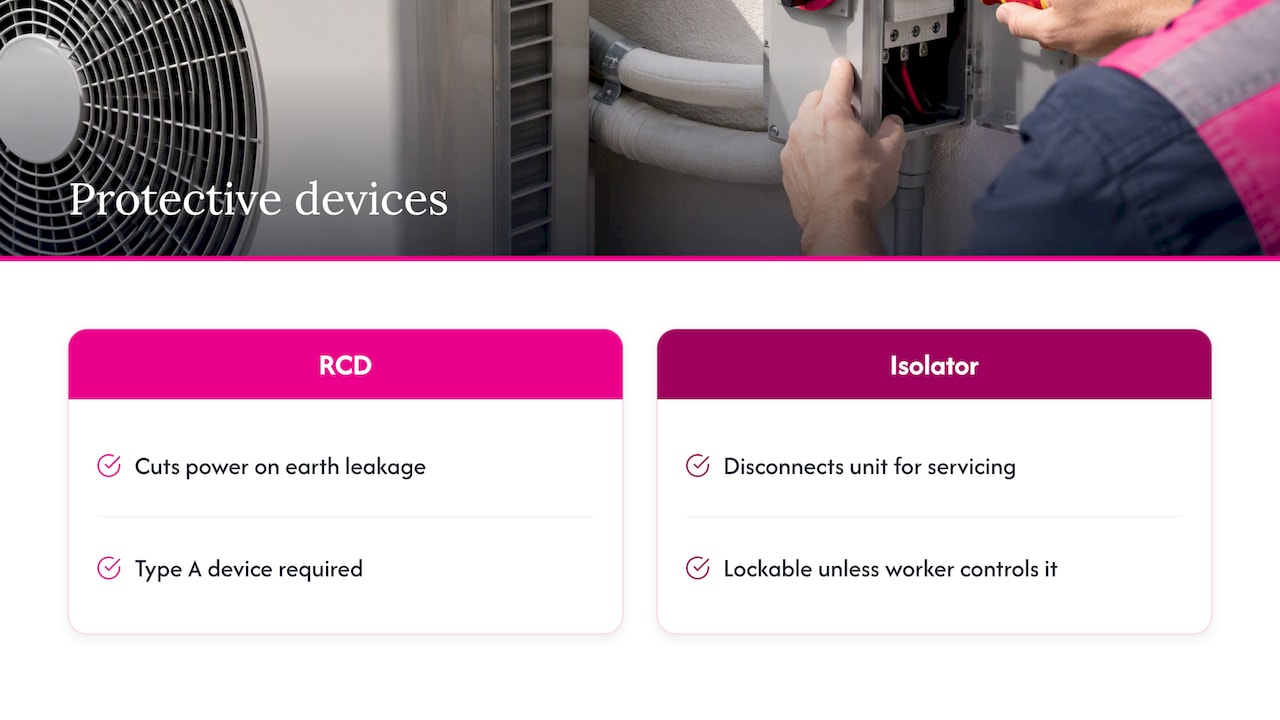
The RCD cuts the power quickly if current leaks to earth, for example through a person or a damaged cable. The requirement is for a Type A device, as noted in the IPART guidance. If your home still has old ceramic fuses or no safety switch on the circuits, this is the point where the board usually comes up for discussion. If you want your existing safety switches checked first, we do RCD and safety switch testing.
The isolator is a switch that lets someone disconnect the unit safely for servicing. The Building Commission NSW says AS/NZS 3000:2018 clause 4.19.1.1 requires local isolation so equipment can be safely maintained and serviced. That page concerns heat-pump hot water, but the safety reasoning is the same for an outdoor aircon unit.
The general principle is also set out by the Northern Territory’s work safety regulator: where equipment could cause injury during mechanical maintenance, an isolator able to disconnect the supply must be provided, and it must be lockable unless it stays under the control of the person doing the work. A service technician working on your compressor depends on that lock.
Where the isolation switch goes
For a fixed-wired air conditioner, Hager’s wiring-rules guidance says the installation needs a readily accessible, lockable isolation switch adjacent to the air conditioner, and not mounted on it. It places the switch at about arm’s length, roughly 1.25 metres, and notes that neutral switching is recommended but not required.
What that looks like on a typical Sydney job:
- The isolator sits on the wall beside the outdoor unit, within reach, without a ladder.
- It is not screwed to the unit’s casing, because a technician removing a panel would have to work around a live switch.
- It is not hidden behind a fence, a stack of bins or a garden bed. “Readily accessible” means a service person can reach it quickly.
- For a roof or balcony unit, the isolator goes at the unit’s location, not only at the switchboard downstairs.
You will see older installs with no isolator at all, or one mounted on the unit. If you are buying, renting or managing a property with an older system, an aircon electrical inspection and report tells you what is there and what needs correcting.
Cable size, voltage drop and breaker rating
The cable between your switchboard and the outdoor unit has to carry the unit’s running current, handle the start-up surge and not lose too much voltage over the run. AS/NZS 3000 sets a voltage-drop limit of up to 5% or 7%, depending on the site. A long run from the board to a far corner of a block or a rooftop plant area is where this limit starts to matter.
Three things drive the numbers:
| Factor | Why it matters |
|---|---|
| Unit rating and manufacturer data | Sets the minimum cable size and maximum protective device |
| Cable length and route | Longer runs lose more voltage, so a larger cable may be needed |
| Installation method | Cables in insulation, conduit or hot roof spaces carry less current than the same cable in free air |
The breaker is chosen to match the cable and the manufacturer’s limit, not simply to “stop it tripping”. Fitting a bigger breaker to cure tripping on an undersized cable is a fire risk and one of the first things an inspector looks for.
You can get a feel for how length and load interact with our cable size and voltage drop calculator. Treat it as a guide for planning. The electrician confirms the final size against the unit’s documentation and the site.
Regulators also flag a labelling problem. Energy Safe Victoria lists among repeated defects failure to label circuit breakers and RCDs to show what they supply. After an install, your switchboard should clearly say which breaker feeds the aircon.
Will your switchboard and supply cope?
This is the question most aircon guides skip. A circuit does not exist in isolation. It draws from your switchboard, which draws from your mains and your connection to the network.
Signs the board or supply may need work before an air conditioner goes in:
- The board has no spare way for a new circuit, or no safety switch protection.
- The board is old, with ceramic fuses, or shows heat damage or loose connections.
- You already run an oven, hot water, pool equipment or an EV charger and the main switch rating is close to its limit.
- You are planning a large ducted system, several split systems, or a commercial fitout with a heavy cooling load.
In those cases the sensible order is: check the board, confirm the supply, then size the circuit. A switchboard upgrade is often cheaper and simpler done alongside the aircon install than as a second visit.
Where the load is large, the question becomes whether a single-phase supply is enough. Whether three-phase makes sense depends on the unit’s electrical specification, what else the property runs and what the network connection allows, so it is a case-by-case assessment rather than a rule of thumb. If you are weighing it for a big ducted system, our page on three-phase power for ducted air conditioning explains how we assess it, and our power supply upgrades cover the single-phase to three-phase work itself.
Who can wire it, and what paperwork you should get
Do not wire an air conditioner yourself. NSW Fair Trading’s licensing guidance says associated electrical wiring for air conditioning may be carried out by a holder of an air conditioning, refrigeration or electrical licence. The same page states that unlicensed electrical work can be fined $22,000 for an individual or $110,000 for a company.
When the work is finished, the electrician must complete and submit a CCEW and give you a copy. The submission side has changed: as of 1 July 2026, Building Commission NSW accepts CCEWs only through its digital eCert portal, no longer as manual or PDF forms.
What to ask for before you pay the final invoice:
- A copy of the CCEW for the electrical work.
- The make, model and rating of the unit and the breaker size used.
- Confirmation the circuit is labelled at the switchboard.
- The manufacturer’s installation manual or warranty conditions, which can depend on a compliant install.
Keep these with your property records. They matter at sale, at a lease handover and for insurance.
Strata, rentals and commercial sites
Strata. In an owners corporation, you cannot just book an installer. NSW Government rules say that installing or replacing a reverse cycle air conditioner in strata is a minor renovation that requires approval. Sort the approval first, then the electrical. The circuit may need to run through common property, and the board or the strata manager will want to see the electrician’s details.
Rentals. Landlords and property managers are responsible for the safety of the fixed wiring and the isolator. A system installed years ago without an isolator is a compliance gap you can fix with a short inspection and a small electrical job.
Commercial. Shops, offices and light industrial units often have a heavy cooling load on supply that was sized for lighting and power points. Our commercial electrical compliance work looks at the whole picture, including board capacity and records.
Our perspective
We see the same pattern on aircon jobs across Sydney. The unit is chosen, the installer is booked, and nobody checks the switchboard until the day of install. That is when a job turns into a delay: no spare way on the board, an old board with no safety switch, or a supply that was never meant to carry a ducted system on top of everything else.
Our view is simple. Treat the circuit as part of the purchase, not an afterthought. Get the model’s electrical specification first, have a Level 2 electrician look at the board and supply, and decide on the circuit, isolator position and any upgrade together. It costs less than coming back twice, and it means the CCEW you receive describes a circuit that was designed rather than squeezed in.
We are triple ISO certified and our electricians are accredited Level 2 ASP electricians, which matters when the job involves the board, the mains or the network connection as well as the aircon circuit. Our free site inspections for Level 2 work are there so you know what the job involves before you commit.
Christopher
Get the circuit checked before the installer arrives
If you are planning an air conditioner, or you have one and are not sure the circuit is right, we can look at the unit’s requirements, your switchboard and your supply, then tell you what is needed. We offer free site inspections for Level 2 work, and our seniors receive special discounts.

Start with our Level 2 electrician service for board, mains and supply work, or book an aircon electrical inspection if the system is already in. Our 24/7 emergency electrician team covers faults that cannot wait, and we aim to call back within 10 minutes.
If an aircon circuit trips, smells hot or fails a check
Some signs mean stop using the unit and call an electrician: a breaker or safety switch that keeps tripping, a burning smell at the outdoor unit or the board, warm or discoloured cable, or a switch that is loose or damaged. Switch the unit off at the isolator if it is safe to reach, and do not keep resetting the breaker.
The regulators’ approach to unsafe installations is to isolate the problem part. NSW guidance on installations after flooding says that if a part of the installation fails testing, it may be isolated and tagged off until repairs are undertaken. The same guidance says that after flooding disconnects supply, a qualified supervisor or endorsed contractor must complete the required tests and an inspection certificate before reconnection. If your outdoor unit has been under water, see our flood damage electrical repairs page. For storm-related faults, our storm damage electrician service responds rain, hail or shine.
If a notice has been issued against the installation, we handle defect notice rectification and the repair work itself under electrical repairs.
A pre-install checklist
Use this before you sign a quote:
- Do you have the model’s installation manual and electrical specification?
- Has someone looked at your switchboard, not just the wall where the unit will go?
- Does the quote say whether a dedicated circuit is included, and what cable size and breaker rating will be used?
- Is a lockable isolator beside the outdoor unit included in the price?
- Is a Type A RCD protecting the circuit?
- Will you receive the CCEW, and will the circuit be labelled at the board?
- If you are in strata, do you have approval?
- If the load is large, has anyone assessed whether the supply needs an upgrade?
FAQ
Does every air conditioner need a dedicated circuit?
Not by a blanket rule. The requirement comes from the manufacturer’s installation instructions, which AS/NZS 3000:2018 requires the installer to follow. Many split and ducted systems specify a dedicated circuit, so check the manual for your exact model before the electrician quotes.
Where does the isolator go?
Next to the air conditioner, readily accessible and lockable, but not mounted on the unit. Hager’s guidance places it about arm’s length away, roughly 1.25 metres. For a roof or balcony unit, the isolator belongs at the unit, not only at the board.
Can I install the aircon wiring myself in NSW?
No. Associated wiring has to be done by a person holding an air conditioning, refrigeration or electrical licence, and unlicensed electrical work carries fines of $22,000 for individuals and $110,000 for companies. You should also receive a CCEW when the work is done.
Do I need a new switchboard for an air conditioner?
Only if the existing board cannot take the new circuit safely: no spare capacity, no safety switch protection, signs of age or heat damage, or a main switch already near its limit. An electrician can tell you after checking the board against the unit’s specification.
Do strata owners need approval to install an air conditioner?
Yes. NSW rules treat installing or replacing a reverse cycle air conditioner in strata as a minor renovation that needs approval. Get that approved before the electrical work is booked.
Sources
- Electrical standards, rules and notes | NSW Government
- Home Energy Efficiency Retrofits | IPART
- EIS 007: Solar Victoria Home Heating and Cooling Upgrades | Energy Safe Victoria
- Heat pump installations for electrical work | NSW Government
- Requirements for isolators on electrical equipment | NT WorkSafe
- Isolation switch requirements | Hager Australia
- Voltage optimisation guide | NSW Government
- Air conditioning and refrigeration work | NSW Government
- Building Commission NSW advisory notes on heat pump installations
- Strata renovation rules | NSW Government
- Electrical installation safety inspection instructions after a flooding event | NSW Government
Recommended
Need Help Fast?
Powering Your Needs with Expertise
If you’re looking for a reliable, experienced, and prompt electrician, look no further than High Demand Electrical. We cater to all your electrical needs, from routine maintenance to emergency repairs and complete system installations. Our skilled team is committed to providing professional service that ensures your electrical systems run smoothly. Whether it's a small task or a large project, give us a call today. Let us meet all your electrical demands with the quality and reliability you deserve.

