18-Circuit Switchboard Upgrade: The Sydney Homeowner’s Guide to Modern Power
If your Sydney home is still relying on a switchboard designed for the early 2000s, you aren't just living in the past; you're likely overloading a system that was never built for the 2026 electrical reality. You've probably felt the frustration of a circuit breaker tripping the moment the aircon kicks in, or the safety anxiety that comes with seeing old ceramic fuses in your meter box. It's a common struggle for homeowners who want to embrace new technology but find their infrastructure lacking. An 18‑circuit switchboard upgrade has become the gold standard for those looking to resolve these capacity issues once and for all. This configuration provides the necessary headroom for high-demand additions like Tesla chargers, induction cooktops, and solar batteries.
We understand that navigating NSW electrical compliance can feel overwhelming, especially with the strict eCert portal requirements now in place. This guide explains why this upgrade is the definitive solution for a future-proof home. You'll discover how a Level 2 ASP ensures your consumer mains can handle the increased load and why professional certification is the only way to guarantee your family's safety. We'll break down the technical requirements and the essential steps to achieve reliable, high-performance power for your modern lifestyle.
Key Takeaways
• Understand why an 18‑circuit switchboard upgrade provides the essential capacity needed for modern Sydney homes transitioning to high-load appliances and electric vehicles.
• Learn to identify the critical components of a modern enclosure, including RCBOs and the importance of leaving spare poles for future solar or battery integration.
• Discover how to allocate circuits effectively across a standard residence to eliminate nuisance tripping and ensure reliable power for high-draw items.
• Recognise when your upgrade requires a Level 2 ASP to manage consumer mains and notify network providers through the mandatory NOSW process.
• Gain insight into the professional installation process, including load calculations and final testing, to ensure your system meets the latest NSW safety regulations.
Why Your Sydney Home Requires an 18-Circuit Switchboard Upgrade
Sydney homes are evolving faster than the wires behind their walls. While a basic six-circuit board was sufficient for incandescent bulbs and a toaster, today's properties demand massive current for induction cooktops, Tesla wall connectors, and multi-zone air conditioning. We view the 18‑circuit switchboard upgrade as the "sweet spot" for medium-to-large Sydney residences. It provides the essential physical volume to house modern safety components without overcrowding the enclosure. Choosing this specific capacity moves you beyond the bare minimum. A modern distribution board must do more than just distribute power; it must manage complex loads while protecting sensitive smart home electronics. By opting for 18 circuits, you ensure your home isn't just meeting today's needs but is ready for the total electrification trend sweeping through NSW.
The Death of the Ceramic Fuse
Older Sydney suburbs are filled with porcelain fuse wedges that represent a significant fire hazard. These outdated components weren't designed for the continuous high-draw loads of modern life. Homeowners often try to "patch" these systems by adding a single RCD, but this is a false economy that leaves the underlying infrastructure vulnerable. A ceramic fuse relies on a thin wire melting to stop current, whereas a modern circuit breaker uses a precise mechanical switch to disconnect power instantly when a fault is detected. Investing in a full 18‑circuit switchboard upgrade eliminates the "hot spots" caused by loose fuse connections and provides a secure foundation for your family's safety.
Meeting Modern Australian Standards (AS/NZS 3000)
Compliance with AS/NZS 3000 is non-negotiable for any renovation or repair. Current regulations mandate RCD (safety switch) protection for all final sub-circuits, including lights and power. These safety modules are physically larger than old fuses, requiring significant "DIN rail" space inside the enclosure. An 18-circuit board offers ample room for these mandatory RCBOs and dedicated surge protection devices. This is vital for protecting expensive smart appliances from voltage spikes, which are increasingly common as the grid integrates more renewable energy sources. Without this extra space, your electrician can't legally or safely install the protection your modern home requires.
The Technical Anatomy of a Modern 18-Circuit Enclosure
An 18‑circuit switchboard upgrade is defined by its internal architecture. It isn't just a container for wires; it's a precision-engineered hub designed to manage high-current loads safely. We prioritise robust, fire-rated metal enclosures or high-impact polycarbonate for Sydney residences. These materials provide superior heat resistance and durability compared to the brittle plastic boxes of the past. Inside, the layout follows a strict busbar architecture. This organised system of copper conductors replaces the "nest" of cables found in older boards, significantly reducing the risk of loose connections and electrical fires. Clear, permanent labelling is also a mandatory feature, ensuring every resident can identify which breaker controls which area of the home during an emergency.
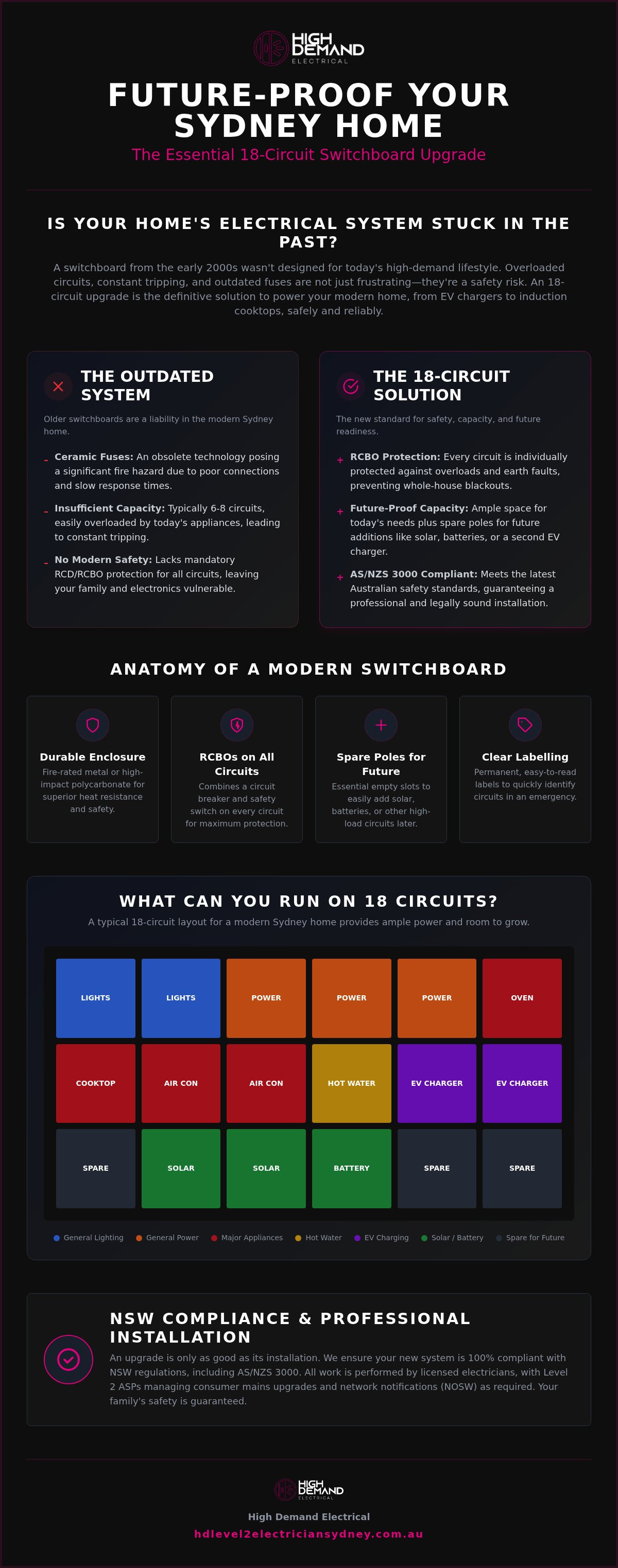
The 18-circuit capacity is chosen specifically to provide "spare poles." A standard four-bedroom home typically consumes 12 to 14 slots for basic lighting, power, and existing appliances. The remaining slots are critical for future-proofing. Without these empty spaces, you cannot add a solar inverter, a home battery, or a second EV charger without another costly enclosure replacement. Planning for these spares today prevents redundant infrastructure spending tomorrow.
Understanding RCBOs vs Standard Breakers
Modern boards rely on Residual Current Breakers with Overcurrent protection (RCBOs). These sophisticated modules combine the functions of a circuit breaker and a safety switch into a single unit. In older systems, one safety switch often protected five or six different circuits. If a fault occurred on one power point, the entire house went dark. RCBOs provide individual circuit protection. If your kettle shorts out, only the kitchen power circuit trips. The rest of your home remains powered, and the specific tripped switch tells you exactly where the fault lies. This technology simplifies fault-finding and ensures critical appliances, like your fridge or home security, stay active during minor electrical issues.
Main Switches and Isolation
Every modern 18-circuit board requires a high-capacity main isolation switch, typically rated at 63A or 100A. This component acts as the primary gateway, linking your internal distribution to the consumer mains. Rapid isolation is a non-negotiable safety requirement; the board layout must allow any adult to find and flip the main switch instantly in an emergency. If you're unsure if your current isolation switch meets 2026 standards, our Sydney switchboard specialists can perform a comprehensive audit of your enclosure's anatomy to ensure total compliance.
Capacity Planning: What Can You Actually Run on 18 Circuits?
Many homeowners ask why we recommend an 18‑circuit switchboard upgrade instead of a smaller 12-circuit alternative. The reality is that a 12-circuit board is often at capacity before you even consider modern upgrades. In a typical four-bedroom Sydney home, basic lighting and general power outlets already consume six to eight slots. When you factor in wet areas, smoke detectors, and the main switch, you're left with almost zero room for expansion. An 18-circuit configuration provides the necessary breathing room to manage high-draw appliances without risking nuisance tripping. We use "diversity factors" to calculate your total household load. This ensures your system handles peak demand effortlessly, even when the oven, aircon, and dryer are all running at once.
This capacity is especially critical if you're planning a switchboard upgrade for EV charger sydney. A dedicated 32A EV circuit requires its own high-capacity breaker. Attempting to squeeze this into a crowded, outdated board is a recipe for thermal stress and potential failure. By opting for 18 circuits, you provide the physical and electrical space required for high-speed charging without compromising the rest of your home's infrastructure.
The High-Load Hit List
Modern living relies on dedicated lines for heavy hitters. We allocate specific circuits for items that draw significant current to prevent them from overloading general power loops. We typically prioritise:
32A-40A Induction hobs
These require a heavy-duty dedicated feed to handle rapid heating cycles.
20A+ Ducted air conditioning
Large units need stable, isolated power to protect the compressor.
32A EV Wall Connectors
Continuous high-load charging demands a dedicated circuit and specialised protection.
Kitchens now function as high-demand hubs. They often require three separate circuits to handle ovens, dishwashers, and high-wattage small appliances simultaneously. Outdoor zones also demand attention; pools and spas need isolated protection to prevent moisture-related faults from cutting power to your entire house.Future-Proofing for Solar and Storage
Smart renovators never fill every slot. We mandate leaving at least 20% spare capacity inside the enclosure. This isn't just a suggestion; it's a strategic move to accommodate solar inverters, home battery systems, and smart energy monitoring hardware. These components require physical space on the DIN rail that a smaller board simply cannot provide. By choosing 18 circuits today, you avoid the high cost of a second upgrade when you decide to go off-grid or add energy-saving automation. It's about building a system that grows with your technology, not one that holds you back.
NSW Compliance and the Level 2 ASP Requirement
Many Sydney homeowners assume any licensed electrician can perform an 18‑circuit switchboard upgrade. This is a common misconception. While a general sparkie can work on your internal wiring, they lack the legal accreditation to touch the service lines connecting your home to the street. If your upgrade involves increasing the amperage of your main switch or altering the metering, you must engage a Level 2 ASP. This specialised qualification is required to ensure your property's infrastructure meets the strict service rules set by Ausgrid and Endeavour Energy. We possess the specific training to handle these high-risk connections that generalists simply cannot touch.
Every significant modification requires the lodgement of a Notice of Service Work (NOSW) and a Digital Certificate of Compliance for Electrical Work (CCEW) through the Building Commission NSW eCert portal. These documents are mandatory as of March 1, 2026. The process ensures the local network is aware of your property's new load profile and confirms that all work meets current safety benchmarks. Failing to follow these protocols can lead to significant fines or even the refusal of service from the network provider during future maintenance.
A frequent bottleneck in older homes is the size of the consumer mains. These are the primary cables carrying power from the street to your board. An 18-circuit board is designed for high-demand electrification, which often exceeds the capacity of old 6mm or 10mm wiring. Without upgrading these "arteries," your new switchboard is like a high-performance engine restricted by a tiny fuel line.
Consumer Mains and Point of Attachment
To safely support an 18‑circuit switchboard upgrade under modern demand, most Sydney properties require an upgrade to 16mm mains. This ensures your system doesn't overheat when an EV charger and ducted air conditioning run simultaneously. As Level 2 specialists, we handle the high-stakes task of connecting these new mains to the Point of Attachment (POA) on your roof or private power pole. We ensure all connections are tensioned and weather-sealed according to the latest NSW service rules, providing a secure link that standard electricians aren't permitted to establish.
Smart Metering and Off-Peak Tariffs
Your upgrade provides the perfect opportunity to modernise your metering. Older analogue meters cannot track the granular data required for off-peak tariffs or solar feed-in credits. Modern 18-circuit enclosures are built to facilitate smart meter installations, allowing you to access cheaper electricity rates for hot water systems and EV charging during the night. We ensure your new board is fully compliant with 2026 NSW metering standards, positioning your home to benefit from the latest energy-saving incentives. If you're ready to secure your home's energy future, contact our Level 2 ASP team for a compliant, professional installation.
Professional Installation with High Demand Electrical
Executing an 18‑circuit switchboard upgrade requires more than just technical skill; it demands a disciplined, methodical approach to safety and logistics. We don't just swap boxes. Our process begins with a rigorous load calculation to verify that your existing service can support your modern lifestyle. Once the site is prepared, our Level 2 ASP technicians manage the high-stakes transition from outdated infrastructure to modern protection. We specialise in level 2 asp electrical work, meaning we possess the authority to disconnect and reconnect your property to the grid without waiting for third-party network providers. This end-to-end capability ensures that your project remains under the control of a single, highly qualified team.
We understand that losing power for an entire day is a major disruption for modern families and home offices. To minimise downtime, we organise the changeover with precision. Most of the preparatory work, including the internal enclosure mounting and preliminary circuit labelling, is completed while your home remains powered. The actual outage is kept as brief as possible, often lasting only a few hours. This efficiency is why we are known as the authoritative rapid responder for complex infrastructure projects across Sydney. Every installation concludes with exhaustive testing of RCD trip times and circuit polarity to guarantee absolute safety before we leave the site.
The High Demand "Rapid Responder" Approach
Electrical safety doesn't allow for shortcuts or vague timelines. Our team approaches every 18‑circuit switchboard upgrade with a focus on immediate response and professional reassurance. We handle the heavy lifting of NSW regulatory paperwork, ensuring your CCEW and NOSW are lodged correctly through the Building Commission NSW eCert portal. This protects your insurance status and guarantees your installation is fully compliant with 2026 standards. Our workmanship is methodical and clean; we respect your property by ensuring the installation site is left tidy and the new board is perfectly organised for any future maintenance or smart home additions.
Next Steps for Your Sydney Home
The first step toward a reliable, future-proof power system is a professional assessment. We don't provide generic estimates because every Sydney home has a unique load profile. Instead, we conduct a comprehensive load audit to determine exactly how your 18 circuits should be allocated to prevent nuisance tripping. This assessment considers your current appliances and your future plans for solar batteries or high-speed EV charging. Following the audit, you'll receive a detailed quote that outlines every protective component and regulatory requirement. You can Secure your Sydney home with an 18-circuit upgrade today by contacting our team for a personalised consultation. We are ready to safeguard your home's electrical future with absolute competence and readiness.
Secure Your Sydney Home's Electrical Future Today
An 18‑circuit switchboard upgrade is more than a simple hardware replacement; it is a strategic investment in your property's safety and functional longevity. By moving beyond the minimum requirements, you ensure your infrastructure can support the high-load demands of modern life, from EV chargers to multi-zone air conditioning. We've established that Level 2 ASP accreditation is essential for managing the complex link between your consumer mains and the Sydney grid. Our team brings specialised expertise in Ausgrid and Endeavour Energy service rules to every project, ensuring your installation is fully compliant and future-ready.
As a Tesla Certified Installer and Level 2 ASP Accredited specialist, High Demand Electrical provides the professional reassurance you need for high-stakes infrastructure work. We handle the technical load calculations and regulatory paperwork so you can enjoy reliable, uninterrupted power. Don't wait for a circuit failure or a tripped breaker to address an outdated board. Get a Quote for Your 18-Circuit Switchboard Upgrade today to safeguard your family and your appliances. We are ready to provide the rapid, expert response your Sydney home deserves.
Frequently Asked Questions
How long does an 18-circuit switchboard upgrade take?
A typical 18‑circuit switchboard upgrade generally takes between six and eight hours to complete. This timeframe includes the removal of the existing enclosure, the physical mounting of the new 18-way board, and the precise wiring of all sub-circuits. We also conduct mandatory testing of RCD trip times and circuit polarity before restoring power. Complex sites requiring consumer mains upgrades or metering changes may extend the process, but we aim for a single-day resolution.
Do I need to upgrade my consumer mains when I get a new switchboard?
Upgrading your consumer mains is often necessary when installing a high-capacity board to support modern loads. If your home still uses old 6mm or 10mm wiring, it won't safely handle the current drawn by an EV charger or ducted air conditioning. As Level 2 ASP specialists, we assess your "power arteries" during the quote phase. We frequently upgrade mains to 16mm to ensure your infrastructure matches the 18-circuit capacity.
Will my power be off during the entire installation?
Your power will be disconnected for the duration of the changeover to ensure the safety of our technicians. While we perform as much preparatory work as possible while the system is live, the final connection of the new busbars and the main switch requires a total outage. We recommend planning for a six to eight-hour period without electricity. We coordinate this carefully to minimise the impact on your daily routine and home office needs.
What is the difference between a standard electrician and a Level 2 ASP for this job?
A standard electrician is restricted to working on the internal wiring of your home. They are not legally permitted to touch the service lines or the point of attachment to the grid. An 18‑circuit switchboard upgrade often triggers the need for a Level 2 ASP because it involves metering changes or service capacity increases. We hold the specific accreditation required to connect your property directly to the Ausgrid or Endeavour Energy networks.
Can an 18-circuit board handle a Tesla or EV charger?
An 18-circuit board is the ideal configuration for handling a Tesla or home EV charger. High-speed chargers require a dedicated 32A circuit and specialised protection that old, crowded boards cannot accommodate. By upgrading to 18 circuits, you create the necessary physical room for the EV breaker and ensure the rest of your household power remains stable while your vehicle charges at maximum speed. This prevents nuisance tripping during peak charging periods.
Is a safety switch (RCD) mandatory for every circuit in NSW?
Safety switches, or RCDs, are mandatory for all final sub-circuits in NSW under the current AS/NZS 3000 Wiring Rules. This includes all lighting and power circuits. During your upgrade, we replace old fuses with modern RCBOs, which combine a circuit breaker and a safety switch in one unit. This ensures that every part of your home is protected against earth leakage faults and potential electric shocks, meeting the highest modern safety standards.
How much does an 18-circuit switchboard upgrade cost in Sydney?
The cost of an upgrade in Sydney varies based on the complexity of your existing wiring and any required infrastructure changes. Factors that influence the final investment include the need for new consumer mains, the condition of your meter box, and whether a Level 2 ASP is required for network connections. We provide detailed, site-specific quotes after a thorough load assessment to ensure there are no hidden surprises during the installation process.
What happens if my existing switchboard contains asbestos?
If your existing switchboard contains asbestos, which is common in older Sydney mounting panels, it must be handled according to strict safety protocols. We identify these hazardous materials during our initial inspection. The removal process involves specialised containment and disposal to prevent the release of dangerous fibres. We ensure the contaminated panel is replaced with a modern, fire-rated mounting surface that complies with current NSW health and safety regulations and building codes.
Powering Your Needs with Expertise
If you’re looking for a reliable, experienced, and prompt electrician, look no further than High Demand Electrical. We cater to all your electrical needs, from routine maintenance to emergency repairs and complete system installations. Our skilled team is committed to providing professional service that ensures your electrical systems run smoothly. Whether it's a small task or a large project, give us a call today. Let us meet all your electrical demands with the quality and reliability you deserve.