NSW Trenching Requirements: The 1.5 m Trigger and Site Checks
Before any trench goes in the ground in New South Wales, we need a Safe Work Method Statement (SWMS) ready wherever the dig is high-risk, a Dial Before You Dig enquiry lodged with asset owners contacted directly, the right contractor licence confirmed for work over $5,000, and a Section 138 road-opening approval where public footpaths or roads are affected. Services require potholing or validation before mechanical digging, and the trench secured before mechanical digging starts.
TL;DR:
- A trench becomes high risk above 1.5 metres, near energized electrical or pressurized gas services, or wherever a worker could fall more than 2 metres.
- DBYD records are only a starting point: they do not confirm service depth or condition, so verify locations by potholing or vacuum excavation.
- Validate services within the commonly required 2 metre zone on each side, unless the asset owner specifies a different clearance distance.
- Choose shoring, benching, or battering for site conditions, keep spoil 600 millimetres from the edge, and inspect at each shift’s start and after rain.
- Council approval for road or footpath work may require traffic plans, insurance, photos, service records, and a restoration bond; electricity easements need separate owner consent.
Table of Contents
- When does excavation become high-risk work under NSW WHS laws?
- How do you locate and validate underground services before digging?
- Which permits and approvals apply to trenching in public land?
- What controls keep a trench safe once digging starts?
- What’s required when trenching near underground electrical assets?
- Pre-start to post-work: a trenching compliance checklist
- What this looks like when a Level 2 contractor runs the job
- Get your underground trenching job scoped properly
- FAQ
- Sources
When does excavation become high-risk work under NSW WHS laws?
NSW classes excavation as high-risk construction work when a trench is deeper than 1.5 metres, based on SafeWork NSW criteria, when work happens near energised electrical or pressurised gas services, or where a worker risks a fall of more than 2 metres, according to SafeWork NSW. Any of these triggers mean a site-specific SWMS must be prepared and available on-site before the first shovel or excavator bucket moves, a duty set out in Clause 299 of the WHS Regulations.
The SWMS needs to name the specific hazards for that trench, not a generic template, and must be signed off by the person doing the high-risk work. It should cover ground conditions, shoring or benching decisions, exclusion zones and emergency procedures.
Duties don’t stop with the person in the trench:
- The PCBU (the business conducting the work) must ensure the SWMS exists, is followed and is reviewed if conditions change.
- Principal contractors on multi-trade sites must coordinate SWMS across all parties working near the excavation.
- Records, including the SWMS and inspection logs, should be retained for the project’s duration and beyond where incidents or disputes are possible.
How do you locate and validate underground services before digging?
Physical validation, not just a plan, confirms where services actually sit. Follow this sequence before any mechanical excavation:
- Lodge a Dial Before You Dig enquiry and review the sequence numbers and contact list it returns.
- Contact any asset owner whose infrastructure falls within the work area, especially where plans show ageing or imprecise records.
- Pothole or vacuum excavate by hand at the indicated locations to confirm exact depth and position, using ground-penetrating radar where conditions warrant it.
- Keep the DBYD plans and sequence numbers on-site, accessible to every worker in the trench.
DBYD is not a permit and it won’t confirm exact depth or condition, so treat the plan as a starting point rather than a guarantee. Transport for NSW guidance and common industry practice point to a mandatory validation area around any located service, commonly 2 metres on each side or to the clearance distance specified by the asset owner.
Pro Tip: Request the asset owner’s as-constructed plans directly when DBYD records look dated. Utility records can lag years behind what’s actually buried.
Which permits and approvals apply to trenching in public land?
Work that touches a public road or footpath typically triggers a Section 138 approval under the Roads Act 1993 where public roads or footpaths are affected, and councils have their own documentary requirements on top of that, as outlined by NSW government licensing guidance.
Most councils, including the City of Sydney, ask for:
- A traffic and pedestrian control plan consistent with AS1742.3 and the Transport for NSW traffic control manual.
- Proof of public liability insurance and a copy of the SWMS.
- DBYD records and photographic evidence of the site before work begins.
- A restoration bond or fee, with the council entitled to recover costs if reinstatement falls short of standard.
Where the trench crosses an electricity easement, factor in separate utility-owner consent as well, and build lead time into your schedule for both approvals to come back before the start date.
What controls keep a trench safe once digging starts?
Choosing the right control depends on soil type, depth and how long the trench stays open. The Excavation Work Code of Practice sets out three main approaches.
- Shoring supports trench walls with a structural system and generally needs engineer design, particularly for deeper or longer trenches.
- Benching cuts the trench walls into a series of steps to reduce collapse risk.
- Battering sloping the trench walls back from vertical, suits looser or sandy soils where a near-vertical face isn’t stable.
Even a trench under 1.5 metres can need shoring if a worker has to kneel or bend inside it, because the risk assessment for that specific site, not depth alone, drives the decision.
Securing the trench matters as much as choosing the right support. Exclusion zones need to be fenced or barricaded against unauthorised access, and spoil should be placed at least 600 millimetres back from the trench edge to avoid loading the walls. A competent person should inspect the trench at the start of each shift, after rain, and after any event that could have changed ground conditions.
Pro Tip: Treat any trench deep enough to stand in as a confined space risk assessment, not just an excavation one. Gas build-up and restricted egress can turn a straightforward dig into an emergency fast.
What’s required when trenching near underground electrical assets?
Cable easements carry their own rules on top of general excavation requirements. The Energy NSW easement guideline separates activities into permitted, controlled and prohibited categories, and anything beyond light gardening work close to an easement generally needs written approval.
- A DBYD enquiry is required before any excavation within or near a cable easement, no matter how minor the work seems.
- Planting beyond 250 millimetres, parking vehicles or placing fill within an easement can all be controlled or prohibited activities.
- Asset owners may insist on their own potholing or inspection before you proceed, particularly near high-voltage cables where thermal or encasement conditions apply.
- Only authorised personnel should expose or work within the mandatory validation area around an energised cable, and damaging electrical infrastructure carries both safety and financial consequences well beyond the repair cost.
Pre-start to post-work: a trenching compliance checklist
Run through this sequence before, during and after every NSW trenching job:
- Confirm whether the work meets high-risk thresholds and prepare the SWMS accordingly.
- Lodge DBYD, contact asset owners directly, and retain the sequence number.
- Confirm the contractor licence applies if the job exceeds $5,000, and apply for a Section 138 or road-opening permit is generally needed if public land is affected.
- Keep the SWMS and service plans accessible to everyone on-site.
- Pothole and validate every located service before mechanical digging.
- Implement exclusion zones, shoring or battering as the risk assessment requires.
- Reinstate the site to permit conditions and retain all records once work finishes.
| Phase | Key action | Why it matters |
|---|---|---|
| Pre-start | SWMS, DBYD, licence, permits | Establishes the legal basis to dig |
| On-site | Validation, exclusion zones, inspections | Prevents collapse, strikes and injury |
| Post-work | Reinstatement, record retention | Closes out permit obligations |
What this looks like when a Level 2 contractor runs the job
Working through SWMS requirements, DBYD validation and council permits on paper is one thing. Doing it on a live site, where a trench crosses a Sydney footpath or sits metres from an energised underground main, is where the real judgement calls happen.
A Level 2 team scoping underground work typically:
- Reviews DBYD plans against a physical walkover before quoting the job, flagging where potholing will be needed.
- Drafts the SWMS around the actual ground conditions and asset proximity, not a generic template.
- Liaises directly with asset owners when plans look outdated or the easement rules are unclear.
- Flags where Section 138 or road-opening approval will add lead time, so the client isn’t caught out on scheduling.
A technical site visit before quoting catches most of these issues early, which is exactly why we build one into every Level 2 underground scope.
— Christopher
Get your underground trenching job scoped properly
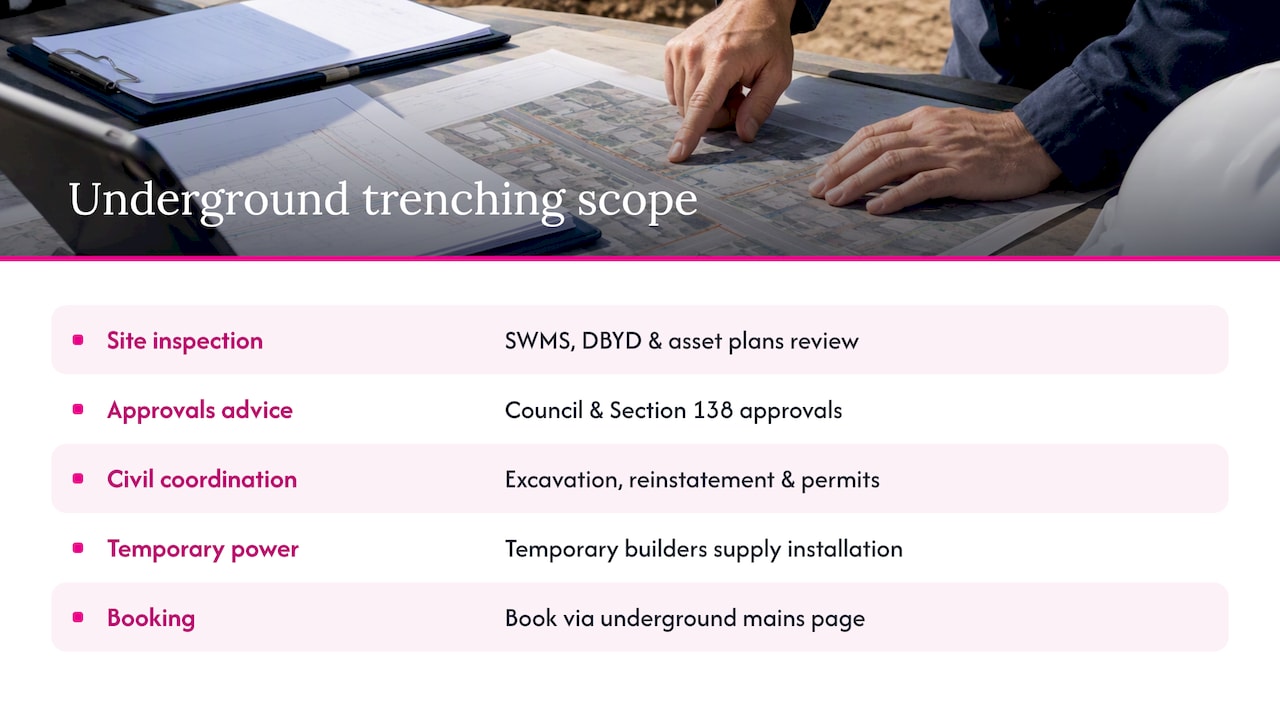
We provide underground service mains installation across Sydney, backed by Level 2 accreditation for work on energised assets that most electrical contractors can’t touch. We offer site inspections that cover SWMS scoping, a review of DBYD and asset plans, and guidance on which council or Section 138 approvals your job will need before we quote.

Where civil works are part of the job, our underground civil works team coordinates excavation, reinstatement and permit conditions alongside the electrical scope, so you aren’t managing separate contractors for digging and connection. For jobs that also need temporary power while the trench is open, we handle temporary builders supply installation as part of the same visit.
Book a site inspection through our underground service mains installation page to confirm what your specific site needs before any ground gets broken.
FAQ
What depth triggers an SWMS requirement for trenching in NSW?
A trench deeper than 1.5 metres is classed as high-risk construction work under SafeWork NSW rules, which makes a site-specific SWMS mandatory before work starts. Work near energised services or where a fall exceeding 2 metres is possible can trigger the same requirement even at shallower depths.
Is Dial Before You Dig enough to start excavating?
No. DBYD gives you a plan of registered assets and asset-owner contacts, but it isn’t a permit and doesn’t confirm exact depth or condition on-site. Physical validation through potholing or vacuum excavation is still needed before mechanical digging begins.
When do I need a council road-opening permit for trenching?
A Section 138 approval or road-opening permit is generally required whenever work disturbs a public road or footpath, as outlined by NSW government licensing guidance. Councils such as the City of Sydney typically require a traffic control plan, insurance proof and a restoration bond alongside the application.
Do I need a licensed contractor for trenching work?
Trade work involving excavation valued over $5,000, including labour and materials, requires the appropriate NSW contractor licence under NSW government rules. Work near electrical assets specifically requires a Level 2 accredited electrician.
What should I do if I suspect heritage relics during excavation?
If there’s any indication that relics or archaeological material might be disturbed, you may need a section 140 excavation permit or confirm a section 139(4) exception applies, according to Environment and Heritage NSW. An archaeological assessment prepared early avoids enforcement action and project delays.
Sources
Powering Your Needs with Expertise
If you’re looking for a reliable, experienced, and prompt electrician, look no further than High Demand Electrical. We cater to all your electrical needs, from routine maintenance to emergency repairs and complete system installations. Our skilled team is committed to providing professional service that ensures your electrical systems run smoothly. Whether it's a small task or a large project, give us a call today. Let us meet all your electrical demands with the quality and reliability you deserve.