What is a Smart Meter? The Complete Sydney Homeowner’s Guide for 2026
By 2030, every outdated analogue meter in Sydney must be replaced by law, yet many residents are still asking: what is a smart meter and how does it actually impact my daily life? If you've ever dealt with the frustration of an "estimated" bill or felt uncertain about who is legally authorised to touch your meter box, you aren't alone. These digital devices are no longer optional upgrades; they're the essential infrastructure required to modernise the NSW power grid and provide real-time visibility into your energy consumption.
We understand that new technology often brings concerns about data privacy and the fear of "bill shock" from new tariff structures. This guide provides the professional reassurance you need to navigate the transition with absolute confidence. You'll discover how smart meters facilitate seamless solar integration and EV charging, the strict regulatory standards for data security, and the specific installation protocols required by the July 2026 eCert mandate. We also detail why a qualified Level 2 ASP is critical for ensuring your switchboard meets current safety compliance during the mandatory rollout process.
Key Takeaways
• Define what is a smart meter and how it replaces outdated analogue dials with digital, interval-based reporting to eliminate estimated billing.
• Explore the functional benefits of digital metering, from pinpointing energy-heavy appliances to enabling future-proof solar and EV charger setups.
• Understand the step-by-step installation process, including the standard 30 to 60-minute power interruption required for a safe transition.
• Determine if your Sydney home requires a Level 2 ASP to manage technical complications like non-compliant switchboards or hazardous Zelemite panels.
• Get the facts on the mandatory 2030 rollout deadlines and the consumer protections designed to secure your data and manage tariff transitions.
What is a smart meter and why is NSW phasing out old ones?
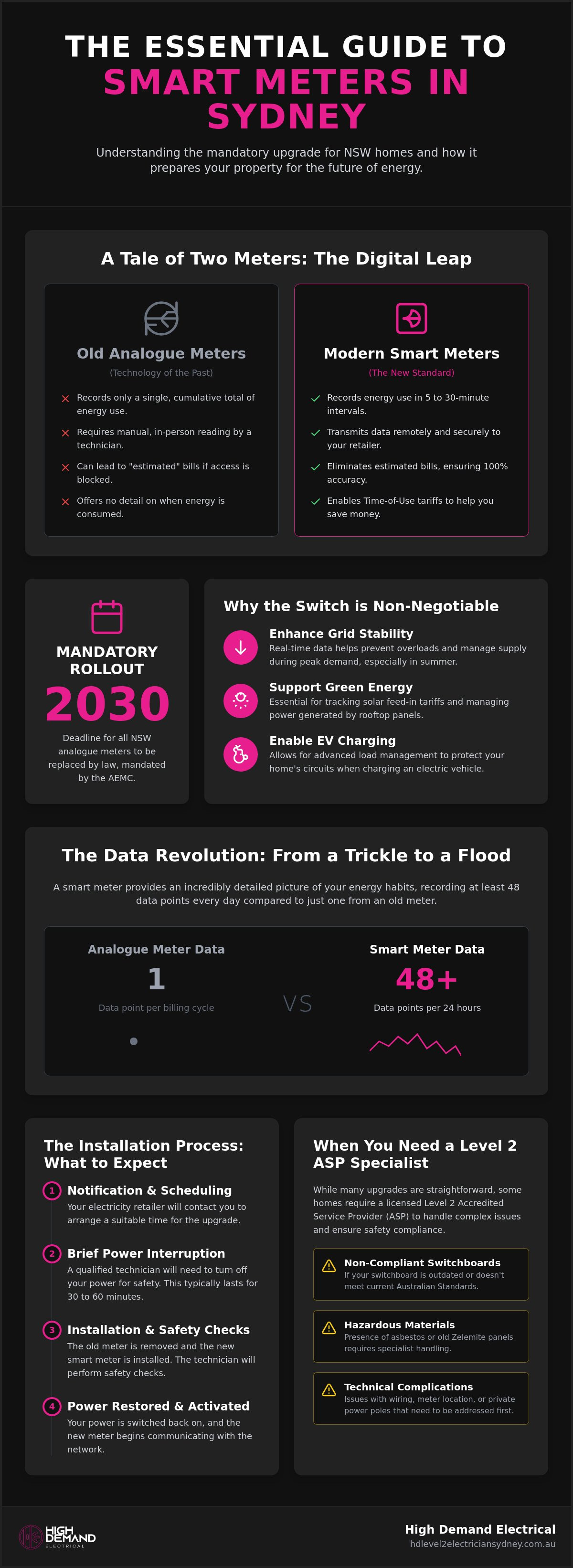
A smart meter is far more than a simple digital replacement for your old spinning dial; it's a high-precision computer for your electrical system. To truly grasp what is a smart meter, you need to understand its role as a two-way communication hub. While traditional meters only show a cumulative total of your energy use, a smart meter records consumption in granular 5 to 30-minute intervals. This data is then transmitted directly to your electricity retailer via a secure, encrypted wireless network. The Australian Energy Market Commission (AEMC) has officially mandated a 100% rollout across the National Electricity Market (NEM) by 2030. This transition isn't just a suggestion. It's a regulatory requirement designed to replace century-old technology with a system capable of supporting a 21st-century grid.
The primary reason for this phase-out is grid stability. As Sydney continues to adopt rooftop solar and electric vehicles at record rates, the network requires real-time data to prevent overloads and manage supply. You can learn more about the technical background of what a smart meter is to see how this technology is being implemented globally to modernise ageing infrastructure. By replacing analogue hardware with digital sensors, NSW is building a resilient energy network that can react to demand spikes instantly. The grid needs this data to remain stable.
The end of estimated bills
One of the most immediate benefits for Sydney residents is the total elimination of "estimated" bills. For years, homeowners with locked gates or pets have dealt with billing guesswork when a meter reader couldn't gain physical access to the property. Smart meters provide actual, verified usage data every single day, ensuring your bill reflects exactly what you've used. Because the device communicates remotely, it removes the need for manual site visits entirely. This transition to remote reading significantly reduces operational overheads for energy providers, which helps to put downward pressure on the service fees charged to consumers.
Supporting Sydney's green energy transition
Smart meters are the non-negotiable foundation for any sustainable home upgrade. If you're planning to install solar panels, the smart meter is the only way to accurately track your feed-in tariffs and ensure you receive credit for the excess power you generate. They're equally critical for advanced EV charging installations, as they allow for sophisticated load management that protects your home's electrical circuits. During Sydney's sweltering summer afternoons, these meters help the grid distribute power more efficiently. This prevents the localised blackouts that often occur when every air conditioner in the street is running at maximum capacity.
How smart meters differ from your old analogue dial meter
Understanding the technical leap between old and new hardware is essential for any homeowner. While an analogue meter is essentially a mechanical odometer for your house, a smart meter functions as a digital data terminal. The old spinning discs only provide a cumulative total, meaning your retailer knows how much power you've used but has no idea when you used it. By contrast, when you ask what is a smart meter, the answer lies in its ability to map your energy habits across the entire day with pinpoint accuracy.
This distinction allows retailers to offer Time of Use (ToU) pricing. Under this structure, you can lower your costs by running heavy appliances like dishwashers or pool pumps during off-peak periods when electricity is cheaper. Beyond billing, the remote capability means you'll never have to wait for a technician to visit your property to manually read the meter or reconnect the power when you move into a new home. Everything is handled digitally and instantly. According to the Australian Energy Regulator (AER), these remote services are a cornerstone of the modern energy market, designed to give consumers more control over their utility costs.
Data intervals and reporting
Old-fashioned meters record exactly one data point between billing cycles. Modern smart meters record at least 48 data points every 24 hours. These 30-minute intervals provide a precise profile of your household's energy demand. This information is transmitted through a secure, encrypted mobile network, similar to the technology used in 4G or 5G handsets. This ensures your data remains private and protected while providing the retailer with the exact figures needed for an accurate bill. When homeowners ask what is a smart meter, they often focus on the digital screen, but the real value is this constant, secure stream of interval data.
Physical differences in the meter box
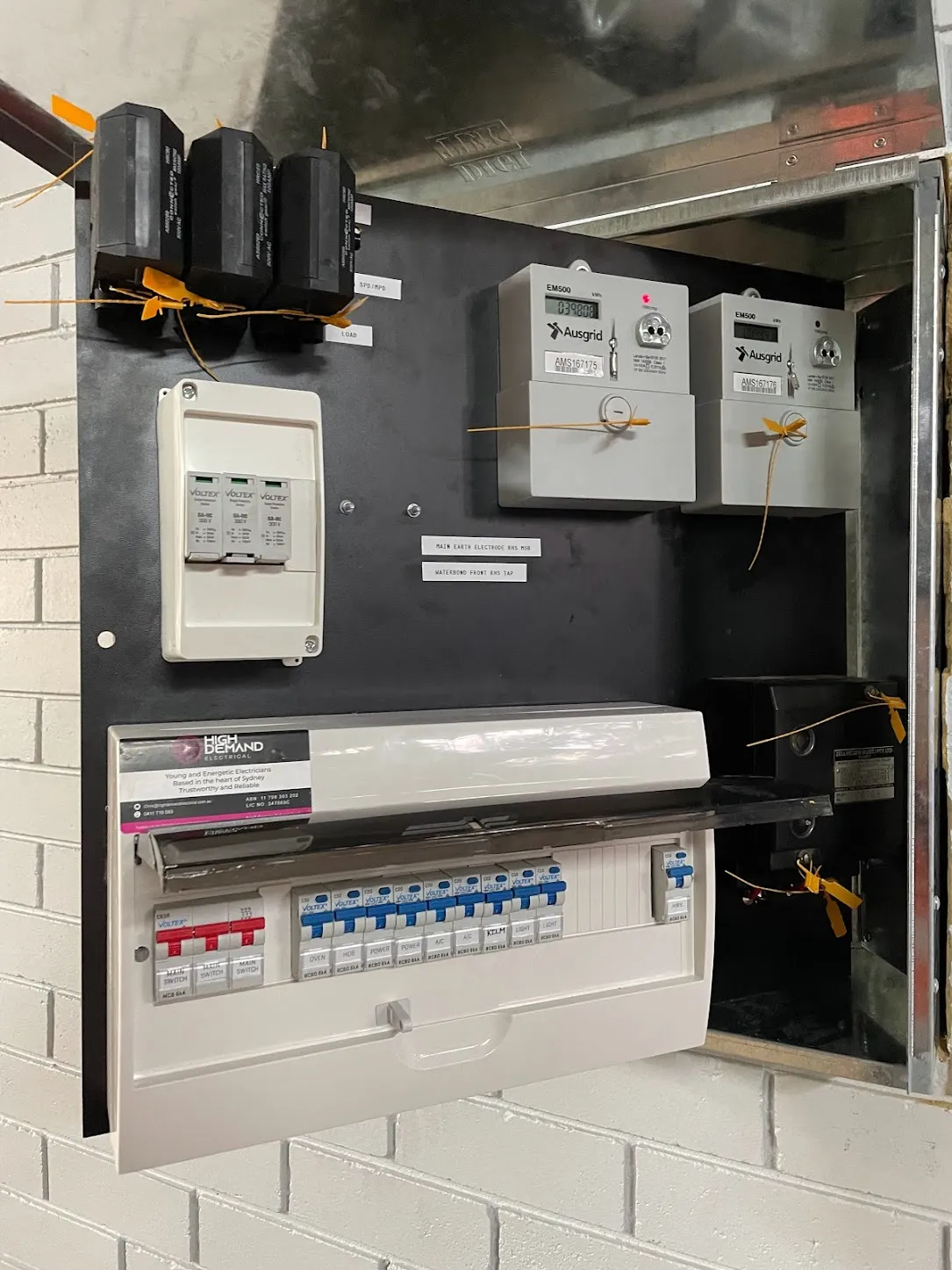
You'll immediately notice the physical shift from mechanical to digital. The clunky clock-face dials and spinning metal discs are replaced by a sleek digital display. These units are often more compact, which can free up valuable space in your enclosure. However, it's common for older Sydney properties to have meter boards that don't meet current safety standards. Before you book an installation, you should learn why switchboard upgrades are often required to accommodate these modern devices safely. If your current enclosure looks cluttered or outdated, it's wise to have a professional Level 2 ASP assess your setup before the mandatory rollout reaches your street.
The pros and cons of upgrading your electricity meter
Every technological shift involves a trade-off between convenience and adjustment. For Sydney residents, the primary advantage of a smart meter is the unprecedented level of visibility it provides. Most homeowners initially ask what is a smart meter because they want to reduce their quarterly expenses. By linking the device to your retailer's smartphone app, you can track energy consumption in real time. This allows you to identify "energy vampires," such as an old secondary fridge or a faulty pool pump, that are quietly inflating your costs. Additionally, these devices act as a digital sentry for your home. If a supply fault or localized outage occurs, your network provider is often notified automatically, allowing for faster restoration of power without you having to pick up the phone.
However, the transition does require a change in household habits. The most significant concern for many is the shift toward "Time of Use" tariffs. While these structures offer cheaper power during off-peak periods, they charge a premium during peak times, typically in the late afternoon and early evening. If you don't adjust your usage, you may experience "bill shock." It is also essential to debunk common myths regarding health. Smart meters emit low-level radio frequency (RF) signals, similar to a mobile phone or Wi-Fi router, and must comply with the strict safety standards set by the Australian Radiation Protection and Nuclear Safety Agency (ARPANSA). The technology is proven, safe, and regulated.
Managing 'Time of Use' tariffs
Success with a smart meter depends on your ability to "load shift." In Sydney, electricity prices are generally divided into peak, shoulder, and off-peak periods. You can save a substantial amount by simply setting your dishwasher or clothes dryer to run after 10:00 PM. Smart meters also enable "demand response" programs, where homeowners can receive financial incentives for voluntarily reducing their power load during extreme grid stress. Under current regulations, if your meter is installed between 2025 and 2030, retailers generally cannot change your tariff structure without your explicit consent for the first two years, providing a vital window to adjust your habits.
Privacy and health: what you need to know
Your energy data is protected under the Privacy Act and the Australian Privacy Principles, ensuring it is handled with the same level of security as your banking information. Only authorised energy companies have access to your usage data for billing and grid management purposes. Regarding the "opt-out" policy, the national rollout aims for 100% coverage by 2030, meaning you cannot legally refuse a meter replacement indefinitely. While you can request to have remote communication functions disabled, this often incurs manual reading fees that negate the cost-saving benefits of the upgrade. Transitioning early ensures you maintain control over the installation process and switchboard compliance.
The installation process: what to expect in Sydney
The transition to a digital grid is a coordinated effort across the Ausgrid and Endeavour Energy networks. For most residents, the process begins when your electricity retailer contacts you to schedule a mandatory upgrade as part of the 2030 rollout. Under current regulations, they must provide at least four business days' notice before the technician arrives. When the installer is on-site, the most critical step is the temporary disconnection of your power supply. This outage typically lasts between 30 and 60 minutes. During this window, the technician removes the old mechanical hardware and secures the new digital unit. Once the physical swap is complete, they will perform a series of safety tests to ensure the connection is stable before restoring your power.
Homeowners often ask what is a smart meter installation like in terms of immediate results. While the hardware is active the moment power returns, you won't see your data instantly. It generally takes up to 10 business days for the new meter to sync with your retailer's systems and for the interval data to appear in your online account or mobile app. The technician will provide a basic overview of the digital display, which allows you to manually check your usage if needed. This structured approach ensures that every Sydney home is brought up to the modern technical standards required for a reliable energy future.
Retailer-led vs. customer-led upgrades
There are two distinct paths to an upgrade. Retailer-led installations are part of the broader NSW phase-out of "end-of-life" or faulty analogue meters. These are usually performed at no upfront cost to the homeowner. However, customer-led upgrades are necessary if you are fast-tracking your home's technology. If you are installing a Tesla Powerwall or an EV charger, you cannot wait for the scheduled rollout. You must initiate the upgrade yourself. It's vital to distinguish between a standard retailer technician and a Level 2 ASP. A retailer technician is often limited in scope; if they discover a non-compliant switchboard or a hazardous Zelemite (asbestos) panel, they will legally refuse to complete the job. In these complex Sydney scenarios, you need a qualified Level 2 ASP to rectify the underlying infrastructure before the meter can be safely installed.
Preparing your property for the technician
Seamless installation requires active preparation. You must ensure the technician has unobstructed access to your meter box. This means unlocking side gates and ensuring pets are secured away from the work area. If your meter is located inside the property, you or a representative must be present to grant entry. Before the scheduled outage begins, you should proactively turn off sensitive electronic equipment, such as desktop computers and high-end AV systems, to prevent any risk of data loss or hardware stress during the power cycle. Always verify whether your meter is in a common area or a private enclosure before the appointment to avoid a "failed access" fee from your provider.
Why your Sydney home might need a Level 2 ASP for an upgrade
A standard smart meter rollout is often straightforward for modern suburban developments. However, Sydney's unique architectural history presents significant technical hurdles that standard retailer technicians are simply not authorised to handle. While you now understand what is a smart meter, you must also understand the limits of who can legally install one. Most retailers send basic electrical contractors who are only permitted to work on the meter itself. They cannot touch the incoming service lines, the main switchboard fuses, or the consumer mains. If your property requires any work on the "service side" of the network, you must Contact a Level 2 Electrician in Sydney who holds the necessary ASP accreditation for Ausgrid or Endeavour Energy areas.
The difference in capability is critical. A Level 2 ASP acts as the bridge between the street's high-voltage power and your home's internal wiring. When a standard technician arrives and discovers a non-compliant setup, they will legally refuse the job, often leaving you with a Defect Notice and a disconnected project. Engaging a specialist from the outset ensures that any infrastructure issues are identified and rectified before the installation begins, preventing unnecessary delays and ensuring your home meets the July 2026 eCert compliance standards.
Dealing with asbestos and wooden meter panels
Older Sydney properties, particularly those built before the mid-1980s, often feature Zelemite or bituminous asbestos meter boards. These black, pitch-based panels pose a severe health risk if they are drilled or cut. If a standard retailer technician identifies a Zelemite board or an outdated wooden enclosure, they will immediately halt the installation. A Level 2 ASP is specifically trained and equipped to safely remove hazardous materials and modernise your switchboard to meet current NSW safety standards. This professional intervention is the only way to transform an antiquated, dangerous meter box into a safe, digital-ready hub.
Handling complex infrastructure upgrades
Modern energy demands often exceed the capacity of original Sydney wiring. If you are asking what is a smart meter because you've just purchased a Tesla or another EV, you likely need more than just a new digital display. Many older homes operate on a single-phase supply that is insufficient for rapid EV charging or large solar arrays. A Level 2 ASP can manage the following complex requirements:
3-Phase Upgrades
Increasing your home's power capacity to support high-speed charging and modern air conditioning loads without tripping the mains.
Meter Relocation
Moving the enclosure during a renovation or extension to ensure it remains accessible and compliant with network regulations.
Consumer Mains Upgrades
Replacing the heavy-duty cables that run from the street to your switchboard to ensure they can handle the increased digital load safely.
Securing a qualified specialist ensures that your infrastructure is future-proofed, preventing equipment failure or safety hazards that occur when modern technology is forced onto an antiquated electrical system.
Secure Your Energy Future with a Compliant Upgrade
The transition to a digital grid is a legal requirement that will impact every Sydney household by 2030. While the primary goal of the rollout is to eliminate estimated billing and stabilise the network, the process often reveals hidden infrastructure risks in older properties. Whether you are managing an asbestos-riddled Zelemite board or preparing for a high-speed EV charger installation, the technical integrity of your switchboard is paramount. Understanding what is a smart meter allows you to take control of your consumption, but ensuring the installation is safe requires specialised expertise.
High Demand Electrical provides the professional reassurance necessary for complex Sydney upgrades. As Accredited Level 2 ASP Sydney Specialists, we offer expert handling of Ausgrid and Endeavour Energy networks, including asbestos-safe switchboard modernisations that standard contractors cannot perform. Don't wait for a defect notice to disrupt your power. Book your Level 2 ASP smart meter upgrade with High Demand Electrical today to ensure your home is ready for the 2026 standards. We are here to guide you through every technical step with absolute competence and speed.
Frequently Asked Questions
Is a smart meter mandatory in NSW?
Yes, smart meters are mandatory for all New South Wales homes and businesses by 2030. This deadline was established by the Australian Energy Market Commission to ensure 100% coverage across the National Electricity Market. You cannot refuse a replacement if your current meter is faulty or has reached the end of its certified life. This regulation ensures the entire grid can transition to a more stable, digitalised system.
Will my electricity bill go up with a smart meter?
Your bill won't automatically increase, but your pricing structure may transition to a Time of Use tariff. This means you'll pay more during peak evening hours and less during off-peak periods. For those who shift heavy appliance use to the middle of the day or late at night, a smart meter can actually lead to lower quarterly costs. It provides the data needed to make informed choices about your consumption habits.
How do I read a smart meter display?
Most digital displays cycle through several screens automatically to show your total energy consumption in kilowatt-hours (kWh). You'll typically see a "Total" reading followed by the current date and time. If you have solar, the meter will also display a separate reading for the energy you've exported back to the grid. Understanding what is a smart meter display showing helps you track your feed-in tariffs in real time.
Can a smart meter tell what appliances I am using?
No, the device does not monitor individual appliances or record specific household activities. It only measures the total volume of electricity entering your home at any given moment. While high-resolution interval data can show "spikes" when a heavy appliance like an oven starts, it cannot identify the specific brand or type of equipment in use. Your data is strictly used for billing and grid management purposes.
Do smart meters cause health problems from radiation?
There is no evidence that smart meters cause health issues, as they emit very low levels of radio frequency (RF) radiation. These emissions are significantly lower than those from a standard mobile phone or a home Wi-Fi router. All devices installed in Sydney must strictly adhere to the safety standards set by the Australian Radiation Protection and Nuclear Safety Agency (ARPANSA) to ensure they are safe for residential environments.
What happens if my meter board is found to be unsafe during the upgrade?
If a technician identifies a hazardous Zelemite board or a non-compliant switchboard, they will issue a Defect Notice and halt the installation. This is a common occurrence in older Sydney suburbs where infrastructure hasn't been updated in decades. In this scenario, you must engage an accredited Level 2 ASP to modernise your infrastructure and clear the defect before the upgrade can legally proceed.
Can I opt out of the smart meter rollout?
You cannot opt out of the national rollout, as the transition is legally required to modernise the Australian power grid. While you can request that the remote communication features be disabled, this often results in manual reading fees that negate the benefits of the upgrade. When asking what is a smart meter and its necessity, remember that it is the required standard for all future grid connectivity.
Who is responsible for the cost of a smart meter installation?
For a standard retailer-led rollout or the replacement of a faulty unit, there is typically no upfront cost to the homeowner. However, if you request an upgrade specifically for a solar installation, a battery, or an EV charger, you may be responsible for the installation fees. You will also bear the cost of any necessary switchboard repairs or asbestos removal required to make the site safe for the new hardware.
Related Services
Powering Your Needs with Expertise
If you’re looking for a reliable, experienced, and prompt electrician, look no further than High Demand Electrical. We cater to all your electrical needs, from routine maintenance to emergency repairs and complete system installations. Our skilled team is committed to providing professional service that ensures your electrical systems run smoothly. Whether it's a small task or a large project, give us a call today. Let us meet all your electrical demands with the quality and reliability you deserve.