
Underground Power Connection Sydney: A Guide to New Connections
What if the cable is the simplest part of an underground power connection Sydney property owners need to plan? The project also involves work at the electricity network boundary and within the property, and understanding who handles each part can help you prepare safely and avoid confusion.
It’s reasonable to expect one straightforward installation, but an underground connection is a coordinated network-and-property project. This guide explains the main stages, what property and network details to gather, and how Level 1 and Level 2 Accredited Service Provider (ASP) work differs. You’ll also learn what to look for in a provider’s documented credentials.
High Demand Electrical (HDE) provides Level 1 network construction and new connection work, and Level 2 service, metering and connection work. HDE is newly accredited with IAC for Level 1 network construction and new connection work, and authorised for specified Level 2 work for Ausgrid, Endeavour Energy and Essential Energy. The article covers how consumer mains can fit into the project and what to consider as you plan your next steps. For enquiries, HDE can be reached on 0402 559 777 or at chris@highdemandelectrical.com.au.
Key Takeaways
• An underground power connection Sydney project links a property to the electricity supply through underground infrastructure, with the route shaped by the site and project needs.
• Understand how Level 1 network construction and new connection work differs from Level 2 service, metering and connection work.
• Compare underground and overhead routes by visibility, route planning and property conditions to help identify what needs consideration for your site.
• Prepare the property address, project purpose and any known supply details to support an informed initial discussion.
• High Demand Electrical holds EC Licence 397193C and triple ISO certification: ISO 9001, ISO 45001 and ISO 14001. Call 0402 559 777 or email chris@highdemandelectrical.com.au.
What an underground power connection in Sydney involves
An underground power connection Sydney property owners may need is an electricity supply route that uses cables and other infrastructure below ground to link a property with the distribution network. The route and work involved depend on the site, the existing supply and the purpose of the project, so there isn’t one design that suits every property.
A new build may need a new supply connection, while a property with changed supply needs may require connection work to be considered. These are examples, not automatic specifications. The project scope is determined by the property and connection requirements.
For a general overview of how an underground power line is installed and the trade-offs involved, see the background information on underground power lines.
To see an illustrative cable installation, watch this video from Building Stuff Australia:
How network infrastructure and consumer mains relate
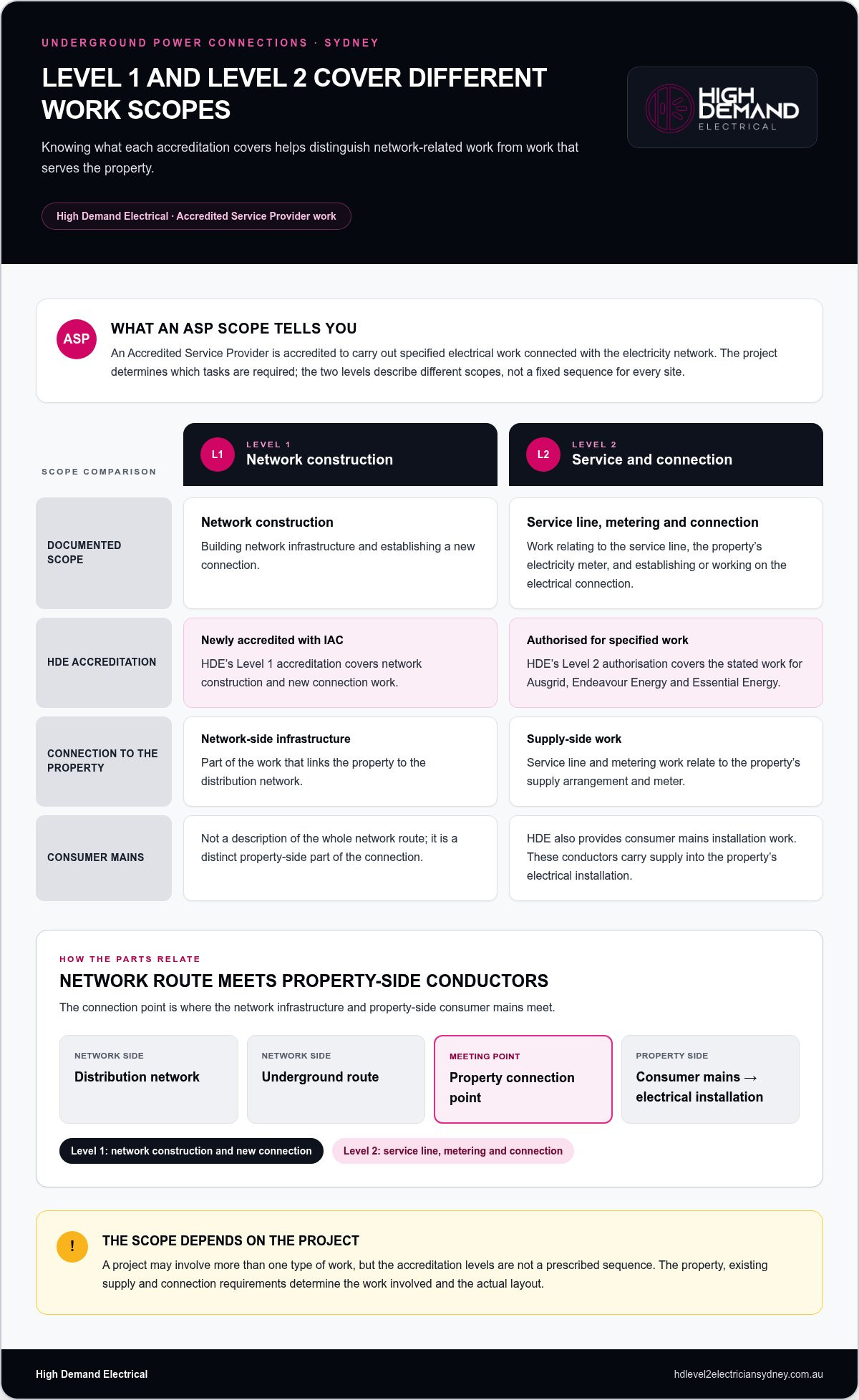
Think of the connection as two related parts: infrastructure that links the property to the electricity network, and property-side conductors that carry the supply into the electrical installation. These parts meet at a connection point, but they are distinct work areas and may involve different accredited scopes.
In plain terms, an underground power connection links a property to the distribution network through underground infrastructure, while consumer mains carry the supply from the connection point into the property.
Simple connection diagram:
Network infrastructure
distribution network → underground route → property connection point
Property-side consumer mains
connection point → conductors supplying the property’s electrical installation
Consumer mains are the electrical conductors that serve a property. Their arrangement is part of the property-side scope, not a description of the whole network route. HDE’s consumer mains installation work relates to this part of a connection project. The diagram is a guide to the distinction; the actual layout depends on the site.
When a new connection project may be relevant
New connection work may be relevant for a residential or small-business property being built, or when supply needs have changed and connection work is being considered. Those circumstances don’t, by themselves, determine a design or establish exactly what work is required. The property and project shape the scope.
High Demand Electrical provides new connection work and network construction as a Level 1 ASP, and service line and consumer mains work as a Level 2 ASP. HDE is newly accredited with IAC for Level 1 network construction and new connection work. For details of its Level 2 electrical work in Sydney, see the service information.
How Level 1 and Level 2 ASP work fits an underground connection
An Accredited Service Provider (ASP) is a provider accredited to carry out specified electrical work connected with the electricity network. For an underground power connection Sydney project, knowing an ASP’s accredited scope helps distinguish network-related work from the work that serves the property. The required tasks depend on the project; the two accreditation levels describe different scopes, not a fixed sequence that applies to every site.
HDE’s documented Level 1 scope covers network construction and new connection work, while its Level 2 authorisation covers service line, metering and connection work for Ausgrid, Endeavour Energy and Essential Energy.
What HDE’s Level 1 accreditation covers
HDE is newly accredited with IAC for network construction and new connection work. In practical terms, this is the documented Level 1 scope relevant to building network infrastructure or establishing a new connection. It sits alongside, rather than replacing, HDE’s Level 2 service and metering work. The exact scope needed for a property depends on its connection project, so this accreditation does not mean every site follows the same design or construction sequence.
What HDE’s Level 2 accreditation covers
Level 2 Accredited Service Provider (ASP) - authorised to carry out service line, metering and connection work for Ausgrid, Endeavour Energy and Essential Energy. A service line is the part of the supply arrangement connecting a property with the network. Metering work relates to the property’s electricity meter, while connection work concerns establishing or working on the electrical connection. HDE’s Level 2 electrician services in Sydney cover this accredited work.
These scopes can be relevant to different parts of one project. For example, a new connection may involve network construction considerations as well as service line or metering work. That example is not a specification: the tasks involved depend on the property and the work required. Consumer mains, the conductors that carry supply within the property, are another distinct part of the electrical work and may also form part of the project scope.
Before planning work, keep the distinction clear: Level 1 describes HDE’s accredited network construction and new connection scope; Level 2 describes its authorised service line, metering and connection work. Accreditation applies to specified work, so it’s useful to understand which scope relates to each task rather than treating “ASP work” as one broad category.
HDE holds EC Licence 397193C and triple ISO certification: ISO 9001, ISO 45001 and ISO 14001. To discuss an underground connection project, call 0402 559 777 or email chris@highdemandelectrical.com.au.
Underground or overhead power connection: what Sydney property owners should weigh
Choosing between an underground and overhead route isn’t simply a matter of appearance. An underground route runs below ground, while an overhead route is visibly supported above ground. Each option has a different physical presence and may interact differently with a property’s layout. For an underground power connection Sydney project, compare the routes as a planning exercise, then consider the actual site and connection requirements.
A clear view of the property can help frame the discussion. Consider where a possible route would run, what parts of the supply would be visible and how the connection fits the property’s existing layout. These are useful questions to organise, not technical requirements or a guarantee that either route can be used.
How to compare connection routes without assuming one is right
Underground infrastructure is concealed below ground; overhead infrastructure remains visible and is supported above ground. That basic difference can affect how a route appears and how it relates to the property. The proposed path, the property’s layout and the existing supply are relevant context for planning. A comparison can help clarify priorities, but it can’t establish the suitable route without assessment of the specific project.
| Comparison point | Documented difference | Requires project-specific assessment |
|---|---|---|
| Visibility | Underground routes are below ground; overhead routes are visible above ground. | How either route fits the property and its surroundings. |
| Route planning | The physical route differs: below ground or above ground. | The feasible route and work for the particular site. |
| Connection choice | Both describe ways of routing electricity supply infrastructure. | Which option suits the project and relevant network and site conditions. |
Use the table to separate what’s inherent to each route from what can’t be decided in general terms. For example, a preference for less visible infrastructure doesn’t by itself establish that an underground route is suitable. The same applies to an overhead route: its visible presence alone doesn’t determine whether it fits a particular project.
Which rules and technical frameworks matter
Connection planning in NSW refers to the Service and Installation Rules of NSW (SIRNSW), the industry code for connecting to the electricity distribution network. Electrical installation work is addressed by AS/NZS 3000, the Wiring Rules. These frameworks relate to different aspects of the work: network connection and the electrical installation. Naming them doesn’t determine a design or confirm that a particular route is appropriate.
The comparison is a starting point, not a substitute for assessing the property and project. The relevant network and site conditions help determine what work and route are applicable. Keep the decision grounded in the actual connection scope rather than assuming underground or overhead supply is always safer, cheaper, more reliable or preferred.
Planning an underground power connection in Sydney: information to prepare
A useful first discussion starts with a clear picture of the property and what you’re trying to achieve. For an underground power connection Sydney project, you don’t need to settle the technical design in advance. Gather what you already know, identify what’s uncertain and describe the work in plain terms. The scope and any coordination needs depend on the connection project and the site.
What property and project details to organise
Have the property address ready and describe the proposed work as clearly as you can. For example, note whether you’re planning a new connection or considering changes to an existing supply. If you know details about the consumer mains or current supply arrangement, include them. Don’t inspect electrical equipment to find out. Clear information helps frame a relevant discussion without assuming what the property needs.
How to keep the project discussion clear
Separate what you know from what you suspect. You might know the property is a new build, for instance, but not know how its supply will be arranged. Recording that distinction helps prevent assumptions from being mistaken for confirmed site details. HDE’s underground service mains installation information relates to service mains work, one aspect that may be relevant to an underground connection.
Use this checklist to prepare for an initial discussion:
Property address
write down the location of the connection project.
Project purpose
state whether it concerns a new connection or existing supply infrastructure.
Known supply details
note any information you already have about the supply or consumer mains, without investigating electrical equipment yourself.
Known facts and unknowns
distinguish confirmed details from questions or assumptions about the property.
Site context
describe relevant property or project circumstances you’re already aware of, without trying to specify a route or technical design.
This is a preparation aid, not a prescribed application, approval pathway or promise of a particular timeframe. It doesn’t replace project assessment or establish which work is needed. It simply gives the discussion a useful starting point and helps keep known information separate from matters that still need to be understood.
That distinction matters because an underground connection can involve related but separate network and property-side work. The route, required scope and coordination depend on the particular site and connection. Avoid treating an assumption about the existing arrangement as a confirmed requirement; a clear description of the project is more useful than trying to decide the technical solution yourself.
Prepare these details to discuss your connection project with High Demand Electrical. Call 0402 559 777, email chris@highdemandelectrical.com.au or contact HDE about your underground connection.
Arrange underground power connection work with High Demand Electrical
Planning an underground power connection in Sydney involves understanding which parts of the work relate to the network and which relate to the property. High Demand Electrical (HDE) brings documented Level 1 and Level 2 ASP scopes to connection work, including new connections, network construction, service line work and consumer mains work. The work required depends on the property and project, so a clear discussion starts with the location and what you need done.
The credentials behind HDE’s connection work
HDE is Engnet Pty Ltd, trading as High Demand Electrical. HDE is newly accredited with IAC for network construction and new connection work at Level 1. Its Level 2 scope is distinct:
Level 2 Accredited Service Provider (ASP) - authorised to carry out service line, metering and connection work for Ausgrid, Endeavour Energy and Essential Energy.
In practical terms, network construction and new connection work concern the documented Level 1 scope. Service line work relates to the supply connection between the property and network, while metering and connection work fall within HDE’s specified Level 2 authorisation. Consumer mains work concerns conductors supplying the property and can also form part of an underground connection project. These descriptions help distinguish scopes; they don’t prescribe the work for a particular site.
HDE holds EC Licence 397193C and triple ISO certification: ISO 9001, ISO 45001 and ISO 14001. The licence and certifications are documented credentials, alongside the specific Level 1 and Level 2 scopes relevant to connection work.
HDE provides Sydney-wide service across the Inner West, Sydney’s West, South West and the Sutherland Shire. If your property is in one of these areas, you can describe whether the project concerns a new connection, an existing supply or associated consumer mains work. Keep known details separate from assumptions about how the current supply is arranged. That gives the project discussion a practical starting point without presuming a design, price, timeframe or outcome.
Discuss your Sydney connection project
Have the property address ready and explain the purpose of the work. For a new build, say that you’re planning a new connection; for an existing property, outline the supply work you’re considering. You don’t need to determine the technical scope yourself. HDE can discuss the connection work in relation to the property and its documented ASP scopes.
To discuss your property’s underground connection project, call 0402 559 777 or email chris@highdemandelectrical.com.au. You can also Discuss your underground power connection with HDE.
Take the next step towards a planned connection
The most useful next move is to turn your intention into a clear project brief. Note what you want the connection to achieve and what you’d like clarified about the property’s supply route. You don’t need to settle every technical detail before starting the conversation. A focused discussion can help identify the questions that matter for your site and the work to consider next.
For an underground power connection Sydney project, keep the decision grounded in the property rather than assumptions about a standard design. Share the address, whether the work concerns a new connection or an existing supply, and any relevant details you already know. That gives the discussion a practical starting point without presuming a scope, timeframe or outcome.
High Demand Electrical holds EC Licence 397193C, and its Level 2 Accredited Service Provider (ASP) authorisation covers service line, metering and connection work for Ausgrid, Endeavour Energy and Essential Energy. HDE also holds triple ISO certification: ISO 9001, ISO 45001 and ISO 14001.
Ready to discuss your property and project? Start a conversation about your underground power connection. A clear first step can make planning feel more manageable.
Frequently Asked Questions
Which electricity networks is High Demand Electrical’s Level 2 ASP accreditation for?
High Demand Electrical’s Level 2 accreditation is: “Level 2 Accredited Service Provider (ASP) - authorised to carry out service line, metering and connection work for Ausgrid, Endeavour Energy and Essential Energy.” This statement identifies HDE’s authorised work and the named network providers. It doesn’t identify which distribution network supplies a particular address, so don’t infer the network serving your property from the accreditation wording alone.
Is High Demand Electrical accredited for new connection work?
Yes. HDE is newly accredited with IAC for network construction and new connection work. This Level 1 scope is in addition to its Level 2 service and metering work. For an underground power connection Sydney project, accreditation describes the work HDE is accredited to perform; it doesn’t, by itself, establish a specific project’s approval, connection design or completion timeframe. Those details shouldn’t be assumed from the accreditation statement.
Can High Demand Electrical install consumer mains?
Yes. Consumer mains installation is a service HDE provides. Consumer mains are the property-side electrical supply conductors that carry supply from the connection point into the property’s electrical installation. This work is distinct from network construction, which relates to network infrastructure. A new build and an existing property with changed supply needs may have different scopes; the project determines what consumer mains work is relevant. No particular specification or result should be assumed.
What standards and rules are relevant to electrical connection work in NSW?
The referenced frameworks include the Service and Installation Rules of NSW (SIRNSW), AS/NZS 3000 (Wiring Rules), AS/NZS 3008, and the Electrical Safety Rules of Ausgrid, Endeavour Energy and Essential Energy. These are named rule and technical-reference frameworks for electrical installation and network-related work. Their inclusion doesn’t determine which provisions apply to an individual property or confirm a project’s compliance; the specific work and site are relevant.
Where does High Demand Electrical provide services in Sydney?
High Demand Electrical’s service area is Sydney-wide, including the Inner West, Sydney’s West, South West and the Sutherland Shire. If you’re making an enquiry from one of these areas, provide the property address and explain whether the work concerns a new connection or existing supply infrastructure. This helps locate the project for discussion. These documented areas describe HDE’s Sydney coverage and don’t extend the stated service area to other regions.
How can I contact High Demand Electrical about an underground connection?
Contact High Demand Electrical on Phone 0402 559 777 or by Email chris@highdemandelectrical.com.au. Include the property address and say whether you’re planning a new connection or considering work to existing supply infrastructure. For an underground power connection Sydney enquiry, add any supply details you already know and distinguish confirmed information from assumptions. This gives the discussion useful context without implying a set quote, response time or project outcome.
Powering Your Needs with Expertise
If you’re looking for a reliable, experienced, and prompt electrician, look no further than High Demand Electrical. We cater to all your electrical needs, from routine maintenance to emergency repairs and complete system installations. Our skilled team is committed to providing professional service that ensures your electrical systems run smoothly. Whether it's a small task or a large project, give us a call today. Let us meet all your electrical demands with the quality and reliability you deserve.

