
Temporary Power Safety on NSW Sites: File CCEWs Within Seven Days
Temporary power on a NSW site must meet AS/NZS 3012 and the Wiring Rules, with every final sub-circuit to a socket outlet protected by a 30mA Type A RCD, and critical work done or signed off by a licensed electrician. From 1 July 2026, the Certificate of Compliance for Electrical Work (CCEW) must be lodged through the BCNSW eCert portal within seven days of the compliance test, with full test logs and SWMS kept on site.
TL;DR:
- Temporary switchboards need IP23 enclosures, clear supply origin labels, and padlockable isolators; network connections and private poles require a Level 2 electrician.
- A licensed electrician must test earthing continuity, insulation resistance, polarity, and RCD operation before energization; portable leads, tools, and lighting need testing every three months.
- A push button RCD check does not confirm trip speed; timed tests and recorded results can reveal devices beginning to fail.
- Safe Work Australia sets a distance of 4 meters for metallic scaffolding near low voltage lines; confirm it with the electricity authority before work.
Table of Contents
- When you need temporary power and the supply options available on NSW sites
- Core regulatory requirements: AS/NZS 3012 and the wiring rules on site
- Generators and inverters: standards, safe connection and site protection
- Inspection, testing and record keeping on a temporary power site
- Working near overhead and underground power lines on site
- Compliance paperwork: BCNSW eCert, CCEW timelines and penalties
- Site manager checklist: keeping temporary power safe and inspection-ready
- How we approach temporary power safety in NSW
- What matters most in temporary power compliance
- How High Demand Electrical can help with your temporary power setup
- FAQ
- Sources
When you need temporary power and the supply options available on NSW sites
Construction managers, owner-builders and event organisers all end up needing a non-permanent electricity supply at some point: new builds and renovations before the meter box goes in, demolition work, outdoor events, and equipment testing on a site with no fixed board yet. The right setup depends on load, duration and how far the site sits from the network connection point.
A temporary builders supply (sometimes called a construction site switchboard) is the standard option for building sites. It draws from the network through a dedicated temporary connection and distributes power through a purpose-built switchboard with RCD-protected outlets. Portable generators, covered by AS 2790, suit sites without network access or as backup during outages. Inverters supply smaller loads where mains power is impractical, and portable socket outlet assemblies (PSOAs) extend protected power around a site from an existing supply point.
Not every connection is a job for any licensed electrician. Work on consumer mains, private power poles or anything touching the network’s overhead or underground service mains requires a Level 2 electrician with Authorised Service Provider (ASP) status. Everything downstream of that connection point, including the site switchboard itself, falls to a standard licensed electrician.
- New builds and renovations typically need a temporary builders supply installed before permanent metering is available.
- Demolition and short-term sites often rely on generators or PSOAs for localised power.
- Events commonly combine generators with distribution boards feeding festoon lighting and catering equipment.
- Network-side work, including private poles and service mains, always needs a Level 2 electrician.
Core regulatory requirements: AS/NZS 3012 and the wiring rules on site
AS/NZS 3012:2019 is the standard NSW relies on for electrical installations on construction and demolition sites, and SafeWork NSW’s own construction site electrical guidance calls it up directly as the benchmark for compliance. It sits alongside AS/NZS 3000, the general wiring rules, and covers everything from switchboard construction to inspection schedules.
Switchboards on site need to be built and positioned to avoid mechanical damage, with a minimum IP23 enclosure rating, clear labelling showing the origin of supply, and a padlockable isolating switch so the board can be locked off during maintenance or when work stops for the day. These aren’t optional extras: they’re the baseline SafeWork NSW expects an inspector to find on any active site.
Every final sub-circuit supplying a socket outlet on a construction or demolition site must be protected by an RCD rated at a maximum of 30mA, and that RCD must be Type A. This single requirement is the backbone of temporary power safety in NSW: it’s what limits the severity of an electric shock if a tool, lead or appliance develops a fault.
Lighting circuits, including festoon lighting strung across a site or event space, need the same RCD protection where they feed socket outlets, and socket ratings must match the connected load rather than being oversized for convenience.
- Switchboards need IP23 minimum enclosures, clear origin-of-supply labelling and a padlockable isolating switch.
- All final sub-circuits to socket outlets require 30mA Type A RCD protection.
- Festoon and site lighting circuits need the same RCD coverage where outlets are involved.
- Socket outlets should be rated to the actual connected load, not oversized “just in case”.
Generators and inverters: standards, safe connection and site protection
Portable generators used on NSW sites and events need to meet AS 2790, with connection practices guided by AS/NZS 3010 where a generator feeds fixed wiring or a distribution board rather than standalone tools. The distinction between generator types matters for safety: isolated winding generators create their own electrical reference and generally don’t need the same earthing arrangements as permanently connected units, while generators wired into a site’s fixed installation need proper earthing and RCD protection matched to the circuits they feed.
A generator feeding a few power tools through its own outlets is a different proposition to one connected to a switchboard supplying an entire site. The latter needs a licensed electrician to set up correctly, with earthing, RCD protection and isolation arranged so the generator can’t back-feed the network or create a shock hazard.
Fuel storage, ventilation and fire safety deserve the same attention as the electrical side. Generators should run in open or well-ventilated areas away from site offices and storage, with fuel kept clear of ignition sources and refuelling done only when the unit is switched off and cool.
Inverter-based supplies work for smaller, steady loads but need the same RCD protection and periodic testing as any other temporary circuit. They’re not a shortcut around compliance, just a different way of generating the power that still has to be delivered safely.
- Standalone generators (AS 2790) suit isolated tool use with minimal connection complexity.
- Generators feeding fixed wiring need AS/NZS 3010 compliant connection, earthing and RCD protection.
- Fuel and ventilation planning reduces fire risk around running generators.
- Inverter supplies still need RCD protection and regular testing, not just a mains alternative.
Inspection, testing and record keeping on a temporary power site
Every temporary installation needs testing before it’s switched on, not after. Under AS/NZS 3012, a licensed electrical worker must inspect and test construction wiring, switchboards and transportable structures prior to energisation, confirming earthing continuity, insulation resistance, polarity and RCD operation.
After that first test, the site isn’t finished with inspections. Switchboards and construction wiring need re-inspection at set intervals while the site remains active, and portable appliances, including leads, power tools and site lighting, typically require testing every three months under AS/NZS 3760.
- Pre-energisation: a licensed electrician tests earthing, insulation resistance, polarity and RCD function before any circuit goes live.
- Periodic re-inspection: switchboards and construction wiring are checked at scheduled intervals for the life of the site.
- Portable equipment testing: leads, tools and fittings are tested roughly every three months in line with AS/NZS 3760.
- RCD verification: both the push-button functional test and a timed trip test confirm the device still operates within its rated time.
RCDs aren’t a “set and forget” safety device. A push-button test only proves the mechanism moves; a timed trip test confirms it actually interrupts the circuit fast enough, and recording that trip time lets a site pick up on a unit that’s starting to drift before it fails outright.
Pro Tip: Keep test logs in a weatherproof folder at the switchboard itself, not in a site office trailer, so an inspector or new subcontractor can check compliance on the spot.
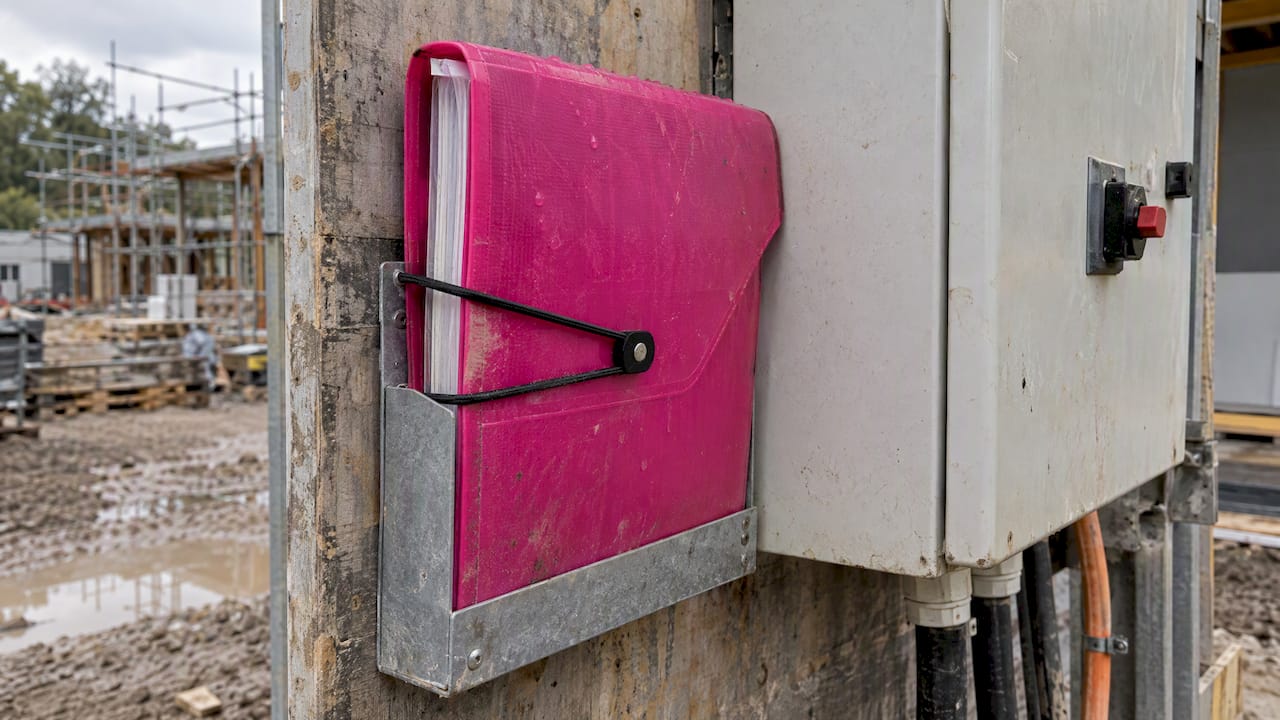
The site supervisor carries the responsibility for making sure these records exist and stay accessible, since an inspector who turns up and finds no test history will treat the site as non-compliant regardless of what’s actually been done electrically.
Working near overhead and underground power lines on site
Scaffolding, cranes and mobile plant near live power lines are where temporary power safety intersects with the rest of a construction site, and the approach distances are not negotiable guesswork. Safe Work Australia’s guidance sets a 4 metre approach distance for metallic scaffolding near low voltage overhead lines, with de-energisation treated as the preferred control wherever it’s practical rather than relying on distance alone.

Other commonly used minimum distances include roughly 3 metres for cranes and mobile plant and around 0.5 metres for hand-held tools, though every distance depends on the line’s voltage and needs confirmation from the asset owner before work starts. These aren’t universal figures to apply blindly: a transmission line carries very different risk to a low voltage service line, and the Electricity Supply Authority is the right party to confirm which applies.
Work zones are typically described as Zone A (no work without authorisation), Zone B (work permitted with specific controls) and Zone C (standard precautions apply), and moving into Zone A or B without the relevant authority’s sign-off is a serious breach rather than a minor paperwork gap.
- Confirm exact approach distances with the Electricity Supply Authority before scaffolding, cranes or plant go near any line.
- De-energisation is the preferred control, not a last resort, when work must happen close to lines.
- Non-conductive scaffolding, insulating matting and tiger tails reduce risk where de-energisation isn’t possible.
- A dedicated safety observer and a written SWMS are standard practice for any work inside the advisory zones.
Compliance paperwork: BCNSW eCert, CCEW timelines and penalties
A Certificate of Compliance for Electrical Work (CCEW) is the formal record confirming electrical work meets NSW safety standards, and it’s the licensed electrician who carried out the work who must submit it, not the site manager or client. NSW Government guidance on CCEW submission sets out exactly when and how this has to happen.
From 1 July 2026, every CCEW must be lodged electronically through the Building Commission NSW (BCNSW) eCert portal within a short period after completing the safety and compliance test, specifically within one week, and older submission methods, including PDF forms, are no longer accepted. Missing that window can lead to on-the-spot fines, so it’s worth building the submission into the job’s final step rather than leaving it until a client chases paperwork.
- Confirm your electrician is registered for BCNSW eCert before work starts, not after the job’s finished.
- The safety and compliance test must check earthing continuity, insulation resistance, polarity and RCD operation.
- Submit the CCEW within seven days of the compliance test, every time, with no exceptions for small jobs.
- Hand the client or venue manager a copy of the CCEW and test records at project handover.
Good electrical compliance support makes this part of routine practice rather than a scramble at the end of a job, and sites that treat documentation as part of the install, not an afterthought, rarely run into enforcement issues.
Site manager checklist: keeping temporary power safe and inspection-ready
A short daily and pre-energisation routine covers most of what an inspector will look for.
- Confirm a licensed electrician has signed off the installation, with switchboard labelling, RCD presence and test results on file.
- Check switchboard enclosures for damage, correct IP rating and a working padlockable isolating switch.
- Inspect leads, socket outlet assemblies, portable RCDs and lighting fittings daily for visible damage.
- Keep CCEW evidence, test logs, SWMS, risk assessments and emergency contact numbers in one accessible location.
- Confirm the isolation procedure and the contact details for a Level 2 electrician and electrical emergency services are posted at the switchboard.
Pro Tip: Laminate the isolation procedure and emergency contact list and attach it directly to the switchboard door, where it survives weather and stays visible to every subcontractor on site.
Weekly checks should go a layer deeper than the daily walk-around, covering portable RCD trip times and confirming nothing’s been bypassed or jury-rigged since the last inspection. A site that keeps this routine tight rarely faces a surprise when a SafeWork inspector or the client’s own compliance officer turns up unannounced.
How we approach temporary power safety in NSW
We build every temporary builders supply around AS/NZS 3012 and the BCNSW eCert requirements from the first site visit, so switchboard construction, RCD protection and test documentation are sorted before power ever goes live. Our Level 2 electricians handle the network-side work, including private pole installations and service main connections, while our broader team covers the switchboard, distribution and testing that keeps the rest of the site compliant.
We provide site inspections for Level 2 work, helping construction managers and owner-builders understand what a compliant temporary supply needs before committing to a quote. Our team provides support to address urgent connections or faults outside business hours.
Clients receive a handover pack at the end of a temporary supply job, including relevant compliance and test documentation to provide on request. Feedback from customers highlights the importance of documentation and responsiveness alongside the quality of the installation.
What matters most in temporary power compliance
The standards get most of the attention in this space, but the real failure point on NSW sites is usually record keeping, not electrical knowledge. Plenty of sites have a properly RCD-protected switchboard and a licensed electrician who did the work correctly, yet still fail an inspection because the test logs are missing, out of date, or sitting in someone’s inbox instead of at the switchboard.
Conventional advice tends to treat compliance as a one-off event: get the CCEW, tick the box, move on. That misses how AS/NZS 3012 actually works, with its ongoing re-inspection intervals and three-monthly portable equipment testing. A site that’s compliant on day one can drift out of compliance by week six if nobody’s tracking trip times or re-testing extension leads.
If there’s one priority worth fixing first, it’s making documentation as physically accessible as the switchboard itself. The seven-day eCert deadline from July 2026 raises the stakes further: a site that treats paperwork as an afterthought will feel that pressure far more than one that’s already built it into the daily routine.
— Christopher
How High Demand Electrical can help with your temporary power setup
Getting temporary power right on a NSW site means getting the switchboard, RCD protection, Level 2 connections and compliance paperwork sorted together, not as separate problems. We handle the full scope: temporary builders supply installation, switchboard upgrades, safety switch testing, and the Level 2 work that private poles and network connections require.

We offer free site inspections for Level 2 work, so you know exactly what a compliant setup involves before committing to anything. Our team responds around the clock for emergency callouts, and every completed job comes with the test records and CCEW documentation your site or venue needs on file.
Ready to get your temporary power sorted properly? Request a Level 2 electrician quote and we’ll organise a site visit.
FAQ
What are the safety rules for electrical work in New South Wales?
Electrical work in NSW must be carried out by a licensed electrician, follow AS/NZS 3000 and, on construction sites, AS/NZS 3012, with RCD protection on socket circuits and testing before energisation. SafeWork NSW’s guidance on electrical work prohibits working on energised equipment in most cases and requires de-energisation to be confirmed first.
What are the rules for temporary construction wiring?
Temporary construction wiring must meet AS/NZS 3012, with switchboards built to a minimum IP23 enclosure rating, clear labelling of the supply origin, and a padlockable isolating switch. Every final sub-circuit feeding a socket outlet needs 30mA Type A RCD protection, and installations require inspection and testing before being switched on.
How much does a Certificate of Electrical Safety cost?
Certificate costs aren’t published by NSW Government as a fixed figure, since the CCEW is issued by the electrician who completes the job as part of the broader installation or repair cost. For an accurate figure, ask for a quote covering the compliance test and eCert submission alongside the electrical work itself; our electrical safety inspection service can include this.
What is the minimum distance from power lines in NSW?
Minimum approach distances depend on the voltage of the line and the type of work, with Safe Work Australia guidance setting 4 metres as a starting distance for metallic scaffolding near low voltage overhead lines. Distances for cranes, mobile plant and hand tools differ again, so confirmation from the Electricity Supply Authority is needed before work starts near any line.
When must a CCEW be submitted in NSW?
From 1 July 2026, a CCEW must be submitted through the BCNSW eCert portal within seven days of completing the safety and compliance test. Older paper or PDF submission methods are no longer accepted, and missing the deadline can result in on-the-spot fines.
Sources
For the official detail behind this guide, consult SafeWork NSW’s construction electrical fact sheet, NSW Government’s CCEW guidance, and Safe Work Australia’s overhead line guidance. For emergency preparedness on site, see construction first aid requirements, and for handover documentation practices, see NCC-ready handover guidance.
Powering Your Needs with Expertise
If you’re looking for a reliable, experienced, and prompt electrician, look no further than High Demand Electrical. We cater to all your electrical needs, from routine maintenance to emergency repairs and complete system installations. Our skilled team is committed to providing professional service that ensures your electrical systems run smoothly. Whether it's a small task or a large project, give us a call today. Let us meet all your electrical demands with the quality and reliability you deserve.

